Soba is Japan's buckwheat noodle, usually served cold on a bamboo tray with a dipping broth. In Tokyo, three old families of soba shops are still talked about: Yabu, Sarashina and Sunaba. Kanda Yabu Soba, in Kanda-Awajicho, is the best known Yabu. The name is not a surname.
A name the neighbours gave
"Yabu" means a thicket of bamboo. Japanese Wikipedia says the name began as local slang for a soba shop on Dangozaka, a slope in what is now Bunkyo Ward. The shop was called Tsutaya, and a large bamboo grove stood around it, so people called it "the yabu soba". The shop's own description, published by a Tokyo association of old shops, tells it the same way: the garden had so much bamboo that customers began to call it Yabu.
In 1880 the first owner of Kanda Yabu, Hotta Shichibei, took over a branch of that shop and its name. Japanese Wikipedia adds that the Dangozaka original closed in 1906 after its third owner lost money speculating in the rice market, and the Yabu name lived on through the branches.
A fire that looked small
In February 2013 a fire broke out at the Kanda shop at night. Japanese Wikipedia puts the date at 19 February and says about 190 square metres of roughly 600 burned.
The shop wrote a letter that October, still readable in a web archive. From the street the damage looked fairly light, it says, but it had spread through the building. Repair was not possible, so they demolished everything and built a new shop of about the same size. They had hoped to reopen that year. They did not, and said it would be early winter the following year.
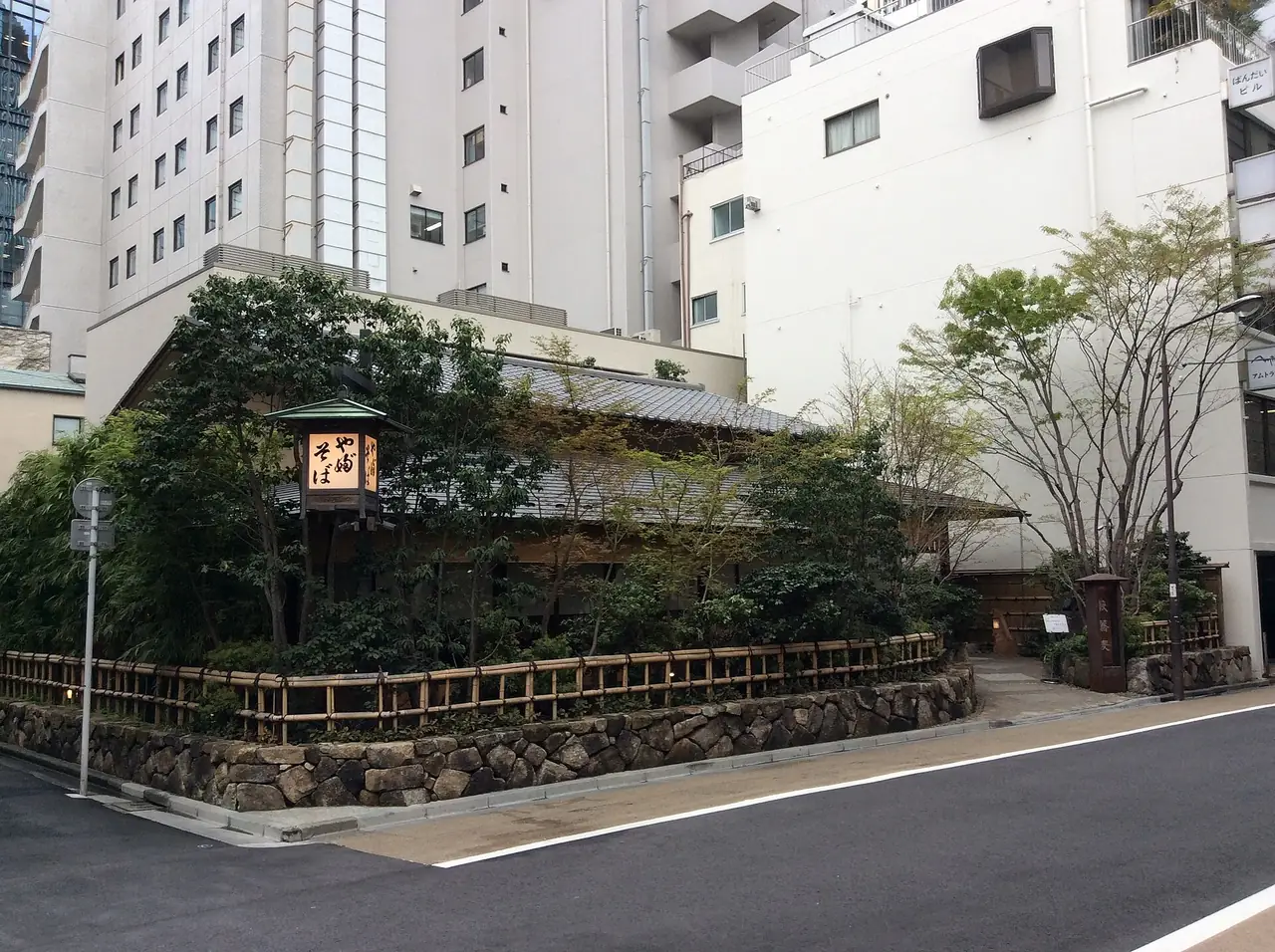
The shop says it reopened in October 2014, after the whole building was renewed. Wikipedia gives the day as 20 October. It says a hanging lantern and a signboard that survived the fire went back up, and that the wooden fence along the street was taken down so the shop would sit more openly in the neighbourhood. The shop says it kept the garden green and shares it with the street.
What a bowl looks like
The classic order is seiro, cold noodles on a tray. The shop says the noodles are ten parts buckwheat flour to one part wheat flour, pale blue green in colour, and served with a dry, strong dipping broth. It also lists tempura soba and a plate of shrimp fritters, tendane, on the side.
See it yourself
- Where. Kanda-Awajicho 2-10, Chiyoda. The shop is a few minutes' walk from Awajicho Station (Marunouchi Line), Shin-Ochanomizu Station (Chiyoda Line) or Kanda Station (JR).
- When to go. Our advice is a weekday, outside the lunch rush, from mid afternoon. The shop does not publish queue times, and reports say weekends are busiest. It is open from 11:30, last order 20:00, closed Wednesdays (the day can change around a public holiday).
- Booking. The shop takes ground floor reservations by phone (03 3251 0287), the day before at the latest. Only 8 seats an hour are bookable, you cannot choose where you sit, and the whole party must be there on time.
- What to order. Seiro is 1,320 yen and tempura soba 2,860 yen on the shop's own menu. A 180 ml bottle of sake or a beer is 1,320 yen.
Hear it on the tour
Photo credits
江戸村のとくぞう (Edomura no Tokuzo) / Wikimedia Commons, CC BY-SA 4.0. Photos resized.