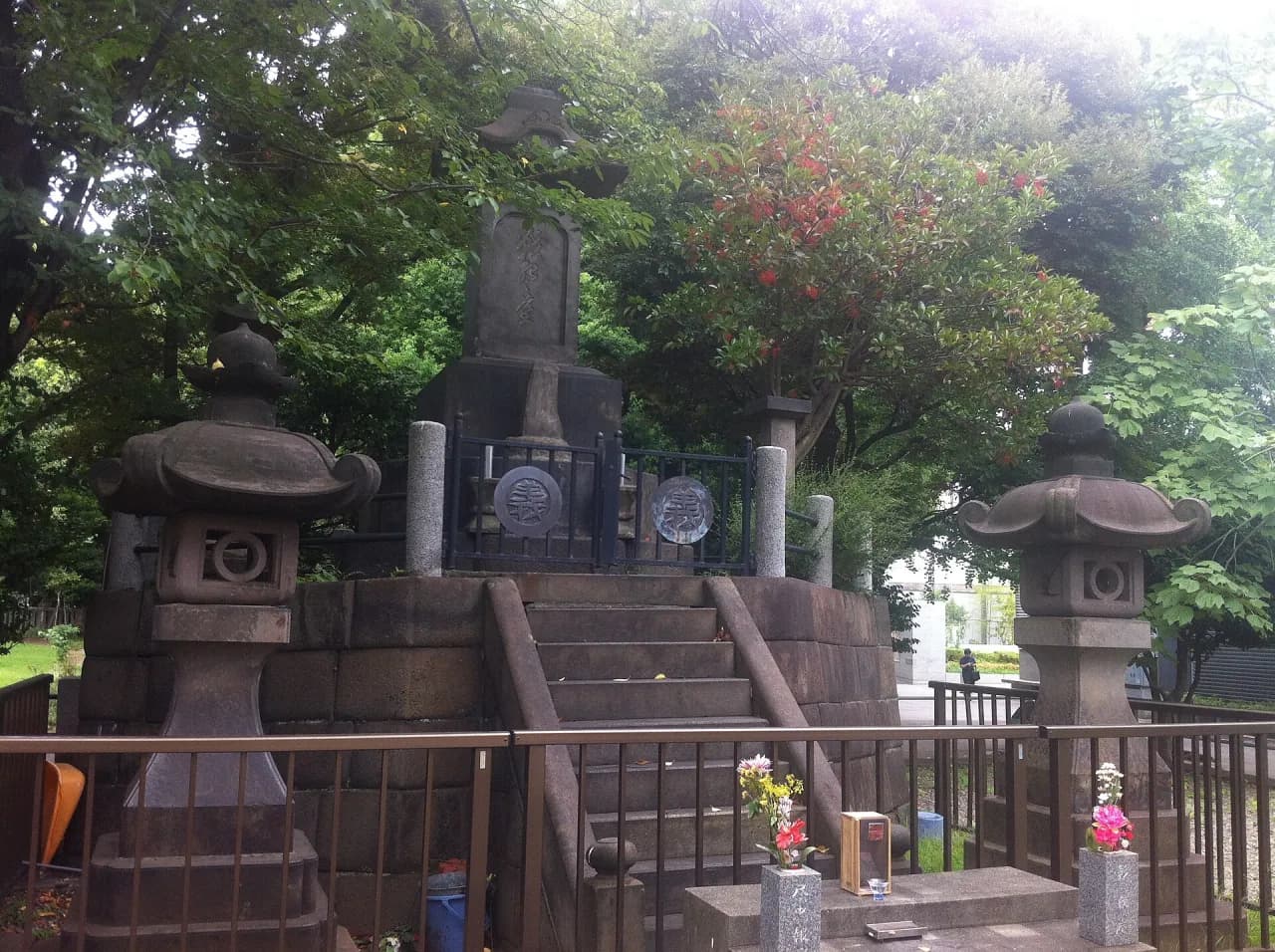
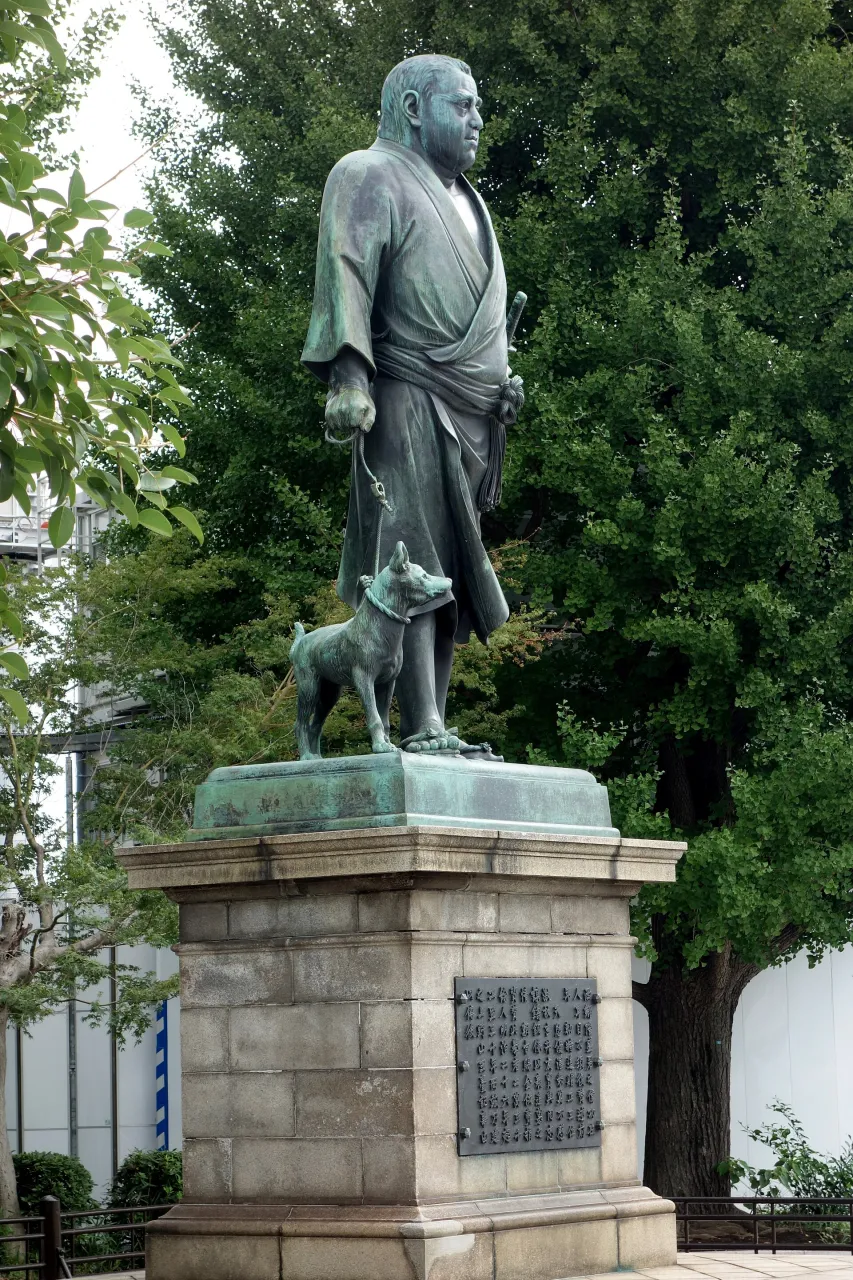
Almost everyone who visits Ueno Park photographs the bronze statue of Saigo Takamori and his dog. Few turn round. Behind it, in the trees, is a grave for the men who fought against Saigo's army, and it was there first: the statue was set down in front of it, in 1898.
Left on the hill
On 15 May 1868 the Shogitai, a force of Tokugawa loyalists, held Ueno hill against the new government's army and were crushed in a day. The new government refused to let the bodies be claimed, and they lay where they fell (Japan's National Diet Library; Ogawa Kiyoshi). A priest and a local merchant later cremated them on the spot. In 1869 two temple priests buried a small stone there, signed with a made-up name built from one character of each of their temples, because they could not use their own (Taito City).
One survivor with a plan
In 1874 Ogawa Okisato, a Shogitai survivor, and two comrades won permission to build a proper grave. He raised a bronze tomb, then could not pay for it, and it was taken away to settle the debt (Ueno Tourism Association; Ogawa Kiyoshi). His descendant Ogawa Kiyoshi writes that he is said to have sold his fields and that, in these years, he parted from his wife and children.
A Nichiren priest, Nisshun, stepped in as the survivors' agent. In 1881, with the government's permission, the large stone that stands today went up: 757 centimetres tall, carved "Grave of the Fallen in Battle" in the hand of Yamaoka Tesshu, a former Tokugawa retainer (Taito City). The name Shogitai is not on it.
The offer
Ogawa Kiyoshi, writing in a 2017 newspaper column, says Tesshu offered Okisato a government post, with the words that he could at least become head of Tokyo's police. Okisato said no and lived as a poor grave keeper. No document records why. What the family handed down is only that he "wanted to leave a mark."
His family stayed beside the grave, running a tea stall, until they moved away in 2003, when Tokyo took over the site. Kiyoshi lived in the house behind the statue. He writes that once, when he was a student, a group from Saigo's hometown, Kagoshima, came to wash the statue and, finding no tap nearby, asked his family for water. They did not know whose house they were at.
See it yourself
- The grave. Walk past Saigo's statue and look in the trees behind it. The large stone stands on a stepped base between two stone lanterns.
- The small stone. In front of the large one is the little stone from 1869, with the invented name carved at the foot of it.
Hear it on the tour
Sources
- Ogawa Kiyoshi, Chugai Nippo, 28 Apr 2017, page 1
- Ogawa Kiyoshi, Chugai Nippo, 28 Apr 2017, page 2
- Ogawa Kiyoshi, Nikkei, 25 Apr 2023 (opening paragraph)
- Taito City, Shogitai tombstones
- Ueno Tourism Association, Ueno history 4 (English)
- National Diet Library, Tomb of the Shogitai
- Japanese Wikipedia, Shogitai
- Taito City, Visit Kaneiji Temple (statue dated 1898)