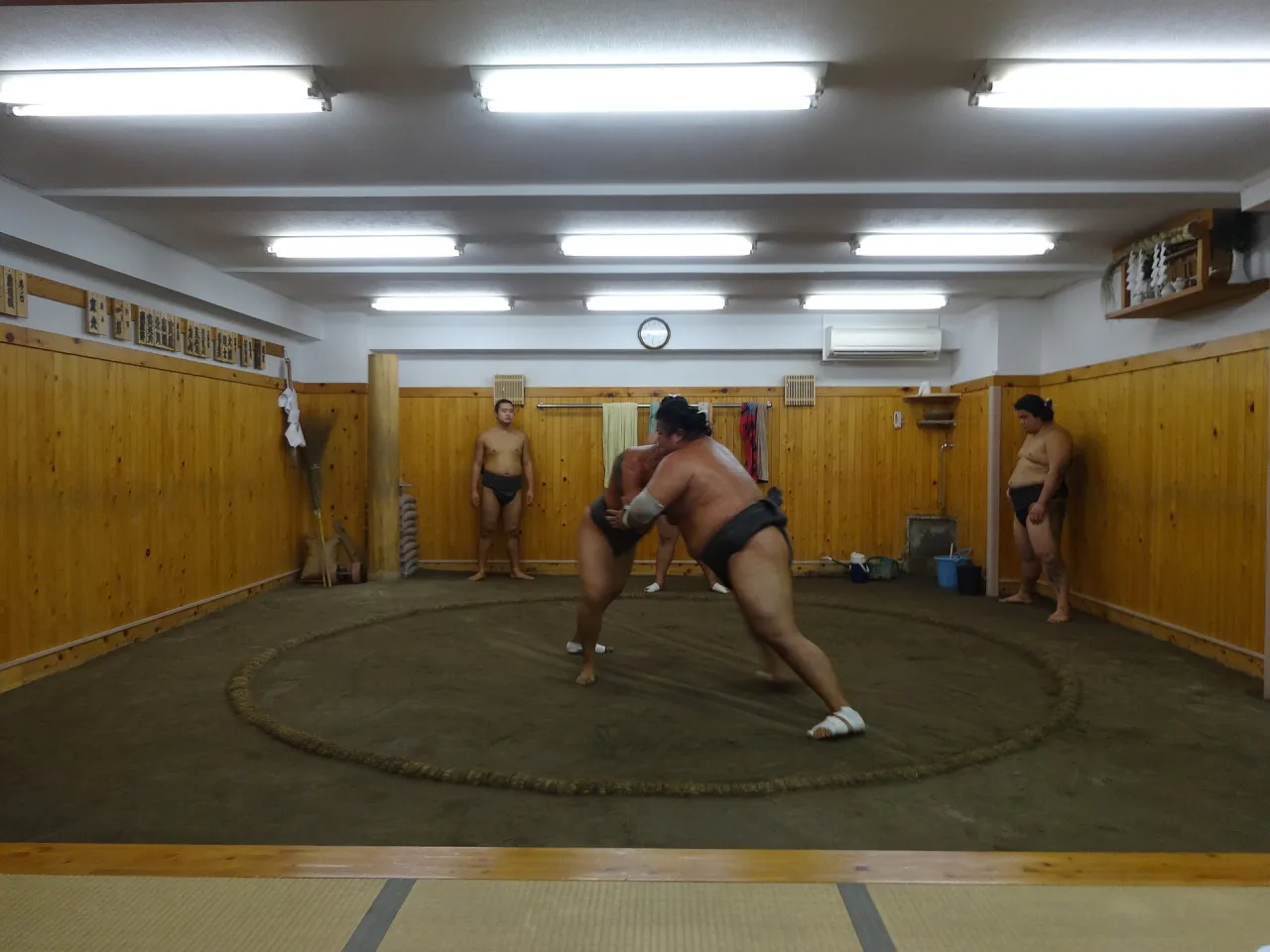
A sumo stable is where wrestlers live, eat and train under one master, and most of them do not let strangers watch. You normally need an introduction, a supporters' club or a paid tour. Arashio stable, in Hamacho, central Tokyo, has a window onto the street, and anyone can stand there in the morning and watch for free. It has that window because its founder had almost no wrestlers.
One apprentice
The founder is Oyutaka, a former wrestler (real name Suzuki Eiji) from Niigata. In June 2002 he left the stable he had worked at since retiring, Tokitsukaze, and started his own. He took one apprentice with him. Japanese Wikipedia says that at first new recruits did not stay and the stable's survival was in doubt. His wife, Yuka, told an Asahi magazine that the two of them "were always worried" in those years.
They found the building by chance, Yuka told the local site HAMACHO.JP. It had been a textile dyeing factory with a car park on the ground floor. To make the practice ring they dug about a metre into the floor and had dump trucks bring in tens of tonnes of soil.
A window for the neighbours
Sumo was going through a hard time, Yuka says, and many people nearby were uneasy about a stable moving in. So from the start the building had a window onto the street. In her words, they wanted to show the town the wrestlers training hard and, little by little, change the image of sumo in Hamacho. Today the front is a full glass wall, rebuilt in April 2022, and neighbours greet her in the street.
The boy he nearly missed
In April 2003 Oyutaka flew to Inner Mongolia, in China, to find recruits. It was the SARS outbreak, and a sumo magazine reported he wore a mask. By his own account the young men he wanted all said no.
On the last evening a local TV worker brought a teenager to his hotel. Oyutaka's first thought, he wrote in the newspaper Nikkan Gendai, was that the boy was muscular but thin: would he ever put on weight? He had not noticed him at the university earlier that day, and to spare the boy's feelings he said he had not visited yet. Next morning at 7:30 he tested him in the university gym, with students crowding round to watch.
The boy was Sokokurai. He joined that year, became the stable's first wrestler in the salaried ranks, and in 2020 took over as master when Oyutaka retired. Oyutaka writes that Sokokurai first said no to the job. He went home to ask his parents, relatives and friends, and every one of them told him to take it.
The want-ad that never closed
Yuka also started a plain, daily-life website for the stable. Oyutaka called it an especially important tool for a small stable nobody had heard of. By July 2023, Japanese Wikipedia says, more than half of the 15 wrestlers had joined after reading it.
In March 2026 the stable announced a new junior-high-school recruit from Chiba, a soft-tennis player who knew sumo only from television. By the stable's own account he had been watching practice through the window when Sokokurai felt something unusual about him and called out. He trained there for about six months, put on 23 kg and joined.
See it yourself
- The window. Arashio stable is in Hamacho, Nihonbashi. Morning practice can be watched from the pavement for free, with no booking. The stable can cancel at short notice and asks watchers to follow the rules on arashio.net.
- The glass wall. It replaced a smaller window in 2022. The ring behind it sits where the car park was.
- The faces. The master you may see is Sokokurai, the boy from the hotel.
Hear it on the tour
Sources
- Nikkan Gendai, Oyutaka column, 17 Sep 2022
- Nikkan Gendai, Oyutaka column, 29 Oct 2022
- Nikkan Gendai, Oyutaka column, 5 Oct 2022
- HAMACHO.JP, interview with Suzuki Yuka, 2025
- Japanese Wikipedia, Arashio stable
- Asahi sippo / AERA NyAERA, 2017
- Waseda GSJAL reprint of Gekkan Oozumo, 2004
- TV Tokyo "Adomachikku", 9 Jul 2022
- Arashio stable, announcement of the new recruit, March 2026
Photo credits
- Two sumo wrestlers in a clash of heads inside the practice room at Arashio stable: amanderson2 (Flickr) / Wikimedia Commons, CC BY 2.0, resized