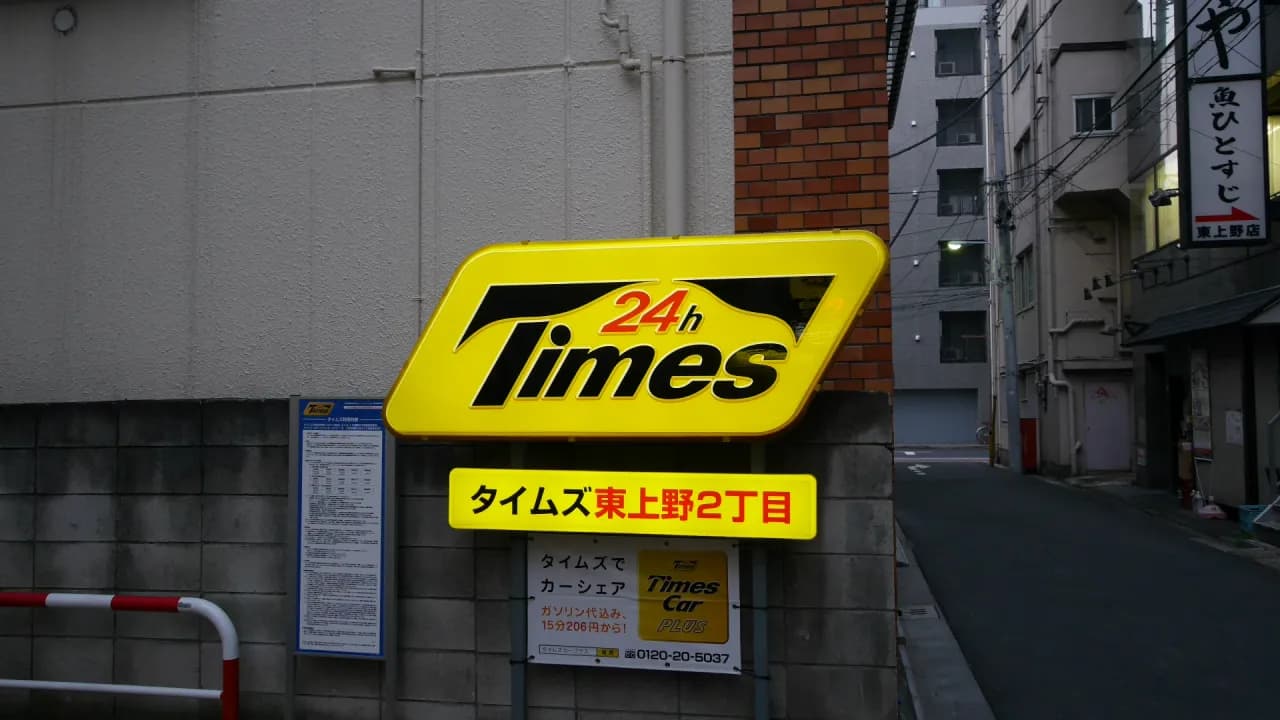
Park a car in one of Tokyo's small pay lots and a metal plate rises under it until you pay. The yellow-and-black Times signs over many of those lots belong to Park 24, a company that began by selling the opposite: signs telling people not to park.
Quitting with no plan
Nishikawa Kiyoshi spent nine years at a company, then left in 1971 at age 33. His son Koichi, now Park 24's president, told Toyo Keizai magazine that his father said that with three children a salaryman's pay was not enough and he wanted to be a boss. By the son's account there was no next job lined up, and the 1 million yen in capital was his mother's dowry.
Park 24's own history says the first company, Nishikawa Shokai, was a three-person firm in a six-mat office in Tokyo's Nishi-Gotanda, making and selling No Parking signs.
An ugly note on a shutter
His son says the idea came while he wandered the streets with nothing to sell. He saw a handwritten "No parking" note on a shop shutter, in terrible handwriting. Most people would laugh. Kiyoshi, the son says, asked why a shop would need that note, and decided it was not just that shop's problem. Signs sold fast.
They were also heavy. A truck could carry about 30, and the money was poor, the son says.
A machine and a closed door
Then he saw a parking machine at work in front of a restaurant, the son recalls. Japanese Wikipedia describes it as a Park Lock from the signal maker Nihon Signal: once you park, a plate rises from the ground and traps the car. According to the son, Nihon Signal turned him away at first. He kept coming back until they gave in and let him sell it. Park 24's company history confirms the deal, signed in January 1972.
The month after, it installed its first Park Lock at a hospital, where people who had no business there kept parking. The son says that when his father checked Tokyo hospitals, about 8 in 10 of the cars in their lots did not belong to patients or visitors. Park 24 calls the change the move from "a business of not letting people park" to "a business of letting people park."
Then his own lots
Park Locks sold once. A 2010 TBS programme says Kiyoshi wanted steadier income and decided to run the lots himself. In December 1991 the company opened a 24-hour, staff-free lot by the hour in Ueno. Park 24 calls it Japan's first. A trade paper says he is "said to be" the first to do it. By 2005, Wikipedia says, Times had more than 100,000 spaces.
See it yourself
- A coin lot. Look for the yellow Times sign, then watch for the plate. Many lots now use cameras instead, so you may not see one.
- No Parking signs. Look at a quiet back street, where the idea started.
Hear it on the tour
Photo credits
- A yellow Times 24h parking sign on a back street in Higashi-Ueno, Tokyo: 運転太郎 (panoramio) / Wikimedia Commons, CC BY 3.0, resized