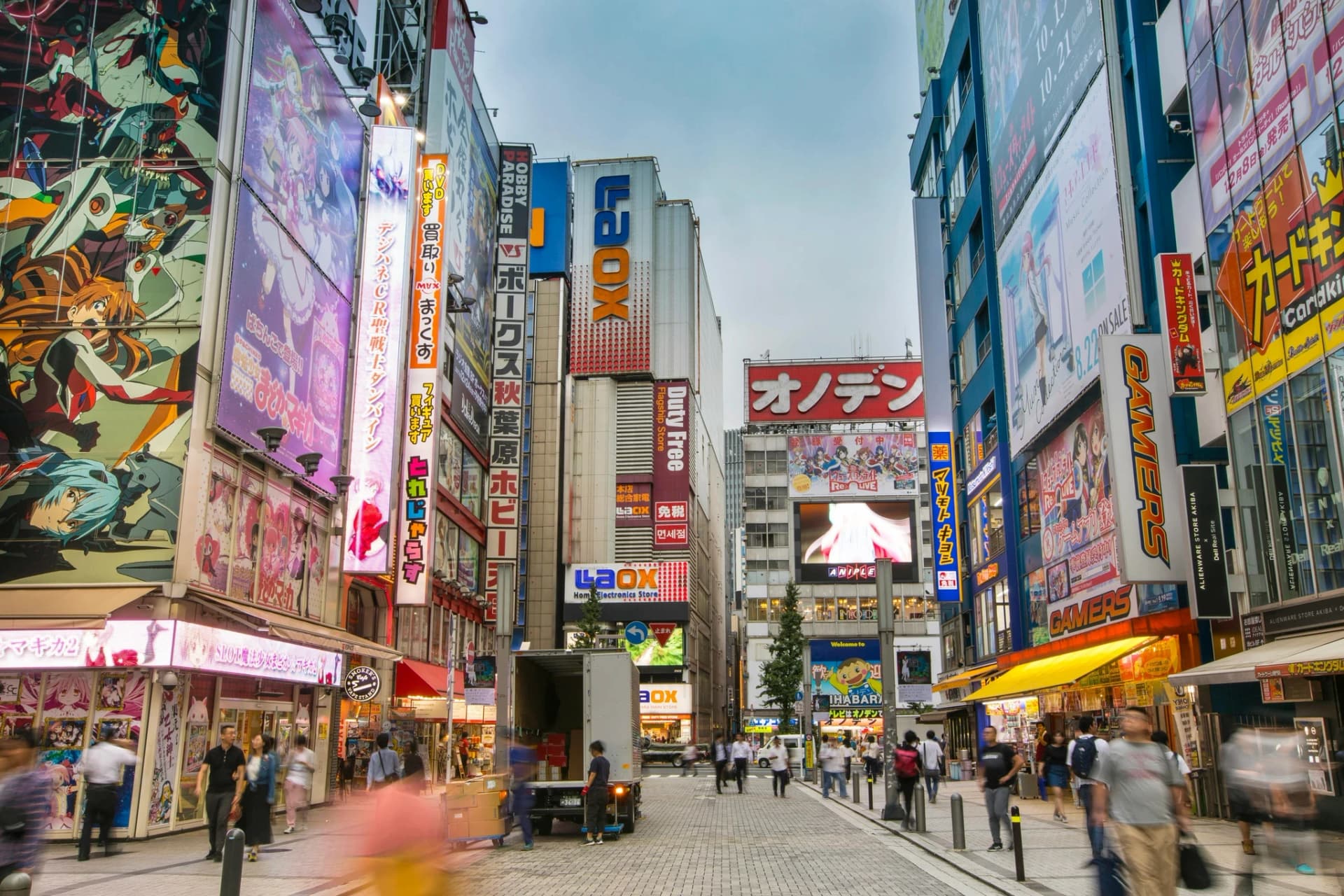
Akihabara's buildings are 8-10 stories. Ground floors serve tourists. Floors 4-8 serve collectors. Most visitors never make it past the first floor.
Akihabara's buildings are 8-10 stories. Ground floors serve tourists. Floors 4-8 serve collectors. Most visitors never make it past the first floor.
The real inventory lives on floors 4-8. Rare collectibles. Vintage hardware. Items that sell for six figures at auction. The problem isn't that Akihabara is overwhelming. The problem is that most visitors don't know the building is organized vertically — and they never make it past the tourist layer.
8-10 Floors, One Building: Why Most Visitors Only See the Tourist Layer
Akihabara's major buildings follow a consistent pattern. Ground floors stock mainstream merchandise — the same Pokémon plush, the same One Piece figures, the same "I ♥ Tokyo" keychains. This isn't an accident. Ground floors capture foot traffic. They're designed for tourists who wander in, buy something recognizable, and leave. First-time visitors rarely realize there's more above.
The specialist inventory is upstairs.
Ground Floor: What Everyone Sees (And Why It Disappoints)
Radio Kaikan has 10 floors plus 2 basement levels. The ground floor houses lottery kuji games, collectible card displays, and a FamilyMart convenience store. It's fine. It's also interchangeable with a dozen other buildings in the district.
Mandarake Complex has 8 floors. The entrance level sells mainstream anime goods. Visitors who stop here see products available in any major city with an anime store.
Animate Akihabara spans 8 floors across two buildings. Ground level: seasonal merchandise, popular franchise tie-ins, and products that move fast.
Floors 4-8: Where the Real Inventory Lives
The vertical stratification is consistent:
-
Ground floors: Mainstream merchandise, high turnover, tourist-friendly
-
Mid-floors (2-4): Specialized collectibles, franchise-specific inventory
-
Upper floors (5-8): Rare items, adult content (with age verification), niche categories
-
Basements: Arcades, used goods, food service
At Radio Kaikan:
| Floor | Store | Focus |
|---|---|---|
| 7 | Volks, DOLK | High-end modeling, customizable dolls |
| 6 | Yellow Submarine | Board games, miniatures, card games |
| 5 | Lashinbang | New/used figures (opened Aug 2024) |
| 4 | AmiAmi | Figures, Gundam models, secondhand |
| 2-3 | K-Books | Doujinshi (largest selection in district) |
At Mandarake Complex:
| Floor | Focus |
|---|---|
| 7-8 | Toys and collectibles (items can exceed ¥1 million) |
| 6 | CDs and DVDs |
| 4-5 | Doujinshi, adult materials (age verification) |
| 3 | Vintage items |
| 2 | Anime toys, cosplay |
Why This Matters for Your Visit
Thorough exploration of one major building takes 45-60 minutes. Akihabara has at least 8 buildings worth visiting. That's 6+ hours just to see what's available — before you start shopping.
If you walk in without a plan, you'll browse ground floors, feel underwhelmed, and miss the inventory that makes Akihabara worth the trip.
Which Kind of Otaku? The Floor Map by Interest
"Akihabara is a paradise for otaku" assumes all otaku want the same things. They don't. Competitive fighting game players, idol fans, vintage hardware collectors, and casual anime tourists need entirely different floors — and sometimes different buildings. For a broader view of Tokyo's anime and otaku districts, see our guide to Tokyo anime tours.
Anime and Manga Collectors
Radio Kaikan is your starting point. AmiAmi on floor 4 has one of the largest Gundam model collections in Akihabara, plus figures organized by franchise and demographic. K-Books on floors 2-3 has the largest doujinshi selection in the district.
For even more selection, the AmiAmi Figure Tower opened in July 2024 as a dedicated 8-floor building on Chuo Dori. It's 2 minutes from JR Akihabara Station. Floor 7 contains adult figures — plan accordingly if you're with family.
Retro Gaming and Arcade Culture
Super Potato (5th floor of its building) is famous for its retro game museum atmosphere. The tabletop-style arcade machines are fun. But for actual purchasing, Super Potato is overpriced.
Better alternatives for serious buyers:
-
Book Off: Cheaper prices, large selection, largest Kanto location in Akihabara
-
Traders: Multiple locations, competitive pricing
-
Friends: Near Suehirocho Station, 5 minutes from Traders, quality inventory
For arcade gaming, GiGO Building 3 has the RETRO:G floor (6F) with classic cabinets — Daytona USA 2, OutRun, House of the Dead. Taito HEY specializes in shoot-em-up games. Game centers stay open until 11:30pm.
Idol Culture (AKB48 and Beyond)
AKB48 Theater is on the 8th floor of Don Quijote. This is where the group performs daily shows.
Getting in is difficult:
-
Tickets: Lottery only (overseas category available one month ahead)
-
Price: ¥3,100 men / ¥2,100 women and students
-
Capacity: 145 seats + 105 standing
-
ID required: Bring passport
Casual tourists rarely get tickets. If you can't attend a show, the Don Quijote building still has AKB48 merchandise. at-home cafe, a pioneer maid cafe, operates on the 5th floor of the same building.
Vintage Electronics and Audio
Akihabara's "Electric Town" heritage survives in Radio Kaikan's Wakamatsu Trading — sound engineering and radio broadcasting equipment. The Akihabara Radio Center under the train tracks has component shops for capacitors, transistors, and vintage parts.
This is niche. Most visitors won't care. But for audio enthusiasts and electronics hobbyists, it's why the district was built.
Casual Curiosity (No Specific Fandom)
If you're interested but not obsessed, focus on three buildings:
-
Radio Kaikan — Walk floor by floor, stop where something catches your eye
-
Mandarake Complex — Skip floors 4-5, browse 2-3 and 7-8
-
One arcade — GiGO Building 3 or Taito Station for the experience
Allocate 2-3 hours total. You'll see the range without drowning in depth you don't need.
When to Go (The Sunday Trap)
Every guide recommends Sunday for Akihabara's pedestrian zone. The 570-meter stretch of Chuo Dori becomes car-free: 1:00 PM to 6:00 PM from April through September, 1:00 PM to 5:00 PM from October through March. The atmosphere is festive. Street photography improves.
But the stores are more crowded. The same visitors enjoying the pedestrian zone are shopping inside. If you're here to browse inventory rather than take photos, Sunday afternoon is your worst option.
Weekday mornings — Monday through Thursday, 10:00 AM to noon — are far less crowded. Some visitors are the only person in a store. No competition for rare items. Staff have time to answer questions.
Most shops open at 10:00 or 11:00 AM. Some open at noon — Mandarake Complex included.
Family Navigation: Avoiding Adult Floors With Kids
Akihabara's vertical organization makes family navigation straightforward once you know which floors to skip.
Where Adult Content Lives (Floor Numbers)
Adult content concentrates on upper floors:
-
Mandarake Complex: Floors 4-5 (doujinshi, adult reading materials)
-
AmiAmi Figure Tower: Floor 7 (adult figures)
-
Most multi-story buildings: Floors 6-8 typically require age verification
Signage is clear. Age verification happens at floor entrances. The system prevents accidental exposure — but knowing in advance saves awkward elevator moments.
Kid-Friendly Floors and Buildings
Stick to ground floors and floors 2-3 in most buildings. These house mainstream merchandise, crane games, and franchise tie-ins.
Gachapon Kaikan (2 minutes from Suehirocho Station, 7 minutes from Electric Town Exit): About 500 capsule toy machines stacked floor to ceiling. Prices range from ¥100-500. Works for all ages.
Animate ground floor: Mainstream merchandise from current popular franchises.
Crane game areas: Ground floors and basements of most arcades.
Gundam Cafe, previously a popular family destination, closed permanently in January 2022. Guides still mentioning it are outdated.
Arcade Timing Note
Japanese law restricts arcade access for minors: under 16 cannot enter after 6:00 PM, under 18 after 8:00 PM. Plan arcade time for the afternoon. If coordinating kid-friendly floors, arcade timing, and adult-content avoidance sounds like a lot to manage, our Tokyo Together family tour handles this routing in real time.
When You Don't Need a Guide (And When You Might)
We run private tours in Akihabara. We're also going to tell you when not to hire us.
Skip the Guide If...
-
You have specific interests and time to wander. If you know exactly what you're looking for — a particular figure, a specific retro game, a favorite franchise — you don't need navigation help. You need hours.
-
You enjoy exploration. Some people want to discover things themselves. Akihabara rewards curiosity. If the hunt is part of the fun, a guide removes what you came for.
-
You're returning. If you've been before and know the layout, you're paying for redundant information.
Consider a Guide If...
-
You have limited time and specific goals. Half a day in Akihabara with a list of priorities is a logistics problem. A guide compresses 6 hours of wandering into 2-3 hours of targeted navigation. Tokyo Essentials includes an Akihabara stop as part of a broader Tokyo introduction.
-
You're traveling with family and need adult-content routing. Navigating age-appropriate floors while keeping children engaged requires advance planning. A guide handles this in real time — here's what to expect on tour day.
-
For families with teenagers specifically, Akihabara often serves as the "teen wins this stop" moment in a blended day. See our guide to touring with teenagers for how to structure days where nobody's just tagging along.
-
You want context, not just merchandise. Why does this district exist? What's the history of the electronics-to-anime transition? How does idol culture actually work? A guide provides subculture translation, not just store directions. For deeper otaku culture focus, see how to customize your tour.
The question isn't whether you can navigate Akihabara alone. You can. The question is whether your time is better spent browsing or buying — and whether private shopping tours change the equation. If you're still weighing whether a guide makes sense, we break down the full cost-benefit analysis.
Practical Details: Getting There, Getting Oriented
Station Access: Electric Town Exit
JR Akihabara Station's "Electric Town Exit" (Denki-gai Exit) puts you directly into the district. Both north and south sides work. Radio Kaikan is visible from the exit — about 1 minute walk.
Tokyo Metro Hibiya Line also serves Akihabara Station. The walk from Suehirocho Station (Ginza Line) reaches Gachapon Kaikan faster (2 minutes).
Orientation: Chuo Dori as Your Spine
Chuo Dori is the main commercial street running through the district. Most major buildings line this 570-meter stretch. Walking from one end to the other takes 10 minutes at a comfortable pace.
Side streets contain smaller specialty shops. The periphery is 5-8 minutes from the station.
GiGO Building 1 Closed (August 2025)
GiGO Akihabara Building 1 — the red building with anime posters, formerly Sega Akihabara 1 — closed permanently on August 31, 2025. The lease expired after 32 years.
Visitors reading older guides will be confused. If someone mentions "the Sega building" or "GiGO 1," it no longer exists.
Remaining GiGO locations:
-
GiGO Building 3: Open, includes RETRO:G floor (6F) with classic games
-
GiGO Building 5: Open, standard arcade operations
GiGO Building 4 reopened in April 2023 as a Bandai Namco arcade.
Where Hinomaru One Fits
For automotive enthusiasts, Tokyo's JDM car culture operates on similar principles—specialized knowledge, access barriers, and subculture etiquette that rewards guided navigation. See our JDM tour guide.
Our Akihabara tours work floor by floor. Your guide knows which levels match your interests—whether that's rare figures on floor 4, retro games on floor 5, or avoiding adult content entirely. No wandering ground floors wondering what you're missing. Direct navigation to the inventory that brought you here.
At Hinomaru One, we design culturally rich, stress-free private Tokyo tours for first-time and seasoned travelers. Unrushed. Insightful. Always customized.