You'll photograph significant things without knowing what you're looking at. The question isn't whether to visit — it's whether to understand.
This Yanaka guide is for people deciding how to spend an afternoon there, and it starts with what usually happens: visitors photograph important things without knowing what they're looking at. Going is easy, so the decision is really about how much you want explained.
People photograph the wall at Kannonji Temple without knowing it's the last surviving Edo-period mud wall in Tokyo, and walk through Yanaka Cemetery unaware that the man on their ¥10,000 bill is buried there. On the way they pass 76 temples and never learn that one of them is where Japan's most famous samurai revenge was planned.
Getting around Yanaka is simple. The streets are well signed, the main shopping street is 170 meters long, and you can walk the whole neighborhood in 45 minutes. Understanding what you've walked through takes a good deal longer.
What You'll Walk Past Without Knowing
The Wall and the Samurai Plot
On a residential street near Kannonji Temple there's a wall of alternating mud and tile layers, 37.6 meters long. People stop to photograph it, and most have no idea what it is.
It's a tsuji-bei, the last surviving Edo-period mud and tile wall in Tokyo. It went up in the Bunsei era (1818–1831), so it's over 200 years old, and it was registered as a national tangible cultural property in 2000. One TripAdvisor reviewer described the usual experience: "Only after we photographed it, and returned home, did we do research on what we saw."
The temple behind the wall has a story of its own. The 47 ronin, who avenged their lord's death in 1703 in Japan's most famous samurai revenge, planned it at Kannonji. Two of them were brothers of the head priest, Bunryō, and the temple gave them cover for their meetings before the attack. A memorial tower on the grounds tells their story.
Plenty of visitors know Sengakuji Temple in Minato, where the 47 ronin are buried. Very few know they planned the killing here.
The Graves That Are on Your Money
Yanaka Cemetery covers 10.25 hectares and holds approximately 7,000 graves. Near the entrance, a signboard lists 70 of the most famous people buried here, and most visitors never find it.
Shibusawa Eiichi, the "father of Japanese capitalism," is one of them. Since 2024 his face has been on the ¥10,000 bill, which is the note you'll use most on your trip. Ichiyo Higuchi, a Meiji-period writer who appears on the ¥5,000 note, is buried here too.
Tokugawa Yoshinobu, the 15th and last shogun, lies in a walled enclosure you can only see through double-barred gates. His grave is surprisingly modest: a simple mound about a meter wide, shaped like a miniature imperial tomb. He chose a Shinto burial, which was unusual for a family that had ruled under Buddhist traditions for 265 years.
If you can't read Japanese and don't know the history, these are just names carved in stone. A guide bridges the language gap that keeps the inscriptions closed to you.
The Temple That Ran Tokyo's Lottery
Tennoji Temple dates to 1274, the oldest in the area. From the street it looks like any other temple, with wooden buildings, a bronze Buddha and stone lanterns.
From 1728 to 1842, though, Tennoji was the only temple in Edo allowed to run public lotteries. It started out in the Nichiren sect and was forcibly converted to Tendai Buddhism in 1698. The bronze Buddha came later, in 1690, and is one of the few pre-modern religious statues left in Tokyo.
Each of those facts says something about Japanese religious and political history, and none of them is posted anywhere you'd notice.
The Machiya: What "Old Buildings" Actually Means Here
When people look up Yanaka's old buildings, they usually mean the machiya, the traditional wooden townhouses of merchants and craftsmen along the backstreets. Yanaka has more surviving machiya than almost anywhere else in central Tokyo because the neighbourhood escaped both the 1923 earthquake and the 1945 firebombing.
Most were built in the Meiji and Taisho eras (1868–1926). A typical Yanaka machiya has a narrow front (merchants paid tax by street frontage, so houses went deep rather than wide) and two storeys, with a shop or workshop downstairs and living space above. The wood is weathered and the lattice windows are original. Most are still lived in, whether by residents, small shops, or the odd cafe that has taken over a ground floor and left the rest alone. Kayaba Coffee is one you can sit in: the machiya went up around 1916, became a coffee shop in 1938, closed in 2006, and was reopened in 2009 by local volunteers who kept the Taisho-era building. You'll walk past dozens of them without a single sign.
The Asakura Museum: The One You Can Actually Go Inside
The Asakura Choso Museum (朝倉彫塑館) at Yanaka 7-18-10 is the best surviving example of early 20th-century residential architecture in the neighbourhood, and most visitors have never heard of it.
The sculptor Asakura Fumio moved here in 1907 and spent nearly thirty years building and rebuilding the compound around his work. He designed it himself: a reinforced concrete studio with three floors above ground and two below, joined to a sukiya-style wooden house. The rooftop vegetable garden was one of the first rooftop gardens in Japan, and the central courtyard has a pond fed by spring water.
Four of the buildings were registered as national tangible cultural properties in 2001, and the garden became a nationally designated scenic spot in 2008.
It's open to the public from 9:30–16:30, closed Monday and Thursday, five minutes on foot from the North Exit of Nippori Station.
Most people walk right past the entrance. The ones who go in tend to say it was one of the best hours they spent in Tokyo.
Two Types of Tokyo Neighborhoods
| Visual Neighborhoods | Contextual Neighborhoods | |
|---|---|---|
| Examples | Shibuya, Harajuku, Akihabara | Yanaka, temple backstreets |
| What matters | What you see | What it means |
| Photos capture | The experience | The surface |
| Guide adds | Enhancement | Access |
Visual Neighborhoods: What You See Is What Matters
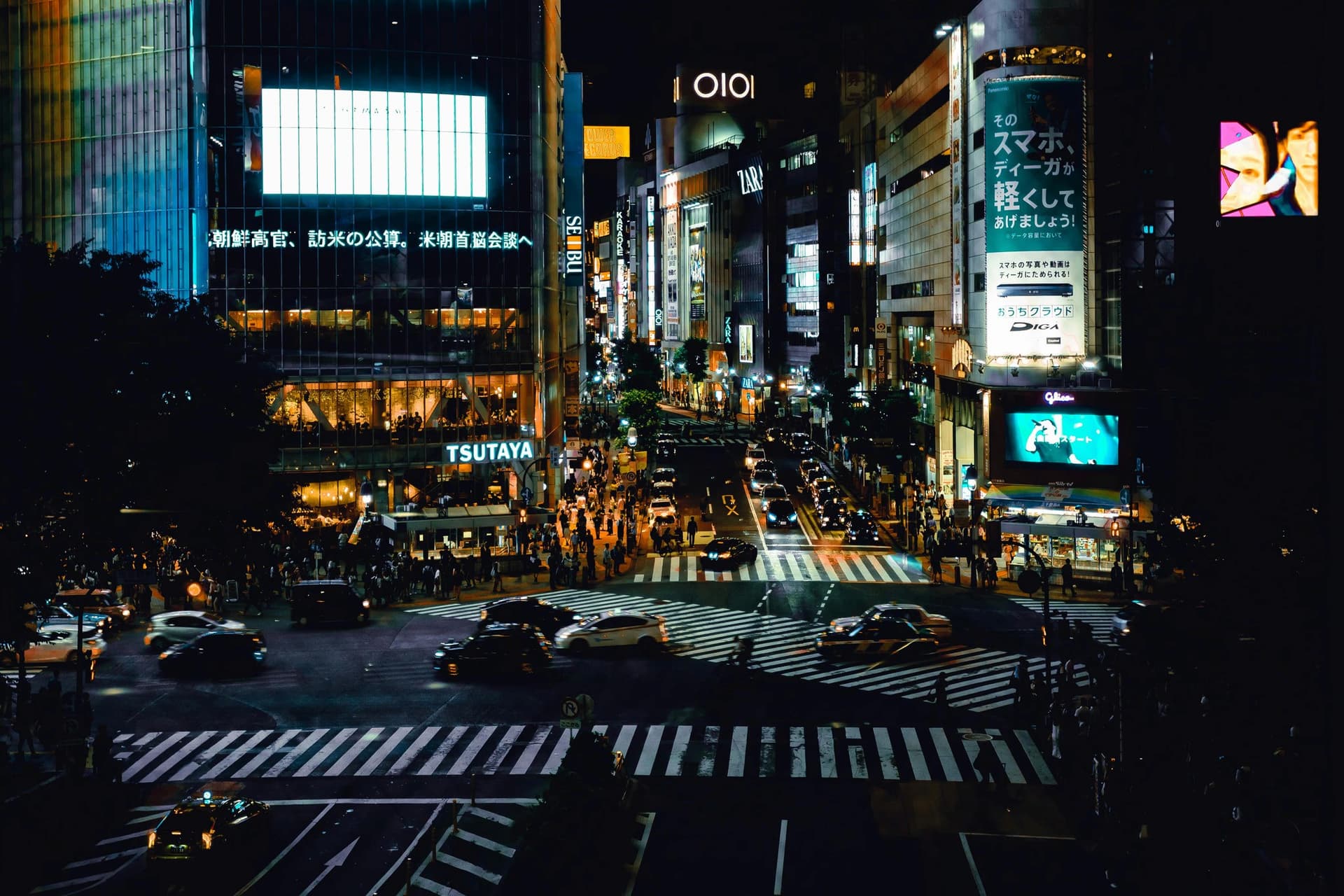
Shibuya's crossing needs no explanation. You get the scramble, the giant screens and the crowds just by standing and watching. Harajuku's fashion makes sense on sight, and Akihabara's anime shops announce themselves.
These neighborhoods are made for cameras. Context helps, but what draws you there is right in front of you.
Contextual Neighborhoods: The Meaning Is Invisible
Yanaka works differently. The narrow streets look charming, the temples look old and the shopping street looks quaint. What you can't see is why it matters that these buildings survived, why the temples cluster here, or what the grave markers say.
Since the Edo period Tokyo has been split into two cultural zones. Yamanote, the higher ground to the west, was home to samurai and aristocrats. Shitamachi, the low-lying east, belonged to merchants and artisans. Yanaka is Shitamachi, and its narrow streets, dense temples, cemetery and shopping street all come out of that class history.
In Shitamachi, social identity is built into the architecture, and almost nothing on the street explains it.
Judged on photos, Yanaka loses to Shibuya. Once you know what you're looking at, it's one of Tokyo's most historically dense neighborhoods. For a wider look at which Tokyo neighborhoods are worth exploring with a guide, the answer depends on the type of neighborhood.
Yanaka vs Asakusa: Different Survival Stories
People often compare Yanaka with Asakusa. Both get called "old Tokyo," and both draw visitors looking for a traditional feel. Their histories are very different.
| Asakusa | Yanaka | |
|---|---|---|
| WWII | Destroyed 1945 | Survived |
| Architecture | Rebuilt 1950s-70s | Original |
| Designed for | Tourists | Residents |
| Rewards | Photography | Interpretation |
Asakusa: Reconstructed and Tourist-Facing
Sensoji Temple burned on March 10, 1945, in the firebombing of Tokyo. The main hall you see today was rebuilt between 1951 and 1958, Kaminarimon Gate in 1960, and the five-story pagoda in 1973.
So Asakusa's traditional architecture is a reconstruction, built with tourists in mind. That's not a knock on it. Sensoji is Tokyo's oldest temple site, founded in 645 AD, and its religious importance is real. The buildings in your photos are postwar, that's all.
Yanaka: Survived Intact, Contextually Dense
Yanaka's temples didn't burn and its cemetery wasn't bombed. The backstreets are original. Tennoji's bronze Buddha dates to 1690, so it's over 330 years old and no reproduction.
What Yanaka has in depth, you only get with context. Nobody arranged the temples for photos, the cemetery is hard to navigate, and the stories pile up with no signposts.
Asakusa photographs better, and Yanaka has more of its history intact. Neither is the better choice in general. If photogenic highlights matter more to you than historical depth, Asakusa will suit you better.
Yanaka Ginza Is Not the Point
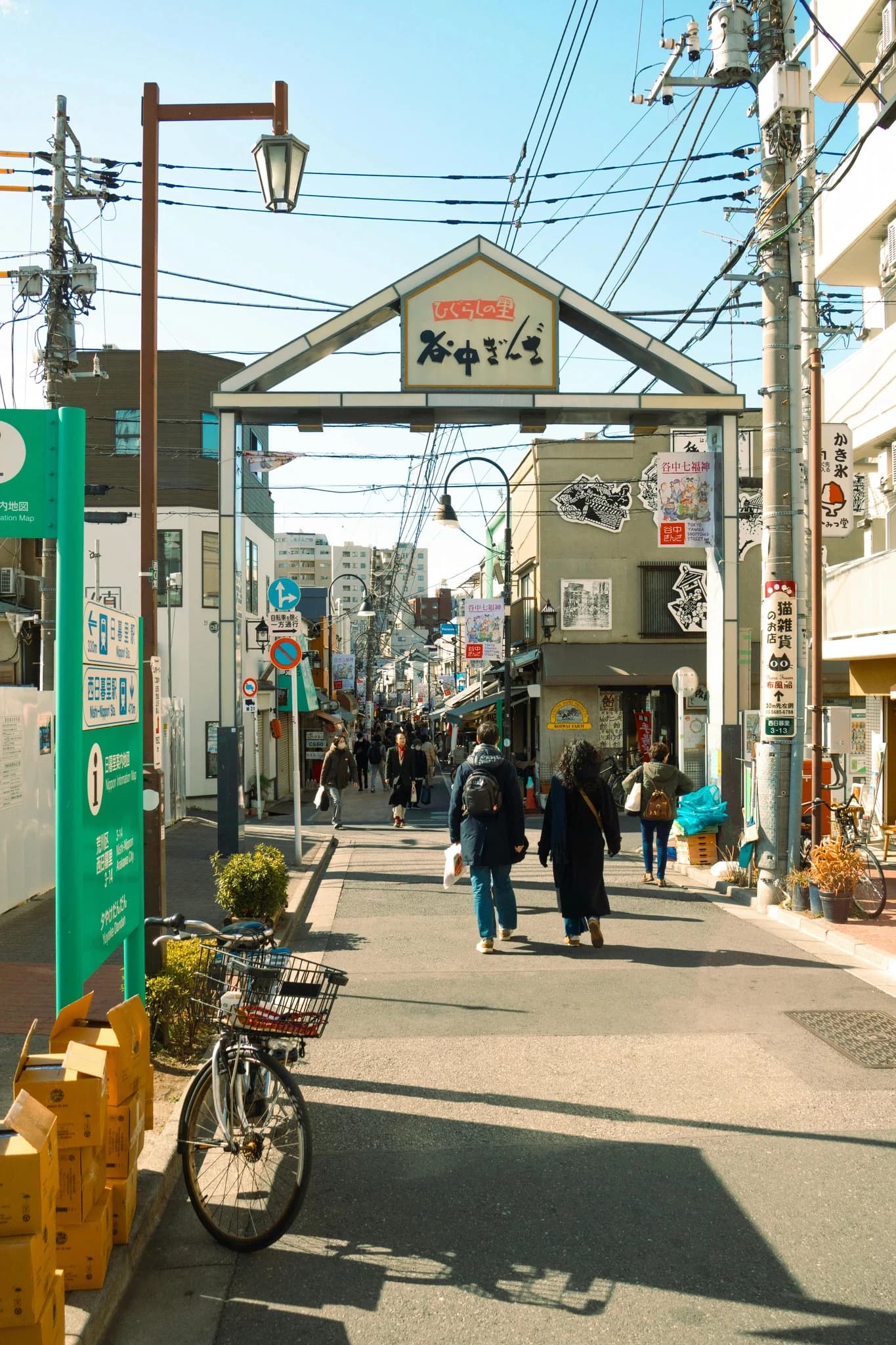
Yanaka Ginza is the neighborhood's best-known attraction. The 170-meter shopping street turns up in every guidebook and travel blog, and it has an Instagram-friendly staircase for watching the sunset called Yuyake Dandan.
What the Shopping Street Shows
It's a nice street. Around 60-70 small shops sell snacks, crafts and souvenirs, and some have real history: Echigoya Saketen has sold liquor since 1904, and Niku no Suzuki has been a butcher for over 90 years.
You can buy menchi katsu, cat-shaped sweets and handmade rice crackers, and watch the sunset from the stairs. None of that needs a guide, and neither does Habutae Dango, about five minutes' walk from Nippori Station, which has made dango since 1819 and gets a mention in Natsume Soseki's I Am a Cat.
What It Doesn't Show
The shopping street grew up around 1945, after the war, so it's Showa-era Tokyo rather than Edo. The "cat town" branding (cat-tail donuts, cat statues, cat souvenirs) is marketing from the 2000s, laid over 400 years of temple-town history.
If the shopping street is what you're after, you probably don't need a guide. The temples behind it, the cemetery above it and the class history built into the street plan are the parts that need explaining.
When Yanaka Does — and Doesn't — Need a Guide
You won't need a guide to find your way. The streets are well signed, the main shopping street is a straight 170-meter walk, and Google Maps works fine.
What a guide gives you is context. Language helps too, but most of what makes Yanaka significant sits in architecture, placement and history that nobody has labeled.
Skip the Guide If...
You just want atmosphere. The narrow streets and old buildings are pleasant to wander. If you want a quiet walk through Tokyo's past and don't mind not knowing what you're seeing, go on your own. Plenty of Yanaka tours stick to the shopping street and call it "old Tokyo charm," atmosphere with no explanation, and if that's all you want, you don't need a guide at all.
You're returning to Tokyo. Repeat visitors come with different goals from first-timers. If you've already done the main sights and want a low-key afternoon in the backstreets, Yanaka works well solo, and you'll already have some context for the city.
Time matters more than understanding. A guided visit takes 3-4 hours to do properly. With two hours between other plans, a quick walk through Yanaka Ginza and the cemetery may fit better. You'll miss the stories but still have a nice stroll.
Consider a Guide If...
You want to understand what survived. Tokyo was destroyed twice in the 20th century, by the 1923 earthquake and then by the 1945 firebombing, and Yanaka came through both. A guide can tell you why it survived, what exactly is original, and what that means for the history of Japanese cities.
You can't read Japanese. Cemetery inscriptions, temple plaques and historical markers are mostly in Japanese only. English signs cover the basics and little more, and a guide reads the rest for you.
You've been confused by historical neighborhoods before. Some visitors walk through old districts with a nagging sense they're missing something: the buildings are old and the mood is nice, but they never work out why any of it matters. If that was your experience in Kyoto's temple districts, Yanaka without a guide will feel the same, because neighborhoods like this need interpreting. If you're drawn to traditional culture, the interpretation is most of the value.
Yanaka fits naturally into Timeless Tokyo, which follows what survived across several historical neighborhoods. If everyday residential Tokyo interests you more than historical layers, Ordinary Tokyo covers similar shitamachi neighborhoods from a different angle.
Where Hinomaru One Fits
Yanaka is part of our Timeless Tokyo tour. Our guides translate the cemetery inscriptions, explain why Tennoji ran lotteries for a century, and show how shitamachi identity shaped the streets you're walking through.
At Hinomaru One we run private Tokyo tours for first-timers and seasoned travelers, built around culture and paced so nobody is rushed. Every tour is customized.