The $400 quote and $600 quote might deliver identical experiences with different payment structures—or completely different experiences at the same duration.
This Tokyo tour pricing guide starts from a familiar spot: two or three quotes open in different tabs, all saying "private tour" and "customizable," with prices $200 apart.
Say the three quotes are $400 for six hours, $500 for eight hours and $600 for a full day. Each comes with an English-speaking guide, each claims to be "customizable," and you can't tell which is the better deal. The information is all there, but providers structure Tokyo private tour pricing so differently that a straight comparison is close to impossible.
Why You Can't Compare Quotes Directly
Tokyo private tours are priced in three main ways, and each one sells you something slightly different. A "$500 tour" could be six hours in a fixed block, a full day with flexible timing, or an hourly rate that's easy to extend. You can't judge whether a quote fits until you know which model it uses.
Hourly Blocks vs Daily Packages
| Pricing Model | How It Works | Extension Flexibility | Best For |
|---|---|---|---|
| Hourly Blocks | Fixed durations (4h, 6h, 8h) - tour ends when time's up | Limited - depends on guide's next booking | Budget certainty, structured schedule |
| Daily Packages | Full day rate (e.g., "8 hours between 9 AM-5 PM") | More flexible - guide's day is yours | Spontaneity, ability to linger or pivot |
| Hourly-with-Extension | Base rate + hourly add-on option | Theoretical but unreliable if guide is booked | Uncertain itinerary needs |
Most providers sell time blocks of 4, 6 or 8 hours. A block is a fixed length: book 6 hours and the day ends at six hours, even if you're having a great time. Some guides will extend if their schedule allows, but many run back-to-back bookings and can't add time partway through.
A daily package works differently. You're buying the guide's whole day, usually described as "8 hours between 9 AM and 5 PM," with some give built in. If you're worn out and want to finish early, or you're enjoying yourself and want to stay out later, the guide's schedule can bend.
The hourly-with-extension model quotes a base rate for a set number of hours and lets you add more at an hourly rate. It sounds flexible. Whether you can actually extend comes down to whether the guide has someone else booked after you. We've written a detailed comparison of full-day vs half-day private tours, including when each makes sense.
Our complete guide to tour options covers how Tokyo's geography, as much as your preferences, decides what's realistic in a given number of hours.
Per-Group vs Per-Person Pricing
Most Tokyo private tours are priced per group. A "$550" quote means $550 for your whole party, whether that's two people or eight. Group size can change the price a little (bigger groups pay slightly more), but you don't multiply the base rate by the number of people.
Some providers charge per person for certain things, especially food tours and specialty experiences. Standard sightseeing tours with a guide are priced for the group. Keep that in mind when you compare: "$400" from one company might cover your group of four, while "$200" from another might be per head.
What "Customizable" Actually Means
Every provider calls its tours customizable, and what that means depends on the pricing model. On an hourly block you can pick where you go, but you're watching the clock, and every extra minute in one place comes out of the next. A daily package gives you more room to linger when something catches your interest.
It also depends on how busy the guide is. A guide running three tours a day can't easily move a start time or finish somewhere else. A guide who blocks out a full day for one booking can change plans as you go.
What "All-Inclusive" Actually Means
Most travelers read "all-inclusive" as everything covered: your costs and the guide's, transport, entrance fees, meals. In the Tokyo private tour business the term has two separate meanings, and they aren't interchangeable.
The Two Definitions
| Definition | Guide's Costs Covered? | Your Costs Covered? | Typical Price Difference |
|---|---|---|---|
| Standard "All-Inclusive" | ✓ Yes (transportation, entrance, meals) | ✗ No - you pay your own | Base rate |
| True All-Inclusive | ✓ Yes | ✓ Yes (everything pre-paid) | +$100-200 |
The usual industry meaning is that the guide's costs are in the quoted price. You pay one rate up front, and it covers the guide's time, train fares, entrance fees and meals. Your own transport, entrance fees and meals are still on you through the day, but you aren't separately paying the guide's costs as you go.
True all-inclusive covers everything, yours and the guide's: your entrance fees, lunch and transport, plus the guide's lunch and entrance fees. You pay the quote and your wallet stays in your pocket all day. It's rare, and it runs $100-200 more than standard pricing because the provider has to pre-pay or estimate every expense.
Most Tokyo providers mean the standard version, so plan on paying for yourself during the day.
What You'll Actually Pay On Tour Day
On the standard model, expect to pay for something 6-10 times over a full day. You'll buy your own train fare at each station (about ¥200-400 per ride) and your own entry at temples, museums or observation decks (¥300-2,000 per place). You'll pay for your lunch and the guide's (¥2,000-5,000 between you, depending on where you eat). Coffee or snack stops come out of your pocket for both of you too.
Some providers set it up differently, with you paying your own costs and the guide paying theirs. Others ask you to cover both. Quotes rarely spell out which.
How to Ask About Inclusions
Ask these before you book:
"What exactly is included in the quoted price?" Have them list it.
"Do I pay for the guide's transportation and entrance fees, or are those covered?" That tells you whether you'll be paying double at each stop.
"What should I budget for additional expenses on tour day?" A good provider will give you an honest number. If you're paying as you go, $3,000-6,000 yen per person for a full day is typical.
"Is there any scenario where I'm pulling out my wallet during the tour?" If the answer is no, check what's covered. If it's yes, ask for examples.
How Money Works During the Tour
Paying for things on tour makes most travelers anxious, and providers rarely explain it in advance. You're unsure of the hospitality customs, unsure when to pay, and trying not to be awkward or get the sums wrong.
The Wallet Question
Tours run on pay-as-you-go. At a temple with an entrance fee, you pay yours and the guide pays theirs, or you pay both, depending on the provider. On the train, you each tap an IC card. At lunch, you settle the bill.
Some guides keep a running tab and settle up at the end. Others would rather you pay at each stop. Some quietly step back and let you handle it, and others will say up front, "I'll get mine, you get yours." Practice varies from guide to guide.
Paying for yourself and the guide at every stop can feel awkward, and it's also completely normal. Guides on the standard all-inclusive model expect guests to cover their costs. They'll wait for you to offer, or politely let you know when it's time.
Guide's Lunch: What Actually Happens
Lunch is where it gets awkward most often. You sit down together, the guide orders, the bill comes. Do you pay for their meal, or do they? Should you invite them to eat with you, or expect them to eat somewhere else?
On standard all-inclusive tours you're expected to pay for the guide's lunch. That isn't a disguised tip (tips aren't expected). Eating together is part of the day: the guide explains the menu, shows you how to order, and gets you to try things you wouldn't pick alone.
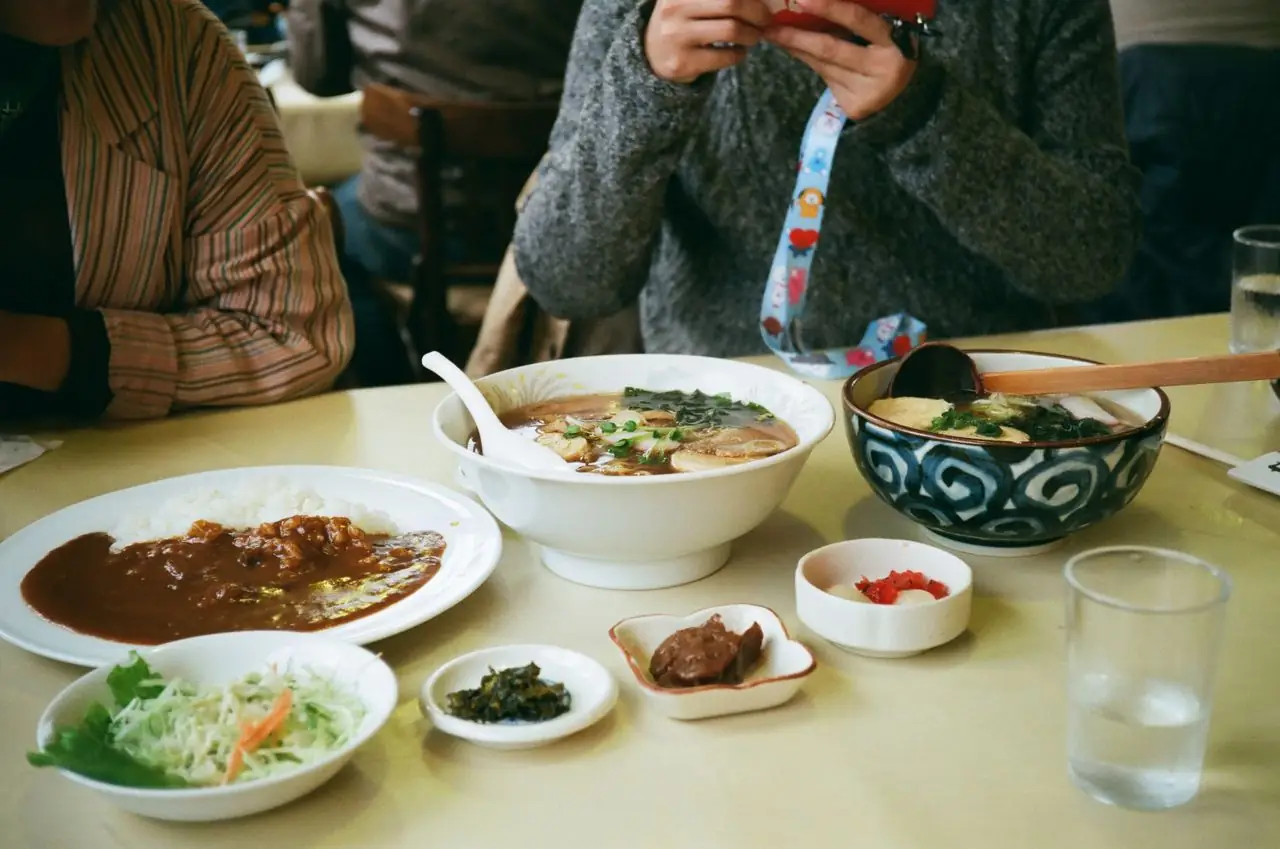
Some providers include lunch in the price and say so: "Lunch costs are covered." Others expect you to pay when the bill comes. Your guide won't bring it up in advance, because talking openly about money is culturally uncomfortable.
If you'd rather not guess, ask your provider before the tour: "Does the guide eat with us or separately? If together, who pays?"
Entrance Fees and Transportation
At paid attractions you buy tickets at the entrance. There's a ticket window, the guide waits while you buy, and you go in together. The guide may go first and buy their own, or wait for you to buy both.
Transport is easier. With IC cards everyone taps and boards, so there's no cash changing hands and no splitting fares. If you take taxis instead of trains, the guide will usually let you pay, or pay and ask you to reimburse them.
Tipping in Japan
Tipping isn't customary in Japan. Guides, restaurants and taxi drivers don't expect it.
More and more Western travelers do tip their guides, though, especially after an exceptional day. If you want to, do it quietly at the end: hand over cash in an envelope rather than making a show of it. The guide isn't expecting it and won't be offended if you don't. Our page on tipping tour guides in Japan has more cultural background and practical amounts.
Group Size Economics (Not What You Think)
Split a private tour between several people and the per-person price looks very good. Four people sharing a $700 tour pay $175 each, which beats many group tours. But group size changes the day in ways the per-person figure doesn't show.
The 2-4 Sweet Spot
Two to four people works best for most Tokyo private tours. You fit in a standard sedan if you decide to grab a taxi. You can walk into tiny neighborhood restaurants without calling ahead. You get through crowded stations and temples without losing anyone, and the guide can talk at normal volume and still be heard.
At this size the per-person cost is well below what a solo traveler pays, and the logistics haven't started to get complicated yet.
What Changes at 5+ People
Five people changes several things at once. You need a van instead of a sedan, so spontaneous taxi rides are out and you're on trains or pre-booked transport. Most izakayas and small ramen shops won't take you without a reservation. Getting through crowds takes longer when you're keeping track of six or seven people instead of three.
The guide's job changes as well. They spend more of the day managing a small group: making sure everyone can hear, waiting for stragglers, repeating things. You stop being a few friends seeing Tokyo with a local and become a guided group.
At six to eight people it gets more pronounced. Places that feel cozy for four feel cramped for eight. Lunch splits into separate conversations. Half the group wants to stay at a shrine while the other half wants to move on.
Per-Person Math vs Experience Quality
Here are real numbers from a typical provider:
| Group Size | Total Cost | Per Person | What You Lose |
|---|---|---|---|
| 2 people | $550 | $275 | — |
| 4 people | $708 | $177 | Some intimacy, flexibility for spontaneous taxis |
| 8 people | $1,016 | $127 | Access to small venues, easy coordination, intimate guide interaction |
Going from the smallest group to the largest saves $148 per person. For that $148 you give up the freedom to change plans, access to small venues, a comfortable pace, real conversation with your guide, and the sense that the day is built around you instead of around keeping a group together. With private tours in Tokyo planned around your own interests instead of a fixed template, that closeness is most of what you're paying for.
Some larger groups work very well: families spanning several generations, friends who know each other well, people who genuinely like a crowd. If you picked a private tour because you wanted closeness and flexibility, though, the savings may not make up for the extra coordination. We go into more detail on how many people is too many for a private Tokyo tour, including vehicle limits and restaurant access.
The Flexibility vs Certainty Trade-Off
The way a tour is priced decides what happens when plans change. Two tours at $500 for eight hours might handle running long, finishing early or a rainy day in completely different ways, depending on the provider's model.
Can You Extend Mid-Tour?
On paper, hourly-extension models make this easy: you're enjoying yourself, you pay the hourly rate, you keep going. In practice it only works if the guide has nothing booked after you. Many guides run back-to-back tours, especially in busy seasons, so the extra hours often aren't available.
Daily-rate packages can't be extended, because you've already booked the most time on offer. "A full day" means the guide's working-hours limit. Some guides will stay on if they have no evening plans, but that's a favor and they don't owe it to you.
Fixed blocks are the least flexible. Book six hours and you get six hours, because the guide's schedule is built around your block ending on time.
What If You Want to End Early?
Here the models really differ. Hourly-extension models ought to let you stop early and pay only for the hours you used, but few providers actually give partial refunds. You booked a minimum block, and that's what you pay for.
Daily packages are paid in full. If you're done after four hours and want to go back to the hotel, the guide will take you, but you've still paid for the day.
A few flexible providers will adjust the bill if you finish very early (ending a 6-hour tour after 3 hours), but don't count on it. Most quotes are non-refundable once the tour starts.
Rain Days and Pivots
It rains a lot in Tokyo, especially in June (rainy season) and September (typhoon season). How a tour copes with weather depends more on the provider's approach than on the pricing model.
Good guides change the route, and almost every neighborhood has indoor options. Temple gardens become covered shopping streets and museums. A riverside walk becomes department store food halls and underground stations.
Some providers will cancel if you ask, under cancellation policies that vary. Most go ahead whatever the weather, since Tokyo works fine in the rain if you adjust the plan.
What Explains Price Differences Between Guides
Two guides can both quote $500 for eight hours and give you very different days. A third might charge $700 for the same hours and be no better than the $500 guide.
Licensed vs Unlicensed Guides
Japan has a national licensing system for guides, and licensed guides usually charge more. A license doesn't guarantee a better day, and many excellent guides work under a company's registration instead of holding their own license. We cover licensed vs unlicensed tour guides and what actually matters in a separate article.
Experience and Insider Access
A guide with ten years behind them knows which restaurants take walk-ins and which need a booking, and which temple is packed at noon but quiet by 3 PM. They know shop owners who'll show crafts tourists usually don't see. They've watched hundreds of guests take in Tokyo and can tell when you're full of energy and when you need a break.
That knowledge shows up in the price. A $700 guide can get you into places a $400 guide can't, because of relationships built over years: the craft studio that lets them bring in small groups, the unadvertised izakaya that will seat their guests, the morning market vendor who explains the seasonal fish.
Most of the extra money pays for a guide who takes fewer bookings, which gives them time to prepare for your interests and to keep up the relationships that get you in the door.
Seasonal and Advance-Notice Pricing
Most Tokyo private tour guides keep the same prices all year. Hotels and flights have obvious cherry blossom or New Year surcharges, but guide pricing mostly doesn't. Availability is what changes: good guides book out 2-4 weeks ahead in peak seasons. The Tokyo Essentials tour and Infinite Tokyo tour are both popular and fill quickly in cherry blossom season (late March through early April).
A few providers do add a small premium during cherry blossom season (late March through early April), but it isn't universal or large. The bigger problem is that last-minute bookings stop being possible when demand peaks.
Book at short notice and you're limited to whoever is free, which can mean guides with less experience or less demand. Booking 2-3 weeks ahead gives you a wider choice. Our guide to how far in advance to book a private tour covers seasonal demand in more detail.
Market Context: What's Out There
Tokyo private tours range from tip-based walking tours to luxury concierge packages that cost thousands a day. Knowing where each provider sits makes it easier to see what you're comparing.
The Full Spectrum
| Tier | Price Range (Full Day) | What You Get | Examples |
|---|---|---|---|
| Free/Tip-Based | ¥1,000-3,000 tip (~$7-20) | Group walking tours, volunteer guides, basic orientation | Tokyo Free Guide, Tokyolocalized free tours |
| Budget Marketplace | $150-250 (per group) | Individual freelance guides, basic customization, variable quality | GoWithGuide budget listings, newer Viator guides |
| Mid-Range Marketplace | $250-450 (per group) | Experienced guides, full customization, established reviews | ToursByLocals, GoWithGuide premium, GetYourGuide |
| Specialist Operators | $400-700 (per group) | Curated experiences, guide selection, concierge support, quality guarantees | Hinomaru One, Magical Trip, Backstreet Guides |
| Premium Walking Tours | $250-400+ (per person) | Expert-led small groups, academic depth, specialized themes | Context Travel, Artisanative |
| Luxury Bespoke | $600-1,500+ (per day) | Private car, dedicated driver + guide, Michelin dining, exclusive access | InsideJapan, Jacada Travel, Artisans of Leisure |
What Each Tier Actually Delivers
Free/tip-based tours are fine for basic orientation. You see the major sites with 10-20 strangers and a volunteer guide, and quality varies a lot. They suit travelers who want to save money and don't mind a group.
Budget marketplace ($150-250) gets you a private guide, often a newer one still building a track record. Reviews are thin, communication can be patchy, and you deal with the guide directly. If you find the right person it's excellent value, and if you don't it can disappoint.
Mid-range marketplace ($250-450) is where most travelers end up. Platforms like ToursByLocals and GoWithGuide vet their guides and run review systems, so you're picking from established professionals with a history. Quality is dependable, though you're still choosing from a list instead of being matched.
Specialist operators ($400-700) sit between you and the guide. They've already vetted, trained and chosen their guides, so instead of browsing profiles you rely on their judgment. They handle the logistics, step in with a backup if something goes wrong, and take responsibility for the day. Their prices cover that.
Premium walking tours ($250-400+ per person) like Context Travel charge per person for small groups (max 6-8) led by scholars, historians or other subject experts. A 3-hour architecture walk might cost $300/person. You're paying for academic depth and specialist knowledge, and you get little flexibility or customization.
Luxury bespoke ($600-1,500+/day) comes with a private vehicle, a dedicated driver, and a guide who works more or less as your personal concierge, handling Michelin reservations, VIP museum access and ryokan bookings. Multi-day packages from operators like InsideJapan or Artisans of Leisure run $800-1,500+ a day before accommodation.
Platform vs Operator: Why Prices Differ
Booking through Viator or GetYourGuide means using a marketplace. The platform takes a 20-30% commission, so either the guide earns less or you pay more. A $400 tour on Viator might cost $320 booked direct, or the guide might charge $400 direct and $520 on the platform to take home the same amount.
Specialist operators price on a different basis. They employ or contract guides directly, train them, run customer service and guarantee the quality. That costs money, and the price shows it. In return you get a backup: if your guide falls ill, the operator finds someone else, and if something goes wrong, a company answers for it.
Marketplaces give you more choice and often lower prices, while operators give you a vetted selection and someone accountable. Which suits you depends on whether you'd rather pick the guide yourself or rely on someone else's pick.
Price ≠ Quality (But It Correlates)
A $600 tour isn't automatically better than a $350 one. Price does tell you something, though:
- Cheaper guides may be newer, still building a business, or running high volume to make up for thin margins
- Mid-range guides have established businesses and reputations to protect
- Premium operators carry overhead (staff, insurance, marketing) that needs pricing they can sustain
- Luxury operators target travelers for whom price isn't the main factor
The $200 guide might be exceptional, say a retired professor who guides for fun or a longtime expat who loves the city. Or they might be someone who couldn't hold a higher price because of quality problems. Reviews help, but marketplace reviews skew positive, because unhappy customers leave and happy ones leave ratings.
Private Tour vs Solo DIY: The Cost Comparison
A full-day private tour costs $400-700 depending on the provider and group size. To decide if that's worth it, you need to know what exploring Tokyo on your own would cost, and what kind of day you'd have.
What You'd Spend DIY
| Expense Category | Cost Range (per person) | Notes |
|---|---|---|
| Transportation | ¥1,000-1,500 ($7-10) | Trains/subways for moderate sightseeing |
| Breakfast | ¥500-1,000 ($3-7) | Convenience store or café |
| Lunch | ¥800-2,500 ($5-17) | Casual restaurant to mid-range |
| Dinner | ¥1,500-5,000 ($10-33) | Ramen/curry to izakaya |
| Entrance Fees | ¥2,000-5,000 ($13-33) | Museums, observation decks, temples |
| TOTAL PER DAY | ¥7,000-14,000 ($50-100) | For group of 4: $200-400 combined |
Entrance fees vary a lot. Most temples are free, but the big attractions charge: museums ¥500-1,500, observation decks ¥1,000-2,000, and specialty sites more.
The Hidden Cost: Time and Energy
The bigger cost is the time you spend working things out. First-time visitors lose 2-3 hours per day to getting around: wrong exits, indecision, and recovering from small mistakes. Over a 3-4 day trip that adds up to almost a full day.
When to DIY vs When to Hire
Past the arithmetic, you're deciding whether a guide's local knowledge, efficient routing and cultural insight are worth the difference for your trip. Our breakdown of when private tours are worth it covers who gets the most out of a guide and when going it alone makes more sense. If you've decided a guide suits you, here's how to choose between walking tours, car tours, and specialty experiences.
Multi-Day Pricing: Package vs Daily Rates
If you're in Tokyo for several days and want a guide on more than one, you can book day by day or commit to a multi-day package. Each has its trade-offs.
How Multi-Day Discounts Work
The usual arrangement is 10% off from day two onward. If day one costs $550, days two and three cost $495 each. Committing up front gets you the later days at a lower rate.
Not every provider does this. Some charge the same daily rate however many days you book. Others step the discount up: 10% for two days, 15% for three or more.
The discount reflects a real saving for the guide, who fills several days in a row with one client instead of juggling separate bookings.
The Relationship Advantage
A multi-day package means the same guide every day. By day two they know your pace, that you'd rather see small neighborhood places than famous landmarks, that your kids need a break every 90 minutes, or that you walk fast and want a full day.
You skip the introductions and don't have to explain your preferences again. The guide picks up from what you saw yesterday, and might say, "Remember that potter we mentioned in Asakusa? Their studio is near where we're going today. Want to stop by?"
That continuity is what makes multi-day packages worth it, more than the discount.
When to Book Day-by-Day Instead
Book separately if you don't know how much guided time you'll want. Some travelers find after day one that they'd like to explore alone on day two. Others find the guide is so good they want more days.
Day-by-day booking also makes sense if you want to try different specialties, for example a food guide on day one, a history guide on day two and a photography guide on day three.
You give up the continuity and the discount, and in exchange you can change course as you go.
Payment Timing and Methods
Once you've chosen a provider and agreed a price, the practical details come next: when you pay, how you pay, and what happens if you cancel.
Deposit Requirements
The usual setup is a 50% deposit when you book and the other 50% on the day. Some providers take the full amount up front. Others take a smaller deposit (25-30%) and collect the rest closer to the date.
If you book within seven days of the tour, expect to pay 100% up front. Short-notice bookings don't allow part payment because the provider has to secure the guide and block their schedule straight away.
Payment Methods and Currencies
Most providers take credit cards through processors like Stripe or PayPal. Some accept bank transfers for large bookings or multi-day packages.
If a provider prices in USD and you pay from a Japanese bank account, you'll pay conversion fees. If they price in yen and your card charges in USD, your bank's exchange rate decides the final amount.
Processing fees run from 1.5% to 5% depending on the provider and payment method, and they're added at checkout instead of being built into the quote.
Cancellation Policies
| Policy Type | Refund Structure | Common Providers |
|---|---|---|
| 24-Hour Cancellation | 100% refund if canceled 24+ hours before tour | Standard among established operators; some extend to 48-72 hours |
| No Refunds | Non-refundable once booked (weather/illness/flight changes don't qualify) | Less common but exists; stated clearly at booking |
| Tiered Refunds | 100% refund 7+ days out, 50% refund 3-7 days, 0% within 72 hours | Mid-range flexibility option |
Check the cancellation policy before you book, especially in seasons when the weather is unreliable (June rainy season, September typhoon season). Our page on Tokyo private tour policies and guarantees has the full details, including refund schedules and quality promises.
Questions to Ask Before Booking
By now you've looked at providers, read reviews and collected quotes. Before you commit, ask a few questions to pin down exactly what you're buying. For a fuller list, see 10 questions to ask before booking a Tokyo private tour.
Once you've weighed the prices and picked a provider, here's how to plan your actual itinerary and booking logistics.
Frequently Asked Questions
How much does a private tour guide cost in Tokyo?
Most private tours cost $300-600 for a full day (6-8 hours), priced per group instead of per person. A couple pays the same base rate as a solo traveler, so the per-person cost falls quickly as the group grows. Budget $400-500 for a good 6-8 hour day for 2-4 people.
Is pricing per person or per group?
Nearly always per group. A "$500 tour" means $500 in total for your party, whether that's 2, 4 or 6 people. Some operators add a small charge for bigger groups (typically $20-50 per additional person beyond 2). Food tours and specialty experiences sometimes charge per person, so check before you book.
What's included in the tour price?
The guide's time and expertise are always included. After that it varies. "All-inclusive" might mean the guide's transport and meals are covered while you pay your own, or it might mean your expenses are covered too. Ask directly: "Do I pay for my own train fares, entrance fees, and meals?"
Why do prices vary so much between operators?
The pricing models differ: hourly blocks or daily packages, per person or per group, guide expenses included or not. A $400 quote and a $600 quote might give you the same day under different payment structures, or two very different days. Compare what's included, not just the headline price.
Are tips included in the price?
No. Tipping isn't customary in Japan, but private tour guides do appreciate it. If you want to tip for exceptional service, ¥3,000-5,000 ($20-35) per person is about right. Give it in cash, ideally in an envelope.
Where Hinomaru One Fits
Our prices are published, so you see the exact rate before you book and never have to "contact us for a quote." There are no surprise fees on the day, because the guide's expenses are already in the price you pay.
Our pricing:
- 4-hour tours: $300 (1 person) to $488 (8 people)
- 6-hour tours: $400 (1 person) to $800 (8 people)
- 8-hour tours: $500 (1 person) to $1,016 (8 people)
Payment: All major credit cards via Stripe, charged in USD at booking. There's no deposit; full payment secures your slot.
Cancellation: Free cancellation up to 24 hours before your tour (full policy).
At Hinomaru One we design private Tokyo tours for first-time and returning travelers. They're unrushed, customized to you, and built to take the stress out of the day.