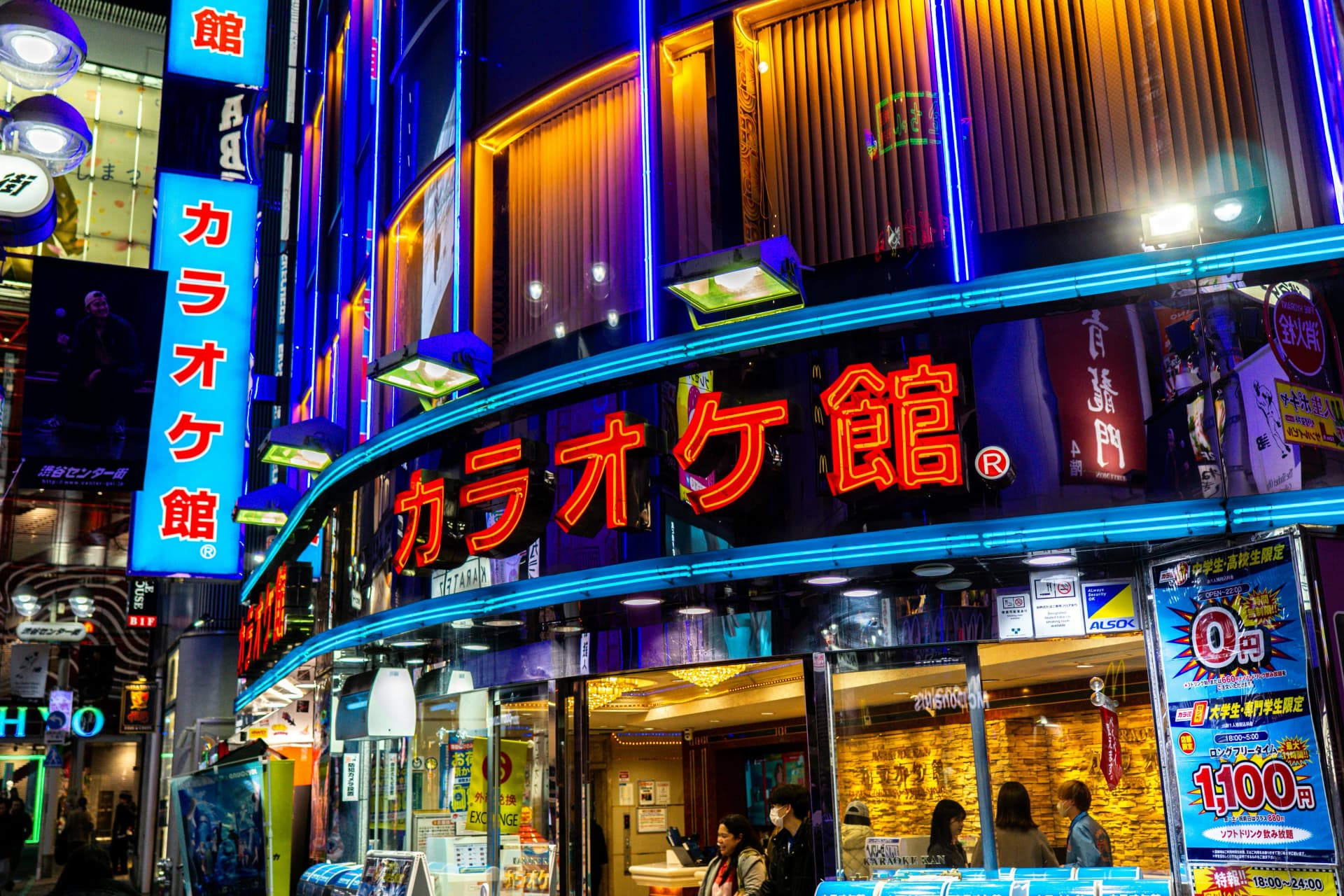
Karaoke in Tokyo is nothing like karaoke elsewhere. The private room format removes the performance anxiety. The machine has an English mode. The pricing is cheaper than you expect. And you do not need to be good.
Karaoke in Tokyo looks different from the karaoke that spread to the rest of the world, even though Japan invented it. In most countries karaoke means a bar with a stage and someone singing in front of strangers. Tokyo has that kind of bar, but it's a sideshow. The main format is the karaoke box: a private room rented by the hour, with a machine, a screen, microphones, and nobody listening except the people you came with.
With only your friends in the room, the stage fright mostly goes, and the one thing left to decide is whether you'll pick up the microphone. That's why karaoke is the most dependable social activity in Japan. It's also where a night out with colleagues usually ends, after the second or third izakaya.
How the Box Works
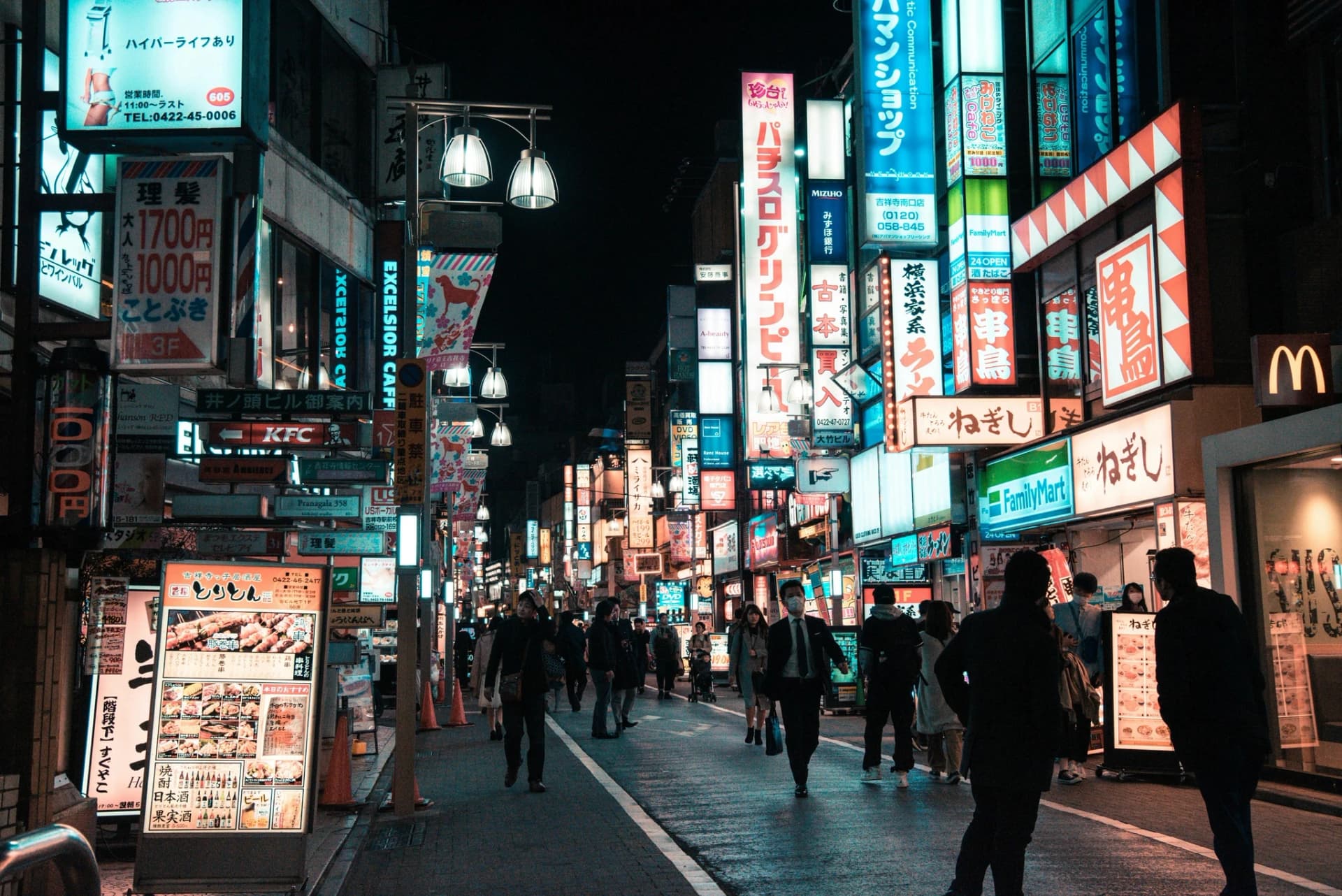
The building is usually near a station with the karaoke on the upper floors, and you'll spot it by the big lit-up signs. Go to the front desk and the receptionist will ask how many people and for how long. The time blocks are thirty minutes, one hour, two hours, or free time (unlimited within a set window). You pay per person for the room, and at every chain except Manekineko you have to order at least one drink. The room rate on display never includes drinks, so the real cost is the room rate plus ¥300 to ¥500 for the drink minimum. They give you a room number and you head upstairs.
Inside there's a couch, a low table, a screen on the wall, the karaoke console, two microphones, and a call button for ordering. The walls are soundproofed, so nobody outside hears a thing.
The Machine
Two companies make nearly all the machines: DAM (made by Daiichi Kosho) and Joysound (made by Xing). Each has a catalog of more than thirty million songs, an English search mode, and a big library of Western music.
They do differ in practice. DAM is stronger on major J-pop, enka, and anime tie-ins, with good backing tracks and official music videos playing behind a lot of songs. Joysound has the biggest catalog overall and covers indie, Vocaloid, K-pop, and niche releases better. For English-language songs, DAM tends to have more of the newer Western releases.
The machine you get depends on the chain. Big Echo uses only DAM, since the same parent company owns both. Karaoke Kan and Utahiroba usually run Joysound. Karaoke no Tetsujin (now rebranding as KARATEZ) is the one major chain with both DAM and Joysound, and you pick the system room by room.
To find English songs on DAM, tap song title search on the home screen of the denmo remote, switch to alphanumeric input, and type in Roman letters. Songs sort alphabetically by artist or title. Both systems also have a "Western music" (洋楽) genre category. If there are particular songs you want, look them up in the DAM or Joysound online catalog before you pick a venue.
Which Chain to Use
In central Tokyo the big names are Big Echo (101 locations), Karaoke Kan (77), and Utahiroba (53). Manekineko has the most stores nationally, nearly 700, but only about five inside the Tokyo 23 wards, so telling a tourist in Shinjuku or Shibuya to "find a Manekineko" isn't much help.
For tourists specifically: KARATEZ (formerly Karaoke no Tetsujin, about 40 Tokyo locations) has put real money into serving overseas visitors. It has a website in four languages, real-time translation at the front desk, luggage storage, phone chargers to borrow, and both DAM and Joysound in the same building. There are branches in Shibuya, Ikebukuro, Akihabara, and Ginza. If you don't speak Japanese and want the easiest time, go here.
Pasela (Karaoke Pasela) is the upmarket option, with Bali resort-themed rooms and full restaurant menus, and the food and drinks get as much attention as the singing. It has branches in Shinjuku, Shibuya, Roppongi, Ginza, Ikebukuro, Ueno, and Akihabara, and English menus. It costs more than the standard chains, and you can tell where the money goes.
Big Echo is the biggest chain in Tokyo, so there's probably one within walking distance of wherever you are. It's clean and reliable and runs DAM machines. There's nothing special for tourists, but the system is simple enough that language rarely gets in the way.
What It Costs
Karaoke in Tokyo is cheaper than most visitors expect, and the price swings a lot depending on the time of day.
Weekday daytime (before 6:00 PM) is cheapest, at ¥120 to ¥300 per person per thirty minutes at most chains, plus a drink. Two hours in the afternoon for two people with a drink bar comes to roughly ¥2,000 to ¥3,000 in total.
On weekday evenings (after 6:00 PM) prices roughly double to ¥280 to ¥550 per thirty minutes. Two hours in the evening for two, with drinks and a bit of food, runs ¥5,000 to ¥8,000 in total, which is less than dinner out.
Weekends and holidays add another twenty to forty percent on top of evening rates.
Free time plans (フリータイム) give you unlimited singing within a time window and are usually the best deal for anything over ninety minutes. At the standard chains, weekday evening free time with a drink bar is ¥1,600 to ¥2,200 per person, and weekend evening is ¥2,200 to ¥3,000.
The all-you-can-drink (飲み放題) add-on covers beer, cocktails, and soft drinks for the whole session and usually costs ¥600 to ¥900 on top of the room. For two hours at a standard chain that puts the total at roughly ¥2,500 to ¥4,000 per person, a lot better than paying drink by drink.
The morning deal: Manekineko's "Asauta" morning plan charges ¥10 to ¥55 per thirty minutes if you go in before 10:59 AM. The only other required cost is one drink at ¥420, so two-plus hours of morning karaoke comes to roughly ¥500 to ¥700. English guides almost never mention it.
Membership cards are free at most chains. You sign up at the front desk and get thirty to fifty percent off room rates. Ask when you arrive, because the discount works straight away.
Solo Karaoke
Singing alone in a private room is a normal, accepted thing to do in Japan. It's called hitokara (ヒトカラ), from hitori (alone) and karaoke. It used to carry a stigma, and now people do it openly, usually to blow off stress, practice their voice, or get songs right before a group night.
Every major chain will put a solo singer in a standard room at the usual per-person rate. If you want something built for it, OneKara (ワンカラ) runs Japan's first chain dedicated to solo karaoke: small soundproofed booths with professional condenser microphones and monitoring headphones. You hear yourself through the headphones instead of room speakers, so it feels more like a vocal booth than a party room. Staff don't come in during your session, and the drink bar is self-service. It has three Tokyo locations, in Shinjuku, Minami-Ikebukuro, and Ueno.
The Etiquette
There aren't many rules in a private room, but people do notice when you break the ones there are.
Queue one song at a time. In a group, everyone sings about the same amount, and stacking several songs while others wait comes across as selfish. Put one in, wait for your turn to come round, then add the next.
Don't sing someone's "song" immediately after them. Following someone with the same track they just sang, especially if you sing it better, comes off as a quiet dig. Leave some space in between.
Don't activate the scoring function without asking. DAM and Joysound both have precision scoring that grades your pitch, rhythm, and vibrato as you sing. Plenty of people hate being graded, so check with the group before you switch it on.
Don't use your phone while someone is singing. In a room that small, people notice when you're not watching.
The first song sets the tone. With a group, open with something upbeat that everyone knows well enough to hum along. Keep the obscure deep cuts for later in the night or for a solo session.
The microphone doesn't touch your mouth. Hold it a few centimeters away, since touching it with your lips is considered unhygienic.
The Overnight Option
If you miss the last train in central Tokyo, a karaoke box is a real alternative to a hotel. Trains stop around midnight and start again around 5:00 AM, and many karaoke places in Shinjuku, Shibuya, and Ikebukuro are open twenty-four hours.
The overnight free time package usually runs from 10:00 or 11:00 PM to 5:00 or 6:00 AM and costs ¥2,000 to ¥3,000 per person with one drink. That's cheaper than a capsule hotel (¥4,000 to ¥6,000), though much less comfortable: you're sleeping on a couch in a soundproofed, climate-controlled room, and people really do it.
Pasela's Shinjuku branch does overnight free time for ¥2,500 Sunday through Thursday and ¥3,000 on weekends. Karaoke no Tetsujin in Kabukicho and Utahiroba in Shibuya both stay open through the morning.
Frequently Asked Questions
Is the English song catalog good enough? At the major chains, yes. DAM and Joysound both have large Western catalogs: Beatles, Queen, Adele, Ed Sheeran, Taylor Swift, classic rock, current pop. What's available depends on how recently the machine was updated, so if there's one song you have to sing, check the DAM or Joysound website first.
Can I just walk in? At most chains, most of the time, yes. Late on Friday and Saturday nights the rooms in the entertainment districts fill up, so for 10:00 PM to 2:00 AM it's safer to book ahead by phone or on the chain's website.
What if I can't speak Japanese? The big chains in Shinjuku, Shibuya, and Akihabara see international visitors all the time. The console has an English mode, and the food menu on it often has English too. Pointing works fine. KARATEZ branches have real-time translation at the front desk.
Is it expensive? Two hours in the evening for two people, with all-you-can-drink and some food, comes to about ¥6,000 to ¥9,000 in total, or ¥3,000 to ¥4,500 each, less than dinner out would cost. Daytime sessions cost about half that.
Can I bring my own food and drinks? Only at Manekineko, which openly allows you to bring in all your own food and drink with no corkage fee. None of the other major chains do. Everywhere else you have to order from the menu, and the one-drink minimum applies.
At Hinomaru One, we can build karaoke into a Tokyo evening itinerary. We find the right place for your group, deal with the front desk, and show you how the machine works, so you can start singing as soon as the door shuts.