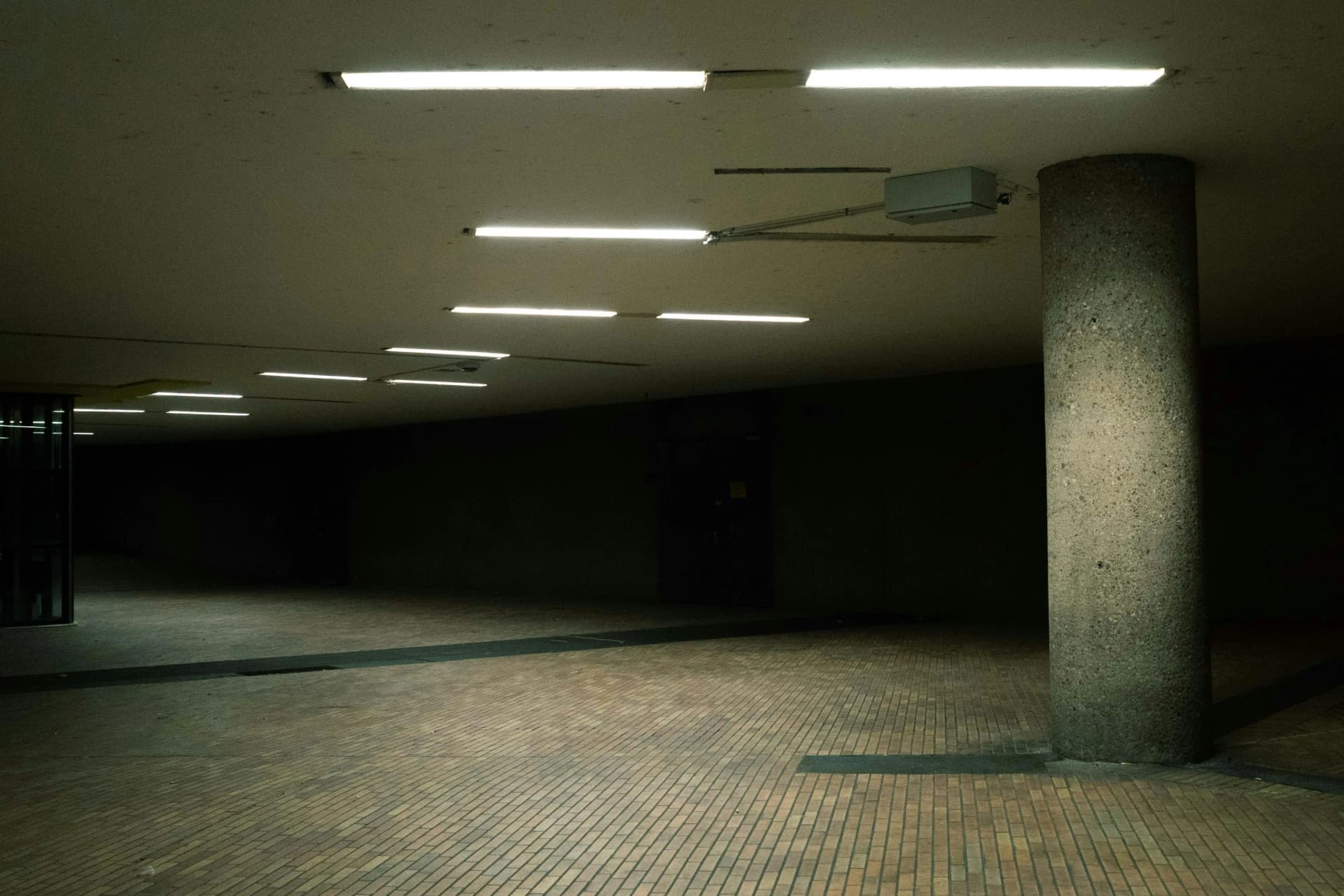
This is functional infrastructure built at a scale that makes most landmarks feel modest. Nothing in Tokyo looks like it.
The Metropolitan Outer Discharge Channel (首都圏外郭放水路) is a flood control system built between 1993 and 2006 beneath the fields of Kasukabe, Saitama Prefecture, 45 minutes from central Tokyo. It was constructed to protect the northern suburbs of Tokyo from the chronic, destructive flooding that had defined life along the region's smaller rivers for generations. And it was built at a scale that no photograph fully prepares you for.
The system consists of five shafts — each 73 metres deep and 32 metres in diameter, large enough to fit the Statue of Liberty inside — connected by 6.4 kilometres of underground tunnels at a depth of roughly 50 metres. The tunnels themselves are cylindrical, 10 metres in diameter: wide enough to drive a double-decker bus through with room to spare. At the far end, water flows into the main pressure-regulating tank, which measures 177 metres long, 78 metres wide, and 25 metres tall. Fifty-nine reinforced concrete pillars, each 7 metres in diameter, support the ceiling. The tank can hold 670,000 cubic metres of water before it is pumped out into the Edogawa River. When it's not holding floodwater, you can tour it.
Why It Was Built
The rivers that flow through Saitama and northern Tokyo — the Naka, the Kuramatsu, the Oochi Furutone, and several smaller waterways — have flooded the surrounding residential areas repeatedly throughout modern history. These are not large rivers by global standards, but they run through densely populated flatlands with nowhere for overflow to go. A heavy typhoon or a prolonged rain event would send water into homes, streets, and rice paddies across Kasukabe and neighbouring towns. The damage was routine enough that the construction of a serious solution eventually became politically unavoidable.
Planning for the Metropolitan Outer Discharge Channel began in the late 1980s. Construction started in March 1993. The project took over a decade, operating partially from June 2002 before reaching full completion in June 2006. The total cost ran into hundreds of billions of yen — this is, by most measures, one of the most expensive pieces of flood infrastructure ever constructed in Japan.
The system operates on a simple principle: when river levels in the protected waterways rise during a flood event, water is captured and diverted underground through the five inlet shafts. It travels through the connecting tunnels to the main tank, where it accumulates until the rain passes. Massive pumps — each one generating roughly 14,000 horsepower — then discharge the stored water into the Edogawa River at a controlled rate. The pumps can move 200 cubic metres of water per second. Since coming online, the system has handled an average of about seven flood activations per year.
The most dramatic test came in October 2019, during Typhoon Hagibis — one of the most powerful typhoons to strike the Tokyo region in decades. While rivers across Kanto flooded and dozens of levees failed, the discharge channel captured vast quantities of floodwater from the protected rivers. The system did precisely what it was designed to do. Aerial photographs taken during and after the storm show the tank nearly full.
What the Space Actually Looks Like
Every photograph of the facility focuses on the main pressure-regulating tank, and for good reason. Fifty-nine pillars arranged in a grid, receding in all directions, lit from above by filtered daylight through steel grates in the ceiling — the visual comparison to a cathedral is not an exaggeration. The proportions are ecclesiastical. The scale is inhuman in a way that clarifies itself only when you see a person standing next to one of the columns.
The floor is often not entirely clean. After flood events, a thin layer of sediment remains until maintenance crews clear it. If a tour runs within a few weeks of significant rainfall, you may find the floor still showing dried mud in patches. This is not a flaw. It is evidence that the place is operational.
The tunnels visible on longer tours reinforce the same sense of displaced scale. Walking through a 10-metre cylindrical passage feels more like being inside a piece of geological infrastructure than anything built by people. The lighting is functional rather than theatrical: this is not a designed experience in the way that a museum is. It is an engineered system that happens to produce extraordinary spaces.
The pump room above the main tank provides a different kind of spectacle. The machinery is fully exposed and comprehensible — large, clearly legible industrial equipment rather than concealed mechanisms. For visitors interested in engineering, it offers a useful counterpoint to the tank: here is the functional heart of the system, unglamorous and impressive in equal measure.
Getting There
Kasukabe Station (Tobu Noda Line, also called Tobu Urban Park Line) — 45 minutes from Asakusa on the Tobu Skytree Line, or approximately 50 minutes from Shinjuku via transfer at Kitasenju. The nearest station to the facility itself is Minami-Sakurai, though Kasukabe is the more practical departure point given transport connections from Tokyo. A free shuttle bus runs from Kasukabe Station on tour days. By car, the facility is roughly 40 minutes from central Tokyo via Route 4. Parking is available on site.
Tours and Booking
Every visit requires an advance reservation. There is no walk-in access.
Book at gaikaku.jp or through the reservation portal at reserva.be/guidetour. The official site is in Japanese; a browser with translation enabled handles the booking process without difficulty for most visitors.
Tours run daily, with reception open from 10:00 to 16:00, subject to cancellation on facility maintenance days. Individual tours accommodate up to 20 people per session. Each visit begins with an explanatory video covering the facility's history, construction, and operation, followed by locker use before you descend underground.
Tour options:
The standard Underground Temple Course is the essential experience — approximately 55 to 60 minutes, focused on the pressure-regulating tank. This is what most visitors come for. The Pump Course extends the tour to roughly 110 minutes and includes the pump room and additional infrastructure above ground. The Vertical Shaft Course is the most physically involved option: participants descend into one of the five intake shafts wearing a safety harness, walking catwalks at height over a 70-metre drop. This course is not available in every booking window and has age and physical condition requirements.
Pricing: Until May 14, 2026, the standard fee is ¥2,500 per person. Beginning May 15, 2026, fees increase to ¥5,500 under a revised course structure being announced by the facility. If you are planning a visit and cost matters, booking before that date is worth noting.
Tours sometimes sell out several weeks in advance. Booking as early as the reservation window opens — typically around one month ahead — is advisable, especially for weekend dates.
What to Wear and Bring
The underground environment is cooler than the surface year-round. Even in summer, the temperature inside the tunnels and tank hovers around 15–18°C. Bring a layer regardless of the season.
Wear proper athletic or walking shoes. The floor inside the tank can retain moisture and sediment after flood events, and the tunnel surfaces are industrial concrete, not tourist-grade flooring. Open shoes are not appropriate. If you are doing the vertical shaft course, the facility provides helmets and safety harnesses — wear clothing that moves easily.
For photography: the tank rewards a wide-angle lens. The space is too large for a standard phone camera to capture meaningful scale from a single shot. Smartphone cameras work and produce atmospheric images — particularly in the areas where ceiling grates create shafts of light — but the sense of depth across 177 metres of pillared space compresses badly without a wide focal length. Photography is permitted in all standard tour areas. Free photography time inside the tank is limited during the tour itself (approximately 15 minutes), so arrive with a clear idea of what you want to capture. There is also a separate commercial rental programme for professional shoots, which requires independent arrangement with the facility.
Planning the Day
The facility sits in suburban Kasukabe, not in a neighbourhood with much else to see or eat nearby. Budget two to three hours total from Kasukabe Station including transport and the tour. Eat before you go or pack lunch; the area around the facility is residential rather than commercial.
The Kawagoe pairing is the natural complement. Kawagoe — called "Little Edo" — sits 30 minutes from Kasukabe by Tobu Noda Line. The town's core district contains some of the best-preserved Edo-period kurazukuri (storehouse) architecture outside of central Japan: dark-plastered walls, latticed windows, streets that look substantially as they did two centuries ago. Hikawa Shrine, originally founded in the mid-16th century, draws couples for its ema (wooden prayer tablet) traditions and a celebrated wind-chime festival each summer. Kawagoe also has a strong candy-making heritage — Candy Alley (駄菓子屋横丁) concentrates the old sweet shops in one lane and is as genuine as it looks.
A morning tour at the discharge channel followed by an afternoon in Kawagoe is one of the more coherent day trips available from Tokyo — not despite the contrast between them, but because of it. Industrial-scale underground infrastructure and preserved Edo streetscapes are both, in their different ways, about how cities persist.
For a custom day trip built around either or both, Infinite Tokyo designs full-day private experiences with a guide who can anchor the logistics on either end.
What Makes It Worth the Trip
There is a category of travel experience that is hard to describe in advance but immediately recognisable when you're in it: the moment when infrastructure stops being abstract and becomes physical, when the numbers acquire a body. The discharge channel is that experience in concentrated form. 670,000 cubic metres of capacity is a figure. Standing under 59 pillars in a space the size of a cathedral, knowing that during Typhoon Hagibis those columns stood in water — that is something different.
It is also genuinely beautiful, in the way that large engineering sometimes is. The photographs circulate widely because nothing else looks like this. Seeing it in person confirms that the photographs are not doing it justice.
Frequently Asked Questions
Do I need to speak Japanese to take the tour?
The guided portions of the tour are conducted in Japanese. The facility provides information panels and some materials in English, and a pre-visit explanatory video covers the main points. For the standard underground temple tour, a Japanese-speaking companion is not required, though it helps with the booking process. The vertical shaft course may have stricter safety briefings that require comprehension of Japanese instructions — confirm with the facility if this matters for your group.
How far in advance should I book?
One month in advance is the standard booking window. Weekends and holiday dates fill up quickly — sometimes within days of the window opening. If your dates are flexible, weekday tours typically have more availability. Book as early as the system allows.
Can I visit even if the channel is currently in use?
No. When the system is actively managing floodwater, tours are cancelled. The facility posts updates on its website (gaikaku.jp). Tours resume after the water recedes and the tank is cleaned, which typically takes a few days to a couple of weeks depending on the flood event. If you are planning a visit around a specific date, check the forecast and the facility's notice board.
Is the vertical shaft course appropriate for visitors who are not physically fit?
The standard underground temple course involves stairs but no extreme physical demands. The vertical shaft course is more demanding — it includes harness-equipped descents and catwalk navigation above a deep shaft. The facility sets age and health requirements; check the booking site for current conditions. Most visitors who are reasonably mobile will be fine for the standard course.
Is the ¥5,500 price increase confirmed?
As of late March 2026, the facility has announced revised course structures and a new fee of ¥5,500 per person effective May 15, 2026, up from the current ¥2,500. The new courses and what they include have not been fully detailed at time of writing. Check gaikaku.jp for the latest before booking.