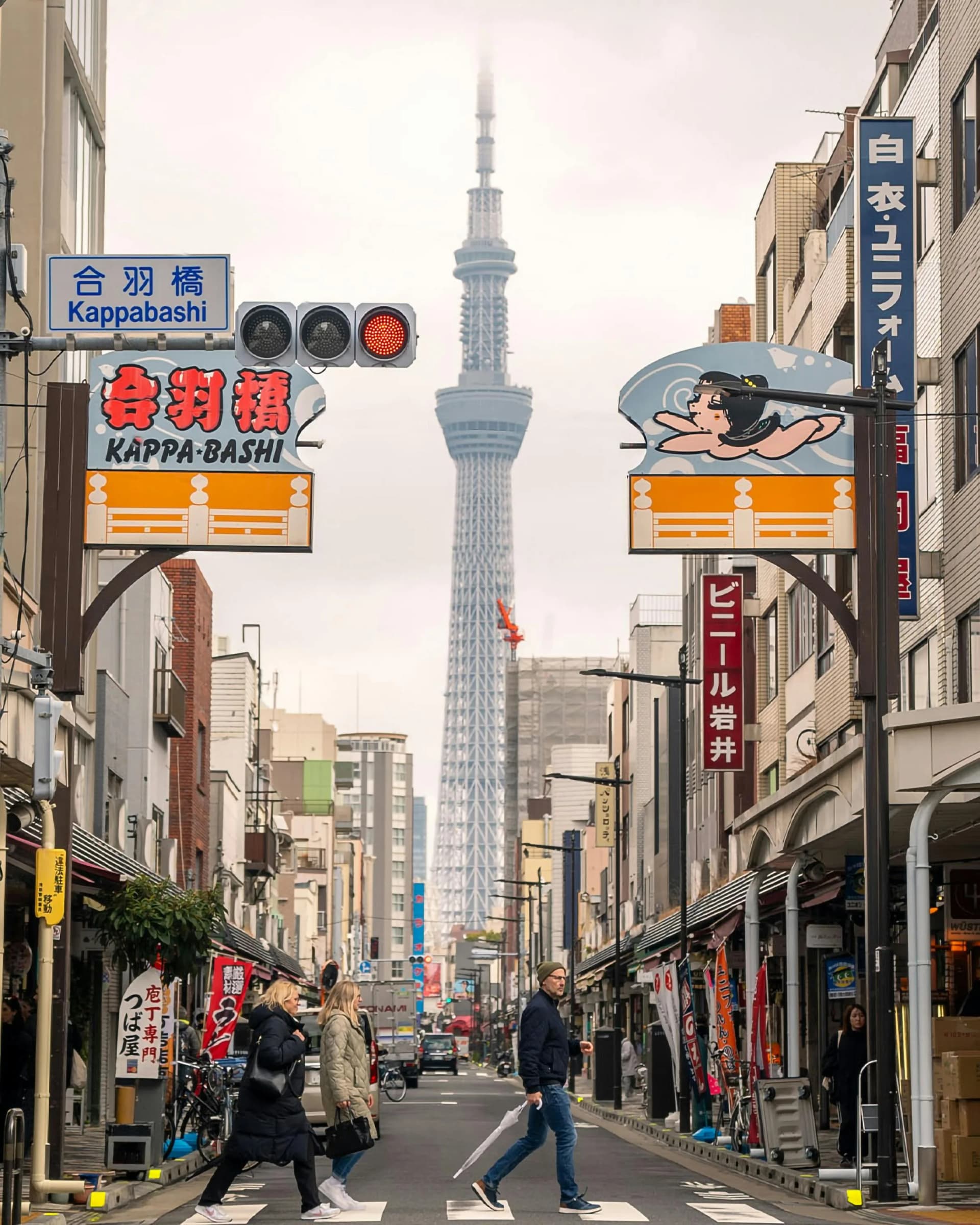
Kuramae is what happens when an area gets just enough development pressure to push out the old businesses but not enough to price out the people who replaced them.
Kuramae defies the usual Tokyo neighborhood pitch. It is not the oldest part of the city. It is not the most scenic. It does not have the most famous temple or the best shopping street or the most recognizable food. What it has is a combination that almost no other neighborhood in Tokyo has managed to assemble without becoming a tourist destination: a functioning restaurant supply district that professionals travel to from across Asia, one of the oldest covered shopping arcades in Japan, and a cluster of independent coffee roasters and artisan workshops that arrived quietly over the past fifteen years and have not stopped expanding since.
The name gives the history away: Kuramae (蔵前) means "in front of the storehouses." During the Edo period, government rice storehouses stood here — 御米蔵 (imperial rice storehouses) that held supplies transported from the productive rice lands of the Kanto region. The land itself was created by design: when the storehouses were built, the earth from cutting down a nearby hill (now the site of Torigoe Shrine) was used to reclaim part of the Sumida River, creating the flat commercial land the storehouses needed. The area developed as a commercial district serving the warehouse function.
That is the origin. What happened since is less linear.
Kappabashi Kitchenware Street
The most practically significant thing in Kuramae's orbit is Kappabashi-dori — a roughly one-kilometer street running between Asakusabashi and Kuramae stations that is lined with somewhere between 130 and 170 restaurant supply shops depending on how you count. This is not a tourist-oriented area. The shops sell to professional chefs, restaurant owners, and catering operations. The customers include people who drive from as far as Osaka or Fukuoka to buy commercial quantities of Japanese knives, professional-grade cookware, and the plastic food samples (食品サンプル, shokuhin sampuru) that every Japanese restaurant window uses to show what the food looks like.
The quality and range of Japanese knives available here is genuinely exceptional. A serious kitchen knife from a reputable smith — Sakai knives, Aritsugu, MAC — at prices that are meaningfully better than what you would find in a tourist retail setting. The shops along Kappabashi are staffed by people who can explain the difference between a white steel and a blue steel blade, who will ask what you cook and how you hold a knife before recommending anything, and who will adjust the edge angle on a purchased blade before you leave the store. If you are buying kitchen equipment in Tokyo with any serious intent, this is where you come. The shops are accustomed to international customers and most will handle export logistics if needed.
The street also produces the plastic food samples that are such a recognizable part of Japanese restaurant aesthetics. Several shops here make and sell these to restaurants across Japan. The production of wax and plastic food models is a minor art form in Japan — the companies that produce them employ artists who spend years learning to replicate the exact sheen of a grilled eel or the translucency of a piece of nigiri. Kappabashi is where that craft is concentrated, and a handful of shops sell smaller souvenir versions alongside their professional stock.
Note: as of early 2026, a significant portion of Kappabashi's main street section is under reconstruction following road widening work. Some shops have relocated; the core cluster is still operating. If you are planning a specific visit, check individual shop websites for current locations.
The Satake Arcade
The 佐竹商店街 (Satake Shopping Arcade) runs alongside the Kappabashi approach and is one of the oldest covered shopping streets in Japan, established in 1898 — second in the country only to the Juningachi arcade in Fukui. It predates the automobile era, which means it was designed for foot traffic and bicycles, not cars. The arcade was built by and for the local merchant community and has operated continuously as a commercial space for over 125 years.
Walking through it now is an exercise in reading decades of commercial adaptation on a single covered street. The corrugated metal roof arches overhead, weathered but intact, and the light underneath is the particular flat gray that old arcades produce — not dark, but never fully bright either. A fishmonger that has been there for multiple generations still sets its display out onto the walkway each morning. A tofu shop with a specific local reputation operates a few doors down. There are dry goods stores, a rice seller, a small shrine tucked into a corner where the arcade turns. Between these anchors sit the evidence of time passing: a shuttered storefront with sun-bleached signage, then a recently opened takeaway shop with a hand-lettered menu, then another shuttered unit, then a barbershop that appears not to have changed its pricing or its interior since the 1970s.
The Satake Arcade is not curated for visitors. It is not particularly photogenic in the way that a traveler with a camera phone would recognize. It is what a Japanese neighborhood commercial street looks like when it has survived in place through the bubble era, the post-bubble stagnation, and the current period of urban renewal pressure without being converted into something designed for external consumption. The customers are local. The pace is local. The conversations happening at the fishmonger's counter are between people who have been having them for years.
The New Kuramae
The version of Kuramae that has appeared in international English-language media over the past decade — "Tokyo's Brooklyn," the craft workshops, the specialty coffee — exists in the same physical area as the storehouse heritage and the Satake Arcade and does not replace them. The new and the old are in direct conversation on the same streets.
The catalysts were affordable rent and Taito Ward's deliberate support for creative industries, which included a program called Design Birth (デザビレ) that offered subsidized studio space to artists and designers starting in 2004. The program attracted craftspeople who had left or never entered the traditional Japanese guild structures, and who needed large studio spaces at rents that central Tokyo was becoming unable to provide. Kuramae's old warehouse buildings were suitable. The cluster built from that initial cohort has expanded without coordinated intervention since.
The Coffee Scene
The coffee scene is the most immediately legible to international visitors. There are at least six independent roasters and specialty coffee shops operating within a five-minute walk of Kuramae Station, and the density is increasing. But what makes Kuramae's coffee different from other Tokyo specialty coffee neighborhoods is not the quantity — it is the character. The roasters here tend toward a deliberate simplicity that you do not find in Shimokitazawa or Shibuya's coffee shops, where the design of the space often competes with the coffee for attention. In Kuramae, the spaces are often converted ground-floor warehouse units: concrete floors, minimal signage, a roaster visible behind the counter, and not much else. The aesthetic is functional because the buildings are functional. Nobody renovated these spaces to look industrial. They are industrial.
The roasting profiles lean lighter and more origin-focused than what you find at the chains, with single-origin pour-overs that emphasize the bean rather than the technique. Several roasters here source directly from farms and will talk about specific lots with the kind of specificity that a wine shop owner uses for appellations. The prices are reasonable by Tokyo standards — lower than Nakameguro, significantly lower than Omotesando — because the rent allows it. These are not coffee shops that apologize for not having Wi-Fi or that serve pour-over to people who want to photograph the process. They serve coffee to people who care about coffee. That market has attracted enough of them to make Kuramae a genuine destination on the specialty coffee circuit in Tokyo.
The Artisan Workshops
The craft workshops that have appeared in Kuramae's old warehouses share the same economic logic as the coffee roasters: they need space, and this is where space was affordable. But the physical reality of these workshops is worth describing, because it is not what most people picture when they hear "artisan workshop" in the context of a city like Tokyo.
These are not boutiques. A typical Kuramae workshop is a ground-floor unit in a converted warehouse, with a rolling metal shutter that opens directly onto the street. Inside, the workspace dominates — a leather-cutting table surrounded by hides and tools, a ceramicist's wheel with shelves of drying pieces against the back wall, a woodworker's bench with sawdust on the floor. The retail component, if it exists, is usually a small shelf or display case near the entrance, almost an afterthought. You are standing in someone's workplace, and many of the makers are visibly working while you browse. The boundary between the production and the selling is essentially nonexistent.
The cluster includes leatherworkers, ceramicists, woodworkers, a growing number of small fashion ateliers, paper goods makers, and at least one gin distillery that has found enough local identity to operate without a major distribution deal. None of these are on the tourist trail. They are there because the rent allowed them to be there, and the growing cluster of similar operations makes it worth staying. A leatherworker whose customers include other makers in the neighborhood has a different relationship to the area than one operating in isolation in Daikanyama. That network effect — informal, unmanaged — is what keeps the craft scene from dispersing as rents incrementally rise.
Torigoe Shrine
The geographic and historical anchor of Kuramae is Torigoe Shrine (鳥越神社), sitting on the hill that was partially cut down to create the land the storehouses stand on. The shrine predates the surrounding commercial development by a significant margin — it was established in what was then the suburban edge of Edo, and local tradition attributes its founding to Yamato Takeru, placing its origins over a thousand years ago. Whether or not that dating is historical, the shrine has survived the area's transformation from marshland to warehouse district to its current mixed identity.
The shrine is not on the standard tourist circuits, but it has a fierce local following — particularly among the businesses and families of the surrounding shitamachi blocks. Its main claim to fame is the Torigoe Matsuri, held annually in June, which carries one of the heaviest portable shrines (mikoshi) in all of Tokyo. The main mikoshi, called Sengan Mikoshi (千貫神輿), weighs approximately four tons and requires several hundred bearers working in relay teams to carry it through the streets. The festival runs over a weekend and transforms the quiet neighborhood into something unrecognizable: taiko drums, food stalls spilling onto every side street, and the mikoshi procession itself — a sweating, shouting, coordinated effort that is as much endurance test as religious observance. If you happen to be in Tokyo during the festival weekend in June, it is one of the most visceral neighborhood matsuri in the city, precisely because it is not staged for tourists.
During the rest of the year, the shrine grounds are quiet. The area around it retains more of a neighborhood scale than the surrounding streets — lower buildings, a few trees, the occasional person stopping to pray on the way to work.
How to Get There
Kuramae sits between two areas that are on most tourist circuits but is not itself a tourist destination. This is the advantage.
- Toei Asakusa Line: Kuramae Station (A17) — direct to Nihonbashi (4 min), Oshiage/Skytree (5 min)
- Toei Oedo Line: Kuramae Station (E-5) — connects to Shinjuku via the Oedo line
- JR Sobu Line: Asakusabashi Station — 5 min walk from Kappabashi's main cluster
From Tokyo Station: approximately 15 minutes by metro. From Asakusa: 5 minutes by foot or one stop on the Asakusa Line.
The walk from Kuramae to Asakusa is approximately 12 minutes and is one of the better walks in this part of the city. You cross the Sumida River on a pedestrian-friendly bridge with Skytree directly ahead, then cut through the low-rise blocks of eastern Asakusa before reaching Senso-ji's back streets. It is a more interesting approach to the temple than arriving by metro, because you see the neighborhood change around you — from Kuramae's quiet warehouse streets to the denser, louder, tourist-oriented blocks around Nakamise-dori. The walk to the Sumida River itself and the Sumida Park walking paths is approximately 5 minutes from the station, and the riverside is one of the better places in eastern Tokyo for an unstructured evening walk, particularly during cherry blossom season when the trees along the embankment are lit up.
Frequently Asked Questions
Is Kuramae worth visiting if I'm going to Kappabashi? Yes — they are the same area. Kappabashi-dori is Kuramae's main commercial street. The coffee shops and craft workshops are within walking distance of the kitchenware shops, and the Satake Arcade runs parallel to the Kappabashi approach. A morning at the knife shops followed by coffee at one of the nearby roasters and a walk through the Satake Arcade is a natural half-day itinerary that does not require any transit between stops.
Do I need to speak Japanese to shop at Kappabashi? For the major knife shops and restaurant supply stores: many have staff who deal with international customers regularly and can manage basic English. For the smaller specialist shops: some Japanese helps, but pointing and gestures work for straightforward purchases. The knife shops are the most accustomed to international customers and several have multilingual printed guides explaining steel types and blade profiles. Bring a rough idea of what you want — the shops are dense and specialized, and having a starting point (a knife type, a price range, a cuisine you cook) helps the staff direct you efficiently.
Is Kappabashi only for professionals? No — the knife shops and the food sample shops sell to individuals. The prices for serious kitchen knives are genuinely good compared to tourist retail, and the advice from the specialist staff is typically expert and honest. You can buy a knife and have it shipped home. The food sample shops also sell miniature novelty versions — sushi magnets, tempura keychains — that are popular as souvenirs.
What's the best time to visit Kuramae? The coffee shops operate on their own schedules, typically 10am-6pm, though some open earlier and a few stay open later. The restaurant supply shops on Kappabashi-dori open roughly 9am-5pm, with some variation, and many close on Sundays. Weekday mornings give you the clearest picture of the area as a functioning commercial district rather than a destination — you will share the streets with restaurant owners loading boxes of plates into vans and delivery riders navigating the narrow side streets. Saturday mornings are busier with individual shoppers but still manageable. Avoid national holidays if you want to see the shops open.
When is the Torigoe Matsuri? The festival is held on the weekend closest to June 9th each year. The main mikoshi procession happens on the Sunday. If you are in Tokyo during that weekend, it is worth seeing — but arrive in the early afternoon before the streets become impassable. Local ward announcements confirm exact dates each spring.
At Hinomaru One, we build private Tokyo days around the city's real infrastructure — and Kappabashi is part of that infrastructure that most visitors never understand exists. Ordinary Tokyo covers the shitamachi commercial districts and the craft workshops that most tours don't reach.