Ochanomizu is the closest thing Tokyo has to a university district — but it's built for students who are here to work, not to pose.
Ochanomizu — "tea water" — is a location name, not an identity statement. It comes from a well that supplied clean water to the area during the Edo period, when the surrounding Kanda River was already too polluted for drinking. That utility-first character has persisted. Ochanomizu is not a beautiful neighborhood. It is not a particularly pleasant walking neighborhood in the way that Yanaka or Kagurazaka are. It is a functional academic and medical district with some genuinely interesting historical layers underneath the concrete.
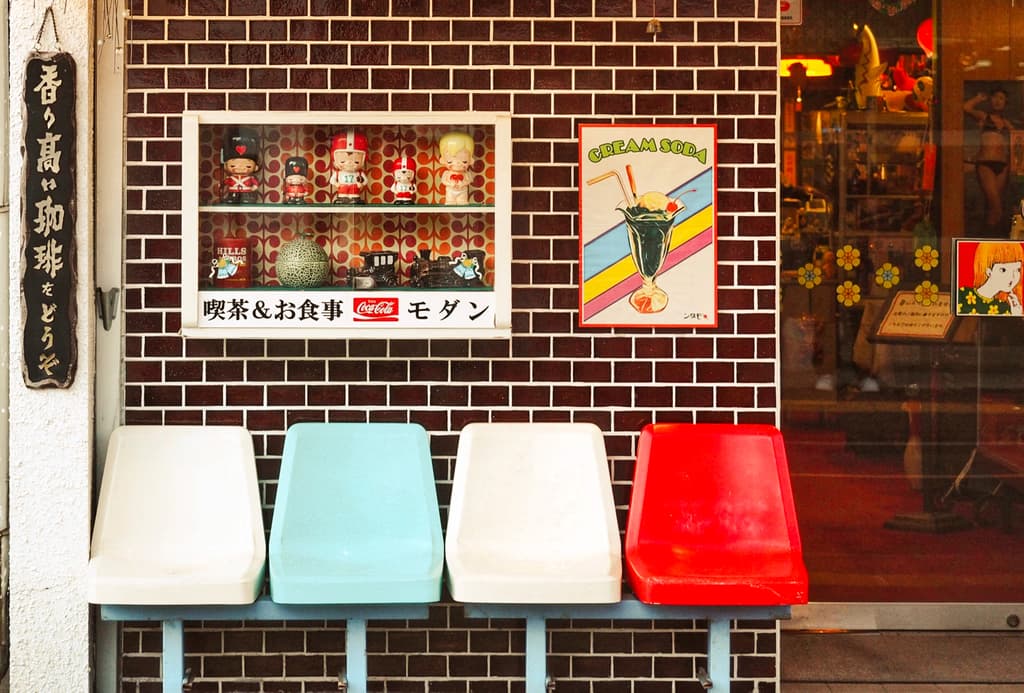
The academic institutions arrived in the Meiji era and have shaped everything since. The student infrastructure — the izakayas, the instrument shops, the used bookshops — grew around the campuses because that's what happens in working university towns. What makes Ochanomizu distinct is that none of it has been gentrified into something prettier for visitors. The cafes here serve coffee in the same ceramic cups they used in 1985. The lunch sets are priced for students on allowances, not tourists comparing Tabelog scores.
The Academic Layer
The area's educational identity starts with Yushima Seido (湯島聖堂), a Confucian academy established in 1632 and maintained through the Edo period as Japan's primary institution for classical Chinese scholarship. The current gate and the stone-paved approach through what is now a small garden area are surviving elements from that period. The Taisei-den, the main hall, is a striking dark-lacquered structure that was reconstructed in 1935 using reinforced concrete after the original was destroyed in the Great Kanto Earthquake. It remains one of the few Confucian temples in Japan built at this scale. When the shogunate ended and Japan began building a modern education system, Yushima Seido's institutional memory fed directly into what became the University of Tokyo, which was originally established here before moving to its current Hongo campus.
The modern campus cluster that defines Ochanomizu's character includes several institutions with significant histories:
Meiji University (明治大学), founded in 1881, is the most visible presence in Ochanomizu. The 1998 Liberty Tower — a 14-storey building that was considered a bold modernist statement when it opened — is the neighborhood's dominant visual landmark and a campus building that the university opened to the public with genuine intent. The Meiji University Museum (明治大学博物館), on the ground floor, houses a collection that reflects the university's range: legal history, political history, and since 2009, the Yonezawa Yoshihiro Memorial Library of Manga and Subculture — one of the first university-affiliated manga research libraries open to outside visitors.
Tokyo Medical and Dental University — now the Institute of Science Tokyo — has been in the area since 1928. It is one of Japan's most selective medical schools and its presence contributes to the high density of medical supply shops on the streets surrounding Ochanomizu Station. The white coat is as common a uniform around here as the student backpack.
Juntendo University, specializing in sports medicine, also has a major campus in the area. The sports equipment shops that cluster around the station exit are partly there because of Juntendo's student body.
The Student Economy
The infrastructure that surrounds the universities is the more immediately interesting layer. This is not the curated student area of a modern Western university campus. It is the result of over a century of student presence creating a market for everything a student needs that is also cheap enough for a student to afford.
The instrument shops along Meiji-dori between Ochanomizu Station and Surugadai-shita are one of those specific urban facts that you cannot find anywhere else in Tokyo or, in some cases, Japan. The stretch is sometimes called Guitar Street — over thirty shops selling new and used guitars, basses, drums, wind instruments, and traditional Japanese instruments like shamisen and koto. Some of these shops have been here for decades, run by families who know the difference between a 1970s Greco Les Paul copy and the Gibson it was modeled on, and can explain why the copy is sometimes the better instrument for a student's budget. The repair benches are visible from the street — you can watch a luthier re-fret a classical guitar or a technician adjusting the intonation on a bass. These are working workshops, not performance spaces. The clientele splits between university music students making their first serious purchase and professional musicians who know that Ochanomizu is where you go for specialist work.
The used bookshops that extend from Ochanomizu toward Jimbocho to the west specialize in academic texts, professional examination materials, and the kind of specialized reference books that students at Meiji or Juntendo need for specific courses. This is not the antiquarian book district that Jimbocho is better known for — this is the functional used book trade. The shops buy back textbooks at the end of each semester and resell them at roughly half the cover price. Medical texts, law casebooks, engineering references — the inventory rotates with the academic calendar, and the shopkeepers know which edition of which professor's textbook is currently required for which course.
The cram school strip along Meiji-dori is also part of the picture. Tokyo's most competitive exam prep culture is visible in the storefronts here. Sundai Preparatory School, Kawaijuku — the major juku chains have flagship locations in Ochanomizu because this is where the students already are. The windows display past success rates, the names of students who passed the medical or law school entrance exams, the teaching staff credentials. Some buildings are entirely occupied by prep schools, floor after floor, each dedicated to a different exam track. In March, the banners change to congratulate the year's successful candidates. It is a specific kind of institutional optimism rendered as urban signage.
The izakayas around Ochanomizu Station operate on student economics. Set meals under 800 yen at lunch, draft beer for 300 yen during happy hour, menus that haven't changed because no one asked them to. Grilled fish sets, katsu curry, ramen made the same way since the shop opened. Some of these places have been feeding students for thirty or forty years.
Nikolai Cathedral
The most visually arresting building in Ochanomizu is Nikolai Cathedral (ニコライ堂), formally the Holy Resurrection Cathedral. It is a Russian Orthodox church with a distinctive green-patinated Byzantine dome that rises above the surrounding campus buildings with enough presence to make you stop on the street. The original structure was designed by the Russian architect Mikhail Shchurupov and completed in 1891, making it one of the earliest examples of Byzantine Revival architecture in Japan. The bell tower, which survived the 1923 earthquake when much of the main structure did not, still rings for services. The cathedral was rebuilt and reconsecrated in 1929, with the architect Shimoda Kikutaro preserving the original Byzantine plan while reinforcing against future seismic events.
The cathedral is named for Nikolai Kasatkin, a Russian priest who arrived in Japan in 1861 and spent his career translating Orthodox liturgical texts into Japanese and building a congregation from scratch. The cathedral that bears his name is both a working church — services are held in Japanese — and a registered Important Cultural Property. Visitors can enter the main nave outside of service times. The interior, with its iconostasis and vaulted ceiling, is unlike anything else in this part of Tokyo.
Kanda Myojin Shrine
A seven-minute walk south from Ochanomizu Station, Kanda Myojin (神田明神) is one of Tokyo's great shrines, and it operates at a scale that most visitors do not expect to find this close to a train station. The shrine's history goes back to 730 AD, making it older than most of the institutions in this area by about a millennium. It was the tutelary shrine of Edo — the protector of the city — and its annual Kanda Matsuri is one of Tokyo's three great festivals, a massive procession that has been running since the early Edo period.
The current main hall dates from 1934 and was one of the first shrine buildings in Japan constructed with reinforced concrete — a pragmatic decision after the wooden predecessor was destroyed in the 1923 earthquake. The vermillion paint and copper roof look traditional, but the structure underneath was built to last in a way that wood could not.
What makes Kanda Myojin unusual for visitors is the range of its appeal. University students come to pray for exam success — the ema boards are covered with handwritten wishes from Meiji and Juntendo students every January and February. The shrine also has a following among IT professionals and Akihabara's tech community, owing to its proximity and the fact that one of its enshrined deities, Ebisu, is the patron of commerce. The omamori selection includes IT safety charms designed to protect against data loss and system failures. This is not ironic. The shrine sells thousands of them.
On the 5th and 6th of each month, the shrine grounds host a market with food vendors and craft stalls that draws a local crowd rather than a tourist one.
Jimbocho and the Book Connection
The walk from Ochanomizu Station to Jimbocho takes about five minutes heading west along Yasukuni-dori. The two districts are functionally continuous — the student bookshops of Ochanomizu blend into the antiquarian dealers of Jimbocho without any clear dividing line. But the character shifts. Ochanomizu sells what students need this semester. Jimbocho sells what collectors have been hunting for years.
Jimbocho is the largest used book district in the world — roughly 170 bookshops in an area of a few city blocks. The specialties range from Edo-period woodblock prints to postwar photography monographs to out-of-print manga to academic journals in French and German. Some shops deal exclusively in maps. Others in ukiyo-e. Others in military history. The annual Kanda Used Book Festival in late October takes over the sidewalks with outdoor stalls stretching for blocks. For visitors walking from Ochanomizu, Jimbocho is the natural continuation of the same intellectual infrastructure, just oriented toward collectors rather than students.
What to Do Here
The most immediately accessible site is the Meiji University Museum, sitting on the ground floor of the Liberty Tower. The collection spans legal history, political history, and the history of Meiji University itself, but the most talked-about section is the manga and subculture archive. This is not a casual collection — the Yonezawa Yoshihiro Memorial Library contains manga from the early postwar period and items that are genuinely difficult to access elsewhere. Whether you are a manga researcher or a casual visitor depends on your relationship with the medium, but as a public access archive attached to a major university, it is unusual enough to be worth noting.
Yushima Seido's grounds are free to enter. The approach through the gate and the remaining stone-paved areas are genuinely old — this is not reconstructed heritage. The compound is quiet on weekday mornings and the small garden attached to it is one of the more unexpectedly peaceful spots in this part of central Tokyo. The Taisei-den hall is open to visitors on weekends and national holidays.
The instrument shops are worth walking past even if you are not buying. Several have open workshops visible from the street. If you have any interest in how musical instruments are maintained and repaired — particularly traditional Japanese instruments, which require specialist knowledge — the cluster on Meiji-dori between Ochanomizu and Surugadai-shita is one of the most concentrated in Tokyo. On weekday afternoons, you can often hear someone testing a guitar in a back room, the sound leaking out through an open door.
For lunch, pick any of the student-oriented set meal shops within two blocks of the station. The quality is consistent because the clientele is local and repetitive — a shop that serves bad food to the same students five days a week does not survive. Look for places with handwritten daily menus in the window and a crowd of people in their twenties. If you are walking to Jimbocho afterward, take the route along Yasukuni-dori and allow at least an hour for the bookshops.
How to Get There
Ochanomizu is one of the better-connected stations in central Tokyo for a neighborhood that most tourists skip:
- JR Chuo Line and Sobu Line: Ochanomizu Station — direct to Shinjuku (10 min), Tokyo Station (3 min)
- Tokyo Metro Marunouchi Line: Ochanomizu Station — direct to Tokyo Station (5 min), Ginza (15 min)
- Tokyo Metro Chiyoda Line: Shin-Ochanomizu Station — connects to Otemachi, Omotesando, and Meiji-jingumae
- Yushima Station (northern approach to Yushima Seido) — on the Chiyoda Line
The walk from Ochanomizu Station to Jimbocho's book district is approximately five minutes west. The walk to Kanda Myojin Shrine is approximately seven minutes south. The distance to Akihabara is approximately fifteen minutes on foot.
Frequently Asked Questions
Is Ochanomizu interesting for visitors? For visitors who want to understand how Tokyo's institutional infrastructure actually works — how the university campuses fit into the urban fabric, how student economies create specific commercial districts — yes. The Meiji University Museum, Kanda Myojin Shrine, and Nikolai Cathedral are each worth a dedicated stop. The instrument shops and the walk to Jimbocho add texture. For visitors looking primarily for scenic streets or high-end food, this is not the neighborhood. Ochanomizu rewards curiosity about systems more than it rewards a camera.
Can I visit the Meiji University Museum? Yes, it is open to the public and free of charge. The museum is on the ground floor of the Liberty Tower and is open Tuesday through Sunday, 10:00 to 17:00. The manga collection in the Yonezawa Yoshihiro Memorial Library may require prior registration for access to the full archive — check the museum website before visiting. The permanent collection can be seen without reservation.
What is the difference between Ochanomizu and Jimbocho? Jimbocho is immediately west of Ochanomizu and is famous for used bookshops — though Jimbocho's specialty is antiquarian, rare, and specialty books rather than academic course materials. Ochanomizu is the university campus area; Jimbocho is the book district that serves it and also draws book collectors from across Japan. In practice, the two overlap — start at Ochanomizu Station, walk the instrument shops and campuses, then continue west into Jimbocho for the bookshops.
Can I enter Nikolai Cathedral? Yes. The cathedral is open to visitors outside of service times, typically Tuesday through Saturday from 13:00 to 15:30. A small donation (300 yen) is requested at the entrance. Photography of the interior is not permitted during services. The iconostasis and vaulted ceiling are worth seeing — this is the only major Byzantine Revival church interior in Tokyo.
When is the best time to visit? Weekday afternoons give you the clearest picture — the izakayas are open, the instrument shops are operating, and the student foot traffic gives the area its actual character. Weekend evenings can be quieter as students return to their home cities. Combining Ochanomizu with Jimbocho works best on weekday afternoons when both districts are at their most active.
At Hinomaru One, we build private Tokyo days around the city's institutional infrastructure — including the university quarters and the neighborhoods that grew up around them. Ordinary Tokyo covers Ochanomizu as part of the shitamachi and institutional Tokyo that most tours don't reach.