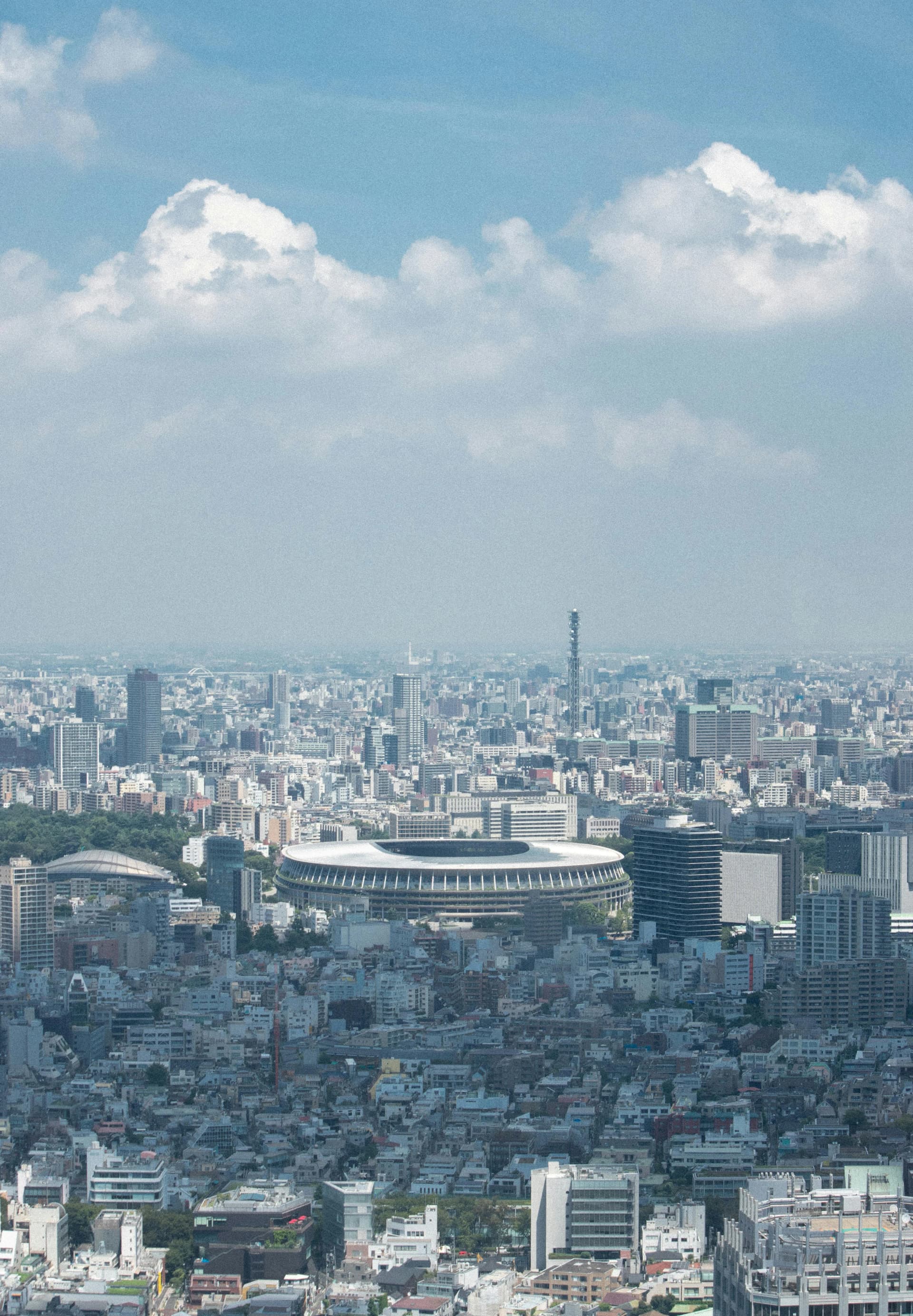
Yoyogi is not a place you pass through on the way to Meiji Shrine. It is one of the most historically layered neighborhoods in central Tokyo, and the layers are visible in the physical fabric of the streets.
Yoyogi, Tokyo, is the neighborhood most visitors walk through without noticing. The Meiji Shrine approach takes you from the edge of Harajuku into what feels like forest, and by the time you reach the shrine you've forgotten that Yoyogi Station is just over there, that the JR tracks run north to south through the area, and that the streets around the station are some of the most tangled urban geography in central Tokyo.
It's worth knowing how they got that way. The same piece of land has been an Imperial Army drill ground, then an American military housing compound for eighteen years, then the 1964 Olympic athlete village. After that, four major institutions went up on the returned land at once: Yoyogi Park, the NHK Broadcasting Center, Kenzo Tange's stadium and the Olympic Memorial Youth Center. None of these layers fully wiped out the one before, so in a single afternoon you can trace eighty years of Tokyo's dealings with the outside world.
The Washington Heights Layer
In December 1945 the US military requisitioned the former Imperial Army drill ground on the ridge between Shibuya and the old Yoyogi village. By 1946 they had built Washington Heights, a self-contained American town of 827 housing units for US Air Force personnel and their families, covering 924,000 square meters. It had schools, churches, a theater, shops and an officers' club, all behind a fence that cut it off from the Japanese city around it, and Japanese civilians were mostly kept out.
Few places in the immediate postwar years showed a sharper contrast. Inside the fence it was Sunday afternoons, American food and American infrastructure, while outside, the bombed city was still rebuilding.
Japan got the compound back in stages, and the final transfer was completed on August 12, 1964, weeks before the Tokyo Olympics opened. That was deliberate. Japan paid the full cost of moving the American forces to a replacement facility at Chofu precisely so it could reclaim the land for the Games. The athlete village went up on the Washington Heights site, and after the Olympics the land was turned over to its current uses.
One original Washington Heights building still stands inside Yoyogi Park, near the Harajuku entrance: a small Dutch-style bungalow that Dutch athletes used during the 1964 Games. No sign explains it, and most people walk past without knowing what it is.
The compound left a less obvious mark as well. Johnny Kitagawa, who founded Johnny's Entertainment (now STARTO Entertainment), the agency behind SMAP, Arashi, KinKi Kids and really the whole Japanese male idol industry, lived at Washington Heights while working for the US Embassy. He ran a boys' baseball team on the compound's grounds, recruiting from nearby Yoyogi Junior High School, and after seeing West Side Story at the Washington Heights theater he decided to move into entertainment. The first Johnnys group formed in 1962. The place where the Japanese idol industry started is now a public park.
The 1964 Stadium
The National Yoyogi Stadium (国立代々木競技場), designed by Kenzo Tange and finished in 1964, is the architectural centerpiece of the area and one of the most admired pieces of Olympic architecture anywhere. Its suspension roof was the first of its kind. Two main columns forty meters high stand 126 meters apart, joined by a main cable thirty-three centimeters thick that weighs 250 tons, and steel wire ropes fan out sideways from it to form the roof. The building manages to look both weightless and enormous.
In 2021 the First and Second Gymnasiums were both designated National Important Cultural Properties, Japan's highest domestic heritage status for architecture. A campaign to nominate the building as a UNESCO World Heritage Site has the backing of architects Fumihiko Maki and Kengo Kuma, and international symposia have been held at the University of Tokyo. As of 2026 it's still at the campaign stage and not yet listed, but there's a formal association behind it (国立代々木競技場世界遺産登録推進協議会) along with institutional support.
Kengo Kuma has said publicly that he swam in the First Gymnasium's pool as a child and was so taken with the light sparkling through the high windows onto the water that he decided to become an architect. He went on to design the new National Stadium for the 2020 Olympics, so Tange's building on this one piece of land helped produce the architect of the next Olympic stadium.
The stadium is still a working venue for sport and concerts, with recent events ranging from K-1 martial arts to volleyball and J-pop. It isn't normally open for tours, but walk around the outside to the west side, where the suspension cables show best, and the roof profile alone is worth the detour.
The Park
Yoyogi Park (代々木公園) covers 54 hectares between JR Yoyogi Station and the Meiji Shrine entrance. That makes it the fifth-largest park in Tokyo's 23 wards, about eleven Tokyo Domes. Because the land had been cleared and kept up continuously, first as military grounds and then as the American compound, it wasn't wasteland when it became a park in 1967, and much of the tree cover was already there. That's partly why the park feels older than its 1967 date.
A stone monument in the park marks the site of Japan's first powered airplane flight, on December 19, 1910. Hardly anyone knows it's there.
The park has two zones. The northern A Zone is the open lawn, fountains and wooded paths most visitors see, and it soaks up the overflow from Harajuku and Shibuya on warm afternoons. The southern B Zone runs an almost constant rotation of cultural events and food markets: Namaste India in September, the Africa Heritage Festival in June, Caribbean and Latin America Street in October. Most are free. On weekend afternoons the park does what a city park should, giving people somewhere to be outside when the streets around it feel too crowded to breathe.
The International Layer
Yoyogi-Uehara, the residential area south of Yoyogi Park, feels international the moment you walk its streets. The embassies of Bulgaria, Vietnam and Côte d'Ivoire are here. The wider streets, bigger plots and designer houses go back to land ownership patterns from the Tokugawa era and to the extension of the Odakyu Line in 1927.
The most striking building is the Tokyo Camii (東京ジャーミイ), Japan's largest mosque and a Turkish cultural center, five minutes on foot from Yoyogi-Uehara Station. It was completed in 2000 in strict Ottoman style, and apart from water and concrete, every building material was imported from Turkey. Seeing the dome and minarets rise between low Tokyo houses is genuinely startling.
The mosque is open to visitors daily from 10:00 to 18:00, except Fridays, when it opens from 14:30 only because of Friday prayers. Entry is free and you don't need a reservation. Free guided tours run every Saturday and Sunday at 14:30 and cover the building's history, Islamic art and the religion itself. Keep in mind that it's a working place of worship.
Within five hundred meters of the mosque, these quiet residential streets hold more Michelin-starred French restaurants than you'd expect: La Façon Koga, which has held Michelin stars for five consecutive years, and emuN, with one star since 2017. Ottoman architecture and French fine dining in a Japanese residential backstreet is worth coming here on purpose for.
How to Get There
- JR Yamanote Line: Yoyogi Station, between Shibuya (3 min) and Shinjuku (4 min). For Yoyogi Park and the stadium.
- Tokyo Metro Chiyoda Line / Odakyu Line: Yoyogi-Uehara Station, for the mosque, the residential area and the French restaurants.
- Tokyo Metro Ginza Line: Gaienmae Station, for the neighboring Meiji Jingu Gaien area.
- JR Yamanote Line: Harajuku Station, for the Meiji Shrine approach and the southern entrance to Yoyogi Park.
Frequently Asked Questions
How much time should I plan for Yoyogi? If you want to see Yoyogi as a neighborhood and not just pass between Shibuya and Meiji Shrine, plan a proper stop. The walk from Yoyogi Station through the park to the Meiji Shrine gate is ten to fifteen minutes. Give the mosque thirty to forty-five minutes, and the same again to walk the residential streets of Yoyogi-Uehara properly. All of it together is a half-day.
Is Yoyogi Park busy on weekends? Yes, especially on Saturday and Sunday afternoons. Locals love the park, so it gets genuinely crowded in good weather. For a quiet walk up the Meiji Shrine approach, go on a weekday morning, when there are far fewer people.
Can I visit the Tokyo Camii even if I'm not Muslim? Yes. The mosque explicitly welcomes visitors of every faith. Entry is free and needs no reservation, and the weekend guided tours at 14:30 are designed for non-Muslim visitors, covering the building, the art and the basics of Islam.
Is the Kenzo Tange stadium open to visitors? It's a working event venue, so you can only go inside with a ticket to an event. Walking around the outside, especially on the west side where the suspension cables show best, still gives you a clear view of the roof that made it famous.
Where is the Japan Folk Crafts Museum I've read about? The Japan Folk Crafts Museum (日本民藝館), founded by Yanagi Muneyoshi as the home of the mingei movement, is in Komaba, which is a separate neighborhood from Yoyogi. The nearest station is Komaba-Todaimae on the Keio Inokashira Line, and you can get there from Yoyogi-Uehara by bus. It's open 10:00 to 17:00, closed Mondays, and admission is ¥1,200.
At Hinomaru One, we build Tokyo days around neighborhoods like Yoyogi, where the history is easy to read once you know what you're looking at. Ordinary Tokyo includes the west Shibuya route linking Yoyogi to the Meiji Shrine approach, Harajuku and the area around them. Infinite Tokyo is a fully custom itinerary that can center on architecture, religious spaces, or the layered history you'll only find in Yoyogi.