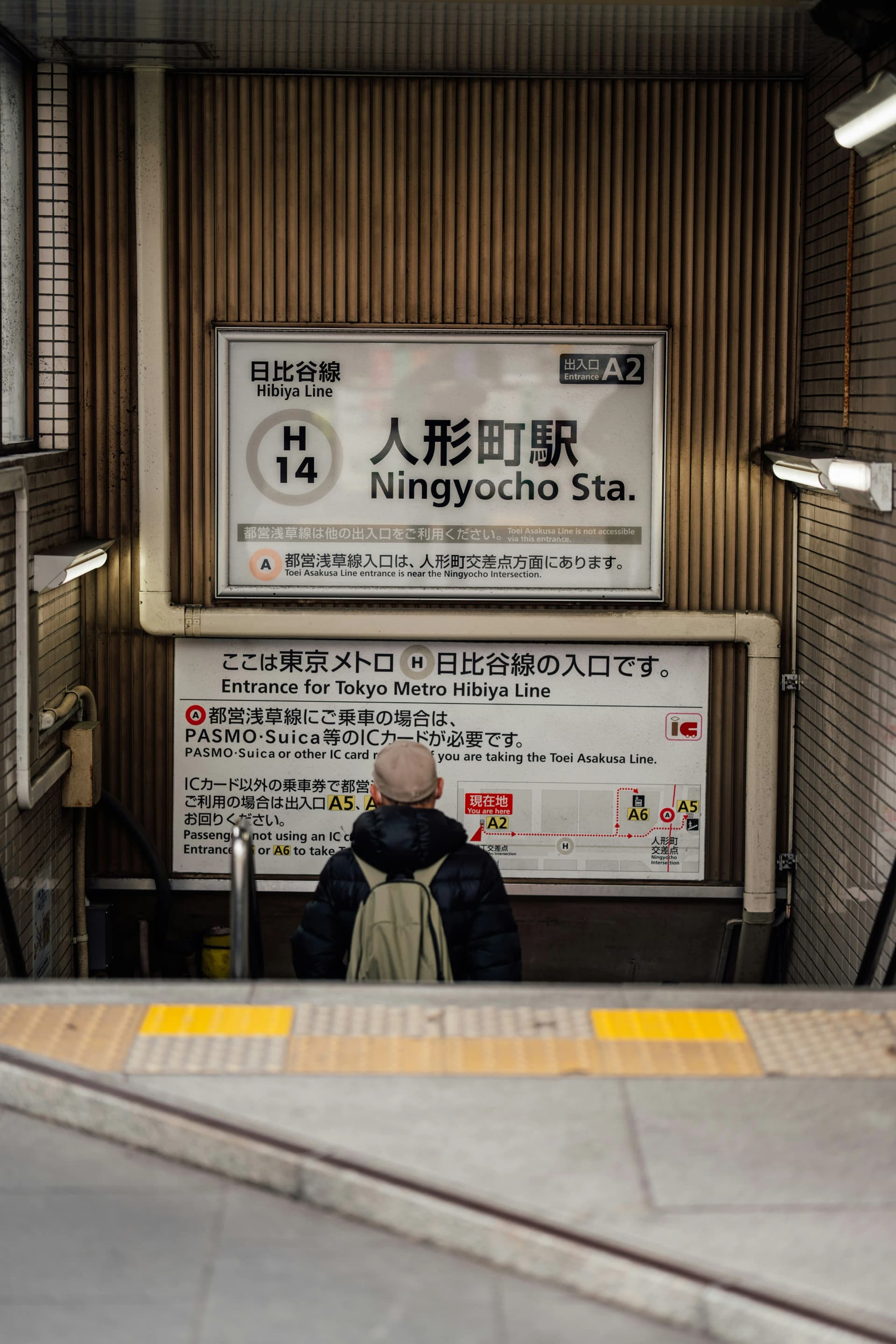
Ningyocho is the part of old Tokyo that survived in place. It has the history of Asakusa without the crowds.
Ningyocho means Doll Town. That much is in the English translation. What the translation doesn't immediately communicate is how literally the name was taken for roughly 300 years, or how recently the neighborhood changed character. Ningyocho as a doll district is essentially over — the entertainment industry that sustained it decamped for Asakusa in the mid-19th century. But the physical memory of the place is still legible if you know what you're looking at, and the neighborhood that replaced the doll industry has its own coherent identity: a shitamachi commercial district with a nine-day market cycle, a century-old sweet shop at the end of a narrow alley, and a shrine that draws more worshippers on the 5th of each month than most tourists will see in a year.
What It Was: 1590 to 1868
Ningyocho's founding story starts with Tokugawa Ieyasu and a marsh. When Ieyasu arrived in Edo in 1590, the area east of the castle plateau was low-lying tidal flats. He had it filled. The resulting land — what is now central Tokyo's eastern flat — became the commercial and residential base for the new city's merchants, craftsmen, and laborers. This is the shitamachi (下町) origin: the low city below the castle, as opposed to the samurai residences on the plateau above.
By 1624, Ningyocho had its first kabuki theater. Saruwaka Kanzaburo arrived from Kyoto and opened the Saruwaka-za — later the Nakamura-za — in what is now Ningyocho 3-chome. This was not a fringe event. It was the beginning of kabuki as an Edo art form. The neighboring playhouse, the Ichimura-za, opened soon after, and by mid-century Ningyocho had become the entertainment center of the entire city. The streets surrounding the theaters filled with teahouses that served audiences before and after performances, puppet workshops where ningyo joruri (人形浄瑠璃) artisans built the jointed wooden figures used in bunraku, and doll makers who supplied the broader market for decorative and seasonal figures. The puppet culture and the kabuki culture fed each other directly — joruri puppet plays were adapted for kabuki staging, and kabuki actors' likenesses were turned into collectible dolls sold from the shops along the main street.
What the neighborhood felt like in its peak era is recoverable from Edo-period woodblock prints and merchant records: a compressed district of wooden storefronts, narrow enough that the upper floors on opposite sides of the street nearly touched, filled with shamisen from the teahouses and the calls of street vendors selling seasonal dolls — hina dolls in March for Girls' Day, musha ningyo warrior dolls in May for Boys' Day, handballs in January. The rhythm of the neighborhood was set by the entertainment calendar and the religious festival cycle, both generating demand for dolls, decorations, and the craftsmen who made them.
In the mid-19th century, the Meiji government decided that entertainment should consolidate in Asakusa. The kabuki theaters relocated. The puppet shows moved. But the doll makers and the craftsmen largely stayed, because their customer base — the ordinary residents of the shitamachi — hadn't gone anywhere. That split is what created the Ningyocho you walk into now: a neighborhood with the institutional memory of an entertainment district and the daily rhythms of a working-class commercial street.
What It Is Now
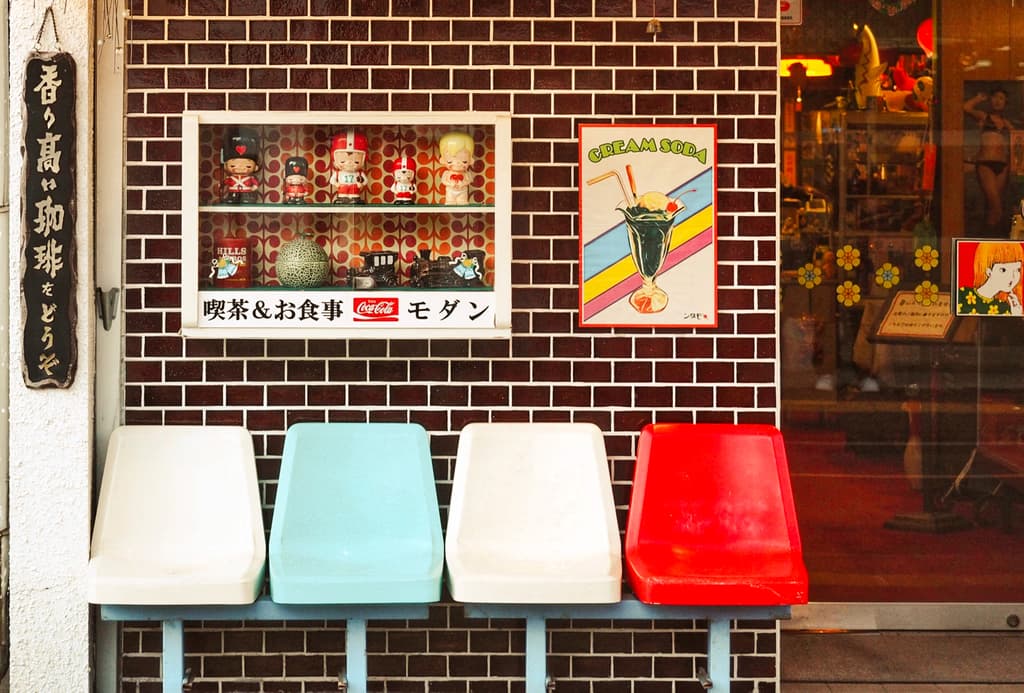
Walking into Ningyocho from Ningyocho Station (Hibiya Line or Toei Asakusa Line), you arrive in a neighborhood that has absorbed several centuries of identity layers without fully shedding any of them. The streets are narrow by central Tokyo standards — the kind where a delivery truck requires negotiation. The buildings are a mix of 3-storey walkups from the 1960s and 70s, older wooden commercial buildings with living quarters above the shop, and the occasional glass-fronted office building serving the Nihonbashi financial district to the north. The scale is human-sized in a way that most of central Tokyo no longer is.
The Amazake Yokocho alley (甘酒横丁) — named after the amazake (sweet fermented rice drink) shop that gave the street its identity — is the neighborhood's most legible surviving element. It runs roughly south from Ningyocho Station toward the Meiji-za theater, approximately 400 meters of unbroken small-scale retail. In the morning, the tofu shop near the north end is already working — you can smell the warm soy before you see the storefront. The tsukudani specialist two doors down sells preserved seafood simmered in soy and mirin using techniques unchanged since the Edo period; the display cases are small glass-fronted cabinets that look like they were installed in the 1970s and never replaced, because the product doesn't require presentation. Farther south, a yakitori place that doesn't take reservations runs a charcoal grill that starts sending smoke into the alley around 4:30pm. The street is narrow enough that two people walking toward each other need to manage it carefully.
At midday on a weekday, Amazake Yokocho is mostly locals — older women shopping for dinner, office workers from Nihonbashi cutting through on their lunch break, the occasional delivery scooter threading between pedestrians. By 5pm the character shifts: the drinking establishments open their sliding doors, the smell of charcoal replaces the smell of tofu, and the foot traffic becomes younger and more purposeful. On weekends, the alley is busier but not crowded — families doing the Seven Lucky Gods pilgrimage pass through, and the sweet shops see a steady stream of buyers. It never reaches anything resembling the density of Nakamise-dori in Asakusa or Takeshita-dori in Harajuku. The alley operates at a pace that assumes its customers will return next week.
Ningyo-yaki
Ningyo-yaki (人形焼) — the small cast-iron griddle cakes shaped like dolls, filled with sweet red bean paste — are the neighborhood's signature sweet and essentially its edible souvenir. The cakes are baked in heavy iron molds that press the dough into shapes of the Seven Lucky Gods, dolls, or local landmarks. The batter is a simple wheat-and-egg mixture, thin enough to crisp at the edges but soft in the center, and the anko filling is smooth-ground koshian rather than the coarser tsubuan you get in cheaper versions elsewhere.
The best ningyo-yaki in Ningyocho come from the stands along Amazake Yokocho and the shops near the station entrance. Several have been operating for three or four generations. You can watch them being made — the baker pours batter into the mold, adds a measure of anko with a small ladle, closes the iron press, and flips it over a gas burner. The whole process takes about two minutes per batch. The ones you eat warm from the mold are meaningfully better than the boxed versions sold at Tokyo Station or department store food halls, because the crust is still slightly crisp and the filling is still soft. A bag of five or six costs around ¥300-400. They are not a gourmet product. They are a neighborhood product made properly, which in this context amounts to the same thing.
Suitengu Shrine
The most practically significant site in contemporary Ningyocho is Suitengu Shrine (水天宮) — one of the most important shrines in Tokyo for matters of childbirth and family protection. The shrine moved to its current location in 1872, when the feudal estates that had surrounded it were reorganized. Its earlier location had been within the Arima clan's estate at Kiba no Watashi (木場の渡し), a ferry crossing on the Sumida River — and before that, the shrine's origins trace to Kurume in Kyushu, where the deity Ame no Minakanushi no Kami was enshrined as a protector of those who worked on the water.
The connection to safe childbirth is the reason most visitors come, and the shrine's architecture reflects this function with unusual specificity. The main hall, rebuilt in 2016 on an elevated platform, is surrounded by prayer stations organized around the stages of pregnancy and early childhood. Expectant mothers purchase a sarashi obi (腹帯) — a long strip of white cotton blessed at the shrine and wrapped around the abdomen during pregnancy, traditionally from the fifth month. The komainu (guardian dog statues) at the entrance are flanked by bronze sculptures of a mother dog with puppies, and worshippers rub the heads of the puppy figures while praying for easy delivery. The connection to dogs is specific: in Japanese folk belief, dogs give birth easily and in litters, making them symbols of safe and abundant childbirth.
The shrine's ema (絵馬, wooden prayer plaques) are distinctive — many carry wishes for safe delivery written in careful handwriting, often with specific due dates. The suzu (鈴), small bells attached to cloth cords, hang from the shrine's gate and accumulate over time as worshippers tie them as prayers. The resulting visual effect is a dense curtain of bells and fabric that gives the gate a textile quality you don't find at shrines maintained for aesthetic consistency.
On the 5th of each month, the shrine holds an ennichi (縁日, open-air market day), which draws large crowds of worshippers and vendors. On the 5th and on the Day of the Dog in the Chinese zodiac calendar (the inu no hi, 戌の日, traditionally associated with safe delivery), the shrine is at maximum density — women in their fifth month of pregnancy come specifically on this day to receive the obi and pray. The queue on a popular inu no hi can stretch outside the shrine grounds and down the block.
This is the part of Ningyocho that most English-language guides undersell: Suitengu is not a scenic shrine. It's a functioning place of worship with a specific community of regulars who come for practical spiritual needs rather than heritage appreciation. That makes it more interesting, not less.
The Markets and the Seven Lucky Gods
Ningyocho runs a rotating cycle of specialist markets. The three most notable are the Setomono-ichi (せともの市, ceramics market), the Ningyo-ichi (人形市, doll and craft market), and the Bettara-ichi (べったら市, pickled vegetable and sake market). These are not the kind of tourist markets that have appeared in every major city in Asia. They are local commercial events, and the vendors are there because the customers are there — buying in quantity, knowing what they want, not looking for something to take a photograph of.
The Shichifukujin Meguri (七福神巡り) — the Seven Lucky Gods pilgrimage through Ningyocho and the surrounding Nihonbashi area — is a walking route that visits seven shrines and temples, each dedicated to one of the seven deities of good fortune. The route begins at Koami Shrine (小網神社, Fukurokuju and Benzaiten) and proceeds through Chanoki Shrine (茶ノ木神社, Hotei), Suitengu (Benzaiten), Matsushima Shrine (松島神社, Daikokuten), Suehiro Shrine (末廣神社, Bishamonten), Kasama Inari Shrine (笠間稲荷神社, Jurojin), and椙森神社 (Ebisu). The total distance is roughly 2 kilometers, and walking time including brief stops at each shrine is about 90 minutes to 2 hours.
What makes this particular pilgrimage accessible is the compression of the route. Unlike the Yanaka Seven Lucky Gods course, which spreads across a larger area, the Ningyocho route stays within a tight radius where every shrine is visible from the approach to the next one. The shrines themselves are small — neighborhood-scale, tucked between buildings, with a single torii gate and a compact prayer area. At each stop, pilgrims collect a stamp (朱印) in a dedicated booklet purchased at the first shrine for ¥300. Completing the circuit with all seven stamps is the practical goal, and the booklet becomes the souvenir. The route is popular with retired locals and Japanese domestic tourists, which means you'll see people actually doing it rather than just signs explaining how to do it. During New Year's (roughly January 1-7), the pilgrimage is at its busiest, and the shrines set up temporary stamp stations to handle the volume.
How to Get There
Ningyocho sits in the gap between Nihonbashi and the edge of the old shitamachi, close enough to the business district that it has good transport connections and far enough from the main tourist flows that it rarely experiences foot traffic pressure.
Tokyo Metro Hibiya Line: Ningyocho Station (H13) — direct to Ginza (8 min), Roppongi (16 min). Toei Asakusa Line: Ningyocho Station (A14) — direct to Asakusa (6 min), Nihonbashi (3 min). JR Sobu Line: Bakurocho Station or Asakusabashi Station (5-7 min walk).
From Tokyo Station: approximately 10 minutes by metro. From Haneda: approximately 40 minutes. From Narita: approximately 60 minutes.
The walk from Ningyocho to Nihonbashi is approximately 10 minutes north. The walk to the Sumida River and Asakusa is approximately 15 minutes northeast. This makes Ningyocho a natural stopping point on a route that connects Ginza, Nihonbashi, and Asakusa without being on any of the obvious tourist paths between them.
Frequently Asked Questions
Is Ningyocho touristy?
No — it's one of the less-visited neighborhoods in central Tokyo by international tourists. The visitors it does attract are primarily Japanese tourists doing the Seven Lucky Gods pilgrimage or worshippers at Suitengu Shrine. The commercial streets along Amazake Yokocho operate for local residents, and the shops stock accordingly: daily groceries, tsukudani, household goods. There are no souvenir shops. The ningyo-yaki stands are the closest thing, and even those exist because locals buy them as gifts when visiting family, not because tourists are expected.
What's the best time to visit?
Weekday afternoons between 2pm and 5pm give you the clearest picture of the neighborhood as a functioning commercial district — the lunch rush is over, the shops are open, and the evening drinking crowd hasn't arrived. The 5th of each month brings Suitengu's ennichi market day, which adds energy and vendors to the shrine area. If the 5th falls on an inu no hi (Day of the Dog), expect larger crowds. The morning markets along Amazake Yokocho start early and sell out of popular items by midday.
Is Suitengu Shrine worth visiting?
For visitors interested in how Tokyo actually functions as a lived city rather than a heritage site: yes. It's not architecturally dramatic. But the accumulated prayer objects, the specific purpose of each station within the grounds, and the steady flow of worshippers give it a presence that most shrine tourism doesn't capture. On an inu no hi, the concentration of expectant mothers and young families makes the shrine's social function impossible to miss.
Should I combine Ningyocho with Nihonbashi?
Yes — the walk between them is 10 minutes and passes through an area that is genuinely commercial rather than arranged for anyone's experience. Nihonbashi has the covered shopping streets and the department stores. Ningyocho has the alley with the sweet shop that has been there for 80 years. The contrast — corporate Nihonbashi and shitamachi Ningyocho — is one of the more legible examples of how Tokyo's neighborhoods change character completely within a single metro stop.
How long should I spend in Ningyocho?
Two to three hours is enough to walk Amazake Yokocho, visit Suitengu Shrine, eat ningyo-yaki, and complete the Seven Lucky Gods pilgrimage at a steady pace. If you want to eat at the yakitori place or one of the small restaurants along the alley, add another hour — some have limited seating and you may need to wait. The neighborhood rewards a slow pace more than a checklist approach.
At Hinomaru One, we build private Tokyo days around the texture that the guidebooks miss. Ningyocho is a case study in a neighborhood that absorbed its history rather than performing it. If you want to understand how Tokyo's old commercial districts actually function — not as heritage, but as living commerce — Ordinary Tokyo includes the shitamachi neighborhoods that most tours skip.