Discover the hidden role of the camellia in Tokyo tea ceremony practice and how to read its seasonal and aesthetic cues.
Discover the hidden role of the camellia in Tokyo tea ceremony practice and how to read its seasonal and aesthetic cues.
For a first-time visitor in Tokyo, stepping into a Japanese tea room can present an immediate, quiet challenge: the single flower in the alcove. Often a camellia (tsubaki), its placement is deliberate, yet its purpose is not immediately clear. What visitors often underestimate is that this is not decoration. It is the thematic focal point of the gathering, chosen by the host to convey a specific, unspoken message about the season and the occasion.
The friction for many visitors begins here. Navigating to a traditional tea house, often located in residential areas like Mejiro with minimal English signage, is a logistical hurdle. Once inside, the etiquette of when and how to observe the flower can cause anxiety. This is where plans for a meaningful cultural experience often meet the practical realities of Tokyo; the quiet, seasonal rhythms that guide the host's choice are easily missed amid the city's intensity.
For a complete guide to tea ceremony experiences in Tokyo — venues, prices, and what to expect — see our Tokyo tea ceremony guide.
The Camellia's Role At A Glance
| Aspect | Significance in Tea Ceremony |
|---|---|
| Seasonal Anchor | The camellia is the quintessential flower for the colder months, its bloom signalling the heart of winter and the promise of early spring. |
| Philosophical Symbol | It represents concepts like purity, humility, and the transient beauty of life (mono no aware). Its sudden, whole dropping of the flower is particularly poignant. |
| Focal Point | Placed in the tokonoma (alcove), it is the primary visual and thematic focus for guests upon entering the tea room, setting the tone for the entire gathering. |
| Host's Message | The specific variety, whether it's a bud or in full bloom, and even the vase it's in, are all chosen by the host to convey a personal message of hospitality. |
| Connection to Tea | Both the tea plant (Camellia sinensis) and the ornamental camellia (Camellia japonica) are from the same family, creating a deep, intrinsic link. |
Each element is a quiet layer of meaning, turning a simple flower into a profound statement.
Common Misunderstandings About the Camellia
A few assumptions often prevent visitors from understanding the camellia's function in the tea room.
Misconception: The flower is merely a decorative touch. Tokyo Reality: It is the spiritual and visual centerpiece of the tokonoma (alcove), chosen to communicate the theme of the gathering. The host selects a specific variety, bud stage, and vase to express a message. This is often misunderstood by visitors accustomed to grand floral arrangements, leading them to overlook its significance.
Misconception: Any beautiful flower could be used. Tokyo Reality: The choice is strictly seasonal. The camellia is the signature flower of winter and early spring ceremonies, a direct reflection of the natural world outside. Using a summer flower in February would be a fundamental error in judgment.
Misconception: Its meaning is straightforward. Tokyo Reality: The symbolism is nuanced, touching on purity, humility, and the fleeting nature of life. The connection is deepened by knowing what matcha is made of—the leaves of Camellia sinensis, the tea plant itself.
Misconception: A perfect, fully bloomed flower is the ideal. Tokyo Reality: A tight bud or a partially opened flower is often preferred. It represents potential and transience, embodying the wabi-sabi aesthetic. A flawless, full bloom can signify a peak that has passed, a less desirable state. Families with young children, often seeking clear visual cues, may find this subtlety particularly hard to interpret.
The camellia isn't just in the tea room; it is a quiet summary of the season, the host's intent, and the unrepeatable moment of the gathering.
The Camellia and the Art of Chabana
The single tea ceremony camellia is an expression of an art form called Chabana (茶花), or "tea flowers." This is where a common misunderstanding arises for visitors, who often confuse Chabana with its more famous cousin, Ikebana. This distinction is critical to reading the atmosphere of the tea room correctly.
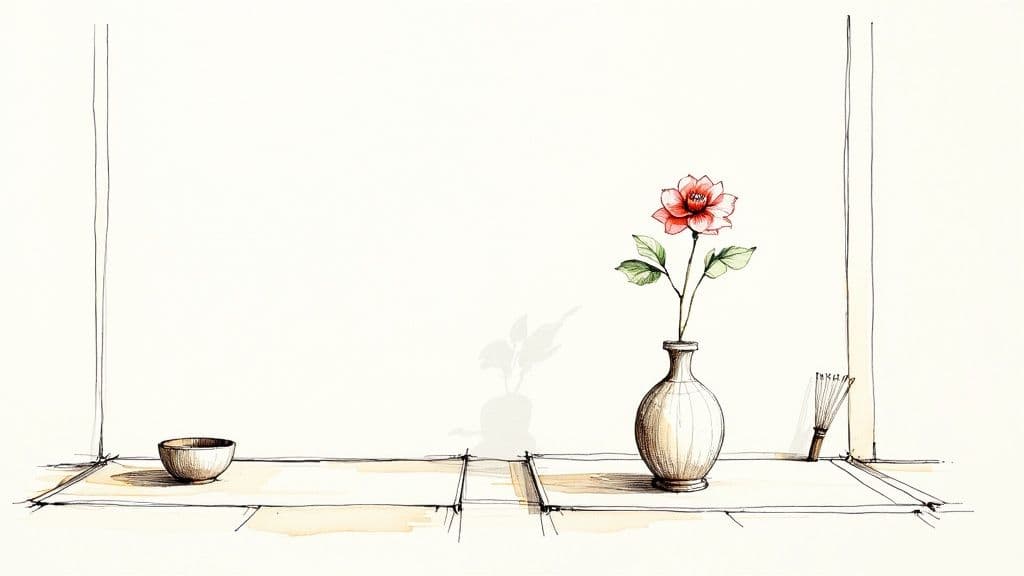
Ikebana is a structured, often sculptural art of floral arrangement. Chabana has a different, subtler purpose. Imagine entering a tea house in a quiet part of Kagurazaka and finding not an elaborate display, but a single, half-opened camellia bud in a simple bamboo vase. For visitors expecting a "floral masterpiece," the initial reaction can be one of quiet confusion.
The Simplicity of Sen no Rikyū
The philosophy behind Chabana was refined by the 16th-century tea master, Sen no Rikyū. While the Japanese tea ceremony, chanoyu, has roots in the 9th century, Rikyū championed the wabi-sabi aesthetic—an appreciation for rustic simplicity and natural imperfection.
Chabana’s guiding principle is to present flowers as they would appear in the wild. This means no excessive trimming, no forcing of shapes, and an honest reflection of the current season.
This is where the expectation of a "beautiful arrangement" breaks down. The objective is not conventional beauty, but naturalness. The flower should evoke a dew-covered bloom on a mountain path, not a crafted object for a gallery.
A Focus on Natural Imperfection
The camellia is the key flower for Chabana, especially during winter. Its form—often a single bud or a partially opened flower—symbolizes transient beauty. A fully bloomed flower is often avoided as it represents a peak already reached.
A host may even intentionally select a camellia with an insect-bitten leaf. For a visitor accustomed to flawless floral displays, this can be puzzling. In the logic of Chabana, that "flaw" is a mark of authenticity—a reminder of the flower's real life in nature. This is particularly difficult for visitors focused on photography, as the aesthetic conflicts with the pursuit of a "perfect shot." The experience is about contemplating a fleeting moment, not admiring a static object.
Why the Camellia is the Flower of Winter Tea
The assumption that the flower in a tea room is chosen for aesthetic appeal alone is a significant misinterpretation, especially in winter. The tea ceremony camellia is not just a flower for the cold months; it is the flower, for reasons tied to the natural world.
The camellia’s most defining trait in this context is its resilience. It is one of the few flowers that blooms vibrantly during the coldest months, from late autumn through early spring. When most other plants are dormant, the camellia offers color and life. This is not just a botanical fact—it is a symbolic statement.
A Mirror to the Season
When a tea host in Tokyo chooses a camellia in February, it is an act of embracing the present moment. The flower embodies resilience, purity, and the quiet strength needed to endure the cold.
The choice of a winter-blooming camellia is a direct reflection of the wabi-sabi principle of finding beauty in nature as it is. The flower doesn't fight the season—it defines it.
This lack of seasonal context is a blind spot for many visitors, especially in a city like Tokyo where urban life obscures natural cycles. One might see a camellia in a quiet Yanaka tea house and appreciate its elegance, but miss the core message: that this bloom is in direct conversation with the chilly weather outside. For more on this season's atmosphere, see our guide to winter in Japan.
Common Misunderstandings About Seasonality
Misconception: The flower's color is the most important feature.
Tokyo Reality: The timing is more significant. A host selects a camellia because its presence in winter speaks to endurance and the promise of spring's return.
Misconception: Any flower that looks "Japanese" will do.
Tokyo Reality: Tea ceremony aesthetics are precise. Using a cherry blossom in January would be as out of place as serving a winter stew in August. The camellia is specifically the emblem of the cold months.
Misconception: It's a purely historical or traditional choice.
Tokyo Reality: While rooted in tradition, the choice is active and relevant. It connects the controlled environment of the tea room to the living world outside, grounding the ceremony in the immediate moment.
How to Appreciate the Camellia in a Tokyo Tea Room
 Knowing the symbolism is one thing; standing in a Tokyo tea room and knowing what to do is another. This is where theory meets practice, and where visitors often feel anxious about etiquette.
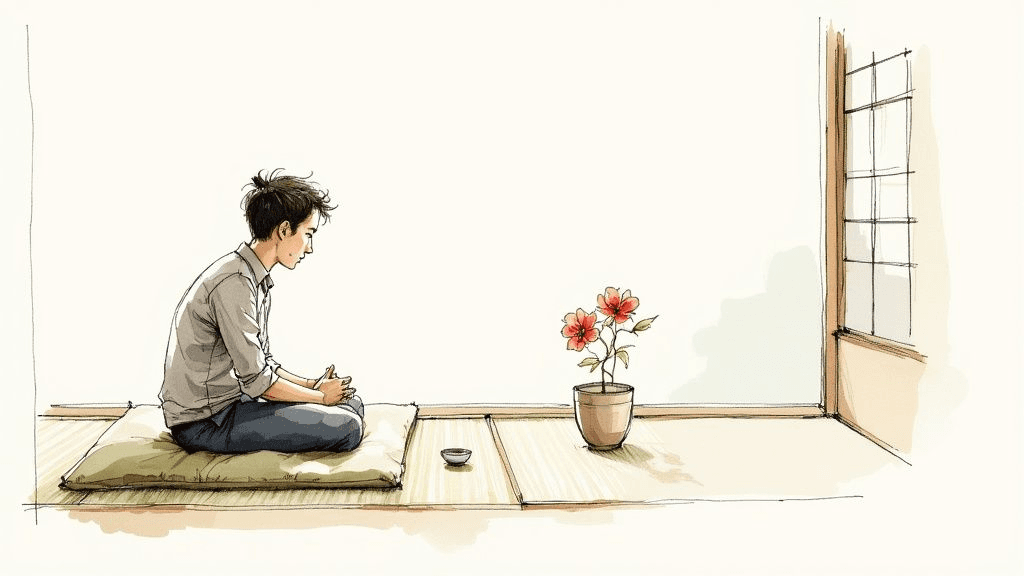
Upon entering a traditional tea room, or chashitsu, one should locate the tokonoma. This is a small, recessed alcove—the most honored space in the room. Here you will find the Chabana arrangement, often a single camellia with a calligraphy scroll. The first act as a guest, before taking a seat, is to quietly approach the tokonoma to appreciate what the host has prepared.
Observing with Restraint
This moment of observation is governed by etiquette. The proper way is quiet contemplation. Kneel respectfully a short distance from the tokonoma, bow your head slightly, and simply observe. You are meant to absorb its presence and feel the season and the host’s sentiment. Touching the flower or vase is forbidden. This can be challenging for visitors from more expressive cultures, where verbal praise is the primary mode of appreciation.
Recognising the Host's Intent
The specific type of camellia communicates another layer of meaning. For instance, a Wabisuke camellia—a small flower that never fully opens—is a direct nod to the wabi-sabi aesthetic. Seeing a Wabisuke indicates the host's focus on understated simplicity and inner spirit. Recognizing this subtle choice allows you to meet their intention with the right kind of appreciation.
Common Visitor Misconceptions About Chabana
| Common Misunderstanding | Tokyo Reality |
|---|---|
| "It's just a decoration, like flowers in a hotel lobby." | The Chabana is a central theme-setter for the entire gathering, reflecting the season and the host's heart. |
| "A bigger, more complex arrangement is better." | Simplicity is prized. A single, imperfect bud can be more profound than a large, flawless bouquet. |
| "I should say something nice about the flowers." | Silent, respectful observation is the highest compliment. Verbal praise can break the room's tranquillity. |
| "The flower is chosen for its beauty alone." | The choice is deeply symbolic, often referencing poetry, history, or a specific aesthetic like wabi-sabi. |
What most people don’t realise is that the observation of the camellia is part of the ceremony itself. It is not a prelude but an integral first step that sets the tone for everything that follows.
A visitor focused on the mechanics of whisking tea might rush past this crucial first step, missing the thematic foundation. Senior travelers, who often have a deep appreciation for tradition but may face mobility constraints, can find the physical etiquette of kneeling and approaching the tokonoma particularly challenging.
The Broader Context: Camellias in Japanese Gardens
To understand the tea ceremony camellia, one must see it outside the tea room, within the Japanese gardens that often contain tea houses. This is where the philosophy of the ceremony connects to the natural world.
The Garden as an Extension of the Tea Room
A Japanese garden is a landscape sculpted to evoke a specific mood or a slice of wild nature. When a tea house sits within a garden, the two are in constant conversation. The garden is the living source from which the Chabana (tea flower) is chosen.
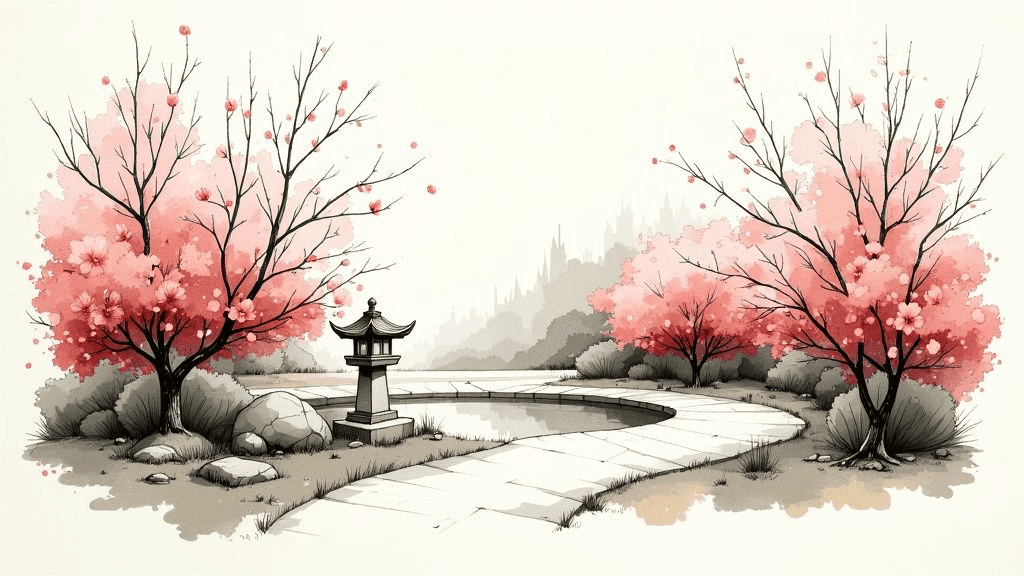 Seeing camellias growing in this planned environment clarifies why a particular bud was picked. The garden’s design—its use of stone, moss, and empty space—echoes the same values of simplicity found in the tea room. The Imperial Palace East Garden is one location where these design principles are visible. More information is in our Tokyo Imperial Palace visitor guide.
Where to See Camellias in Context
Certain Tokyo locations illustrate how camellias are woven into these landscapes. The gardens at the Nezu Museum in Omotesando are laid out like a winding mountain path. One encounters camellia bushes as one would in nature. It is a curated experience, not a botanical lineup. A walk through Mukojima-Hyakkaen Gardens, a historic flower garden, shows how different varieties are cultivated for their seasonal beauty.
What many visitors don't realise is that the garden path, or roji, leading to a tea house is the first stage of the ceremony. It is a deliberate transition from the outside world. Camellias are often planted along this path to guide the mind toward the quiet contemplation inside.
Observing camellias in their intended garden setting provides a richer context. For those interested in garden design, reviewing general tips for planning a garden can be a useful starting point. The single flower in the tokonoma is the distilled essence of the living world just outside.
Self-Serve Planning: A Realistic Approach
For those planning to attend a tea ceremony independently, focusing on risk management rather than optimization is a practical strategy.
Timing and Transport: Check train and subway schedules meticulously, including the time of the last train. Stations like Shinjuku or Shibuya are notoriously complex; identify your exit and walking route from the station to the venue in advance using a mapping app with satellite view. Allow at least 30 extra minutes for potential navigation errors.
Backup Options: Have a secondary plan. If you are unable to locate the reserved tea house or arrive late, know what other points of interest are in the area so the trip is not wasted.
Etiquette Preparation: Review the basic sequence of a tea ceremony beforehand. Understanding the flow—from observing the tokonoma to handling the tea bowl—reduces the anxiety of making a social error. The primary expectation is respectful, quiet observation.
By preparing for logistical friction points, you can create a buffer that allows for a more focused and less stressful cultural experience.