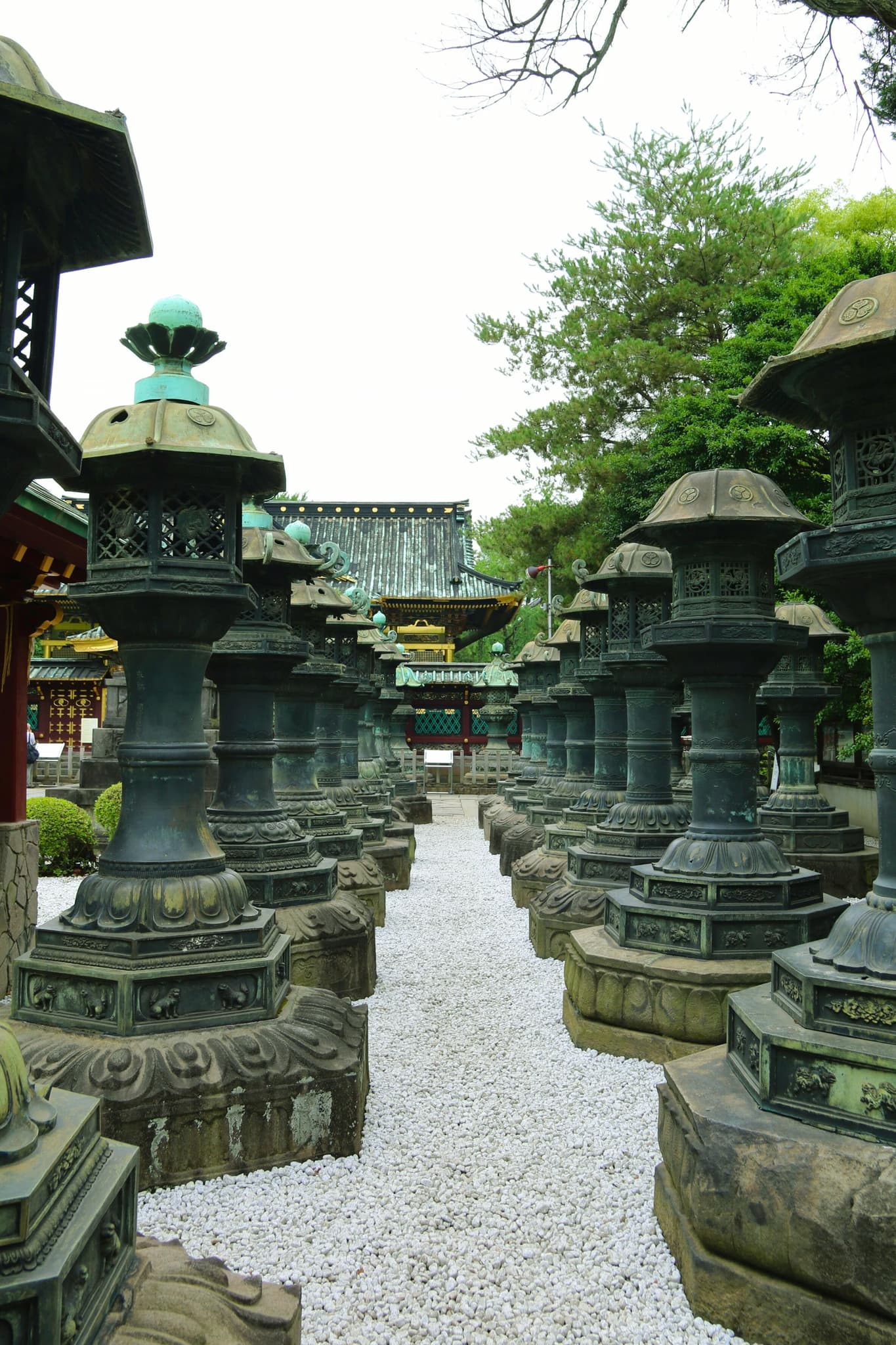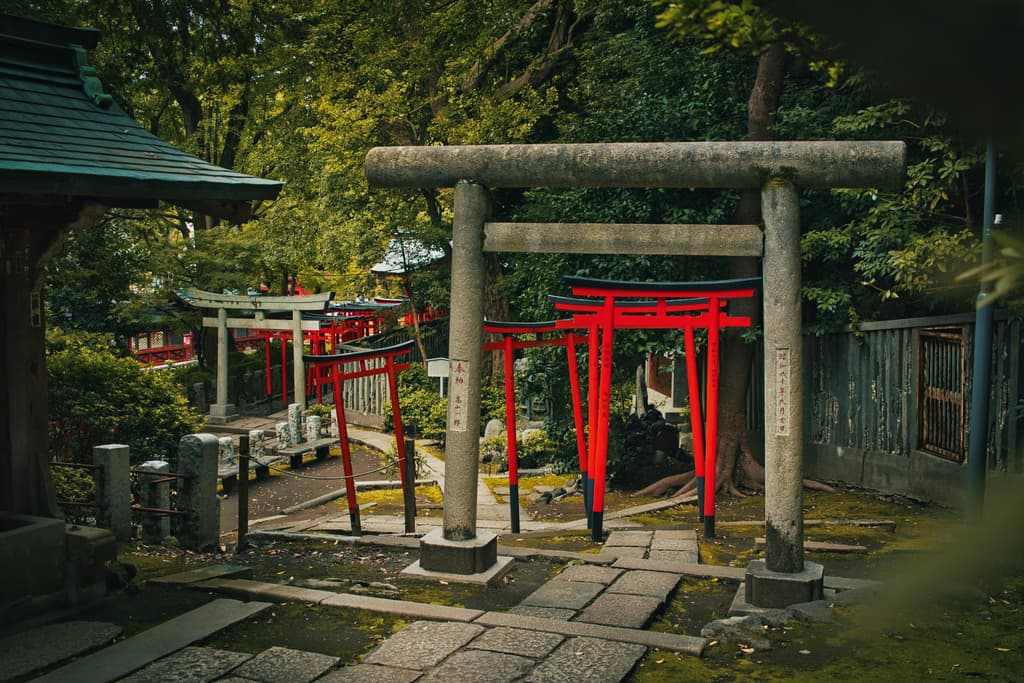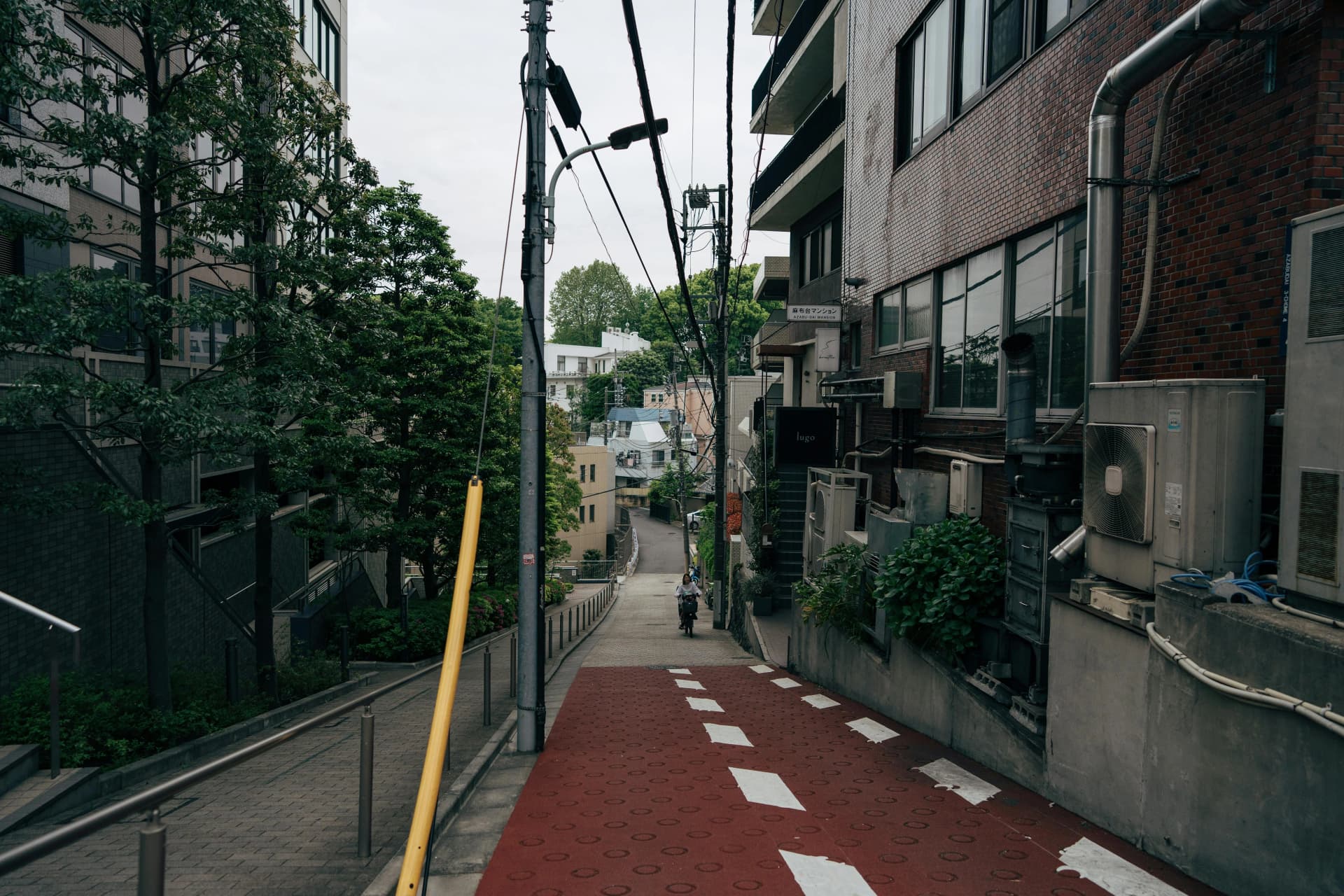
The contrast between the ancient shrine and the surrounding towers isn't incidental — the shrine was here first.
Hie Shrine has stood in some form in central Tokyo since the 14th century. The current location — a hillside in Akasaka, between the Prime Minister's official residence, the parliament building, and the headquarters of several major corporations — gives it a context that no other shrine in Tokyo shares.
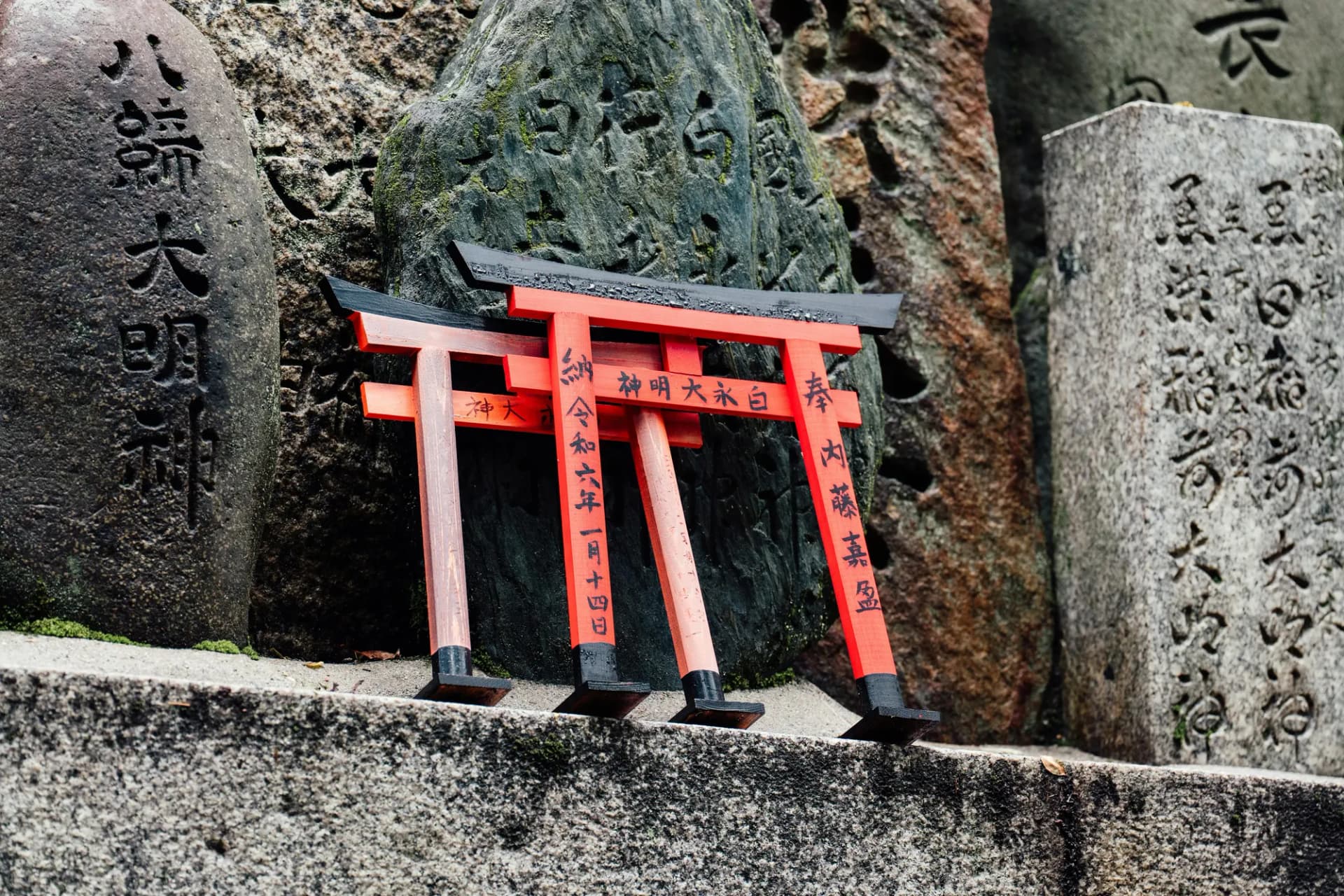
The approach from the Sannō-dori side involves an escalator rising through a tunnel of vermillion torii gates, approximately 90 metres in length, with the main shrine complex visible at the top. The gates are dedicated by businesses in the area — the names of corporations and their executives are inscribed on each post, which makes the tunnel an unusual kind of prayer: institutional devotion rather than individual.
Getting There
Akasaka Station (Tokyo Metro Chiyoda Line) — Exit 2, 5 minute walk
Tameike-Sanno Station (Tokyo Metro Ginza/Namboku Lines) — Exit 7, 5 minute walk
Nagatacho Station (Tokyo Metro Hanzomon/Namboku/Yurakucho Lines) — 7 minute walk
The shrine is on a hillside — the escalator approach from the south gives you the torii tunnel experience; the main staircase from the north is the more traditional approach.
Admission and Hours
| Admission | Free |
| Hours | 6:00 AM – 5:00 PM (5:30 PM in summer) |
| Closed | No regular closure days |
A History Built Into the City Layout
The story of Hie Shrine is inseparable from the story of Edo, and understanding it changes how the surrounding urban landscape reads.
The shrine's origins trace to the Kamakura period, when the Edo clan — a branch of the Taira family who controlled this area — enshrined a deity known as Sannō-sha as the guardian of their domain. The formal consolidation came in 1478, when the warlord Ōta Dōkan constructed Edo Castle and transferred the Sannō-sha deity from Kawagoe to the castle grounds, establishing the shrine as the tutelary protector of the fortification. That act set the pattern for the next four centuries.
In 1590, Tokugawa Ieyasu entered Edo Castle and immediately elevated the shrine's status, designating it the guardian deity of the Tokugawa family and the protective spirit of the city of Edo. He had the shrine buildings formally constructed and donated a stipend of 600 koku — significant institutional patronage that would define the shrine's standing throughout the shogunate. The third shogun, Tokugawa Iemitsu, continued that tradition in 1649 with additional endowments. For the Tokugawa government, the shrine wasn't a peripheral spiritual concern — it was the ceremonial anchor of the city they were building.
The current location in Nagatachō dates to 1659, when repeated expansions of Edo Castle's grounds forced the shrine to relocate outside the castle walls. It has occupied this hillside ever since, while the city around it transformed from feudal capital to industrial metropolis to modern government district. When you stand at the top of the main staircase and look out over the rooftops toward the Prime Minister's residence, what you're seeing is roughly what the shrine's administrators have looked out over — in one form or another — for more than three and a half centuries.
In 1868, with the Meiji Restoration, the shrine was renamed from its previous designation as "Sannō Gongen" to Hie Shrine, and received the highest rank in the Meiji state shrine system as a Kanpei Taisha (官幣大社). That same year, the new government designated it one of the Tokyo Jūsha — the Ten Shrines of Tokyo — a grouping of shrines selected to pray for the protection of the newly designated imperial capital. The designation formalized what had been true since the Edo period: Hie Shrine functions as a civic institution as much as a religious one.
The Two Approaches
Most visitors arrive via the south entrance from Akasaka or Tameike-Sannō Station, where three outdoor escalators rise through the vermillion torii tunnel to the shrine complex above. This is the rear approach — more accurately, the secondary entrance — and it happens to be the most photographed route in the complex.
The primary approach, from the north side, is the Otokozaka (男坂) — literally "male slope" — a staircase of 53 stone steps rising steeply to the main shrine gate. To its left runs the Onnazaka (女坂), a gentler, more gradual incline offering the same destination for those who find the main steps too abrupt. The distinction between the two approaches is traditional, found at various Japanese sacred sites where steep terrain requires more than one path.
If you arrive via escalator, a loop through the grounds and down the Otokozaka stone steps on the other side gives the complete picture — and the view down the staircase toward the city, framed between the stone lanterns and torii, is worth the descent.
What's Here
The Sannō Torii Tunnel. Approximately 90 metres of vermillion torii gates rising up the hillside via escalator, making Hie unusual among Tokyo shrines: you ascend through the sacred approach mechanically, which is either a compromise or a pleasing urban pragmatism depending on your perspective. The view back down the tunnel from the shrine level, looking toward the city, is one of the more striking compositions in central Tokyo. Each gate bears the name of a corporate donor and its representative — a living record of which companies have sought the shrine's protection and in which years.
The main shrine. The current buildings are mostly postwar reconstructions following wartime damage, but the site itself and the sense of spatial arrangement have been maintained to their pre-war configuration. The shrine is dedicated to Ōyamakui-no-kami (大山咋神), a mountain deity associated with the development of land and prosperity, whose origins connect to the parent shrine of Hiyoshi Taisha on the slopes of Mount Hiei near Kyoto. The architectural compound — haiden (hall of worship) and honden (inner sanctuary) connected under a single complex roof — follows the Hie-zukuri style particular to this lineage of shrines.
The Sannō Inari Shrine and inner torii. Within the main compound, a secondary shrine dedicated to the Inari deity sits at the end of its own passage of smaller torii gates — the senbon torii (千本鳥居) that the shrine literature describes separately from the main escalator approach. This inner passage, narrower and less photographed than the southern entrance, is worth locating: it's quieter, and the scale of the individual gates is more intimate.
The sacred animals. Hie Shrine's sacred creature is the monkey — specifically the shinzaru (神猿), pronounced "masaru." Where most Japanese shrines place komainu (狛犬, lion-dog) guardian statues at their entrances, Hie uses a pair of monkey figures. At the main entrance, a male monkey cradles a peach; a female monkey cradles an infant. The reason is layered. Ōyamakui-no-kami is a mountain deity, and monkeys are mountain animals — a natural association reinforced by the shrine's connection to Hiyoshi Taisha, where wild monkeys have lived on Mount Hiei for centuries. But the deeper pull is linguistic: masaru (まさる) is also the reading of the characters for "to ward off evil" (魔が去る) and "to excel" (勝る), turning the monkey from a simple sacred animal into a figure carrying active symbolic charge. Business people visit Hie in significant numbers — the concentration of government and corporate headquarters in the surrounding district makes this one of the more professionally focused shrines in the city, and the monkey's associations with success and evil-warding fit that congregation.
The Sannō Matsuri
In even-numbered years, Hie Shrine hosts the Sannō Matsuri — one of the three great festivals of the Edo era, alongside the Kanda Matsuri and the Fukagawa Matsuri. It runs over approximately eleven days in early to mid-June, with the grand procession (the Shinkōsai) as the centrepiece.
The scale is substantial. Around 500 participants in Heian court dress depart the shrine in the early morning, following a route that winds through roughly 23 kilometres of central Tokyo — passing through the Chiyoda, Shinjuku, Chūō, and Minato wards before returning to the shrine by late afternoon. The procession includes two御鳳輦 (gohōren, imperial palanquins), one portable mikoshi shrine, and several dashi floats. In the Edo period, the Sannō Matsuri held a distinction shared by no other festival: it was permitted to enter the grounds of Edo Castle. The procession effectively became a state ceremony, funded and endorsed by the shogunate — hence its Edo-period name, Tenka Matsuri (天下祭), the "festival under heaven."
On odd-numbered years, the full procession does not run, but the shrine still holds ceremonies and smaller ritual events throughout the festival period, including a bon odori (Bon dance event) near Tameike-Sannō Station. Visitors whose trips fall in odd years aren't locked out of the festival atmosphere entirely, but the grand parade is a biennial event — if you can plan for an even year, the Shinkōsai is the version worth scheduling around.
The next full Sannō Matsuri grand parade is in June 2026. The one after that: June 2028.
When to Go
Early morning. The shrine opens at 6am. Before 8am on weekdays, it's quiet enough to experience the torii tunnel without other visitors. This is the version worth seeking.
The Sannō Matsuri (June, even years). If your trip coincides with festival years (2026, 2028 etc.), the procession is genuinely impressive and unlike anything else in central Tokyo.
Year-round. Unlike Nezu Shrine's azalea season, Hie has no single seasonal peak that crowds it. The autumn foliage around the shrine complex in November is pleasant without being particularly famous — which is its advantage.
Day Pairing
Akasaka + Roppongi circuit: Hie Shrine in the morning (15 minutes) → coffee in Akasaka → Roppongi for art museums in the afternoon. Both are walkable or short taxi rides apart.
Political Tokyo: Hie Shrine → National Diet Building (exterior viewing) → Imperial Hotel → Hibiya Park. A 2-3 hour walk through the political and historical centre of modern Japan. The shrine anchors this sequence particularly well because it makes the surrounding government district legible — these buildings exist in relationship to a site that preceded them all.
For a guided exploration of the relationship between Tokyo's ancient sacred sites and its modern urban landscape, Timeless Tokyo covers the historical depth of central Tokyo. Infinite Tokyo allows any custom itinerary.
Frequently Asked Questions
Is Hie Shrine worth visiting if I'm only in Tokyo for a few days?
Yes, with conditions. Hie takes 15-20 minutes to walk through — it's not a half-day site. Its value is contextual: the shrine makes the surrounding Akasaka and Nagatacho government district considerably more interesting, and the torii tunnel is genuinely striking. If you're passing through the area anyway, it earns its stop. As a standalone destination requiring a separate trip, it's better suited to visitors with more than three days.
What's the difference between the escalator approach and the main staircase?
The escalator approach comes from the south (Akasaka/Tameike-Sannō side) and runs through the 90-metre torii tunnel — it's the photogenic rear entrance. The main staircase (Otokozaka) runs from the north side and represents the traditional frontal approach: 53 stone steps rising to the main gate. Both reach the same shrine complex. The ideal route is escalator up, Otokozaka down, giving you both approaches in a single visit.
Why are there monkey statues instead of the usual lion-dogs?
Hie Shrine's parent institution is Hiyoshi Taisha on Mount Hiei near Kyoto, where wild monkeys have inhabited the mountain since ancient times. The enshrined deity, Ōyamakui-no-kami, is a mountain deity — and monkeys are the mountain's animals. Beyond the zoological connection, the monkey (神猿, masaru) carries auspicious linguistic associations in Japanese: the word masaru also means "to ward off evil" and "to excel." That combination — sacred animal plus lucky wordplay — explains the monkey's prominence throughout the shrine's iconography.
When does the Sannō Matsuri run, and should I plan my trip around it?
The full Sannō Matsuri grand procession (Shinkōsai) runs in even-numbered years — next in June 2026, then June 2028. Smaller ceremonies occur in odd-numbered years. The procession covers approximately 23 kilometres of central Tokyo with around 500 participants in Heian court dress, making it one of the largest ceremonial events in the city. If your travel window is flexible and falls near June of an even year, it's worth adjusting dates to catch it.
What does the Tōkyō Jūsha designation mean?
In 1868, following the Meiji Restoration and the formal establishment of Tokyo as the imperial capital, the new government designated ten shrines as jun-chokusai-sha — shrines selected to conduct ceremonies praying for the protection of the capital and its people. Hie Shrine is one of these ten. The designation is largely ceremonial today, but it marks Hie as a shrine with an explicit civic function that extends beyond ordinary religious practice: it was chosen to guard the city, not just serve its residents.