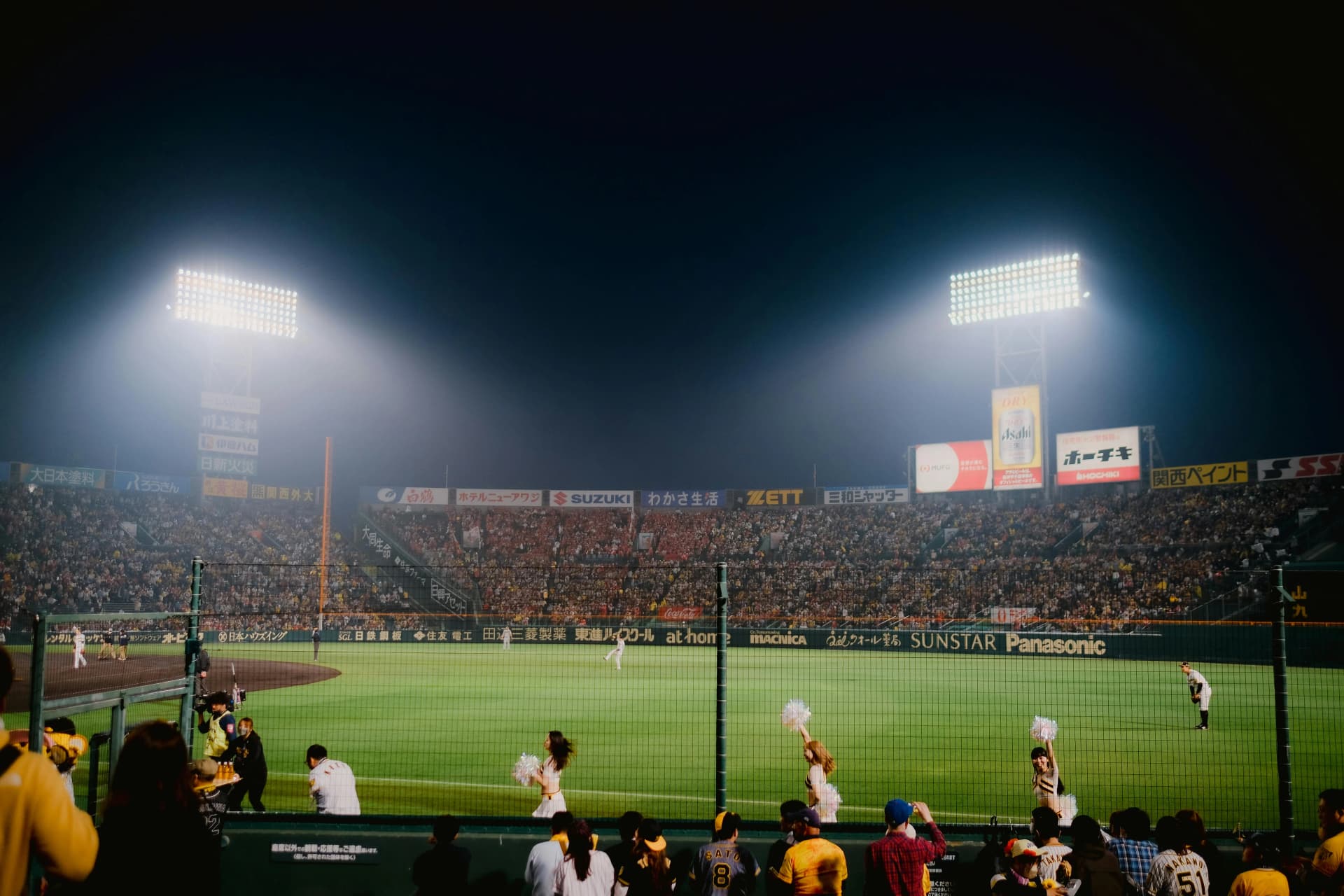
The game on the field follows the same rules. Everything around it — the cheering, the food, the social function of the stadium — is different enough that watching baseball in Tokyo is a genuinely distinct experience.
Baseball in Tokyo sounds different before it looks different. When the home team bats, the outfield section breaks into a coordinated chant: brass, taiko drums and several thousand voices singing a song written for the batter at the plate. When the half-inning ends and the home team takes the field, the cheering stops dead, and the visiting fans start their own chants. Noise for whoever is batting, quiet while your team defends, back and forth for three hours. Nobody heckles, and nobody reacts on their own to a close pitch, because the cheering is rehearsed and it runs the whole game.
That's NPB. The rules on the field match what you know from home, while almost everything in the stands works differently.
Tokyo's Two Teams
Yomiuri Giants (読売ジャイアンツ) are the most successful franchise in Japanese baseball, roughly the Yankees of Japan in commercial clout and history. They play at Tokyo Dome in Bunkyo Ward, a fully enclosed stadium that opened in 1988 and holds 43,500. It's five minutes from Suidobashi Station on the JR Chuo/Sobu Line, and one minute from Korakuen Station on the Tokyo Metro Marunouchi and Namboku lines.
Tokyo Yakult Swallows (東京ヤクルトスワローズ) are the other Tokyo team, and about as unlike the Giants as you can get: smaller and more local, with a cult following that comes from a particular kind of communal warmth. They play at Meiji Jingu Stadium, an open-air ballpark in the Meiji Jingu Gaien grounds. The stadium opened in 1926, so 2026 is its centennial. It holds about 31,800. The easiest way in is Gaienmae Station on the Tokyo Metro Ginza Line, a five-minute walk.
Picking one means picking a baseball culture. The Giants have the spectacle and the dome. The Swallows have the open sky, the atmosphere and the beer.
Jingu at 100
Meiji Jingu Stadium turns a hundred in 2026, and the centennial is worth planning a trip around. The official celebration weekend is June 5 through 7, when the Swallows host the Hokkaido Nippon-Ham Fighters in retro Kokutetsu Swallows throwback uniforms. Those recall the team's original corporate parent, Japanese National Railways, so a bit of postwar economic history rides along with the nostalgia. The weekend also brings commemorative plaques, a special food menu named after Swallows legends, and a tabloid newspaper handed out to ticketholders.
The stadium is due to be demolished in the Jingu Gaien redevelopment, with a new covered ballpark planned for around 2032. The current one stays in use through about 2031. If you visit in 2026, Jingu is fully open and in the most historic season it will ever have.
The Cheering System
Every NPB team has licensed private fan groups called ouendan (応援団) who lead the organized cheering from the outfield stands. They're independent of the team, and they write and lead every player's chant, with brass, taiko and other percussion.
When a batter steps up, his team's ouendan starts his chant, a short rhythmic song with lyrics written for that player. The lyrics show on the scoreboard so newcomers can follow. When runners get into scoring position, the section switches to a chance theme, a more intense chant everyone joins to push for a run. The outfield sings, claps and moves together while the infield sits and watches, so the two halves of the crowd are having very different nights at the same game.
Tourists can sit in the outfield cheering section with a standard outfield ticket, and you don't need an invitation. You will be expected to stand and join in. Copy the people around you; the ouendan's gestures are easy to follow without any Japanese. If you'd rather relax, sit in the infield.
The Umbrella Dance
The Swallows' signature ritual is worth the ticket on its own. When Yakult scores, or during the seventh-inning rally, the stadium plays Tokyo Ondo, a traditional Tokyo folk dance song first written in 1932 for Bon Odori festivals at Hibiya Park. Fans open small plastic umbrellas in Swallows light blue and pump them up and down in time with the music.
It started around 1978, after the Swallows won their first Japan Series. Ouendan leader Okada Masayasu noticed the Swallows had far fewer fans than the Giants, and had them bring umbrellas from home and wave them. A section full of open, bobbing umbrellas makes a small crowd look much bigger, and you notice it straight away.
The official Swallows cheer umbrella (応燕傘) sells at the stadium shop for roughly ¥1,500 to ¥2,000. It's a working compact umbrella with team branding, and locals carry it around the city when it rains, so it's a souvenir you'll actually use.
Getting Tickets
Giants at Tokyo Dome: The official English ticket site, e-tix.jp, takes international credit cards and sends tickets as mobile QR codes. Giants tickets go on sale in batches, with each month's games usually released two to three weeks ahead. Prices run from ¥2,000 for the upper outfield (Designated D) to ¥7,700 for premium infield (Designated S on Saturdays). Student tickets at ¥1,000 for Designated C seats are a great deal. Games against the Hanshin Tigers, the rivalry that defines NPB, sell out weeks ahead. Midweek games against weaker teams usually still have seats at the box office on the day.
Swallows at Jingu Stadium: Book through SwaTicket (ticket.yakult-swallows.co.jp) or Ticket Pia (pia.jp), which works in English, Korean and Chinese. Prices run from ¥2,400 for Outfield C to ¥7,200 for premium infield. Pricing is dynamic, so the outfield seat that costs over ¥10,000 on a Saturday night against the Tigers might be ¥2,400 on a Tuesday against DeNA.
Jingu also has Chokotto Ouen Tickets, which few visitors know about. Two hours after the start or after the bottom of the sixth inning, whichever comes first, the stadium window sells leftover seats at ¥1,000 for outfield and ¥2,000 for infield. It's cash only and supply is limited, but it gets flexible visitors into sold-out games.
If you want the simplest English booking, Klook, GetYourGuide and Japan Ball Tickets (a concierge service that delivers paper tickets to your hotel) all sell NPB tickets on international credit cards, at a markup.
What to Eat
At Tokyo Dome: The stadium is fully cashless, and nowhere inside takes cash. Top up your Suica or Pasmo before you arrive or bring a credit card. Beer vendors walk the aisles with big kegs on their backs and take tap payments on handheld terminals. Draft beer is ¥800 to ¥900 a cup. The food is standard stadium fare (hot dogs, fried chicken, ramen) at stadium prices.
At Jingu Stadium: The food is clearly better, and Jingu regulars will tell you with a straight face that it's the best beer garden in Tokyo. Being open-air, it can cook over open flame in a way a domed stadium can't, and you can taste it.
The signature dish is the Wiener Platter, ¥600 regular or ¥800 mega, from the Gate 18 area with self-service ketchup and mustard. It has a line all game. The Miyazaki Chicken Teppan at ¥500, grilled chicken from Miyazaki Prefecture, is reportedly the best seller in the stadium. The Tokyo Ramen at ¥650 is soy-based with self-service seaweed. Regulars drink Sapporo in bottles at ¥450, which is cheaper than draft, and they'll tell you it tastes better from the bottle.
The beer vendors at Jingu have fans of their own. A dedicated fan website lists individual vendors by name and brand, and regulars follow their favorites the way they follow players. We can't think of anything like it in Western sports.
"Jingu Nomi"
The Swallows sell their stadium as a place to hang out, and Jingu Nomi (神宮呑み, drinking at Jingu) is now a recognized Tokyo pastime in its own right, whether or not you follow baseball. Office workers from Shibuya, Shinjuku and Aoyama buy the cheapest outfield ticket and treat the stadium as an outdoor restaurant with a ball game on in front of them.
Call Jingu Tokyo's best outdoor beer garden that happens to have a baseball game, and you won't be wrong. The cheapest outfield seat, ¥2,400, is basically the cover charge for a table at an open-air stadium restaurant on a warm Tokyo evening.
How NPB Differs from MLB
The game follows the same basic rules, with a few differences that catch Western visitors off guard.
Tie games exist. If the score is level after twelve innings, the game ends as a draw (引き分け). There's no thirteenth inning, and for Americans this is the biggest shock: a game can just end with no winner. Allow three and a half to four hours if it's close.
Games are shorter. The average NPB game takes about three hours and ten minutes. There's no pitch clock, but it feels quicker than pre-clock MLB because batters don't keep stepping out and pitchers work fast out of habit.
The baseball is different. NPB balls have higher, raised seams, which give pitchers more grip and sharper breaking balls. Players who switch leagues keep naming the ball as the biggest adjustment.
The cheering is organized. This is the difference you'll feel most. MLB crowds react as things happen. In NPB, the outfield section chants together for every at-bat, led by an ouendan with brass. Three thousand people chanting one player's name in rhythm is unlike anything at an American ballpark, and so is the silence between half-innings when your team goes from batting to fielding.
No heckling. All cheering is for your own team and never aimed at the opponent. Shouting insults at opposing players is unacceptable here, and fans actively discourage it.
Practical Details
When to arrive: Night games start at 6:00 PM and end around 9:00 to 9:30 PM. Day games start at 1:00 or 2:00 PM. Get there thirty to forty-five minutes early to clear the gates, get food and find your seat.
What to bring: Your ticket (a QR code on your phone), an IC card with money on it for Tokyo Dome's cashless system, and a portable charger. For Jingu, bring a rain poncho and leave the umbrella, since umbrellas block views and are discouraged except during the umbrella dance. Even summer evenings get cool in the open-air stadium after 9:00 PM, so bring a light jacket. Both stadiums check bags at the gate.
Outside food: Both stadiums let you bring food and non-alcoholic drinks. You can't bring your own alcohol.
Re-entry at Tokyo Dome: Allowed until the end of the seventh inning, through Gates 11 and 22 only. Leave by any other gate and your ticket is void.
Frequently Asked Questions
Which team should I see? The Giants at Tokyo Dome if you want scale and the dome. It's more tourist-friendly, with English signs and the e-tix booking system. The Swallows at Jingu if you want the open air, the umbrella dance and the food. If you're in Tokyo in June 2026, the Jingu centennial weekend (June 5 to 7) only comes around once a century.
Can I just show up and buy tickets? For the Giants, usually yes for midweek games and no for weekend rivalry games. For the Swallows, almost always yes, and after the sixth inning Chokotto Ouen Tickets sell leftover seats for ¥1,000 to ¥2,000.
Is the language barrier a problem? Barely at Tokyo Dome, which has English signs and an English ticket site, and the game explains itself. Jingu is more Japanese, but everything there is visual and you join in by copying. You don't need Japanese to enjoy a ball game.
What if it rains? Tokyo Dome is enclosed, so rain never touches the game. Jingu is open-air, and heavy rain can delay or cancel games. Check the forecast if you're planning on Jingu.
Is it good for kids? Yes. NPB stadiums are family-friendly and the mood is positive, so kids can join the cheering or just watch. They tend to love the Swallows' umbrella dance. Tokyo Dome City, next to the stadium, has rides and attractions for before or after the game. For more on planning a family day around stops like this, see our Tokyo with Kids guide.
At Hinomaru One, we build Tokyo days around a Giants or Swallows game, timing the day to the neighborhood around the ballpark: the Bunkyo museum district around Tokyo Dome, or the Meiji Jingu Gaien area around Jingu Stadium. We think it's one of the best evenings you can spend in the city.