The Great Wave was made in the neighbourhood where this museum stands. That context changes what it means to see it.
Sumida Hokusai Museum is where the world's most comprehensive collection of Hokusai's work is held — in the ward where Katsushika Hokusai was born in 1760 and lived for most of his life. The Great Wave off Kanagawa is one of the most reproduced images ever made. Most people encounter it on phone cases, T-shirts, and museum shop magnets in cities that have no relationship to the print whatsoever. Seeing it here, in the neighbourhood where it was created, is something different.
Hokusai was born in Sumida Ward in 1760. Despite moving house 93 times over the course of his life, the vast majority of those moves stayed within Sumida. He never really left. The reason for his restlessness was peculiarly practical: Hokusai drew to the exclusion of everything else, including cleaning. He would let a room fill with discarded papers, food wrappers, and accumulated debris until it became uninhabitable, then simply find somewhere new. Historical records note that he occasionally moved three times in a single day. His 93rd and final move was reportedly back to a house he'd lived in before — still in the state he'd left it. He died there in 1849, aged 88.
The Sumida Hokusai Museum opened in 2016, designed by Pritzker Prize–winning architect Kazuyo Sejima of SANAA. It sits within the same streets where Hokusai painted throughout his seven-decade career. The museum's permanent collection holds approximately 1,800 works — paintings, woodblock prints, illustrated books, personal artefacts, and preparatory sketches — with additional works borrowed from institutions in Japan and overseas for its rotating special exhibitions.
The Building
The museum's architecture is immediately striking, and deliberately so. Sejima designed the building as five interlocking volumes clad in aluminium panels with a slightly mirrored surface. The practical effect is that the building reflects the surrounding Sumida streetscape back at you — residential buildings, trees, passing traffic — making it appear to dissolve into its environment rather than announce itself. The appearance changes depending on the angle you approach from and the quality of light at different times of day.
The design intent was accessibility. Rather than presenting a single monumental entrance, the building is cut through at ground level by passageways from multiple directions. There is no formal front. You can enter from the park to the south, from the side street to the east, or from the main road — the building accommodates all of them. This was a deliberate response to Hokusai's own connection to the neighbourhood: his house was a place people came to watch him work, not a studio set apart from ordinary life.
Inside, angular geometry carries through from the exterior. The building runs four stories above ground, with exhibition space on the third and fourth floors. The structure was built to museum standards for the preservation of ukiyo-e — light-sensitive works that require controlled humidity and temperature — but the slits in the façade allow light to enter the public areas without compromising the collection spaces.
Getting There
Ryogoku Station (Toei Oedo Line) — 5-minute walk east, following Hokusai Street
Ryogoku Station (JR Sobu Line) — 8–10 minute walk
Bus: Multiple routes to Kamezawa
The walk from Ryogoku Station along Hokusai Street is intentional preparation. The street is named for the artist and marked with interpretive panels and small public artworks related to his life and the Sumida landscape he depicted. It's worth walking slowly.
Hours and Admission
Hours: Tuesday–Sunday, 9:30am–5:30pm (last entry 5:00pm)
Closed: Mondays (or the following Tuesday if Monday is a public holiday), December 29–January 3
Permanent collection (Education Room — Discover Hokusai):
Adults ¥400 · High school/university students and seniors 65+ ¥300 · Middle school and under free
Special exhibitions: Separately priced; check the museum's official website (hokusai-museum.jp) for the current exhibition and its admission fee, which varies.
At ¥400 for the permanent collection, the Sumida Hokusai Museum is one of the most affordable admission fees in Tokyo for the quality of the experience. The Tokyo Museum Grutto Pass covers discounted entry if you're doing multiple museums in a week.
The Permanent Collection
The permanent gallery occupies the fourth floor in a single, focused room. The approach is deliberate — rather than sprawling across multiple halls, the space concentrates your attention. High-resolution replicas of Hokusai's most important works are displayed alongside the originals that can be safely exhibited under sustained public viewing conditions. Multilingual touch panels and video installations provide context that rewards taking your time here.
The signature works are the Thirty-Six Views of Mount Fuji series — published between 1826 and 1833, when Hokusai was already in his late sixties. The Great Wave off Kanagawa and Red Fuji (South Wind, Clear Sky) are the icons, but the series is 36 prints covering the same mountain from viewpoints across Japan: from boat, from city, from mountain pass, in storm and in calm. Seeing the complete series reframes what the Great Wave actually is — not an isolated masterpiece but one image in an extended meditation on how a single subject looks different from every conceivable angle and condition.
The Hokusai Manga — his serial sketchbooks published from 1814 onward — are also represented here. These weren't comics in the modern sense but encyclopaedic illustrated reference works: figures in motion, animals, plants, landscapes, mythological scenes, common people at work and at rest. They were introduced to Europe in the 1830s by the Dutch physician Philipp Franz von Siebold, who included illustrations from the Manga in his documented account of Japan. By the time of the 1867 Paris International Exposition, Hokusai's prints had reached the hands of Degas, Van Gogh, Henri Rivière (who responded with his own Thirty-Six Views of the Eiffel Tower), and the composer Claude Debussy, who named The Great Wave as an inspiration for his orchestral work La Mer.
The Scenery on Both Banks of the Sumida River Picture Scroll — an original work held by the museum — is the most specifically local piece in the collection. It depicts the Sumida riverbanks in careful detail: bridges, temples, boats, the ordinary life of an Edo city neighbourhood. Standing in the museum looking at it, the same riverbanks are a few minutes' walk away.
The Education Room
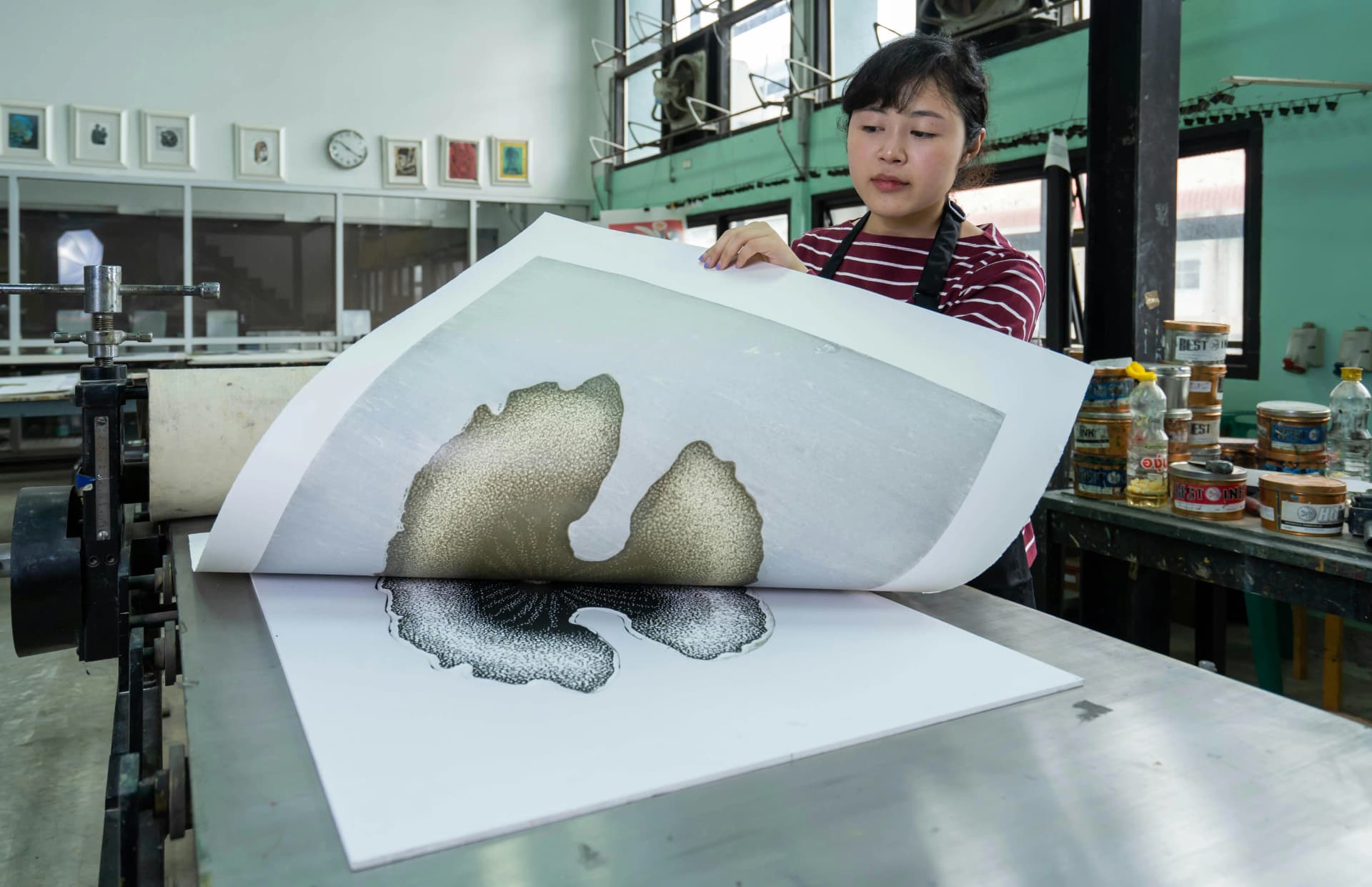
The education space — formally called Discover Hokusai — tends to be underused by visitors who head straight to the gallery. It shouldn't be overlooked. The multilingual interactive panels here cover Hokusai's printing technique (the collaboration between artist, block-cutter, and printer that produced a finished woodblock print), his influence on Western art movements, and the historical context of ukiyo-e production in Edo commercial culture. For anyone without background knowledge of Japanese printmaking, this is the clearest English-language explanation available anywhere in Tokyo.
The museum also runs seminars, workshops, and lectures throughout the year — check the official website if you want to attend an event, as these are programmed seasonally and often fill quickly. The first floor houses a library with an English-language collection on Japanese history, art, and Hokusai specifically, alongside a museum shop.
The Special Exhibitions
The museum's rotating exhibitions on the third and fourth floors are where original works are displayed in depth — and where the admission fee steps up accordingly. Past exhibitions have focused on The Hokusai Bird Park (bird imagery in Hokusai and his students' work), the origins of manga as an artistic tradition, and The Soul of the Brush, examining calligraphic influence on his print style. The 2026 programme marking the museum's decade anniversary is scheduled to focus on the best pieces from the permanent and loaned collections, including the Sumida River Picture Scroll.
If a special exhibition is running during your visit, the total time allocation moves from 30–45 minutes to 1.5–2 hours. The exhibitions are worth attending when they coincide with your visit — the permanent room is excellent, but the originals on display in rotating exhibitions are a different order of experience.
What to Understand About Hokusai Before You Arrive
Two things change the experience of the museum if you hold them going in.
The first is scale. Hokusai produced somewhere in the range of 30,000 works across his career — paintings, prints, illustrated books, teaching materials, commercial illustration, formal commissions. The 1,800 items the museum holds represent the most comprehensive institutional collection of his work in the world, but they're a fraction of the output of one man who drew every day of his adult life and refused to stop. He was still producing significant work in his mid-eighties. His reported last words were a wish for another decade of life to continue painting.
The second is his relationship to his own craft. Hokusai changed his artistic name more than 30 times during his life, treating each name as marking a new phase of technical development. He was apprenticed at 19, broke with that tradition, studied under multiple schools, and eventually declared nature and the universe his only teachers. His late series — the Thirty-Six Views, the One Hundred Views of Mount Fuji, the botanical and animal studies — came after 50 years of intensive technical preparation. The Great Wave was made by a man in his late sixties who had been drawing for half a century and still considered himself in progress.
Building a Ryogoku Day
Ryogoku is Tokyo's sumo district — the Kokugikan arena, the Sumo Museum inside it (free, one hour), the chanko-nabe restaurants that serve the calorie-dense stew that makes up most of a wrestler's diet. The Hokusai Museum sits at the edge of this neighbourhood, and the combination of sumo history and Edo-period artistic history is coherent in a way that few Tokyo day-trip combinations achieve.
A well-sequenced Ryogoku full day runs: Sumo Museum at Ryogoku Kokugikan in the morning, lunch at a chanko-nabe restaurant nearby, the Hokusai Museum in the early afternoon, a walk along the Sumida River riverbank, and then one stop by train to Asakusa for dinner. Everything is within 15 minutes on foot of Ryogoku Station. The Edo-Tokyo Museum — closed for renovation until 2026 — will add a further option when it reopens.
For a guided day that places the Hokusai Museum in context — the ukiyo-e tradition, the relationship between Edo commercial culture and printmaking, the Sumida neighbourhood as Hokusai actually knew it — Infinite Tokyo allows any custom itinerary. Your guide can make the connection between The Great Wave and the Sumida River visible in a way that walking between them alone doesn't quite achieve.
FAQ
Is the Sumida Hokusai Museum worth visiting?
Yes, particularly if you have any interest in Japanese art history or the Impressionist movement's origins. At ¥400 for the permanent collection, it's one of the best-value museum admissions in Tokyo. The special exhibitions cost more and vary in quality — check what's running before your visit if cost matters.
Does the museum display original Great Wave prints?
The permanent gallery displays high-resolution replicas. Original woodblock prints — including works from the Thirty-Six Views of Mount Fuji series — appear in the rotating special exhibitions, where they're exhibited under controlled conditions appropriate for the works' fragility. If seeing originals is important to you, check whether a special exhibition is running during your visit.
How long should I plan for the Sumida Hokusai Museum?
30–45 minutes for the permanent collection alone. 1.5–2 hours if a special exhibition is running. If you want to use the library or attend a workshop, budget more time accordingly.
Can I combine it with the Edo-Tokyo Museum in the same day?
The Edo-Tokyo Museum is scheduled to reopen in 2026 after renovation. When it does, both museums are within walking distance of each other in the Ryogoku neighbourhood — easily combined in a single day. Check current status before planning.
Is the museum accessible?
Yes. The building was designed for accessibility from all sides, with no steps required to reach the main entrance. Lifts connect all floors. The architecture's multiple ground-level passageways mean visitors approaching from any direction reach an accessible entrance.