Discover how to navigate Tokyo’s New Year’s Eve with confidence and cultural insight, avoiding common pitfalls and planning a memorable night.
Discover how to navigate Tokyo’s New Year’s Eve with confidence and cultural insight, avoiding common pitfalls and planning a memorable night.
New Year's Eve in Tokyo operates on fundamentally different principles than celebrations in most Western cities. The friction points aren't dramatic, but they consistently disrupt plans: extended outdoor standing in near-freezing temperatures, multi-hour queues at major religious sites, and unexpected business closures across the city.
Plans fail when visitors import assumptions from other global capitals. Tokyo's New Year is neither a fireworks spectacle nor a street party—it's a cultural transition marked by solemn traditions and immense, orderly crowds. If you're visiting Tokyo for the first time, New Year's Eve represents a special case where normal planning approaches need significant adjustment.
What New Year's Eve in Tokyo Actually Is (Not What You Expect)
Tokyo's New Year celebration centers on two fundamentally different options: organized modern countdown events or traditional Buddhist and Shinto ceremonies. Neither resembles the typical Western New Year's Eve.
There are no large-scale public fireworks in central Tokyo. The cultural energy goes into religious observances, not pyrotechnic displays. If you're expecting a fireworks show over the city skyline, it doesn't exist.
Shibuya Crossing is not hosting a countdown. The famous Shibuya Scramble Crossing countdown has been officially cancelled for the sixth consecutive year due to safety and overcrowding concerns. The area around Hachiko statue will have temporary fencing, and alcohol sales will be restricted.
Businesses close for the holiday. New Year is Japan's most significant family holiday. Most independent shops and restaurants close from December 31 through January 3. Even major department stores close on January 1, reopening January 2 or 3 for their first sales of the year. This severely limits spontaneous dining and shopping options.
The public mood is calm and reflective, not celebratory in the Western sense. If you're seeking a high-energy party atmosphere, you'll need to book a private venue or hotel event well in advance.
The Two Paths: Modern Countdown vs Traditional Hatsumode
New Year's Eve in Tokyo presents a binary choice that determines your entire evening. One path is a modern, organized countdown event. The other is participation in Japan's most important religious tradition.
| Aspect | Modern Countdown | Traditional Hatsumode |
|---|---|---|
| Event Type | Organized countdown with performances | Religious ceremony at shrines/temples |
| Location | Shinjuku Gov Building Citizens' Plaza | Major shrines (Meiji Jingu, Sensoji) or local shrines |
| Time Commitment | 3-4 hours (9:30 PM - 12:30 AM) | Entire night (10 PM - 3 AM at major shrines) |
| Crowd Size | ~2,000 (registration limited) | Millions at major shrines, hundreds at local |
| Atmosphere | Modern, celebratory | Solemn, reflective |
| Registration | Required weeks in advance | None needed |
| Cultural Focus | Entertainment, spectacle | Religious tradition, prayer |
The Modern Option: Shinjuku Countdown
The primary organized countdown event for 2025-2026 is "Happy New Year Tokyo 2026" at the Tokyo Metropolitan Government Building Citizens' Plaza in Shinjuku. The event features projection mapping, live performances (Hatsune Miku, breakdancer Shigekix, Hello Kitty & Friends), and delivers a recognizable countdown experience.
Entry is free but requires advance registration, limited to approximately 2,000 participants. The pre-program starts around 9:30-10:00 PM, building toward midnight, with the event ending shortly after (around 12:10 AM). It's located 10 minutes walk from Shinjuku Station West Exit.
This isn't a casual drop-in event. You need to register weeks in advance, arrive hours early to secure a viewing position, and commit to standing in a dense crowd for 3-4 hours total.
The Traditional Option: Joya no Kane and Hatsumode
The traditional path involves two simultaneous customs that occur at midnight:
Joya no Kane is the Buddhist practice of ringing temple bells 108 times. Each ring represents one of the 108 worldly desires in Buddhist teaching. The final ring at midnight symbolically cleanses you of the past year's troubles.
Hatsumode is the first shrine or temple visit of the new year. This is arguably the single most important Japanese New Year tradition. At major sites like Meiji Jingu or Sensoji Temple, millions of people participate in the first three days of January.
The issue most visitors misjudge is time commitment. Both traditions happen simultaneously at midnight, and if you choose a major shrine for hatsumode, you're committing your entire evening to that single activity. Understanding why these traditions matter, what the symbolism represents, and how to participate respectfully presents challenges for visitors unfamiliar with the cultural context. A guide can provide the cultural interpretation that turns observation into understanding.
Hatsumode: The Reality of Japan's Most Important Tradition
Hatsumode at a famous shrine is not a quick cultural stop. It's a multi-hour commitment involving standing in a slow-moving queue in near-freezing temperatures.
Scale and Duration
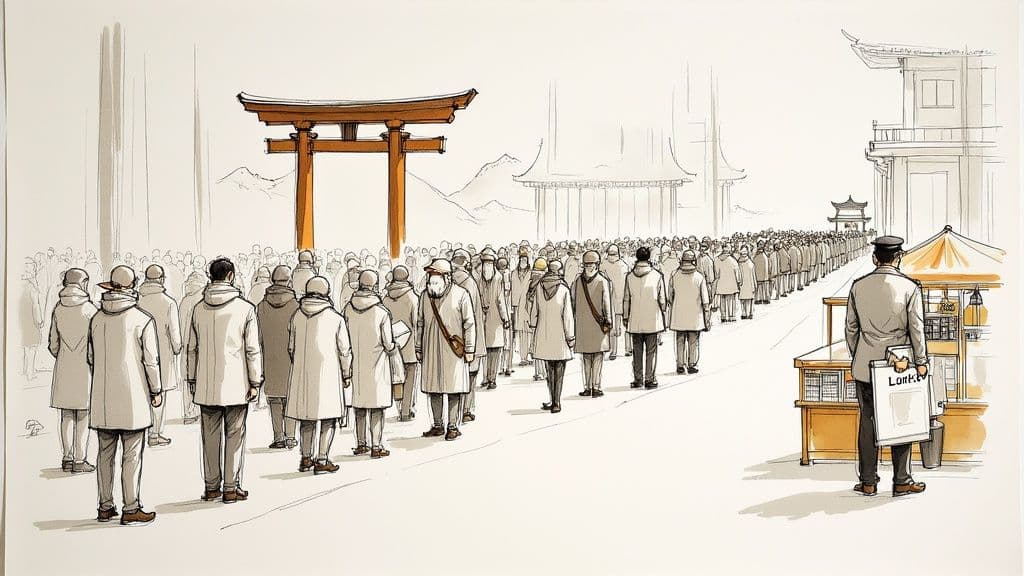
Meiji Jingu alone attracts over 3 million visitors during the first three days of January. On New Year's Eve, joining the queue at Meiji Jingu just before midnight means you will almost certainly not reach the main prayer hall until 2:00 or 3:00 AM.
The 10-minute walk from the entrance torii gate to the main shrine can take 3 hours during peak times. This is not an exaggeration—it's the result of police-managed crowd control processing hundreds of thousands of people through a confined space.
What Happens Inside
The shrine grounds are extremely orderly. Police and staff guide the flow along designated pathways. The atmosphere is quiet and respectful despite the enormous crowd.
Along the approach, food stalls (yatai) sell festival snacks:
-
Yakisoba (fried noodles)
-
Takoyaki (octopus balls)
-
Amazake (sweet fermented rice drink)
-
Various grilled items
These stalls are a significant part of the experience, but accessing them requires navigating dense crowds.
The Prayer Ritual
When you finally reach the offering box, the ritual itself is brief:
-
Toss a coin into the box (five-yen coins are considered auspicious—the word "go-en" sounds like "good relationship")
-
Bow twice (two deep bows)
-
Clap twice (two sharp claps)
-
Make a silent prayer
-
Bow once (one final bow)
The entire act takes less than a minute before you're moved along for the next person. After praying, many people queue again to purchase omamori (good luck charms) or draw omikuji (fortune slips).
Major Shrines vs Local Shrines
The intensity of hatsumode varies drastically by location.
| Aspect | Major Shrine (Meiji Jingu, Sensoji) | Local Neighborhood Shrine |
|---|---|---|
| Crowd Size | Hundreds of thousands to millions | Dozens to hundreds |
| Wait Time | 2-4 hours from midnight | 5-20 minutes |
| Atmosphere | Impressive scale, heavy police presence | Community-focused, personal |
| Food Stalls | Abundant festival atmosphere | Few or none |
| Accessibility | Requires stamina and patience | Manageable for most |
If your goal is cultural participation without dedicating your entire night to standing in a queue, a local shrine offers the same ritual in a fraction of the time.
Transportation: The Hidden Complexity
Tokyo's transit system doesn't shut down on New Year's Eve, but it operates on a fundamentally different pattern than normal service. Understanding Tokyo's transit system provides essential baseline knowledge, but New Year's Eve introduces unique complications.
All-Night Service Details
JR East operates all-night service on 7 lines from December 31 to January 1:
| Line | Service Area | Notes |
|---|---|---|
| JR Yamanote Line | Inner and outer loop | Every 15 minutes, 1:00-5:00 AM |
| Keihin-Tohoku/Negishi Line | Sakuragicho to Omiya | Every 20-50 minutes |
| Chuo Line Rapid Service | Mitaka to Takao | Reduced frequency |
| Chuo/Sobu Line Local | Mitaka to Chiba | Reduced frequency |
| Yokosuka Line | Yokohama to Zushi | Limited service |
| Ome Line | Tachikawa to Mitake | Special trains only |
| Sobu Main/Narita Line | Chiba to Narita | For Naritasan Temple access |
Tokyo Metro (subway) does not run overnight—it operates on a Saturday/holiday schedule only, with last trains running around midnight to 1:00 AM.
Frequency and Crowd Reality
JR Yamanote Line runs approximately every 15 minutes from 1:00 AM to 5:00 AM. Other lines run every 20-50 minutes depending on the segment.
This sounds manageable until you factor in crowd density. Lines serving major shrines—particularly the JR Yamanote Line stopping at Harajuku (for Meiji Jingu)—are packed to capacity. Platforms become bottlenecks where a simple transfer can degrade into a 20-30 minute wait just to board a train.
Station Navigation Challenges
Large transfer stations become human traffic management exercises on New Year's Eve:
| Station | Challenge | Impact |
|---|---|---|
| Shinjuku | Multiple levels, long corridors, dense crowds | Complex transfers, easy disorientation |
| Shibuya | Multiple exits, platform congestion | 20-30 minute waits just to board |
| Tokyo Station | Enormous facility, numerous platforms | Difficult navigation in crowds |
For seniors or visitors with mobility constraints, navigating these stations during peak holiday crowds is physically exhausting even without luggage.
Why Multi-Location Plans Fail
A common mistake is planning to see Joya no Kane bell ringing at Sensoji in Asakusa, then travel to Shibuya or Shinjuku for a countdown event. This is logistically impossible around midnight.
You're combining:
-
Enormous crowds trying to access the same stations
-
Trains running on reduced frequency
-
Station platform bottlenecks
-
30-45 minute travel times even when trains are running normally
Movement between neighborhoods from 11:00 PM to 2:00 AM is extremely slow and unreliable. Walking several kilometers may actually be faster than waiting for overcrowded trains. For reference, Meiji Jingu is accessed from Harajuku Station (JR Yamanote Line), Sensoji from Asakusa Station (Ginza Line, Asakusa Line), and the Shinjuku countdown from Shinjuku Station (multiple lines).
What You Can't Find: Food, Bathrooms, and Closed Businesses
Tokyo's reputation as a 24/7 city does not apply during New Year. The normal infrastructure largely shuts down.
Business Closure Patterns
Different business types follow distinct patterns during the New Year holiday:
| Business Type | Typical Closure | Reopening | Notes |
|---|---|---|---|
| Independent restaurants/shops | Dec 31 - Jan 3 | Jan 4 | Some close Dec 30 |
| Department stores | Jan 1 | Jan 2-3 | Reduced hours Dec 31 (close ~5-6 PM) |
| Chain restaurants | Mixed | Varies | Many close Jan 1; don't assume they're open |
| Convenience stores (konbini) | Mostly open 24/7 | N/A | Some suburban locations may close 1-2 days |
In central Tokyo, konbini are your most reliable food source during the holiday period.
What to Buy at Konbini
Convenience stores offer essential supplies for the long night:
| Item | Purpose | Notes |
|---|---|---|
| Onigiri (rice balls) | Substantial food | Main meal option |
| Hot canned drinks | Warmth, hydration | Coffee, tea from heated cabinets |
| Hand warmers (kairo) | Essential warmth | Critical for long outdoor waits |
| Packaged sandwiches | Quick food | Lighter than onigiri |
| Bottled water | Hydration | Important even in cold weather |
| Snacks | Energy between meals | Various options available |
Convenience stores do not replace a proper meal. Eat a substantial, warm dinner before 8 PM if you're heading out for the evening.
Bathroom Access
Public facilities will be available at major shrines and stations, but expect long queues. At peak times (11:00 PM to 2:00 AM), a bathroom stop can take 15-20 minutes. Factor this into your timeline.
The Physical Reality: Cold, Standing, and Preparation
New Year's Eve in Tokyo is an outdoor endurance event, not a typical night out. Most visitors underestimate the physical demands.
Temperature Conditions
Late December to early January in Tokyo brings cold outdoor conditions for extended periods:
| Time of Day | Temperature Range | Feels Like | Duration Outdoors |
|---|---|---|---|
| Daytime | 10-13°C (50-55°F) | Chilly with wind | N/A for NYE events |
| Evening/Night | 2-4°C (35-39°F) | Near or below freezing | 3-8 hours |
| Midnight-Dawn | Often below 0°C (32°F) | Significantly colder with wind chill | Peak exposure time |
You'll spend 3-8 hours outdoors depending on your chosen activity, mostly standing still in queues. Wind chill makes it feel significantly colder than the stated temperature.
The cold conditions described here are the same that make winter touring in Tokyo physically demanding—but also rewarding. Outside of New Year's Eve crowds, winter delivers the clearest skies and emptiest temples of the year.
Required Clothing
Start with thermal base layers—long-sleeved tops and leggings worn under your clothes are essential for retaining body heat during extended standing. Add insulated outerwear: a windproof and waterproof jacket, preferably down or padded. The outer layer needs to block wind effectively.
Footwear matters most. You'll be on your feet on cold pavement for hours, so insulated, comfortable boots or shoes are arguably the most important item. Finish with warm accessories: scarf, gloves, and beanie aren't optional—they're necessary for hours of outdoor standing.
What Happens If You're Underprepared
Dressing for a typical night out instead of a long outdoor vigil turns the experience into an endurance test. You'll be cold, uncomfortable, and potentially unable to complete your planned activity. The experience shifts from cultural participation to simply surviving until you can get indoors.
How Different Visitor Types Experience This Night
The unique demands of Tokyo's New Year's Eve amplify challenges for certain groups.
Families with Young Children
The main cultural events are not designed for children:
-
2-4 hour queues with minimal shelter
-
Near-freezing temperatures
-
Limited bathroom access
-
No activities to occupy bored children
-
Dense crowds with no space to move around
Managing warmth, hunger, and boredom in a static crowd is challenging. Plans for a "brief, atmospheric visit" typically break down after the first hour. For families who want cultural participation without the logistical burden of managing children in these conditions, guided experiences can adjust timing and approach to match young attention spans.
Seniors and Visitors with Mobility Constraints
The physical demands are significant:
-
Hours of standing in one place
-
Slow shuffling progress in queues
-
Navigating multi-level stations with stairs
-
Long walking distances at major shrines
-
Dense crowds making movement difficult
Stations like Shinjuku become particularly challenging environments—multiple floors, long corridors, crowded escalators, and limited elevator access. Visitors with mobility considerations often find guided experiences adjust for accessibility needs, including elevator-accessible routes and pacing that maintains comfort.
Visitors Seeking a Party Atmosphere
There's a fundamental cultural mismatch here. The public mood across Tokyo on New Year's Eve is reflective and tranquil, not celebratory in the Western sense.
Finding a lively party requires specific advance knowledge. Most bars and clubs either close for the holiday or operate on a private, reservations-only basis. A spontaneous search for a street party will lead to disappointment—the city's energy is channeled into solemn religious observances.
Planning Framework: One Location, One Objective
The core strategic principle for New Year's Eve in Tokyo: select one location and commit to one primary objective for the hours around midnight.
Planning Options
Choose one approach based on your priorities and physical capabilities:
| Approach | Arrival Time | Duration | Commitment Level | Best For |
|---|---|---|---|---|
| Major shrine hatsumode | 10:00-11:00 PM | Until 2:00-3:00 AM | Entire night, single activity | Cultural immersion, stamina |
| Shinjuku countdown | 9:00-9:30 PM | Until 12:30 AM | 3-4 hours standing | Modern experience, requires registration |
| Local shrine | 11:30 PM | Done by 12:30-1:00 AM | Brief, flexible | Authenticity without crowds |
Major shrines are an entire-night commitment. The countdown event is more contained but still demands hours of standing. Local shrines offer the most flexibility.
Transportation Planning
Know your train line's holiday schedule before you leave. Don't assume normal service patterns.
Where you stay in Tokyo affects your New Year's Eve logistics significantly. A hotel in Shinjuku simplifies access to the countdown event, while a hotel near Harajuku Station reduces travel time to Meiji Jingu. Pre-positioning through accommodation choice reduces transport complexity.
Prepare for crowds: JR Yamanote Line and other lines serving major shrines will be at maximum capacity. Platform waits of 20-30 minutes are common.
Have a walking backup route: In some cases, walking 2-3 kilometers back to your hotel is faster and more reliable than waiting for overcrowded trains.
Pre-position yourself: If you're attending the Shinjuku countdown or going to Meiji Jingu, be in that neighborhood hours before midnight. Don't plan to travel during the peak period (11:00 PM to 2:00 AM).
The combination of timing constraints, limited business hours, and crowd dynamics makes New Year's Eve one of Tokyo's most logistically complex nights. Many first-time visitors find that local expertise removes uncertainty on Tokyo's most logistically complex night, allowing them to focus on cultural experience rather than coordination.
Local Shrine Strategy: The Alternative Most Visitors Miss
Major shrines attract attention, but local neighborhood shrines offer authentic cultural participation without the logistical burden.
What Defines a Local Shrine
Local shrines serve their immediate community:
-
Visitor count: Dozens to hundreds, not millions
-
Atmosphere: Community-focused, often family-oriented
-
Wait times: 5-20 minutes maximum
-
Food stalls: Usually none, occasionally a few
The ritual is identical to major shrines. You'll perform the same prayer sequence, and the cultural meaning is the same. The difference is scale and accessibility.
How to Find a Local Shrine
Walk 10-15 minutes from your hotel in any residential direction. Look for:
-
Torii gates (the distinctive Shinto shrine entrance)
-
Small compounds with traditional wooden structures
-
Modest grounds, often surrounded by trees
You don't need to research specific names. Nearly every neighborhood has multiple small shrines. The point is finding one that's convenient and uncrowded.
Trade-Offs
Local shrines offer:
-
Manageable wait times
-
Authentic community experience
-
Opportunity to observe local families participating
-
Less physical strain
You give up:
-
The spectacle of enormous crowds
-
Festival food stalls
-
The "famous landmark" experience
-
Photo opportunities at locations
This isn't better or worse—it's a different experience. If your goal is cultural participation without consuming your entire evening, local shrines make that possible.