Pachinko is not a game tourists play. It's a cultural institution worth understanding.
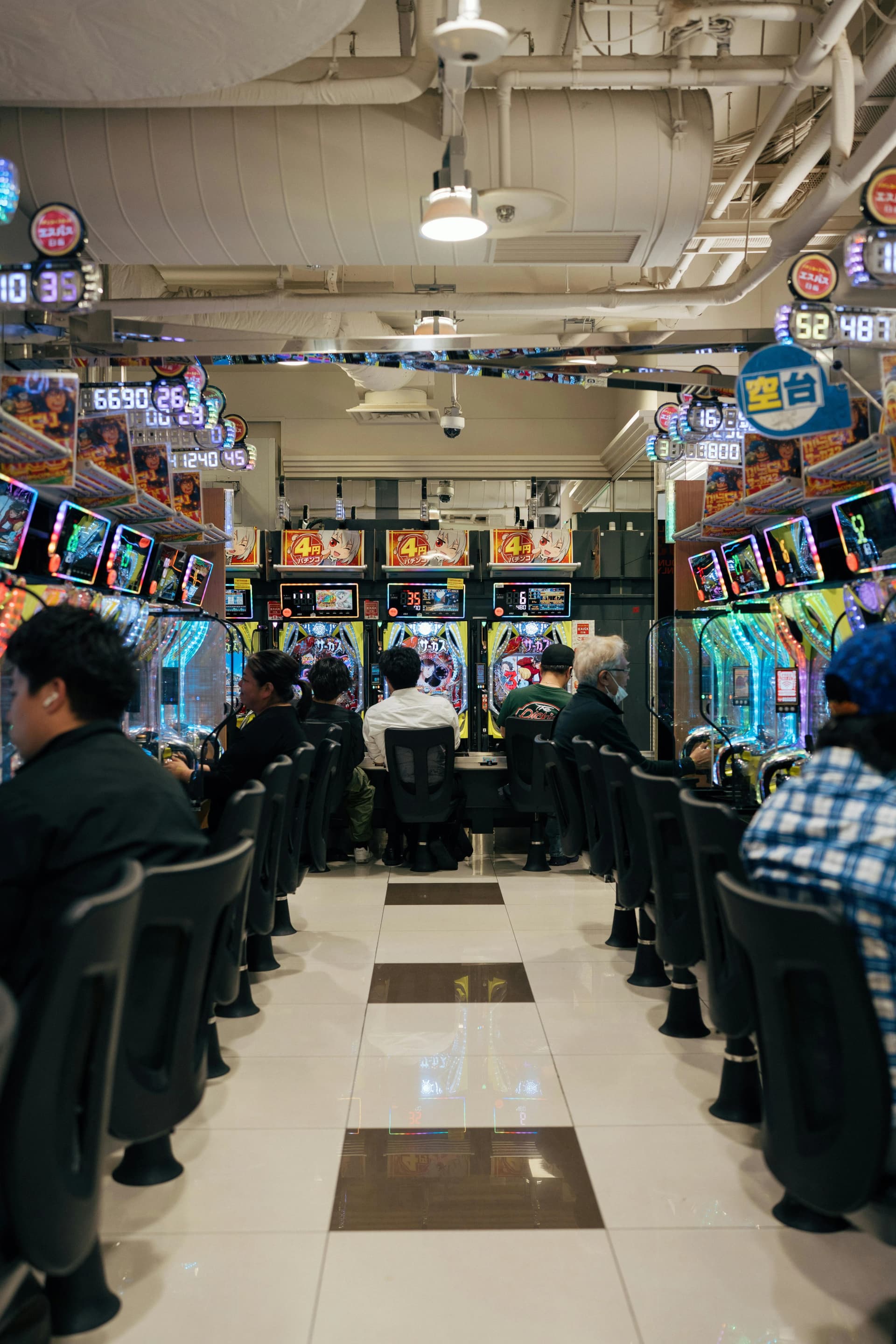
You'll walk past pachinko parlors every day in Tokyo without necessarily clocking what they are. They announce themselves with walls of neon and a noise you can hear from across the street — a dense, clattering roar that hits you when the door opens. Inside, rows of people sit motionless in front of vertical machines, watching tiny steel balls cascade through lit-up mechanisms at a pace that suggests nothing casual. Then the door closes and Tokyo's ambient hum returns.
Most tourist guides file pachinko under "quirky Japan things to notice" and move on. That's an incomplete read. At its 2023 market size of roughly ¥15.7 trillion — that's pachinko and its close cousin pachislot combined — this is the largest entertainment industry in Japan by revenue. It dwarfs annual casino revenue from Las Vegas. At its 1994 peak, the industry touched ¥30 trillion. Even in decline, it's a business larger than the Japanese film, music, and sports industries combined. The parlors you pass aren't a curiosity. They're the country's dominant form of commercial leisure.
What Pachinko Actually Is
A pachinko machine is a vertical playing field — roughly the dimensions of an arcade cabinet — mounted with hundreds of small pins, ramps, and pockets. Players load small steel balls into the machine and use a spring-loaded dial to launch them one at a time toward the top of the board. The ball drops through the pin field, and most of them fall into dead zones at the bottom and are gone. The goal is to land balls in specific pockets that trigger a digital slot machine displayed on a screen embedded in the machine. Hit the right pocket, and the slot spins. Three matching symbols, and the machine releases a cascade of winning balls into a tray in front of you — sometimes hundreds at a time, sometimes thousands, accompanied by lights and sound effects that make adjacent machines look asleep by comparison.
The distinction between pachinko and pachislot matters. Pachislot machines look like traditional Las Vegas-style slot machines and are controlled purely by a button. Pachinko involves physical skill in the shooting — there's a technique to dialing the launch strength to hit specific targets, which is why regulars sit with the concentrated stillness of someone threading a needle. Beginners tend to overshoot or undershoot. The skill floor is low enough for anyone to try; the skill ceiling is real.
The Three-Store System: Why This Isn't Technically Gambling
Japan's Penal Code prohibits gambling — specifically, directly wagering money on games of chance. Pachinko operates inside a legal structure designed around this prohibition. Understanding it is necessary to understand the industry.
When you win balls at pachinko, you don't receive cash from the parlor. Instead, you take your tray of balls to a counter inside the parlor and exchange them for prizes — typically everyday goods, or small special items that look like gold-plated tokens or playing cards. These "special prizes" (特殊景品, tokusu keihin) have no apparent value outside this system.
You then leave the parlor, walk to a small exchange window nearby — often on a side street, sometimes in a shuttered booth around the corner — operated by a completely separate company. This business purchases your special prizes for cash at a fixed rate. The exchange shop accumulates these prizes, then sells them to a wholesaler, who sells them back to the pachinko parlor, completing the loop.
This is the three-store system (三店方式, santen hōshiki): parlor, exchange shop, wholesaler. Three legally independent entities. No single business transaction involves trading game outcomes for cash. The parlor gives out prizes. An unrelated shop happens to buy those prizes. The fact that everyone involved understands the system exists for cash conversion doesn't change the formal legal structure.
It has never been prosecuted under the Penal Code. There is no court ruling that has tested whether the system constitutes gambling. It operates under administrative tolerance — the government's formal position is that prize exchange shops don't require secondhand goods licenses because the items aren't linked to theft. This is why you'll see "pachinko is technically not gambling" in virtually every account of the industry. It isn't. It's also not not gambling. It exists in a formally maintained legal gray zone that has been stable for decades.
The Experience of Walking In
The sound is the first thing. It's not background noise — it's the entire acoustic environment. Hundreds of machines running simultaneously, each launching balls at roughly 100 per minute, each winning machine triggering a fanfare. The total noise level in an active Tokyo parlor sits around 80-90 decibels. That's roughly equivalent to standing in front of a running lawnmower. Most regulars wear the look of someone who stopped noticing it years ago.
The interior layout is rows of machines back-to-back, with narrow aisles between them. The lighting is intense — fluorescent overheads supplemented by the flashing displays on every machine. The air quality varies by establishment. Japan's revised Health Promotion Act, which came into full effect in April 2020, requires indoor smoking to be confined to designated smoking rooms in pachinko parlors. General playing areas are technically smoke-free. In practice, compliance varies — some parlors are rigorously separated, others have designated areas that feel porous, and enforcement depends on the establishment. High-end chain parlors like MARUHAN operate modern facilities with cleaner air separation; older neighborhood parlors may be less strict.
The clientele skews older — the average pachinko player in Japan is in their 40s or 50s, and the industry's decline tracks closely with an aging and shrinking regular player base. You'll see people eating at their machines from trays of food, managing multiple trays of balls simultaneously, or studying a specific machine over multiple sessions to understand its payout patterns. The machines are individual worlds. Nobody talks.
How to Actually Play
Walk in and sit at any empty machine. Insert yen into the cash slot — most machines accept ¥1,000 notes. This dispenses balls into a tray attached to the machine. The per-ball cost is 1-4 yen depending on the parlor and machine tier.
The dial is in the lower right. Turn it clockwise to increase launch force. The full range from minimum to maximum launch power spans perhaps 60 degrees of rotation. You're looking for the specific force that lands balls in or near the pockets that trigger the slot. This is what regulars call the "sweet spot" — it varies by machine and by how worn the pins are. Watch the machine for a few shots before committing to a position.
When the slot triggers, the machine plays a short animated sequence and the symbols spin. Most spins result in two matching symbols and then a third that doesn't match — a "reach" state, where the machine shows three symbols close to matching but not quite. This happens constantly and is designed to maintain attention. An actual win (three matching symbols) triggers a payout state where balls flow continuously for a fixed period.
Cash out by pressing the call button, which brings a staff member to count your balls. You receive a receipt, take it to the prize counter, select your prizes, and — if you want cash — locate the exchange window and convert there. Parlors near tourist areas like Shinjuku and Akihabara often post exchange window locations visibly or have English-speaking staff who can explain the process.
Budget Expectations
¥1,000 gets you around 250-500 balls depending on the machine setting. At a modest play rate, this lasts 15-20 minutes. Budget ¥2,000-3,000 for a 45-minute experience where you're learning the machine and not expecting profit. Professional players manage sessions much more carefully, timing machines they've tracked across multiple visits.
The expected financial outcome for a first-time visitor is a small net loss. You might win — machines do pay out — but the edge is calibrated in the house's favor. Treat it as a ¥2,000-3,000 activity, not an investment, and the experience is worth the money as cultural immersion. Chasing losses is where the industry's social problems start.
MARUHAN Shinjuku (東新宿エリア) is the consistently recommended starting point for foreign visitors — large, modern, has multilingual staff, and is set up in a way that makes the process legible to someone who has never been inside a parlor. Akihabara also has multiple parlors with modern machines and accessible layouts.
The Cultural Weight
Pachinko's history runs deeper than its economics. The game emerged as a children's toy in Japan in the 1920s — a variant of the American Corinthian bagatelle — before transitioning to adult parlors by the 1930s. It effectively disappeared during WWII, then re-emerged around 1946 in the chaotic postwar economy.
The Zainichi Korean community — ethnic Koreans who had been in Japan during the colonial period and remained after the war — entered the industry around 1947. Discriminated against in mainstream employment markets, many found pachinko parlor operation one of the few business sectors available to them. Today, a significant portion of the industry's ownership traces to Zainichi Korean families, a demographic reality that has been weaponized historically by nationalist narratives and that overlaps with the industry's associations with organized crime, money flows, and murky regulatory history. The Apple TV+ series Pachinko (2022) dramatized this history to international audiences and prompted renewed English-language attention to its complexities.
The industry's peak in 1994 — ¥30 trillion in annual sales — coincided with a moment when 1 in 10 Japanese adults was an active player. Pachinko was genuinely everywhere in Japanese postwar culture: the affordable leisure of the salaryman, the neighborhood parlor as social space, the background hum of urban Japan. That era is over. By end of 2023, the number of active parlors had dropped to 6,839 — down from a peak of over 18,000 — with around 526 parlors closing in 2023 alone.
What remains is still formidable. But the trajectory is clear: a shrinking regular player base that ages faster than it replaces itself, regulatory tightening, and competition from legal online entertainment. The parlors closing across Tokyo aren't just businesses shuttering — they're a postwar cultural institution contracting in real time.
The Social Costs
Pachinko has a gambling addiction problem that the industry and government have been slow to address. Japan has estimated rates of problem gambling — with pachinko and pachislot as the primary vectors — that are among the highest in the developed world. The Japan Institute on Addiction Studies has cited figures suggesting several million people in Japan experience gambling-related harm, with pachinko accounting for a substantial share.
The industry introduced self-exclusion programs and mandatory cooling-off features on machines in recent years, partly under pressure related to Japan's broader push toward regulated casino gambling (the Integrated Resorts Act, passed in 2018). There's a structural tension here: pachinko operates in legal gray space while the government simultaneously licenses new casinos, and the regulatory framework has never fully resolved what pachinko is and what obligations flow from that.
Child abandonment cases — parents leaving children in hot cars while playing for hours — drew media coverage and led to some parlors installing parking lot monitoring systems. These incidents aren't common, but they were common enough to generate a specific cultural response. The pachinko addiction narrative is part of the parlor's texture; it's present in how people talk about the industry, in the warning posters on parlor walls, in the academic literature on Japanese public health.
Understanding this doesn't require moralizing. It's part of what pachinko is: an industry that generated enormous value for decades, built on mechanisms that reliably produce some percentage of people who lose control of their play. That's not unique to pachinko. It's true of gambling globally. What makes pachinko specific is its formal legal denial that this is gambling at all — a denial that has constrained the regulatory response.
Frequently Asked Questions
Is pachinko legal for tourists? Yes. There are no citizenship or residency requirements to enter a pachinko parlor in Tokyo. You do not need ID to enter or play. Foreign visitors are welcome, and major chain parlors in tourist areas have multilingual staff and English instructions on machines.
Do I need to speak Japanese? Not at the larger, modern parlors. MARUHAN Shinjuku is explicitly set up for foreign visitors with English-language guidance. That said, the prize exchange process involves some navigation — staff can usually direct you to the exchange window, or it's posted near the exit.
Is it really that loud inside? Yes. Consistent noise levels in a full parlor run around 80-90 decibels. Earplugs are a legitimate choice and nobody will find this unusual. The sonic environment is part of the design — it creates a zone of sensory focus that disconnects players from outside time.
Are parlors still smoky? It varies. Japan's 2020 smoking regulations require designated smoking rooms rather than open floor smoking. Modern, high-end parlors in Tokyo largely comply; older neighborhood parlors may be more permissive. If smoke sensitivity is a concern, MARUHAN-chain parlors are the safest bet.
Can I actually win money? Yes, technically. Players do win — machines pay out, sometimes substantially. The expected outcome for a random visitor is a modest loss. To consistently profit from pachinko requires tracking individual machines over many sessions to understand payout timing, which is a skill set that takes months to develop. Go for the experience, not the edge.
At Hinomaru One, we design private Tokyo days around the city's real texture — not the curated surface. Understanding what fills the spaces between temples and shopping streets is part of understanding Tokyo. If you want a guided day built around authentic cultural engagement, Infinite Tokyo allows fully custom itineraries built around what you're actually curious about.