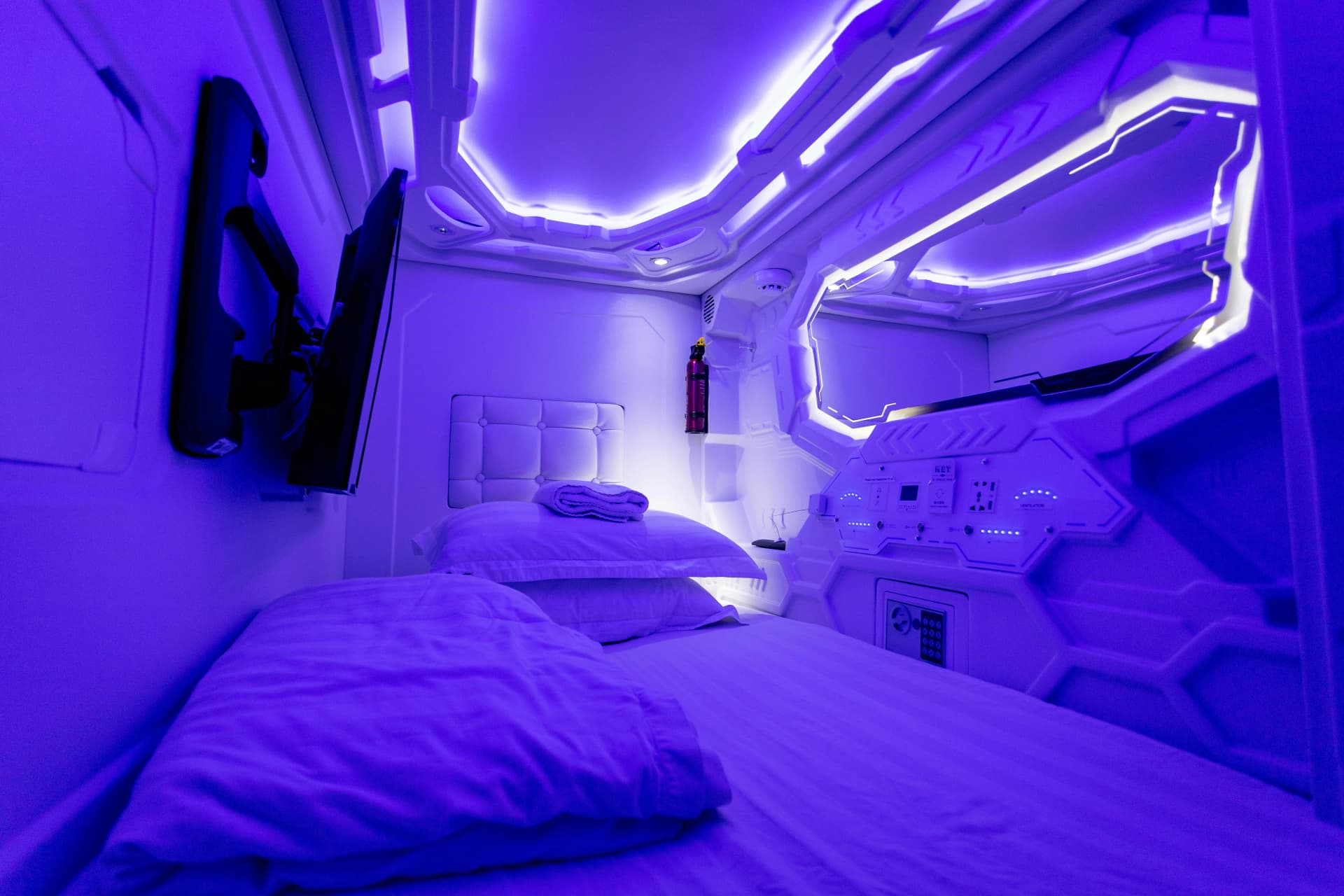
A capsule hotel is infrastructure for a specific Japanese lifestyle problem. Understanding that changes what you expect from the experience.
Capsule hotels in Tokyo exist because of the last train. It's midnight in Shinjuku, the Yamanote Line just shut down, and your options are a ¥6,000 taxi ride to the suburbs, sleeping in a 24-hour Denny's, or walking two minutes to a capsule hotel and getting a clean bed, a hot bath, and a fresh towel for ¥3,500.
That is the problem capsule hotels were built to solve. Not "how do tourists find cheap accommodation" — but "how does a salaryman who missed his train get through the night with his dignity and his wallet intact."
This distinction matters more than it sounds. Understanding what capsule hotels are actually for changes what you bring, what you expect, and which ones are worth your time.
Where Capsule Hotels Come From
The first capsule hotel in the world opened on February 1, 1979, in Osaka's Umeda district. It was called Capsule Inn Osaka, and it was designed by architect Kisho Kurokawa — the same man who designed the Nakagin Capsule Tower in Tokyo seven years earlier, in 1972. That building, a radical experiment in modular residential architecture, is where the aesthetic vocabulary came from. The pods, the stacked geometry, the idea that a dwelling unit could be a single fabricated module rather than a built room.
Kurokawa didn't come up with the capsule hotel concept on his own. Nakano Yukio, who ran saunas and cabarets in Osaka, saw Kurokawa's "Capsule House" exhibit at the 1970 World Expo and called him a decade later with a question: could that design be applied to overnight accommodation? The men sleeping on the floor of his sauna after missing the last train needed somewhere better to be.
The timing was specific to Japan's economic moment. The 1970s and 1980s were the height of Japan's post-war growth period. Salarymen worked late — routinely, structurally, as a matter of corporate culture. They drank with colleagues after work. And Tokyo's train system, unlike London's Underground or New York's subway, stops running at midnight. Combine mandatory overtime with mandatory socializing and a hard midnight cutoff, and you have a guaranteed nightly market of men who need somewhere cheap and close to sleep.
Capsule Inn Osaka filled up almost immediately. Within weeks it was turning people away. By the late 1980s, there were more than 500 capsule hotels operating across Japan.
That origin story is not just trivia. It explains the entire logic of how a capsule hotel is structured: efficient, functional, organized around sleep and basic hygiene, not around comfort or storage or socializing. You arrive late, you sleep, you shower, you leave. Everything else is secondary.
What You Actually Get
A standard capsule is a fiberglass or polycarbonate pod roughly 1.2 meters wide, two meters long, and one meter high — slightly smaller than a single bed in a Western hotel, significantly larger than the mythology suggests. You can sit up in most modern capsules. You cannot stand. There's no door in the traditional sense, though most have a blackout curtain that pulls across the entrance; newer hotels often have hard-panel privacy screens.
Inside: a single mattress, a light you control, an alarm clock, Wi-Fi, a power outlet, and usually a TV. You're sleeping in a personal module, not a broom closet. People who've never stayed in one tend to imagine something far more claustrophobic than the reality.
What you don't get is a private bathroom, private storage for large bags, or anything resembling a hotel room in the Western sense. The toilet, shower, and sink are shared facilities — clean, usually well-maintained, and available at any hour. The locker is your entire storage space: a small locker for valuables and your day bag, with no guarantee that a full-size rolling suitcase will fit.
The communal bath is where capsule hotels earn their relationship to Japanese bathing culture. Most places have a proper ofuro — a large communal soaking bath — and many have sauna facilities. You shower before entering, you soak after. For someone coming off a long day of Tokyo sightseeing, that bath is worth more than the pod.
Meals are not part of the deal. Some locations have restaurants or breakfast packages available, but most don't — vending machines, nearby convenience stores, and the understanding that you're checking in at 11pm and leaving by 10am handle the food question.
How the Format Evolved
The original clientele was almost entirely male, almost entirely Japanese. Capsule hotels were men-only for most of the 1980s and 1990s, a functional reflection of who was working the late hours that created demand for them.
The format started changing in the 2000s and accelerated through the 2010s as capsule hotels began competing for a new customer: the budget traveler. International tourism to Japan grew sharply, youth hostels were limited, and capsule hotels offered something hostels couldn't — genuine privacy and a Japanese bathing experience. Women-only floors appeared. Design started mattering.
Nine Hours was the inflection point. When Nine Hours opened its first location (Kyoto, 2009), then expanded to Tokyo, it announced that capsule hotels weren't just crash pads for salarymen — they could be architectural objects. The company commissioned industrial designer Fumie Shibata for the pods, applied medical-grade sleep science research to mattress selection, and designed the entire space around the premise that sleep was the product. Everything white, everything minimal, the pods stacked like a precision instrument rather than a warehouse. Locations now operate in Hamamatsucho, Suidobashi, Akasaka, and Shinagawa, among others.
The Millennials pushed further into experience territory. The Shibuya location lets guests control the pod's LED lighting via an iPad, has a co-working lounge that doubles as a social space in the evening, and treats the shared areas as an amenity rather than a compromise. It draws a crowd that would not have gone near a capsule hotel in 1985.
First Cabin went a different direction: bigger. Their "cabins" are roughly the size of an airplane first-class pod — not a full room, but enough vertical space to stand up, enough horizontal space for a desk. They've positioned themselves between a standard capsule hotel and a budget business hotel, targeting exactly the traveler who wants the capsule experience without the tight geometry. Locations at Haneda Airport Terminal 1 and Shimbashi/Atagoyama, among others.
Tokyo Capsule Hotels: A Comparison
| Hotel | Best For | Location | Price Range (per night) | Notable Feature |
|---|---|---|---|---|
| Nine Hours Suidobashi | Design-focused, first-timers | Suidobashi | ¥3,500–5,500 | Sleep research-backed pods, near Tokyo Dome |
| Nine Hours Akasaka | Business district convenience | Akasaka | ¥4,000–6,000 | Central location, women's floor |
| The Millennials Shibuya | Social, design-forward travelers | Shibuya | ¥3,800–6,500 | iPad pod controls, co-working lounge |
| First Cabin Atagoyama/Shimbashi | Travelers who want more space | Shimbashi | ¥5,000–8,000 | Stand-up cabin, premium amenities |
| Anshin Oyado Tokyo Woman (Shiodome) | Solo female travelers | Shiodome/Ginza | ¥3,500–6,000 | Women-only facility, onsen, free breakfast |
| My Cube by MyStays Kuramae | Asakusa base, longer stays | Kuramae | ¥3,000–5,000 | Near Asakusa, suited for multi-night stays |
Pricing varies significantly by season. Golden Week, New Year, and major events can push rates substantially higher. Book at least a week in advance for popular options.
The Practical Guide
Booking. Most capsule hotels accept online reservations through Booking.com, Rakuten Travel, or directly via their own sites. Walk-ins exist but popular spots fill by early evening on weekends. Book at least a few days ahead; for Nine Hours or The Millennials on a weekend, book a week out.
Check-in and check-out. Standard check-in starts between 3pm and 5pm; check-out is typically 10am. Many hotels will hold your luggage for a few hours outside these windows, which is useful if you're arriving early or leaving late. Confirm this policy before you assume.
What to bring. Most capsule hotels provide towels, toiletries (soap, shampoo, conditioner), a yukata or pajamas for moving around the building, and slippers. You do not need to bring your own bedding. What they often don't provide: a razor, full-size cosmetics, or hair dryers that rival a proper hotel. Bring your toiletry bag regardless.
Luggage reality. A large rolling suitcase will not fit in a standard capsule hotel locker. It will likely fit at the front desk as a stored bag, but the in-room locker — your actual in-pod-floor security — accommodates a backpack or small carry-on. If you're mid-trip with a big suitcase, call ahead. Some hotels have larger storage options; most expect you to arrive with a day bag.
Tattoo policy. This is the onsen rule applied to capsule hotels: tattoos are generally prohibited in communal bath areas. This is not directed specifically at foreigners — it's a long-standing policy rooted in Japanese bathing culture, where tattoos carry historical associations with organized crime. If you have visible tattoos, cover them with adhesive bandages or waterproof patches for the bath. Alternatively, check whether the hotel has private shower rooms (many now do), which sidestep the policy entirely. If tattoo coverage is impractical, select a hotel with individual showers rather than communal baths.
Noise. You are sleeping in a room with other people's pods three feet away. Modern capsule hotels do reasonably well on sound attenuation — hard shell pods block more than curtains — but light sleepers should bring earplugs. Nobody is obligated to be silent.
Who they don't work for. People who are claustrophobic, people who need to stand up in the middle of the night without thinking, people traveling as a couple (almost all capsule hotels are individual-occupancy), and anyone with a large suitcase who hasn't planned for luggage storage. If your Tokyo nights are nightlife-focused and you expect to return at 3am in need of a proper debrief, a shared-bath capsule hotel deserves a second thought.
For Solo Female Travelers
Women have been a target market for capsule hotels since the early 2000s, and the infrastructure reflects it. The standard setup at reputable hotels is a separate women's floor, accessible only via IC card wristband or key. Men cannot access these floors, period. Security cameras monitor entrances. Changing rooms and shower facilities are entirely separate.
The hotels designed specifically around female travelers go further. Anshin Oyado Tokyo Woman in Shiodome is a women-only facility — men cannot enter at all. They have artificial hot spring baths, saunas, a lounge, and a free breakfast, and they accept solo female travelers as their explicit primary guest. The security setup removes ambiguity entirely.
Nine Hours locations maintain strict floor separation with electronic access control. First Cabin offers female-designated cabin areas with separate bath facilities. The women's area at Grand Park Inn Kita-Senju has its own entrance with security cameras and electronic locks.
If you're a solo female traveler deciding between a capsule hotel and a budget private room, the main variables are: Do you want the onsen experience? (Capsule hotel wins.) Do you need to spread out or work from the room? (Private room wins.) Do you have a large suitcase? (Reconsider.) Do you want an authentically Tokyo experience for one night before a long journey? (Capsule hotel, full stop.)
What Stays the Same
Under all the design evolution and tourist-friendly rebranding, the capsule hotel is still solving the same problem it solved in 1979. A salaryman who stays out too late, a traveler who booked a late-night flight out of Haneda and needs somewhere to land first, someone doing Tokyo nightlife seriously and not wanting to worry about the last train home — the capsule hotel is a piece of Tokyo infrastructure that sits at the intersection of train schedules, work culture, and bathing culture.
Staying in one tells you something about the city that a regular hotel room doesn't. The communal bath at midnight, the quiet rows of pods, the slippers-and-yukata shuffle to the vending machine at 2am — it's less "budget accommodation" and more a specific kind of Tokyo social contract. Everyone in this building agreed to be briefly part of the same system.
That's worth experiencing once. Maybe more than once, if the where to stay in Tokyo question eventually lands you somewhere worth the upgrade.
Frequently Asked Questions
Can anyone stay in a capsule hotel in Tokyo, or are they just for Japanese people?
Capsule hotels are open to international visitors. The better-designed chains — Nine Hours, First Cabin, The Millennials — have English-language booking systems, English-speaking staff, and are accustomed to foreign guests. A few older traditional capsule hotels have less English support; if that matters to you, stick to the chains listed above.
Are capsule hotels safe?
Yes. Electronic locker systems secure your valuables. Women's floors have electronic access control that physically blocks male guests. The overall safety record of capsule hotels in Japan is very good — the guest population skews heavily toward business travelers and domestic tourists, not the party hostel crowd. The main risk is forgetting your locker combination at 6am.
What's the difference between a capsule hotel and a pod hotel?
"Pod hotel" is the Western term that emerged later, inspired by the Japanese capsule format. In Tokyo, you'll encounter both traditional capsule hotels (utilitarian, often attached to sauna or sento facilities) and modern design-forward properties that call themselves pod hotels or just use the chain name. The core structure is the same: private sleeping pod, shared facilities. The difference is in finishes, amenities, and price.
Can couples stay together?
No. Capsule hotels are individual-occupancy by definition, and sleeping quarters are gender-segregated on separate floors. If you're traveling as a couple, you'll each have your own pod on your respective floors. This works logistically — you meet in common areas, you each have a separate sleeping space — but it's not a romantic setup. For couples wanting to share a room, a budget business hotel makes more sense.
How do I find capsule hotels near Tokyo Station or major train hubs?
Capsule hotels cluster around major transit nodes by design — their original purpose was catching salarymen near the rail network. Shinjuku, Shibuya, Ueno, Akihabara, Shimbashi/Shinagawa, and Hamamatsucho all have multiple options. For stays near the airport, First Cabin operates at Haneda Terminal 1 specifically for travelers catching early flights. Search Booking.com with accommodation type filtered to "capsule hotels" and your preferred neighborhood — the inventory is large and well-mapped.
Hinomaru One designs private guided days in Tokyo for international visitors who want to understand the city, not just see it. If your Tokyo trip involves early morning markets, a guided Tokyo Essentials day, and a capsule hotel night in Shinjuku, we can help you build that.