You'll leave having visited Sensoji without ever engaging with it — unless you know the ritual sequence and have someone to go first.
This Sensoji Temple guide is for people who want to do more than look. Most people leave Tokyo's oldest temple having visited it without ever taking part, and the ones who do take part know the ritual sequence and have someone to go first.
The Temple You Won't Engage With
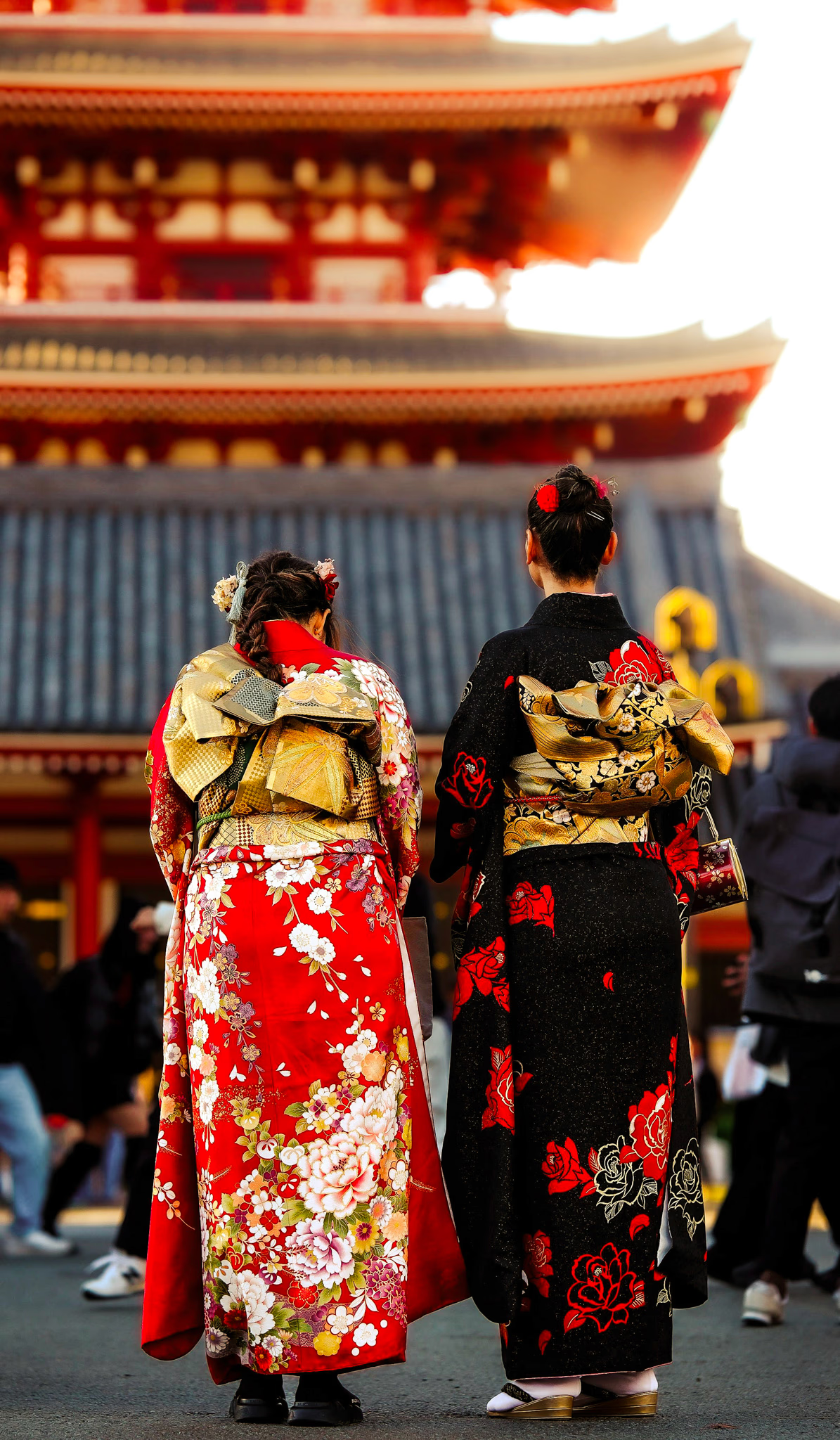
Most visitors to Sensoji do the same thing. They photograph the incense burner, watch other people draw fortunes, stand at the main hall unsure what to do, and leave. For first-time visitors, this is often the only temple they see on the whole trip.
The rituals people photograph (purification, incense, prayer, drawing a fortune) are meant to be done. This is the order.
The Ritual Sequence
Start at the temizuya, the purification fountain near the main hall.
The steps:
-
Hold the ladle in your right hand. Fill it with water.
-
Pour water over your left hand.
-
Switch the ladle to your left hand.
-
Pour water over your right hand.
-
Switch back to your right hand.
-
Cup your left hand. Pour water into it.
-
Rinse your mouth from your cupped hand. Do not touch the ladle to your lips.
-
Spit the water onto the rocks outside the basin, never back into the basin.
-
Hold the ladle upright so the water runs down the handle.
-
Put the ladle back.
You do all of this with one scoop of water.
Next is the incense burner. Waft the smoke over yourself: over your head for wisdom, over your hands for skill. It's how you prepare before approaching the hall.
At the main hall, drop your offering gently into the box. Put your hands together in the Buddhist prayer position and bow once. You can pray silently or say the chant.
Plenty of travel guides get this part wrong. Don't clap. Clapping belongs to Shinto shrines, and Sensoji is a Buddhist temple. Two bows and two claps is the right ritual in the wrong place. (At Meiji Shrine clapping is correct, because the protocol follows the religion.)
"Namu Kanzeon Bosatsu"
The chant is "Namu Kanzeon Bosatsu." It means "I place my trust in Bodhisattva Kannon."
You don't have to say it, and silent prayer is fine. If you'd like to do what temple visitors have done for centuries, though, these are the words.
The Fortune Ritual (Not a Souvenir)
Omikuji is a form of divination, so treat it as more than a photo.
Pay 100 yen. Shake the metal container until a numbered stick falls out, find the drawer with your number, and take one fortune paper.
Sensoji is known for handing out bad fortunes. If you get kyo (bad luck), don't worry, it happens to a lot of people. Tie the paper to the racks set aside for it, and you leave the bad luck behind at the temple.
If you draw a good fortune, keep it.
Why You Probably Won't Do It Anyway
Knowing the steps and actually doing them in front of a crowd are two different things.
The "Am I Allowed?" Hesitation
You'll stand at the temizuya watching everyone else and wondering. Is this only for Japanese people? Will you look silly? Are foreigners even supposed to join in?
Yes, you're welcome. The temple's own information says visitors are welcome to pray and take part. People from many countries, Thai, Chinese, Korean, and Western, take part in their own way, and the temple expects it.
Knowing that still doesn't always give you the nerve at the fountain. The social uncertainty is real.
The Misinformation Problem
Even if you read up first, you might learn the wrong thing.
Big travel platforms get the protocol wrong. One popular tea ceremony operator in Tokyo tells visitors to "bow twice, clap twice" at temples, and a well-known guide booking platform repeats it. That's Shinto shrine protocol applied to a Buddhist temple, and it's wrong in both places, so doing your reading doesn't settle it.
The Facilitation Difference
A book can explain what the pagoda stands for or tell the legend of the fishermen who found the Kannon statue. At Sensoji, a guide is there to get you through the rituals.
Walking Through With You
The guide does the sequence with you and goes first, which makes it normal for you to join in. They stand next to you at the temizuya and show you the hand positions, then walk with you to the incense burner and up to the main hall. At cultural sites, this is what makes a private tour worth it.
You learn by doing it alongside someone. For more on what that looks like in Asakusa, see our Asakusa guide.
Getting the Protocol Right
A guide knows the correct protocol and can settle it on the spot when sources disagree, so you aren't working from a half-remembered blog post.
A guide also picks when you arrive. We aim for the hours when the temple is in use, with drumming from the main hall and chanting in the courtyard, even if that means company.
When to Join, Not Avoid
The usual advice is to go early to avoid crowds. That gets you empty photos, and you miss the temple while people are using it.
The Daily Prayer Schedule
Sensoji holds prayers three times a day:
| Time | Notes |
|---|---|
| 6:00 AM | 6:30 AM from October through March |
| 10:00 AM | |
| 2:00 PM |
The ceremonies include drumming and chanting, and visitors can watch and join in. The temple is quiet at 7:00 AM because nothing is going on. Prayers ended an hour before.
If you want to see the temple in use, time your visit for a service as well as for the crowds.
Special Observance Days
The 18th of every month is Kannon's day, with larger services. March 18 marks the discovery of the Kannon statue in 628 AD and has the Kinryu-no-mai golden dragon dance. October 18 repeats the celebration.
July 9 and 10 are Shiman Rokusen Nichi. A prayer offered on these days is said to count as 46,000 visits.
December 13 is the only day the replica Kannon statue goes on display. The original has been hidden since 645 AD, and not even the head priests have seen it. At 2:00 PM on December 13, the replica carved by the monk Ennin in 857 AD is shown briefly.
If you'd like this kind of participation beyond Sensoji, our traditional culture tours take the same approach at Tokyo's most significant sacred sites.
30 Million Pilgrims Can't Be Wrong
People worry that Sensoji is a "tourist trap." The history says otherwise.
300 Years of Selling to Pilgrims
Nakamise wasn't built for modern tourists. The Tokugawa shogunate let local residents open shops in the late 1600s and early 1700s, and in return the shopkeepers cleaned and looked after the temple grounds.
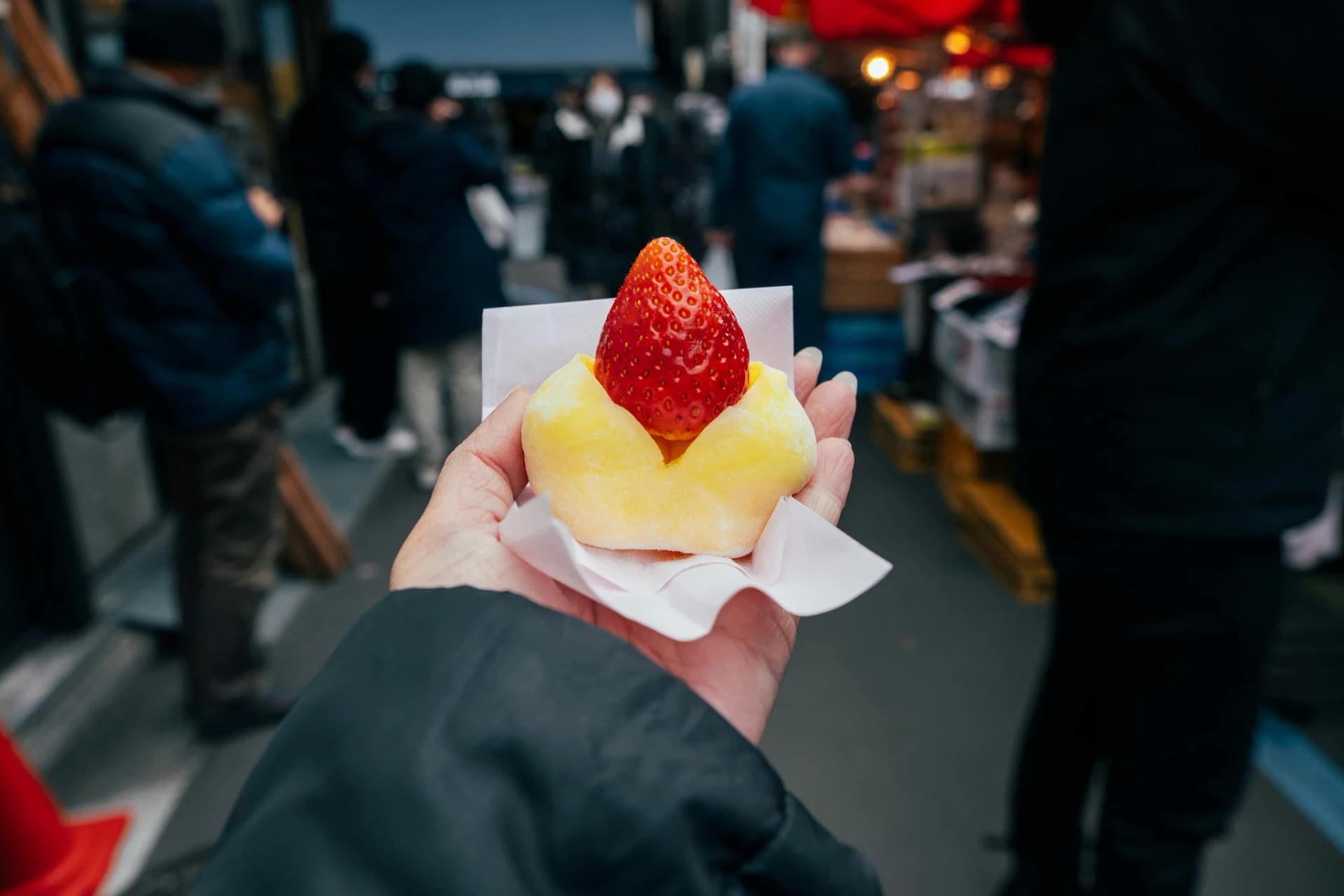
Eighty-nine shops line Nakamise today, and they've been selling to pilgrims for more than three centuries. The street food here is older than most of Tokyo's famous food districts.
Buying a Rice Cracker Is the Tradition
The shopping has always been part of the pilgrimage. Pilgrims needed food, souvenirs, and somewhere to rest, and the shops were providing them before Tokyo was Tokyo.
Thirty million people visit Sensoji every year. They're carrying on 1,400 years of a temple that has always had crowds, shops, and festivals.
An empty temple at dawn is no more authentic than a busy one, since the crowd has always been part of the place.
When Observation Is Enough
You don't have to take part.
If you're coming back to Sensoji and know it well, watching may be all you want. If you're there for photography and want clean shots, that's a fair priority. If you've done your reading and feel confident doing the rituals on your own, a guide adds less. And if Sensoji is a quick introduction before temples in Kyoto, a short visit does the job; our Tokyo Essentials tour has Sensoji as one stop of several.
This page explains what taking part looks like and why most visitors skip it, and watching is a perfectly good choice too.
What Hinomaru One Does Differently
Our guides go through the ritual sequence with you. They go first at the temizuya, stand next to you at the incense burner, and walk up to the main hall with you. You end up taking part because someone showed you how right there, which reading about it beforehand rarely manages.
Hinomaru One plans relaxed, unrushed private Tokyo tours for first-time and seasoned travelers, with plenty of background along the way, and every tour is customized.