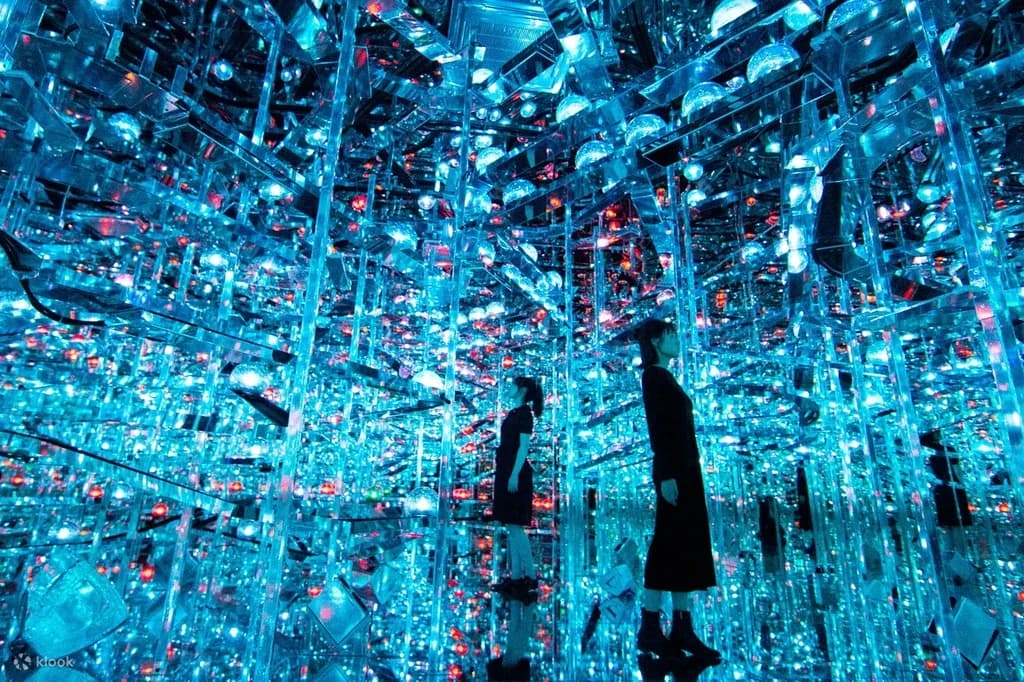
The question isn't "Planets or Borderless?" — it's "What full Tokyo day do I want to build?"
A good teamLab Tokyo guide starts with the full Tokyo day you want to build and picks Planets or Borderless to fit it.
Private tour guides can buy tickets and walk through teamLab alongside you, but there's nothing for them to guide. The experience is self-guided by design, with no path, built for freeform discovery. Whatever a guide adds to that day happens outside the building.
So the question is whether 2-4 hours of your guided day should go to a museum designed to need no guidance. If the answer is yes, then pick the venue, Planets in Toyosu or Borderless in Azabudai Hills, that gives you the rest of the day you're after.
The TeamLab Question Guides Actually Answer
What guides can (and can't) do at teamLab
Guides can buy tickets and go in with you. They pay their own admission, since there's no professional exemption, and once inside they're visitors like everyone else.
TeamLab is built for wandering. There's no fixed path and no scheduled programming, and a guide's knowledge doesn't unlock anything deeper. The projections respond to how you move, and you wander until you feel ready to leave.
A temple, a market, or a museum with permanent collections is different, because there the context is most of what you get out of it.
The 2-4 hour opportunity cost
Visits run 2-3 hours, or 3-4 hours if you add the ramen café or the flower shop. For that whole time a guide's expertise sits idle, because the interpretation they're trained to give has nowhere to go in rooms made for sensory immersion.
Entry is ¥3,600-5,400 per person, on top of whatever you're paying for guided hours. So the question gets economic: would those same hours, in the same area, be worth more with a guide interpreting? That depends on what surrounds each venue.
Planets or Borderless? The Day Design Decision
Most comparisons stick to the exhibitions. Planets has water up to knee height, barefoot walking, and a flower garden with real orchids. Borderless keeps your shoes on, has artwork that flows between rooms, and is accessible at every mobility level. All useful, but it leaves out most of the day.
What surrounds Planets (Toyosu ecosystem)
TeamLab Planets is in Toyosu, Tokyo's wholesale market district. Toyosu Market is 12 minutes on foot, or one Yurikamome stop to Shijo-mae Station. The market has famous sushi restaurants like Sushi Dai (Block 6, 3rd floor) and Daiwa Sushi (Block 5, 1st floor), both serving omakase breakfast from 5:30am.
Next to the market, Toyosu Senkyaku Banrai opened in February 2024 as an Edo-themed complex with 70+ restaurants and Tokyo Toyosu Manyo Club, a 24-hour onsen using water brought in from Hakone and Yugawara. A free public footbath on the 8th floor looks out over Tokyo Bay, and you don't need spa admission to use it.
LaLaport Toyosu is 12 minutes away with 180+ shops, including KidZania Tokyo for families (ages 3-15, 90+ professions in a 2/3 scale city).
What surrounds Borderless (Azabudai-Roppongi ecosystem)
TeamLab Borderless is in Azabudai Hills, which has Japan's tallest building, Mori JP Tower. Tokyo Tower is a 10-minute walk away through Shiba Park.
The Roppongi Art Triangle puts three major museums within walking distance: Mori Art Museum (52nd-53rd floors, Roppongi Hills), National Art Center Tokyo, and Suntory Museum of Art. The ATRo Saving discount takes ¥200 off one museum when you show your ticket stub from another.
At Tokyo Midtown, 21_21 Design Sight was designed by Tadao Ando and founded by Issey Miyake. It hosts design exhibitions in a building that's 70% underground.
How the surrounding area determines your day
Planets puts you by the market and the water, so the day leans toward seafood. Borderless puts you among Roppongi's museums and towers.
A guide earns their fee outside teamLab: getting you through Toyosu Market before the crowds, explaining the ATRo system across Roppongi, knowing which observation point gives the best Tokyo Tower sunset shot, and handling the logistics that join it all into one day.
A Planets Day — Toyosu Market to Odaiba Waterfront
The Toyosu breakfast → Planets morning sequence
The morning version starts early. Toyosu Market restaurants open at 5:30am, and the sushi counters run until early afternoon. Sushi Dai has the longest lines, 3-5 hours at peak, but it now uses a ticket system: you check in and come back at your slot. Daiwa Sushi has twice as many seats and faster turnover (15-30 minute meals versus an hour), with waits of 1-2 hours.
After breakfast, Planets opens at 8:30am. The first slots sell out quickly, though the January 2025 expansion has spread crowds across more space. The new Athletics Forest and Catching and Collecting Extinct Forest add 1.5x the previous exhibition area.
During this stretch, the guide handles market navigation, the timing between sushi and your teamLab entry, and the Edo-era architecture of Senkyaku Banrai if you stop at the free footbath afterward. We cover Toyosu Market as a guided experience separately.
Navigating the market is a real problem. Toyosu Market is split across several buildings, and first-time visitors regularly get confused. Sushi Dai is on the 3rd floor of Block 6 and Daiwa Sushi is on the 1st floor of Block 5, which are different buildings joined by elevated walkways. At Sushi Dai you register your party size and get a time slot. Arrive at 5am and you might get a noon slot. Arrive at 6am and the slots may be gone for the day.
When Planets fits an afternoon slot
The afternoon version leaves you a relaxed morning elsewhere, such as Ginza shopping, Tsukiji Outer Market, or a neighborhood walk, before you reach Planets. Evening slots (7pm+) are now less crowded than morning, because the "book early" advice has saturated and the first slots attract influencer crowds.
After an afternoon visit, dinner can be any of the 70+ restaurants at Senkyaku Banrai or the waterfront cafés at LaLaport Toyosu. The day-fee onsen at Manyo Club is ¥3,850 for adults if you want to finish with a soak. If this structure appeals, Tokyo Essentials includes Toyosu Market navigation as part of a broader Tokyo introduction.
Families: The January 2025 Athletics Forest
The January 2025 expansion made Planets much more relevant for families. The Athletics Forest zone is built around movement, with playground-style physical interactions. In Catching and Collecting Extinct Forest, kids catch 80+ digital animals with a smartphone app, as part of teamLab's educational project.
A visit has grown from 2 hours to 3 with the new zones. If children are in the group, that's a reason to pick Planets over Borderless. Tokyo Together is designed for intergenerational groups who want to do things together.
Vegan Ramen UZU is in the outdoor plaza and needs museum admission to get in. The Kyoto-origin restaurant has held a Michelin Bib Gourmand four years running. Miso ramen is ¥2,000, or ¥3,000 to eat inside the art-room space.
A Borderless Day — Art, Architecture, and Tokyo Tower
The Roppongi art triangle connection
Borderless fits easily into an art-focused day. Mori Art Museum, open until 10pm except Tuesdays, is 12-15 minutes away in Roppongi Hills. The current exhibition, Roppongi Crossing 2025, runs through March 2026.
ATRo Saving works only with physical ticket stubs. Buy at the counter (not online), keep your stub, and show it at the next museum for ¥200 off. National Art Center Tokyo and Suntory Museum of Art make up the rest of the triangle.
21_21 Design Sight takes ¥100 off with a Suntory Museum stub. It opens 10am-7pm, closes Tuesdays, and general admission is ¥1,600.
The guide's job here is explaining exhibition context at Mori Art Museum, moving you between venues efficiently, and giving the background on Tadao Ando's design philosophy at 21_21. If you're mostly interested in Tokyo's built environment, we cover private architecture tours in depth.
Tokyo Tower: 10 minutes on foot
Tokyo Tower is a walk from Azabudai Hills through Shiba Park, 10-13 minutes, past Zojoji Temple, where Tokyo Tower photographs frame behind traditional temple architecture. The classic shot is from the grounds directly in front of the Main Hall. The hall faces east, so early morning light works best, while evening catches the illuminated tower. Azabudai Hills now shows up on the right side of the traditional frame.
Main Deck (150m) admission is ¥1,200-1,500. The Top Deck Tour (150m+250m) is ¥2,800-3,500, and advance booking is recommended. The tower opens at 9am and stays open until 10:30pm (last Main Deck admission at 10pm).
For a sunset from Tokyo Tower, arrive 60-90 minutes before golden hour. A guide can work that out from your Borderless exit time.
When an art-focused day makes sense
This day suits travelers who want interpretation throughout. Mori Art Museum benefits from context in a way the self-guided Planets experience doesn't, and the architecture of Azabudai Hills and Roppongi's design district is worth having explained.
If you want a guide's expertise working from morning to evening, the Borderless area supports that better than Planets, whose main attraction deliberately excludes interpretation. Infinite Tokyo allows fully custom itineraries built around specific interests like contemporary art and architecture.
The 2025 Crowd Reality
Why "book early" no longer works
The usual advice is to book the first morning slot for fewer crowds. It has become self-defeating, since everyone reads the same tips. First slots now sell out first and draw concentrated crowds, especially visitors lining up Instagram and TikTok content.
Traveler reports from 2024-2025 confirm the shift. Weekday first slots no longer guarantee lighter crowds. The influencers arrive early and create bottlenecks in the photogenic spaces.
Evening as the new strategic window
Late evening slots (7pm+) are now less crowded than morning. Official Borderless guidance says the venue "tends to be less busy on weekday mornings AND after 3:00 PM," with weekend crowds thinning "after 5:00 PM."
Dynamic pricing follows demand. Morning and weekend slots cost more (up to ¥5,400-5,600) because they sell first. Evening slots stay available closer to the date and cost less.
How timing affects the rest of your day
With a 9am teamLab slot, the guide's morning hours turn into waiting time. Your guide meets you at your hotel, travels to Toyosu or Azabudai Hills, and then pauses while you go through teamLab on your own.
An afternoon or evening slot keeps the morning and lunch hours guide-active. The market breakfast, the museum circuit, and the neighborhood walk come first, and teamLab becomes the self-guided finale instead of an awkward start.
When TeamLab Might Not Fit Your Guided Day
When the hours are better spent elsewhere
TeamLab doesn't belong in every Tokyo itinerary. Consider skipping it if:
-
Time is limited. On a 3-day Tokyo visit with one guided day, 2-4 hours is a big commitment while the guide's expertise sits unused.
-
You've experienced similar digital art. teamLab runs permanent venues in Singapore, Kyoto, and other cities. If you've seen one, you get diminishing returns.
-
You prefer guide-enhanced experiences throughout. Some travelers want someone explaining things every hour of the day, and teamLab is built to work without that. If that's you, traditional culture tours give the layered explanation that makes temple visits and tea ceremonies meaningful.
-
Photography isn't your priority. Much of teamLab's appeal is visual. If you don't care about capturing images, it's worth less to you.
When teamLab earns its place in a guided day
TeamLab fits some itineraries well:
-
Art-focused day (Borderless). Paired with Mori Art Museum and the Roppongi triangle, Borderless becomes one stop in a curated art circuit where the guide adds value at every other venue.
-
Family day with Athletics Forest (Planets). The January 2025 expansion added genuinely family-oriented spaces. Combined with KidZania or Toyosu Market, teamLab anchors the day without taking it over.
-
Waterfront day (Planets + Toyosu). With a sushi breakfast, teamLab, an onsen footbath, and sunset at the waterfront, the self-guided hours feel like part of the plan.
If the guide is doing real work on either side of teamLab, the hours inside feel like a break in a good day.
Practical Details — Tickets, Prices, Timing
Current pricing (2025)
Both venues use dynamic pricing based on date and time:
-
Planets: ¥3,600-5,400 for adults. Children (4-12) ¥1,500-2,000. Under 3 free.
-
Borderless: ¥3,600-5,600 for adults. Similar child pricing.
Morning slots and weekends sit at the high end. Evening and weekday slots cost less.
Book 2-3 weeks ahead for popular time slots, especially weekends and school holidays. First morning slots sell out earliest, and evening slots stay available closer to the date.
What to know before you arrive
| Planets | Borderless | |
|---|---|---|
| Shoes | Remove at entry | Keep on throughout |
| Floors | Water to knee height; mirrored areas | Hard, flat; mirrored areas |
| Clothing | Wear shorts or roll-up pants. Free loan shorts available. Shorts under skirts for mirrors. | White/plain clothes photograph best. Shorts under skirts for mirrors. |
| Lockers | Free, accessible between exhibition areas | Free, no access once inside until exit |
| Food | Vegan Ramen UZU outside (requires admission) | EN TEA HOUSE café inside |
| Accessibility | Water and barefoot areas limit mobility options | Fully accessible |
Both venues:
-
Only phones and cameras allowed inside. No tripods, selfie sticks, or fanny packs.
-
No outside food or drinks.
-
Plan 2-3 hours minimum. Planets now takes 3 hours with the expanded areas.
Where Hinomaru One Fits
Your guide's work is in the hours before and after teamLab: timing your Toyosu Market breakfast to your Planets entry slot, or sequencing Borderless with Roppongi's art museums and the Tokyo Tower sunset.
At Hinomaru One, we design culturally rich, stress-free private Tokyo tours for first-time and seasoned travelers, unrushed and always customized.