Fall foliage timing is messier than guides admit—two separate peaks, a 3-day crossover window, and crowd dynamics that make arrival time matter more than location choice.
Tokyo fall foliage timing is messier than most guides admit. There are two separate peaks, a 3-day window where they overlap, and crowds that make your arrival time matter more than which spot you pick.
On paper it looks simple: the trees turn in November, you find the famous ginkgo avenue, you take photos. In practice, ginkgo peaks November 25-27 and maple peaks November 28-December 2. Meiji Jingu Gaien is mobbed by 1 PM on Saturdays, and the light that makes a photo worth keeping only shows up at 7:30 AM or late in the afternoon. Most first-time visitors work this out after losing their first day.
Why "Visit Tokyo in November" Isn't Enough
Foliage guides tell you to come "mid-November to early December" for peak colors. That squeezes three weeks into one line and skips how Tokyo's foliage actually behaves.
The Two Waves Most Guides Don't Explain
Tokyo has two foliage peaks, and they run on different schedules:
| Tree Type | Peak Dates | Color |
|---|---|---|
| Ginkgo | November 25-27 | Yellow |
| Maple | November 28 - December 2 | Red |
| Both near peak | November 27-29 | 3-day window |
Come November 15-20 and you'll see pre-peak colors, mostly green with a little yellow. Come December 5 and you've missed the ginkgo completely and caught only the tail of the maple.
Why Timing Varies More Than Cherry Blossoms
Foliage timing moves 1-2 weeks from one year to the next depending on autumn temperatures. Cherry blossoms move about a week.
Cherry blossom forecasts get accurate 4-6 weeks before bloom, once the green buds appear. Foliage stays uncertain until mid-October, when the temperature pattern becomes clear.
A warm autumn pushes the peak later and a cold one brings it earlier. The Japan Meteorological Corporation puts out weekly foliage forecasts from October, and they move by several days as new data comes in.
When "Mid-November" Actually Means
Mt. Takao, in western Tokyo, peaks 2-4 weeks ahead of central Tokyo, in early to mid-November. If you're in Tokyo November 10-15, Mt. Takao will be at 80-100% of peak while Meiji Jingu Gaien is still mostly green.
The central spots (Meiji Jingu Gaien, Rikugien Garden, Shinjuku Gyoen) peak from late November into early December.
If your dates are fixed in early November, you'll still see foliage, just at different elevations and stages. For the wider seasonal picture, see our guide to fall in Tokyo.
What Makes Foliage Tours Different From DIY
Google "Meiji Jingu Gaien" and the ginkgo avenue comes right up, so finding the trees takes a minute. Getting the timing right for each spot takes a lot longer, and it decides whether your photos come out flat or good.
The Four Things That Aren't Obvious Until You Miss Them
Location scatter creates navigation problems. Meiji Jingu Gaien (ginkgo) is in one part of Tokyo and Rikugien Garden (maple) is in another. Shinjuku Gyoen has both, but only some of its gates are convenient. Mt. Takao is an hour from central Tokyo.
First-time visitors lose 2-3 hours per day to navigation: wrong exits, confusing transfers, working out which entrance to use. By your third location you've spent longer on trains than looking at leaves.
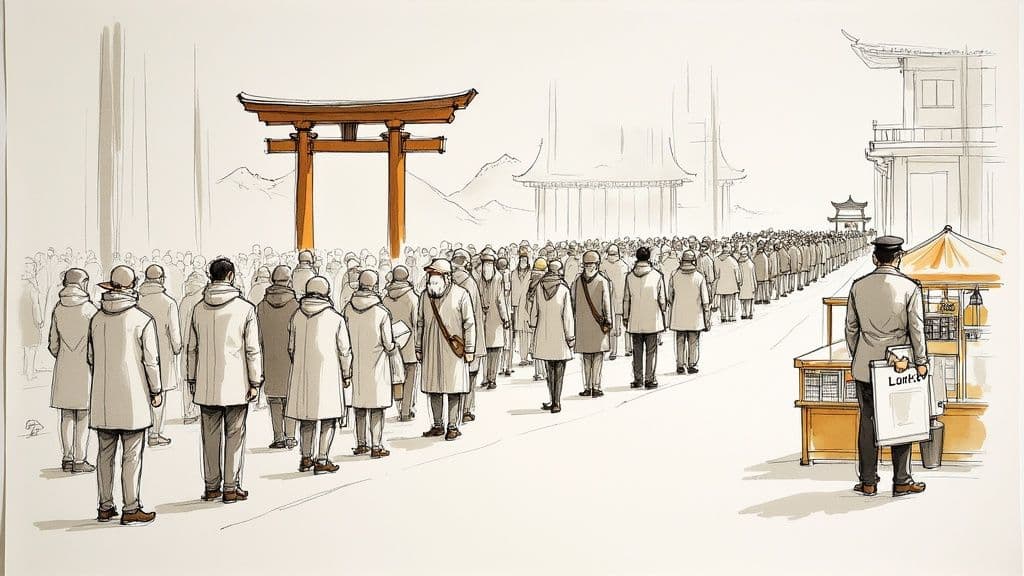
Crowd timing changes everything. Meiji Jingu Gaien at 7:30 AM on a weekday is peaceful. At 1 PM on a Saturday it's wall-to-wall people.
On a peak-season weekend you'll queue just to get into Rikugien Garden, and on a weekday afternoon you'll have room to enjoy it. Our page on avoiding crowds in Tokyo covers timing tactics that work in any season.
Photography timing matters as much as location. Ginkgo wants backlit golden-hour light, early morning or late afternoon. Harsh midday sun washes out the yellow, and noon photos look flat next to early ones.
Maple is the opposite. It photographs better in soft overcast light with no hard shadows on the red leaves, so a cloudy day helps your maple shots and makes the ginkgo look dull.
Real-time adaptation requires monitoring forecasts. Going by last year's peak dates will put you off by a week. Guides read the Japan Meteorological Corporation's weekly reports and adjust to what's happening now.
If the ginkgo peaked early, they lean on maple and secondary spots. If rain is forecast, they plan around indoor-outdoor combinations or the evening illuminations.
Why 7:30 AM Matters More Than Which Spot You Visit
Here's Meiji Jingu Gaien at 7:30 AM compared with 1 PM on a Saturday:
| 7:30 AM | 1 PM Saturday | |
|---|---|---|
| Crowds | Peaceful | Wall-to-wall; some people give up after 20 minutes |
| Light | Golden hour, backlit | Harsh midday, washed out |
| Photos | Clean shots, full tunnel effect | A clear shot is close to impossible |
| Street | Open to traffic, empty | Closed, pedestrian mall |
It's the same at every major foliage spot: early morning or late afternoon beats midday, and weekdays beat weekends. Our guide to the best time of day for tours applies the same logic to other activities.
What Evening Illumination Changes
Rikugien Garden runs evening illuminations in foliage season, November 28 - December 9. It stays open until 8:30 PM (last entry 7:30 PM) instead of closing at the usual 5:00 PM.
The trees are lit from below, the maples reflect in the pond, and there's projection mapping on the storehouse walls. It feels nothing like a daytime visit, and most tourists don't know it happens.
Tickets are ¥1,200 on the day (cash only at the counter, with 10-20 minute waits on weekends) or ¥1,000 bought ahead online. Buy ahead for weekends, because they sell out.
When a Guide Actually Makes Sense
Foliage tours aren't for everyone. Guided and DIY both work, and which one suits you depends on your trip. Are private tours worth it goes through the general trade-offs.
The Time vs. Experience Trade-off
DIY saves money and costs time: 2-3 hours per day on navigation, wrong exits, and confusing transfers.
A guide costs money and saves that time. They handle the navigation, know the best time for each spot, and adjust the day to the light and the crowds.
So ask yourself whether your time in Tokyo is short enough that hours lost to navigation hurt, or whether you have 5+ days and like figuring things out.
When DIY Makes Perfect Sense
| DIY works if you... | Guide makes sense if you... |
|---|---|
| Have 5+ days in Tokyo | Have 2-3 days |
| Don't mind trial and error | Care about photography timing |
| Just want to see pretty leaves | Want ginkgo and maple in one day |
| Plan to visit one location | Are visiting during the peak window (Nov 25 - Dec 2) |
| Enjoy figuring things out | Can't afford to guess wrong |
Unlike cherry blossoms, autumn leaves don't blow away in the rain. Once the peak arrives, the color holds for several days, so if you have time to adjust and try again tomorrow, DIY works fine.
What you pay a guide for is the timing: when the light is right at each spot, which order to go in, and what to change when conditions shift. What it's like touring with a private guide explains how that works in practice. If photography is the point of your trip, photography-focused tours build the day around golden hour and the evening illuminations.
What a Foliage Tour Actually Solves
Google "best fall foliage Tokyo" and you'll get 10 listicles telling you where to go. A foliage tour works out the rest: which spot, in what order, at what time of day, given today's conditions.
Crowd avoidance. Aoyama Cemetery sits next to Meiji Jingu Gaien and has ginkgo just as good, scattered among stone lanterns and old tombs, with about one-tenth of the crowd. When even Aoyama feels busy, Gyoko-dori Avenue near Tokyo Station has ginkgo against the Marunouchi towers and is rarely crowded.
Efficient sequencing. Meiji Jingu Gaien, then Aoyama Cemetery (a 5-minute walk and much quieter), then over to Rikugien for maple, then Shinjuku Gyoen for both. That keeps train time down and leaf time up. You can walk to Meiji Jingu Gaien from Harajuku, so it's easy to fold into other sightseeing.
Rikugien vs Yanaka: The Famous Garden Tradeoff
Rikugien Gardens is Tokyo's most famous foliage spot, which also makes it the hardest to enjoy at peak.
| Rikugien | Yanaka | |
|---|---|---|
| Foliage quality | Best in Tokyo: lots of maple and ginkgo, very well kept | Good, not spectacular; part of the streetscape |
| Travel time | 30-40 min each way from central Tokyo | 10-15 min from Shimbashi/Ueno |
| Peak crowds | 10-20 min waits; much longer for illuminations | No waits, no queues |
| What else is there | Garden only | Temples, Yanaka Ginza shopping, old Tokyo atmosphere |
| Wheelchair access | NOT fully accessible: much of the garden, including most scenic spots, is out of reach | Temple areas vary; shopping street is flat and manageable |
| Best for | 7-10 day trips, foliage-first visitors | 3-4 day trips, foliage as background |
Accessibility note: If mobility is a concern, Shinjuku Gyoen is much better for wheelchairs than Rikugien. It has free wheelchair rental at each entrance, accessible toilets, and paved paths through most areas. The Japanese Garden section is harder going, but the Western and French formal gardens are fully accessible. Wheelchair users should come in through the Shinjuku Gate from Shinjuku Station or Shinjuku-sanchome Station, because the other nearby stations have stair-only exits.
Rikugien earns its reputation. It was built 1695-1702 as an Edo-period strolling garden, and its foliage is the most intense in Tokyo. The peak-season illuminations give you photos a daytime visit can't.
Getting there is the catch. On a peak Saturday afternoon it's 30 minutes there, 20 minutes in line, 45 minutes inside, and 30 minutes back. That's 2+ hours of overhead for 45 minutes of looking, which is a lot to spend on a 3-4 day trip.
Travelers often rate Yanaka higher because you're already there for the temples, the Yanaka Ginza shopping street, and the old Tokyo feel, and the foliage comes along with the rest of the day.
Time of day matters a lot. At 7 AM in late November, gardens and temples are close to empty, and by 11 AM they're crowded. Weekdays are far quieter than weekends. In cherry blossom season the crowds are extreme no matter when you go, while fall crowds rise and fall by hour and day, so good timing pays off.
The 7:30 AM Advantage
Most tour operators start at 9 or 10 AM. Starting at 7:30 AM means:
-
Reaching Meiji Jingu Gaien ahead of the crowds
-
Clean photos with no tourists in the frame
-
Golden hour light
-
Time for 3-4 locations at an easy pace, where a later start gets you 1-2 rushed stops
Not everyone wants a 7:30 AM start. If photography matters to you or you want to dodge crowds, though, it's the start time we'd push for.
Getting There: Station Access for Major Foliage Spots
If you're doing it yourself, knowing the exact station and exit saves a lot of time:
| Location | Nearest Station | Line(s) | Exit | Walking Time |
|---|---|---|---|---|
| Meiji Jingu Gaien | Gaienmae | Ginza Line | Exit 2 | 3 min |
| Meiji Jingu Gaien | Aoyama-itchome | Ginza/Hanzomon/Oedo | Exit 1 | 5 min |
| Rikugien Garden | Komagome | JR Yamanote/Namboku | South Exit | 7 min |
| Shinjuku Gyoen | Shinjuku-gyoenmae | Marunouchi | Exit 1 | 5 min |
| Shinjuku Gyoen | Shinjuku-sanchome | Marunouchi/Fukutoshin | Exit C1 | 8 min |
| Koishikawa Korakuen | Iidabashi | JR/Metro | Exit A1 | 8 min |
| Yanaka Cemetery | Nippori | JR Yamanote | West Exit | 5 min |
| Mt. Takao | Takaosanguchi | Keio Line | Main Exit | At trailhead |
Navigation tips:
- Switch Google Maps to "walking" mode once you're out of the station; GPS is reliable above ground
- Meiji Jingu Gaien's ginkgo avenue runs north-south, so come from Gaienmae for the famous tunnel view
- Rikugien has two entrances, the main gate (染井門) and the side gate (駒込門), and the ticket office is at the main gate
- Shinjuku Gyoen closes at 4:30pm (4pm in winter), with last entry 30 min before
DIY vs Guided: The Cost Comparison
Here's what a fall foliage day costs each way:
| Expense | DIY | With Guide |
|---|---|---|
| Transportation | ¥800-1,500 (~$6-10) | Mostly walking; you pay for trains |
| Garden admissions | ¥500-1,200 (~$3-8) | Same; you pay directly |
| Lunch | ¥1,500-3,000 (~$10-20) | Same; you pay directly |
| Guide fee | $0 | $430-550 for 6-8 hrs (2 people) |
| Navigation time lost | 2-3 hours | 0 |
| Wrong timing mistakes | Likely on a first attempt | Unlikely |
| Total (2 people) | ~$40-60 + time | ~$470-600 |
The math: For a couple, a guided foliage day costs roughly $400 more than doing it yourself. That buys you a day planned around this week's conditions by someone who reads the foliage reports every week.
When DIY makes sense:
- You have 5+ days and can spare a "learning day"
- Photography isn't a priority
- You're going to one location rather than juggling several
- Budget is the main constraint
When guided makes sense:
- You have 2-3 days during the peak window
- Photography timing matters (golden hour, illuminations)
- You want ginkgo and maple in one well-planned day
- You're there for the November 27-29 crossover window (the trickiest timing)
Timing Your Visit (If You're Doing It Yourself)
Getting the timing right matters more than which spots you choose. For planning the whole trip, our guide to the best time to visit Tokyo covers every season.
When to Check Forecasts
Start checking 4-6 weeks before your trip. The early forecasts are rough but give you a window, and they get more accurate two to three weeks out.
The Ideal Window for Both Types
If you want ginkgo (yellow) and maple (red) both near peak:
| Your Dates | What You'll See | Best Strategy |
|---|---|---|
| November 15-25 | Ginkgo coming on, maple mostly green | Go to Mt. Takao for early color |
| November 27-29 | Both near peak (crossover window) | Plan around this window |
| November 30 - December 7 | Ginkgo past peak, maple in full color | Focus on maple spots; fallen ginkgo leaves make a golden carpet |
What to Do If Your Dates Are Off
Arriving too early (early November)? Head to Mt. Takao (it peaks 2-4 weeks ahead of central Tokyo), or accept pre-peak colors.
Arriving too late (mid-December)? Stick to maple spots (Rikugien, Koishikawa Korakuen), where some color may hang on.
Build flexibility if possible. Leaving 2-3 days loose in your schedule lets you move with the real conditions.
What to Know About Foliage Tours
Tour Format Options
| Format | Duration | Best For |
|---|---|---|
| Full-day | 6-8 hours | Ginkgo or maple focus, depending on timing |
| Multi-day | 2 separate tours | Both types, 3-5 days apart |
| Photography-focused | Starts 7:00-7:30 AM | Golden hour + evening illumination |
Tour duration options helps you choose based on your schedule. Every tour is fully customizable, so if there are places you want to prioritize or photos you're after, the guide plans the day around them. Infinite Tokyo suits combining foliage with other interests, and Tokyo Essentials works well for a full day focused on foliage.
Booking Windows for Peak Season
Foliage season (mid-November) is peak demand, on par with cherry blossom season.
8-12 weeks advance booking recommended for November dates. The prime dates (Thanksgiving week and the November 27-29 crossover window) book up 6 months ahead. How far in advance to book breaks this down by season.
Last-minute bookings work, but guide availability is limited, and inside 2-3 weeks of your dates it's hit-or-miss.
Booking early also leaves more time for the pre-tour consultation, where you talk through your interests and the guide starts planning your itinerary. The booking process explains how the consultation and guide matching work.
What Happens If Colors Are Off
Foliage timing moves 1-2 weeks from year to year. Guides follow the weekly reports and adapt, shifting to maple-heavy spots if the ginkgo peaked early or to Mt. Takao if the maple is late. The tour goes ahead either way with an itinerary that fits the conditions.
Tours run in any weather unless you cancel. Rain doesn't ruin foliage, because the leaves don't blow off the way cherry petals do. What happens if it rains explains how guides change the route.
Accessibility for Fall Foliage Viewing
Foliage spots vary a lot for wheelchair users and anyone with limited mobility. Traditional Japanese gardens put looks ahead of access, and the gravel paths, uneven stepping stones, and small changes in level make them hard going.
Location Accessibility
| Location | Wheelchair Access | Walking Difficulty | Notes |
|---|---|---|---|
| Meiji Jingu Gaien | Excellent | Easy (flat sidewalks) | Best access of any foliage spot. Wide paved paths. |
| Shinjuku Gyoen | Good | Easy-moderate | English/French gardens accessible. Japanese garden section has gravel. Wheelchair rental at the gate. |
| Ueno Park | Good | Easy | Wide paved paths throughout. Museums next door fully accessible. |
| Koishikawa Korakuen | Limited | Moderate | Traditional garden. Some paved sections, but mostly gravel and uneven ground. |
| Rikugien Garden | Limited | Moderate | Classic stroll garden with gravel, bridges, and uneven surfaces. Wheelchair users can get around the edge but not the full circuit. |
| Hamarikyu Gardens | Partial | Moderate | Main paths accessible. The island tea house is over a bridge with steps. |
| Mt. Takao | Not accessible | Difficult | Mountain hiking. The cable car is accessible; the trails are not. |
Accessibility-Focused Foliage Itinerary
If mobility is a concern, this is the best foliage day:
- Morning: Meiji Jingu Gaien ginkgo avenue (flat, excellent access)
- Midday: Lunch in Omotesando (accessible restaurants)
- Afternoon: Shinjuku Gyoen English/French gardens (paved paths, wheelchair rental)
That skips the traditional gardens, where the best foliage is often over difficult ground.
Station Accessibility Notes
| Station | Elevator Access | Notes |
|---|---|---|
| Gaienmae (Ginza Line) | Yes | All exits |
| Komagome (Rikugien) | Yes | Elevator at south exit |
| Shinjuku-gyoenmae | Yes | Exit 1 has elevator |
| Iidabashi (Korakuen) | Yes | JR and Metro elevators |
Every station serving the major foliage spots has elevators, though some routes to the accessible exits are long. Check the Toei/Metro accessibility maps or ask station staff.
Family-Friendly Foliage Viewing
Foliage days work well for families with a different pace and different spots from an adults-only trip.
Stroller-Friendly Locations
| Location | Stroller Access | Notes |
|---|---|---|
| Shinjuku Gyoen | Good | Paved paths through the French and English gardens. Japanese garden section is harder. Wheelchair/stroller rental. |
| Meiji Jingu Gaien | Excellent | Flat, wide sidewalks along the ginkgo avenue. Easy viewing. |
| Ueno Park | Good | Wide paved paths. Several playgrounds nearby for breaks. |
| Rikugien | Limited | Traditional garden with gravel paths and uneven ground. Not recommended with a stroller. |
| Mt. Takao | Not practical | Hiking trails. Leave the stroller at the hotel. |
Kid-Friendly Strategies
Shorten viewing time, add play breaks. Kids don't need 45 minutes in each garden. Give them ten to fifteen minutes of "look at the pretty leaves," then a playground or a snack. Ueno Park has several playgrounds inside the foliage area.
Morning over afternoon. Kids have more energy and patience in the morning, and crowds are lighter before 10am, so there's less stroller wrangling.
Ginkgo over maple for young kids. The carpet of fallen ginkgo leaves at Meiji Jingu Gaien is something kids can play in. They can kick through the leaves, pick them up, and make piles. Maple viewing in a traditional garden is much more look-but-don't-touch.
Have an indoor backup. If the kids hit a wall, go indoors. Ueno has museums (the National Museum of Nature and Science has dinosaurs), and Shinjuku has playgrounds on department store rooftops.
Evening illumination is magical but late. Rikugien's illumination starts at 5pm and runs until 8:30pm. That's fine for older kids (8+) and hard on toddlers used to an early bedtime.
Where Hinomaru One Fits
Our guides follow the weekly foliage forecasts and plan your day around this year's conditions instead of last year's peak dates. A 7:30 AM start gets you to Meiji Jingu Gaien ahead of the crowds. When the main spots are mobbed, they switch on the day to quieter places like Aoyama Cemetery or Gyoko-dori. Photography-focused tours include the evening illumination at Rikugien.
At Hinomaru One, we plan private Tokyo tours for first-time and returning travelers, at an unhurried pace, with a guide who explains what you're seeing, and every one is customized.