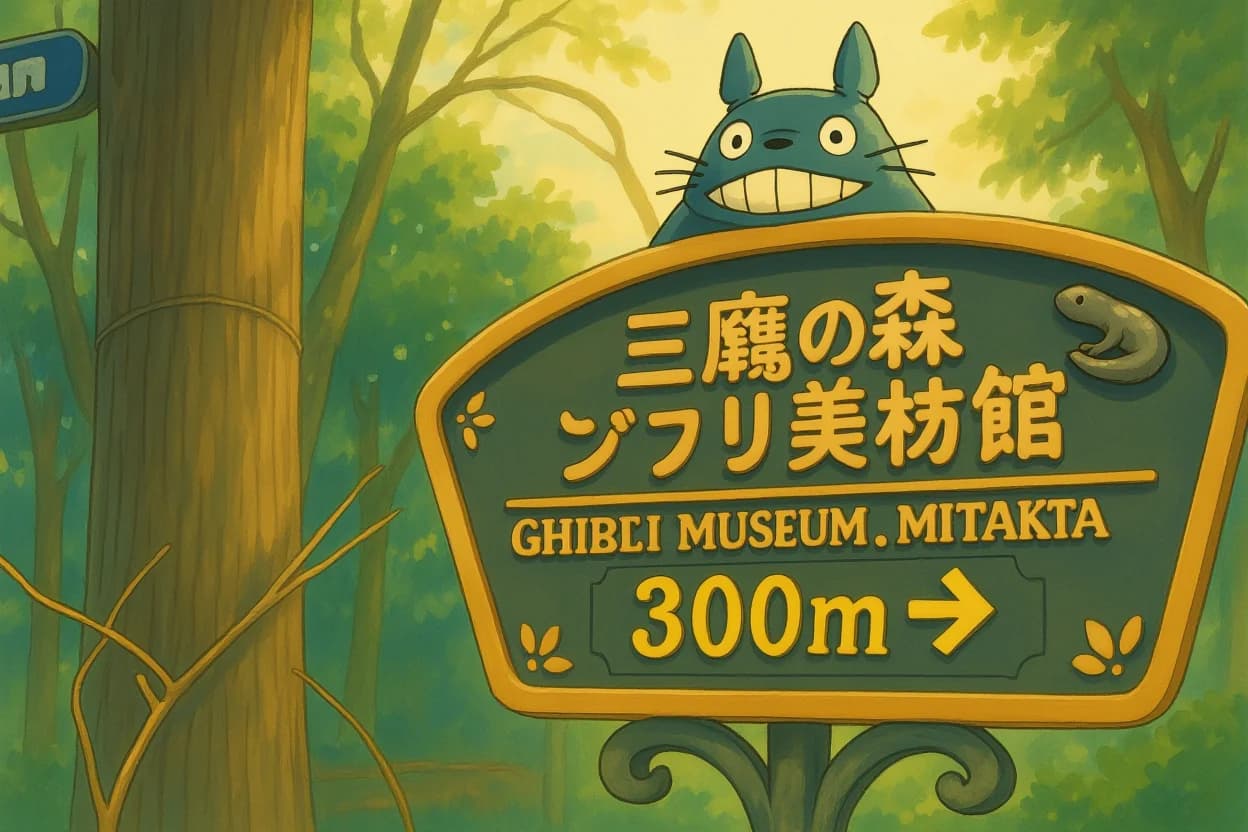
The museum visit runs 2–3 hours. The question is what you build around it.
The first thing to understand about the Ghibli Museum is that it was designed to resist documentation. No photographs inside. No fixed path. No audio guide narrating what you're looking at. The experience is built for presence — and it stays that way because the museum enforces it.
The second thing to understand is that this design has a practical consequence for guided tours: private tour guides can arrange tickets and design your full day around the visit, but they cannot guide you through the museum itself. The building is dense, maze-like, full of hidden staircases and unexpected rooms. You explore it at your own pace. That's the point.
So the right question isn't "how do I visit the Ghibli Museum." It's how do you secure tickets that sell out two months in advance, what's waiting inside when you arrive, and what full day do you build around 2–3 hours of independent exploration in Mitaka.
The Ticket Problem — And How to Solve It
How the system actually works
The Ghibli Museum sells no tickets at the entrance. Every visitor must book in advance. The booking system opens on the 10th of each month at 10:00 AM JST for the following month — meaning if you want to visit in May, you need to be online on April 10th at exactly 10am Tokyo time.
Tickets are sold through Lawson Ticket (l-tike.com/ghibli/). The catch: the system requires a Japanese phone number for SMS verification. This creates a real barrier for foreign visitors booking from abroad.
July and August operate differently. Summer demand is high enough that those months use a separate lottery system rather than standard booking. Apply early if you're traveling during school holidays.
For visitors booking from outside Japan
Several approaches work:
Through authorized travel agents. JTB Group and other licensed tour operators hold ticket allocations specifically for international visitors. You pay a premium, but you bypass the Lawson system entirely. This is the most reliable path for foreign visitors who can't access the Japanese booking platform.
Through a private tour operator. Tour operators with local relationships can handle ticket acquisition as part of a full day package — transport, timing, and itinerary built around your entry slot.
If you have Japanese phone access. Create a Japanese phone number via SIM card or eSIM before booking day. Register with Lawson Ticket in advance. Be online at exactly 10:00 AM on the 10th.
The realistic takeaway: book 2+ months in advance through whichever channel you can access. Summer visitors need even more lead time.
Pricing and what to know about entry
| Age | Price |
|---|---|
| 19 and over | ¥1,000 |
| 13–18 | ¥700 |
| Under 13 | Check official site for current rates |
Tickets are non-refundable. No changes after booking. Identity verification may be required at entry — bring the ID you used when purchasing.
Timed entry slots run at 10:00, 11:00, 12:00, 13:00, 14:00, 15:00, and 16:00. You can generally enter up to 30 minutes after your assigned slot, but arriving early lets you start before the cumulative crowd inside builds up.
What's Inside
The museum is small. The building is not. Three floors, staircases that appear where you don't expect them, doorways that connect rooms you thought were separate. First-time visitors consistently describe the feeling of the architecture itself as part of the exhibit.
A few things that earn the visit:
The Saturn Theater
This is the one element you genuinely can't experience anywhere else. The Saturn Theater (土星座) screens original short films made exclusively for the museum — animations that have never been released outside these walls and never will be. The program rotates with exhibitions. The current program includes Sora Iro no Tane (Sky-Colored Seed), a 90-second Miyazaki-directed short debuting in 2025, alongside Kujira Tori (Whale Catching), adapted from Chie Nakagawa's picture book.
Your entry ticket includes one screening. The films are in Japanese with no subtitles, but they're visual enough that language is rarely a barrier.
The animation process exhibits
The museum's clearest statement of purpose is in the permanent animation exhibits. The Trace & Color Room on the first floor shows how characters move from pencil sketch to finished frame — the actual finishing process, not a simplified version. Storyboard (絵コンテ) drafts are displayed alongside finished scenes so you can see the gap between initial idea and final movement.
The Workspace Display ("Monogatari-ru Basho") recreates a director's desk as it might actually exist during production — cluttered, specific, annotated. Miyazaki's quotes on creative struggle run along the walls. This is not a sanitized retrospective. It shows the work.
The rooftop and the Robot Soldier
The rooftop terrace features the iron Robot Soldier from Castle in the Sky, overgrown with plants. It's the exterior shot most people know from photos and one of the few places outside where photography is permitted. The garden area is genuinely lovely and easy to miss if you don't find the exit to the upper level.
The Cat Bus Room
For children under elementary school age, this is the centerpiece. A full-scale Cat Bus from My Neighbor Totoro — soft, climbable, interactive — sits in a dedicated room. Young children tend to spend most of their energy here. Plan your time accordingly.
The 2025 exhibition
The current major exhibition — "Yamawaki Yuriko's Workroom" — runs November 2025 through May 2027. It explores illustrated books co-created by Yuriko Yamawaki and her sister Chie Nakagawa, the same relationship behind the Saturn Theater program. This exhibition runs for the better part of two years, so visitors in 2026 and early 2027 will experience it as the featured show.
The No-Photography Rule
No cameras, no phones for photos, no exceptions inside the museum.
This decision is architectural as much as it's a policy. The museum was designed for repeat visits — because the building hides things. Returning visitors find rooms they missed the first time. Photographs would reduce the museum to its most obvious surfaces. The no-photo rule keeps the building doing its intended work.
What this means practically: you'll experience the museum more slowly than you might expect. Without the reflex to document, you look differently. Most visitors describe this as a feature. A few find it frustrating. Know which kind of traveler you are before you go.
The Crowd Reality
Which slot to choose
Entry slots are not a rotate-out system. You enter at your assigned time and can stay until closing. The crowd inside accumulates across the day.
The first entry slot (10:00) consistently sees the lightest crowd. By 14:00, the museum is noticeably more packed. The last slot (16:00) produces the densest conditions in the museum shop and café.
Weekdays during non-holiday periods are meaningfully less crowded than weekends. The museum is closed Tuesdays.
School holidays — late March through early April, mid-July through late August, and late December through early January — are the highest-demand periods. These are also when the summer lottery system applies. If your trip overlaps with Japanese school breaks, plan further ahead and verify the current booking mechanism.
The café situation
Café Straw Hat (麦わらぼうし) is inside the museum and requires admission to access. During peak periods — weekends and school holidays — waits of 90 minutes have been reported. If café time matters to you, plan to eat early in your visit rather than end with it, or eat before you arrive.
How to Build the Day
The Kichijoji approach
Most visitors arrive via Kichijoji Station, the main hub for this area of western Tokyo. From the South Exit (also called the Park Exit), you have two options:
Bus (5–7 minutes). Buses departing toward Chofu run every 2–5 minutes and stop at Mansukebashi (万助橋), closest to the museum. The Ghibli Museum Loop Route is explicitly signed. This is the faster option.
Walk through Inokashira Park (15 minutes). The park path is genuinely pleasant — a forested walk alongside a lake that builds toward the museum rather than breaking the mood. If the weather is good and your time allows, this is the better arrival experience.
The Ghibli Museum sits inside Inokashira Park. The park itself is worth time before and after your visit. The lake is central, there's a small zoo and shrine, and the atmosphere is quieter than most Tokyo parks.
Kichijoji has enough depth for 2–3 hours beyond the park. Harmonica Yokocho (ハーモニカ横丁) — a narrow alleyway of bars and small restaurants near the station — is worth seeing for architecture alone, even if you don't eat there. The shopping streets around the station cover everything from vintage to mainstream retail. A guide familiar with western Tokyo neighborhoods can thread these into a half-day that ends long before your evening train.
The Mitaka approach
Mitaka Station is the closest station to the museum — about a 5-minute ride on the Ghibli-illustrated community bus (yellow, unmistakable). This is the route if you've already spent time in Kichijoji or if your hotel is on the Chuo Line.
Walking from Mitaka takes 15–20 minutes via the Tamagawa Josui canal path — a quiet residential route that's a genuine alternative to the bus if you're in no hurry.
Where guide value lives
A private tour guide cannot accompany you through the Ghibli Museum. The museum's policy restricts guided tour formats inside — the building is designed for individual exploration.
What guides provide around a Ghibli Museum day:
- Ticket acquisition through professional channels, removing the Lawson booking barrier entirely
- Timing the arrival, park walk, and café visit to minimize wait times
- Kichijoji before and after — the neighborhood has layers that reward someone who can explain what you're walking through
- Context on Studio Ghibli's production history and Miyazaki's philosophy, which makes the animation process exhibits land differently
- The full day shape: museum plus Inokashira Park plus neighborhood plus dinner
For families, a Tokyo Together experience can build a day that makes the Ghibli Museum its anchor without the 2–3 hour visit becoming the whole itinerary. For travelers who want a fully custom western Tokyo day, Infinite Tokyo allows the itinerary to be built around whatever combination of Ghibli, Kichijoji, and surrounding neighborhoods suits your interests.
Families: What to Expect
The Cat Bus Room is for young children (under elementary school age). It's interactive, physical, and genuinely delightful for kids who know the film. The experience has historically had a time limit to manage volume — verify current operations before treating it as unlimited playtime.
The museum is multi-story with staircases throughout. Strollers are restricted in some areas. A baby carrier is essential if you have an infant or toddler. The maze-like layout is exciting for children old enough to explore independently and genuinely exhausting for parents carrying a child too young to walk.
For a lower-key animal encounter afterward, Tokyo's cat cafés are an easy add to a family day and require none of the advance booking the museum does.
Recommended visit duration for families: 2–3 hours, not more. The exhibits reward attention, but young children reach saturation before adults typically want to leave. A shorter, energized visit is better than a long, tired one.
Practical Details
| Details | |
|---|---|
| Hours | 10:00–18:00 (last entry 16:00) |
| Closed | Tuesdays (some holiday Tuesdays may open) |
| Address | 1-1-83 Shimorenjaku, Mitaka, Tokyo |
| Tickets | Advance only — Lawson Ticket or authorized agents |
| On-site purchase | Not available |
| Photography | Exterior and rooftop permitted; interior strictly prohibited |
| Payment | Bring cash for café and shop (some vendors card-only; confirm) |
| Entry slots | 10:00, 11:00, 12:00, 13:00, 14:00, 15:00, 16:00 |
Arrive 15–20 minutes before your entry slot. The queue for verification and entry can move slowly when multiple entry windows converge. Early arrival ensures you don't lose time to a line outside.
The museum is closed in December at reduced hours. December 26 has historically operated morning-only (closes at 15:00). Verify current holiday hours on the official site before visiting in late December.
Frequently Asked Questions
Is the Ghibli Museum worth it?
Yes, for most visitors — but it helps to know what you're buying. The museum is small, deliberately hard to navigate, and has no photography inside. It's not a Ghibli film retrospective. It's an exploration of how animation is made, told through the philosophy of a studio that treats craft as serious work. The Saturn Theater alone — exclusive short films made only for this museum — is something you can't experience anywhere else. If Ghibli films matter to you, the visit is worth it. If you're going because it's famous, manage expectations.
How far in advance do I need to book tickets?
At least 2 months, ideally more. Tickets release on the 10th of each month at 10:00 AM Japan time for the following month. They sell out within minutes during popular periods. Summer (July–August) uses a separate lottery system. If you don't have a Japanese phone number for the Lawson system, book through an authorized travel agent or tour operator — they hold international allocations.
Can I just turn up and buy a ticket at the museum?
No. The Ghibli Museum sells zero tickets at the entrance. Every visitor must book in advance through the Lawson Ticket system or an authorized agent. If you don't have a ticket, you cannot enter, no exceptions.
How long should I spend at the Ghibli Museum?
Plan 2–3 hours for the exhibits, plus extra time if you want to eat at Café Straw Hat (allow 60–90 minutes on weekends due to waits) or browse the shop. Most visitors find 3–4 hours total is the right amount. Going longer tends to produce diminishing returns. For families with young children, 2 hours inside is usually enough — the Cat Bus Room is the highlight and kids hit saturation quickly.
Can a private tour guide take me through the museum?
No — the museum's design explicitly rejects guided tours inside. There's no fixed path, no scheduled programming, and the experience is meant for freeform independent exploration. A private tour guide can arrange tickets, design the day around your entry slot, and add depth to Kichijoji and Inokashira Park before and after. The museum itself is yours to explore.
What's the best time of day to visit?
The first entry slot (10:00 AM) gives you the least accumulated crowd inside. Afternoons get progressively busier. The last slot (4:00 PM) is the most crowded, particularly in the shop and café. Weekdays are noticeably lighter than weekends. Avoid school holiday periods if flexibility allows.
The Hinomaru One Context
A Ghibli Museum visit rewards a full western Tokyo day rather than a single-stop trip. The museum is 2–3 hours of self-guided exploration in a park that deserves more time than the ticket allows. Kichijoji is substantial enough to fill a morning or afternoon with things worth explaining.
At Hinomaru One, we design private Tokyo tours for first-time and seasoned travelers — unrushed, insightful, and always built around how you actually want to experience the city.