The value of understanding kaiseki before you sit down is not cultural enrichment — it's that you'll notice things the chef intended you to notice, and you'll handle the lacquerware without scratching it.
Kaiseki in Tokyo can mean one of two related meals, and knowing which one you've booked changes what happens at the table.
The first is tea ceremony kaiseki (懐石), a light meal served before matcha at a formal tea gathering. The name comes from Zen monks who held warm stones (温石) against their stomachs to keep hunger down during meditation. Sen no Rikyū formalized the meal in the late 1500s as a prelude to tea, filling enough to be comfortable and light enough to leave the palate sharp. In tea kaiseki the rice comes first: you arrive hungry, the host feeds you, and then comes the tea.
The second is banquet kaiseki (会席料理), which grew up in Edo-period restaurants in the 1700s. It took the tea meal's structure and turned it into the main event, with sake in place of matcha. Here the rice comes last, because filling up on rice early would spoil the sake and the dozen courses that come before it.
When a Tokyo restaurant advertises a kaiseki course, it almost always means the banquet version. Real tea ceremony kaiseki only happens at formal tea gatherings. The quick test is the rice: if it arrives at the end, you're at a banquet. That meal is built around sake, the season, and a set order of courses that moves from light to filling, cold to warm, and plain to rich.
The Course Sequence
A full kaiseki dinner runs eight to fourteen courses, and the order is fixed. Each course has a name and a job, and there's a reason it comes where it does.
Sakizuke (先付) opens the meal with one small, elegant bite that sets the season. In spring it might be a sliver of bamboo shoot with a kinome leaf; in autumn, persimmon with white miso. It tells you the month before anyone speaks.
Wanmono (椀物) is the soup. Kaiseki kitchens have a saying, 椀刺しが華: the bowl and the blade are the flower. The dashi in the soup and the knife work on the sashimi say more about how a chef was trained than any other course. A proper wanmono has four parts: the broth, the main ingredient (椀種), the garnish (椀づま), and an aromatic finish (吸い口) that changes with the season, such as kinome leaf in spring, yuzu peel in winter, or mitsuba in autumn.
Mukouzuke (向付) is the sashimi course. The name means "placed on the far side," because it sits on the far side of the tray from you. The fish is whatever the chef thinks is best right now: sea bream in spring, sweetfish in summer, Pacific saury in autumn, fugu in winter. The choice follows the season, so don't expect a sushi-bar spread.
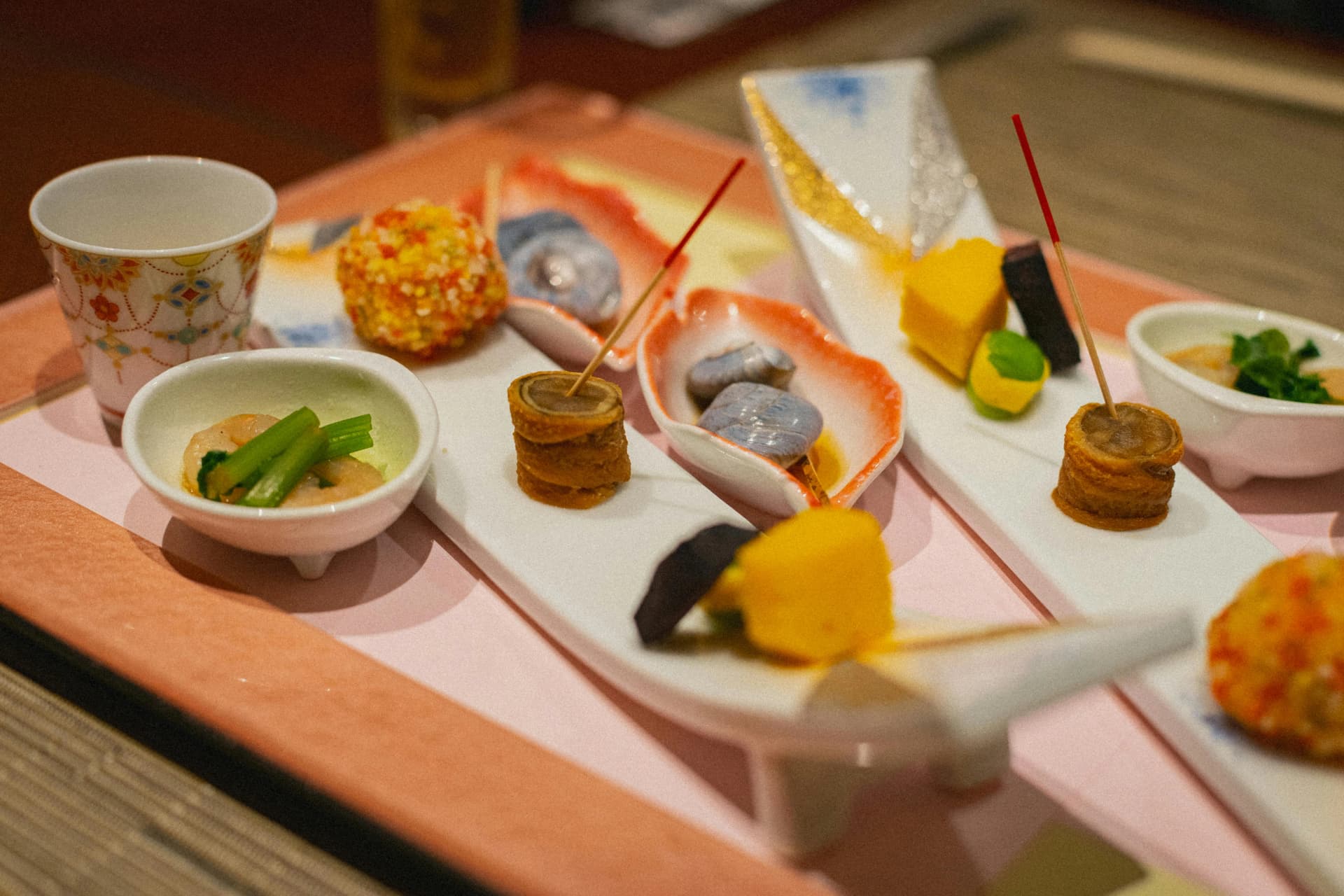
Hassun (八寸) is the seasonal platter, laid out on a dampened cedar tray exactly eight sun (24 centimeters) across. It follows the rule of 海のものと山のもの, putting food from the sea and from the mountains side by side. It's the most carefully arranged course, and the one where you see the chef's eye most clearly.
Yakimono (焼物) is grilled fish, usually over charcoal, with a seasonal garnish such as a maple leaf in autumn or a pine sprig at New Year. Depending on the restaurant it comes whole or as a fillet. With a whole fish there's a specific etiquette: eat the top half, then lift the backbone out with your chopsticks instead of turning the fish over. Turning it over suggests a capsized boat, a fishing-village superstition that has stuck as real etiquette.
Takiawase (炊き合せ) is the simmered course: a protein and seasonal vegetables cooked separately in dashi and then arranged in one dish. It shows off the kitchen's stock, which matters as much in kaiseki as the knife work.
Agemono (揚物) is the fried course, light tempura or vegetable fritters. After the grilled and simmered dishes, the change in temperature and texture is on purpose.
Mushimono (蒸物) is steamed, often chawanmushi, the egg custard with seasonal ingredients hidden inside. Not every restaurant serves it, and some swap it in for the simmered course.
Sunomono (酢の物) is a vinegared dish that clears the palate and tells you the end is near.
Shokuji (食事) is the last savory course: freshly cooked rice, a clear soup (止め椀), and pickles (香の物), served together. The rice is cooked for this moment and eaten right away. To the kitchen this is the most important part of the meal, since the rice is its foundation, and the soup marks the end of the sake. Once the rice arrives, stop drinking and finish your meal.
Mizumono (水菓子) ends things with seasonal fruit or a simple sweet, kept plain and light. Sometimes matcha follows.
The order shifts a little between restaurants, but the idea doesn't change. The meal goes from light to filling, cold to warm, and complex to simple, and it finishes with rice, the most basic food in Japanese cooking.
What It Costs
Kaiseki in Tokyo covers a wide price range, and the bottom of it is lower than most visitors expect.
Lunch is the way in. A kitchen that charges ¥30,000 for dinner will often do a lunch course for ¥3,300 to ¥8,000. You get six to eight dishes instead of twelve, but the ingredients are just as seasonal and the technique is the same. Hirosaku in Tokyo has lunch kaiseki from ¥3,300. Shirokanedai Kobayashi does a ¥5,000 lunch. Yakumo Saryo has a ¥5,400 lunch course that includes afternoon tea, in a space designed by the owner of D&Department.
The middle of the market, ¥10,000 to ¥20,000 per person, is where Tokyo kaiseki is most competitive. The food is excellent, the seasonality is strict, and the chefs are still making their names. For a visitor who wants the real thing without paying top-tier prices, this is the range to aim for.
Michelin-level dinners start at ¥20,000, and the three-star restaurants (Ryugin, Kohaku, Kagurazaka Ishikawa) cost ¥40,000 to ¥50,000 or more. Foreigners can book them, and Ryugin has been on Pocket Concierge for years, but you'll need to book two to three months ahead and pay in full up front.
On a first visit, remember that Michelin two-star kaiseki is available at lunch for ¥5,800 at Seizan and ¥8,000 to ¥12,000 at Sekihoutei. Both take reservations from foreigners, and both come up again and again as easy to get into. A ¥5,800 lunch and a ¥50,000 dinner really are different, but the difference is mostly the length of the course, how rare the ingredients are, and the chef's reputation. You'll understand what kaiseki is from either one.
How to Book as a Foreigner
Three platforms handle most foreign bookings at serious kaiseki restaurants.
Pocket Concierge is backed by American Express and covers most Michelin-starred restaurants. You prepay the full course price when you book, and you don't need any Japanese. If your date is full, you can join a waitlist.
OMAKASE (omakase.in) is the official Michelin Guide partner. It charges ¥390 per seat on top of the course price and is good for top restaurants that are otherwise hard to reach.
TableAll buys seats in advance at places like Ishikawa and Kohaku. It charges ¥8,000 per seat plus a membership fee. It's the most expensive route, but it gets you into restaurants that are otherwise booked months out.
For mid-range kaiseki, TableCheck works well. It supports eighteen languages and lists thousands of Tokyo restaurants. Tabelog launched a multilingual app in late 2025 and is useful for the level below Michelin.
For three-star restaurants, the most reliable route is still the concierge at a four-star hotel or better. Luxury hotels and top restaurants have worked together longer than any booking site has existed in Tokyo.
How far ahead to book: two to three months for Michelin three-star, two to four weeks for one or two stars, and one to two weeks for mid-range kaiseki. Walking in on the day almost never works at formal kaiseki, though kappou restaurants (counter seating) sometimes fit you in.
The Etiquette Gap
English-language guides cover how to hold chopsticks and tell you to bow. Japanese etiquette sources go a lot further, and it's worth catching up before you sit down.
Start with the lacquerware lid. When soup arrives in a lidded bowl, steady the bowl with your left hand on its side. With your right hand, trace the shape of the character の on the lid, a gentle circle that breaks the seal without forcing it. Tilt the lid toward you as you lift so the condensation drips back into the bowl. Put the lid to the right of the bowl if the bowl was on your right, and to the left if it was on your left. When you've finished, put the lid back exactly as it came. Never turn the lid upside down into the bowl, because you can scratch makie lacquer decoration worth tens of thousands of yen a piece.
Then the aroma. Before each course, pause and take in the smell. Several Japanese etiquette sources mention this, and no English ones do. When the wanmono comes, lift the bowl and notice the steam before you taste. When the yakimono comes, notice the char. The chef timed the dish for that moment, and pausing for it is part of the etiquette.
With sashimi, don't stir wasabi into the soy sauce. Put a little straight onto the fish, then dip lightly. Wasabi mixed into soy loses its aroma almost immediately, so you get the heat without the fragrance.
The oshibori, the hot towel, is for your hands only. Japanese etiquette sources list wiping your face, your mouth, or the table with it among the most noticeable mistakes foreign diners make.
Take off your jewelry. Japanese sources specifically warn against rings, watches, and bracelets around lacquerware and ceramics, because a scratch on a makie bowl can't be repaired.
Eat at the chef's pace. Hot food should be eaten hot and cold food cold, and the Japanese phrase is 熱いものは熱いうちに, eat hot things while they're hot. If you linger over one course while the next one waits, people notice. The kitchen times each course to how fast you're eating.
Kappou: The Easier Entry Point
If formal kaiseki sounds like too much protocol for a first try, look at kappou (割烹).
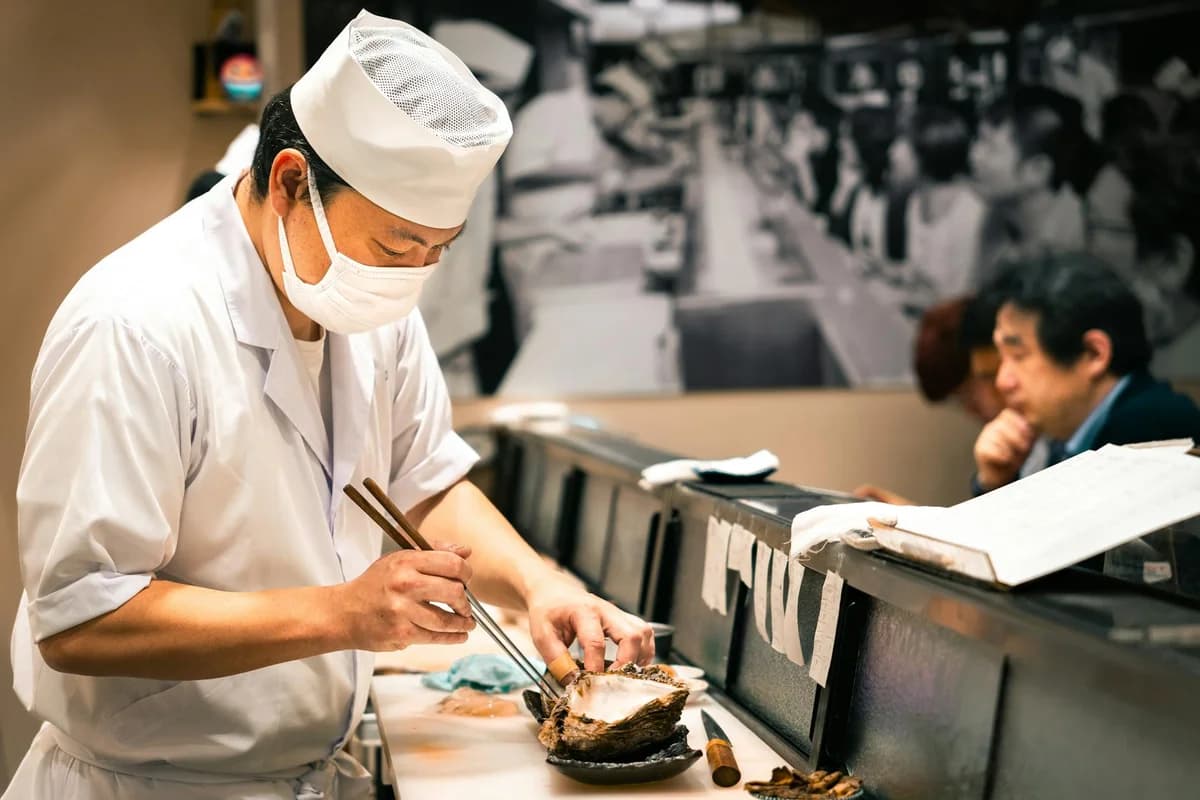
The word means "cut and cook." You sit at a counter while the chef works in front of you, and what gets served is more flexible. Kaiseki is a fixed course set in advance, while kappou is closer to omakase with a Japanese sensibility: the chef watches the room, adjusts, and improvises. You can watch the knife work, ask questions by pointing, and sometimes order individual dishes.
Kappou suits solo diners, since a counter seat works fine for one. It also suits anyone nervous about protocol, because you deal with the chef directly and kappou chefs are used to guiding curious guests through unfamiliar food. Prices run wider, ¥5,000 to ¥30,000, and booking is usually easier, often just a few days ahead.
Kappo Ise Sueyoshi in Nishi-Azabu offers English commentary on the course and handles dietary restrictions including gluten-free, vegetarian, and halal. It's one of the few high-end Japanese restaurants in Tokyo where language really isn't a problem.
What Each Season Puts on the Table
Seasonality in kaiseki comes down to specific ingredients that turn up in certain months and then vanish.
Spring is bamboo shoots (筍), the great spring ingredient, with rapeseed flowers, snap peas, and sea bream. Summer is sweetfish (鮎), a prized river fish, with eggplant and eel, which is traditionally eaten on Doyō no Ushi no Hi in late July. Autumn brings matsutake mushrooms, the most expensive ingredient of the year, with Pacific saury, chestnuts, and persimmon. Winter is fugu, the regulated pufferfish, with snow crab, cod, turnips, and yuzu, the citrus that scents almost every winter course from soup to dessert.
The garnishes change too. The yakimono comes with a maple leaf in autumn and a pine sprig at New Year. The wanmono's aromatic finish moves from kinome in spring to yuzu in winter, and the hassun tray shows the month. Eat at the same kaiseki restaurant in October and again in April, and only the sequence will be the same.
Frequently Asked Questions
Is kaiseki worth the money? At ¥5,000 to ¥12,000 for lunch, yes, if food as a structured experience interests you at all. Seasonal sourcing, technique, and philosophy come together at a serious kaiseki restaurant in a way Western fine dining doesn't match, because Western fine dining borrowed the philosophy and applied it to different ingredients.
What's the difference between kaiseki and omakase? Kaiseki is a fixed course in a set order, so you know the shape of the meal in advance. Omakase means "I leave it up to you" and is mostly used at sushi counters, where the chef decides what you eat as you go. Both are multi-course and led by the chef. The easiest way to tell: at a sushi counter, it's omakase. In a private room eating seasonal soup, sashimi, grilled fish, and rice in a set order, it's kaiseki.
Can I go alone? To kaiseki in a private room, it's hard at dinner but possible at lunch. To kappou at a counter, yes, that's common and often the better choice for a solo visitor.
Do I need to speak Japanese? At Michelin-starred restaurants the staff can usually manage basic English. At mid-range places it varies. The booking platforms (Pocket Concierge, OMAKASE) handle the reservation in English. At the table, pointing and asking "kore wa?" (what is this?) is perfectly fine, and staff expect it from international guests.
What should I wear? Smart casual at mid-range places. At the high end, a jacket and collared shirt, no tie needed. Skip tight trousers if you might sit on tatami, and take off rings and bracelets before handling lacquerware. Japanese etiquette sources specifically discourage heavy perfume, because it gets in the way of the food's aroma.
At Hinomaru One, we arrange kaiseki as part of a private Tokyo day. We pick the right restaurant for your budget and experience, handle the reservation, and make sure you know what you're sitting down to before you arrive. The Ordinary Tokyo itinerary includes kaiseki as part of seeing how Tokyo's food culture works at every price point.