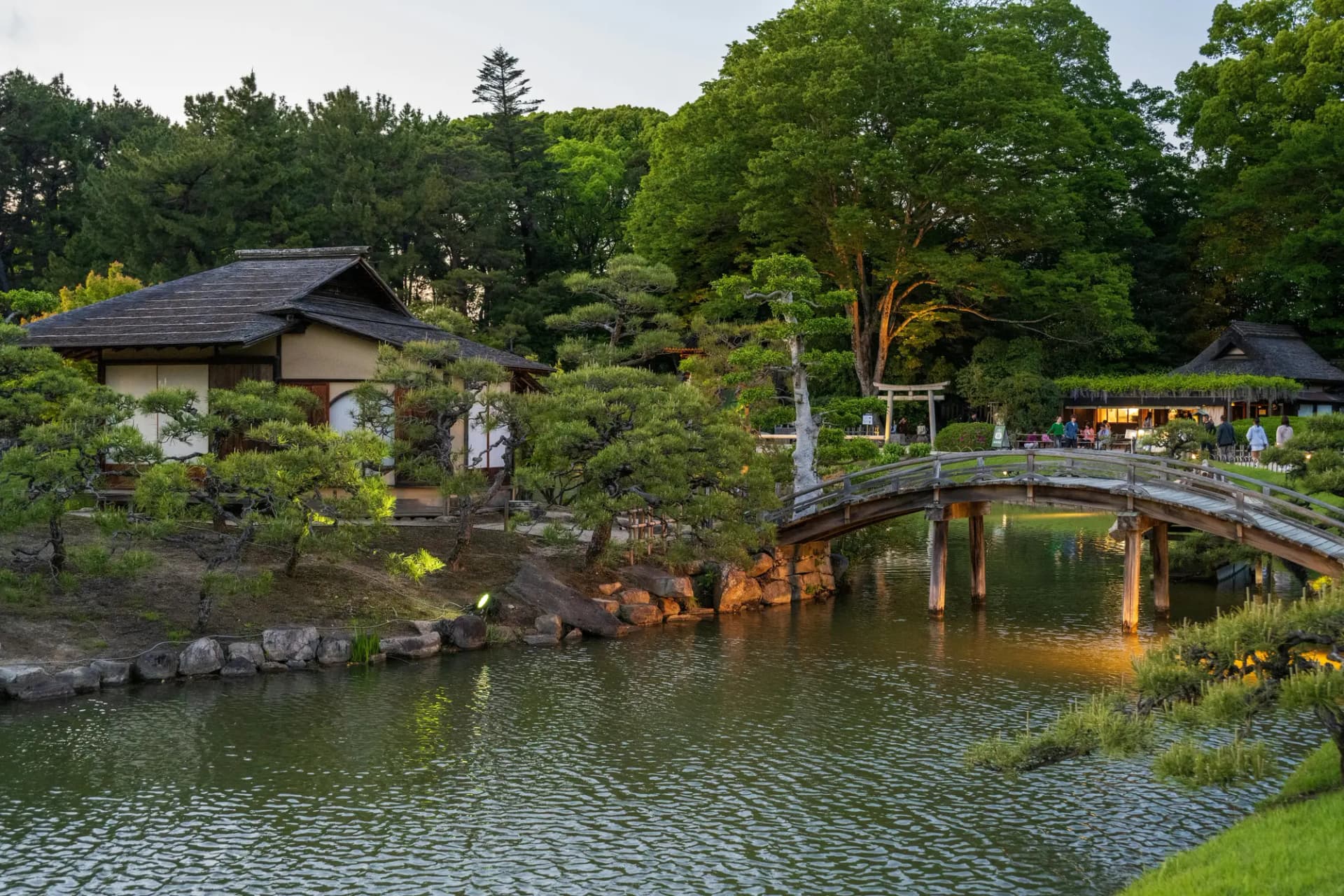
This garden is older than most of what Tokyo considers ancient. It was built when Edo was still being constructed around it.
Koishikawa Korakuen garden sits beside Tokyo Dome, but predates the stadium by 359 years. The baseball stadium, completed in 1988, receives millions of visitors a year and has become one of the defining structures of the Bunkyo skyline. The garden next to it was built in 1629 and has a higher heritage designation than any sports venue in Japan. The juxtaposition is typically Tokyo: the ancient and the contemporary sharing a city block without ceremony.
Koishikawa Korakuen (小石川後楽園) is the oldest surviving garden in Tokyo. It predates the city itself — when construction began in 1629, Edo was still emerging as the Tokugawa capital, and the garden was built on the western fringe of the new city's administrative and residential expansion. It holds the highest dual designation in Japan's heritage system: Special Historic Site (特別史跡) and Special Place of Scenic Beauty (特別名勝). There are only a handful of sites in Japan that carry both.
The Men Who Made It
The garden was begun by Tokugawa Yorifusa, the eleventh son of Tokugawa Ieyasu and the founding lord of the Mito Domain — one of the three senior Tokugawa branch families (the Gosanke) that served as the primary succession pool for the main Tokugawa line. This dynastic context matters: Yorifusa was building a garden in Edo not as a peripheral figure but as the head of one of the most powerful families in the shogunate. The garden was an expression of that standing.
His son Tokugawa Mitsukuni — known to generations of Japanese schoolchildren as the wandering magistrate Mito Komon — completed the garden and gave it its distinctive character. Mitsukuni was a scholar as much as a lord. He commissioned the great historical compilation Dai Nihon-shi (Great History of Japan), patronized Confucian learning, and invited Zhu Shunshui, an exiled Ming dynasty Chinese scholar, to serve at his domain in Mito and later to consult on the garden's design.
Zhu Shunshui's contribution is specific and visible. He introduced elements of Chinese garden design — the Full Moon Bridge, the representation of a landscape from Hangzhou's West Lake — that created the synthesis of Japanese and Chinese landscape traditions that defines the garden's character. The garden's very name comes from his influence: 後楽 (kōraku) is drawn from the Chinese maxim "the wise man is the last to enjoy pleasures and the first to bear hardships" — a phrase from the Song dynasty statesman Fan Zhongyan's famous essay "On Yueyang Tower," expressing a philosophy of public-spirited leadership. Mitsukuni named the garden for this ideal.
Understanding the Design
Koishikawa Korakuen is a kaiyū-shiki-teien (回遊式庭園) — a strolling garden. The design principle is movement: the garden reveals itself through walking, with the view changing at each step along the path. There is no single correct vantage point; the experience is cumulative. This design tradition stands in contrast to the "borrowed scenery" gardens (shakkei-teien) that frame a distant view, or the dry stone gardens (karesansui) designed for contemplation from a fixed position. At Koishikawa Korakuen, you move through it.
The garden is built around several interconnected ponds fed by springs, with hills rising on the western and northern sides. The terrain is varied enough that it can represent, in miniaturized form, multiple famous landscapes — a principle common to Japanese gardens of the period, where the garden functioned as a condensed version of the known world's scenic wonders.
The Named Features
Engetsu-kyō (円月橋 — Full Moon Bridge). The stone arch bridge near the center of the garden creates a perfect semicircle, which reflects in the water to complete the full circle implied by its name. Zhu Shunshui is credited with designing this bridge, bringing the Chinese technique of semicircular stone arching to a Japanese garden. It is one of the most photographed elements in the garden and one of its most directly Chinese-influenced features.
Seiko no Tsutsumi (西湖の堤 — West Lake Causeway). The long earthen embankment dividing part of the central pond replicates the Su Causeway at West Lake (Xihu) in Hangzhou — one of China's most celebrated landscapes, painted and described in Chinese literature for centuries. Mitsukuni's garden contains a Japanese version of it, making this a garden that holds foreign landscapes within its own perimeter.
Tsūten-kyō (通天橋 — Bridge to Heaven). The vermillion lacquered bridge at the northern section of the garden is modeled on Tsūten-kyō bridge in Tōfukuji Temple in Kyoto — itself famous for the autumn maples that canopy it in November. At Koishikawa Korakuen, Japanese maples surround the equivalent bridge, and it becomes the most intensely visited point in the garden during autumn foliage season.
The Rice Paddy. In the southwest corner of the garden, a small working rice paddy is planted each spring and harvested in autumn. This is not decorative — the paddy actually grows rice, tended by garden staff. The inclusion of agricultural land in an aristocratic garden is deliberate and philosophically consistent with the garden's name: the Confucian ideal expressed in 後楽 values the welfare of the common people, and including a rice paddy — the foundation of Japanese agriculture — in a lord's garden was a statement of connection to that reality. The paddy is planted in late spring (early June) and harvested in autumn (late September or October). When the stalks are green and the water shimmers between the rows, it makes for one of the strangest and most memorable views in the garden.
The Tōtōmi-zaka (遠江坂). A small hill in the western section of the garden, planted with plum trees, represents the landscape of Tōtōmi Province — modern Shizuoka Prefecture — in a tradition of geographic miniaturization. The plum grove here is one of the earliest to bloom in the garden, typically starting in late January and continuing through mid-February, before the rest of Tokyo's spring season has begun.
Seasonal Calendar
The garden operates on a distinct seasonal rhythm, and knowing it changes when a visit is worth making.
Plum (January–February): The Tōtōmi-zaka plum grove and a second plum cluster near the garden's west entrance bloom in late January and through February. Plum blossom season at Koishikawa Korakuen is the best-kept seasonal secret in central Tokyo — the garden sees modest crowds while Shinjuku Gyoen and Ueno are still bare.
Cherry (late March–early April): The cherry trees cluster most densely near the central pond and the earthen causeway. The setting — water reflections, stone bridges, old pines as background — makes for cherry blossom photographs with more compositional interest than most park lawns. Crowds during peak blossom are substantial but still lower than equivalent spots.
Iris and Wisteria (May): Irises bloom around the garden's ponds in late May. A small wisteria trellis near the central section flowers at the same time. These are quieter, less-celebrated seasons at the garden.
Lotus (July–August): Lotus flowers cover sections of the pond surface through July and August. The garden in summer heat is not its best season, but early morning — the gate opens at 9:00 AM — is pleasant before the humidity builds.
Autumn Maple (late October–late November): This is the garden's peak season. The Japanese maples around the Tsūten-kyō bridge turn deep red and orange from late October through November, with peak color typically in early to mid-November. The combination of the vermillion lacquered bridge, the autumn maples, and the dark water below is the defining image of Koishikawa Korakuen. Weekday visits during peak color are strongly recommended over weekends.
Winter (December–February): The garden in winter is bare-branched and quiet, with the stone features most visible when the foliage is gone. Snow, when it falls on Tokyo, settles on the old stone and the remaining pine branches in ways that reward early-morning visits.
Getting There
Iidabashi Station (JR Sobu Line, Tokyo Metro Tōzai/Yūrakuchō/Namboku Lines) — West Exit, 8 minute walk through the park approach.
Kōrakuen Station (Tokyo Metro Marunouchi/Namboku Lines) — Exit 3, 8 minute walk.
Suidobashi Station (JR Chūō Line) — 3 minute walk to the east entrance. This is the faster approach from the JR network, though the Iidabashi approach from the west is the traditional main entrance.
Admission and Hours
| Admission | ¥300 adults; ¥150 for ages 65 and over |
| Hours | 9:00 AM – 5:00 PM (last entry 4:30 PM) |
| Closed | December 29 – January 1 |
Primary school children and under enter free. Major credit cards accepted at the entrance.
The Tokyo Dome Context
The garden sits directly beside Tokyo Dome, which generates significant foot traffic to the surrounding area — restaurants, shops, the Prism Hall entertainment complex. On event days (baseball games, concerts), the area outside the garden becomes dense with people. Inside the garden, the transition to quiet is immediate. The garden walls and the difference in grade (the garden is slightly sunken from street level) create an effective acoustic buffer. The contrast between the stadium's exterior noise and the garden's interior quiet takes about 30 seconds to complete once you've passed through the gate.
This relationship is worth using deliberately: the garden opens at 9:00 AM, before most Tokyo Dome events. A 90-minute garden visit in the morning allows you to leave before any significant crowd arrives.
Building a Day
Koishikawa + Iidabashi: The Iidabashi area has excellent cafés and restaurants in the canal-side Kagurazaka district, 10 minutes on foot to the north. The combination of garden visit and a slow lunch in Kagurazaka is a natural central Tokyo half-day, bookended by the walk through the old streets connecting them.
Koishikawa + Nezu Shrine: Both are in Bunkyo Ward and connect via the Tokyo Metro Namboku Line. The oldest garden in Tokyo followed by the finest intact Edo-period shrine complex makes a coherent historical morning — both feature water, old trees, and structures that survived where most of their contemporaries didn't.
Koishikawa + Yanaka: From the garden's east entrance, the Yanaka district is accessible in about 20 minutes on foot or 10 minutes by train. The combination pairs the garden's curated historical landscape with Yanaka's organic, inhabited old-town character.
For the historical context of the garden within Edo-period aristocratic culture — the Confucian philosophy encoded in the name, the political significance of the Mito domain, Zhu Shunshui's influence on Japanese intellectual life — Timeless Tokyo covers this kind of layered cultural history. Infinite Tokyo allows any custom itinerary built around a garden and culture day in central Tokyo.
Frequently Asked Questions
Is Koishikawa Korakuen the same as Korakuen (the amusement park)?
No. Korakuen Amusement Park (後楽園遊園地, now called Tokyo Dome City Attractions) is a separate facility adjacent to Tokyo Dome. Koishikawa Korakuen (小石川後楽園) is the historic garden. The shared name causes confusion because both are near the same train station. The garden entrance is signed clearly; look for the stone gate and the green signage on the south side of the Tokyo Dome complex.
When is the best time to visit?
Autumn (late October through mid-November) for the maples around the Tsūten-kyō bridge. Late January through February for the early plum blossom, which is one of the quietest and most atmospheric periods in the garden. Cherry blossom season in late March and early April is beautiful but more crowded. The garden is worth visiting in any season; the autumn and plum windows are the peaks.
How long does a visit take?
Sixty to 90 minutes covers the garden at a relaxed walking pace. The strolling-garden design rewards slow movement — the garden reveals itself through the path rather than presenting a single panoramic view. Allow an extra 30 minutes to sit somewhere and take the space in, which is what the design is actually for.
Can I visit Koishikawa Korakuen and Tokyo Dome on the same day?
Yes. The garden and the Tokyo Dome City complex share the same city block. A morning in the garden followed by lunch at one of the restaurants in the Dome complex works well. Dome stadium tours and the amusement park are separate ticket purchases. If there's a baseball game scheduled, arrive at the garden in the morning before the pre-game crowd builds around the stadium.