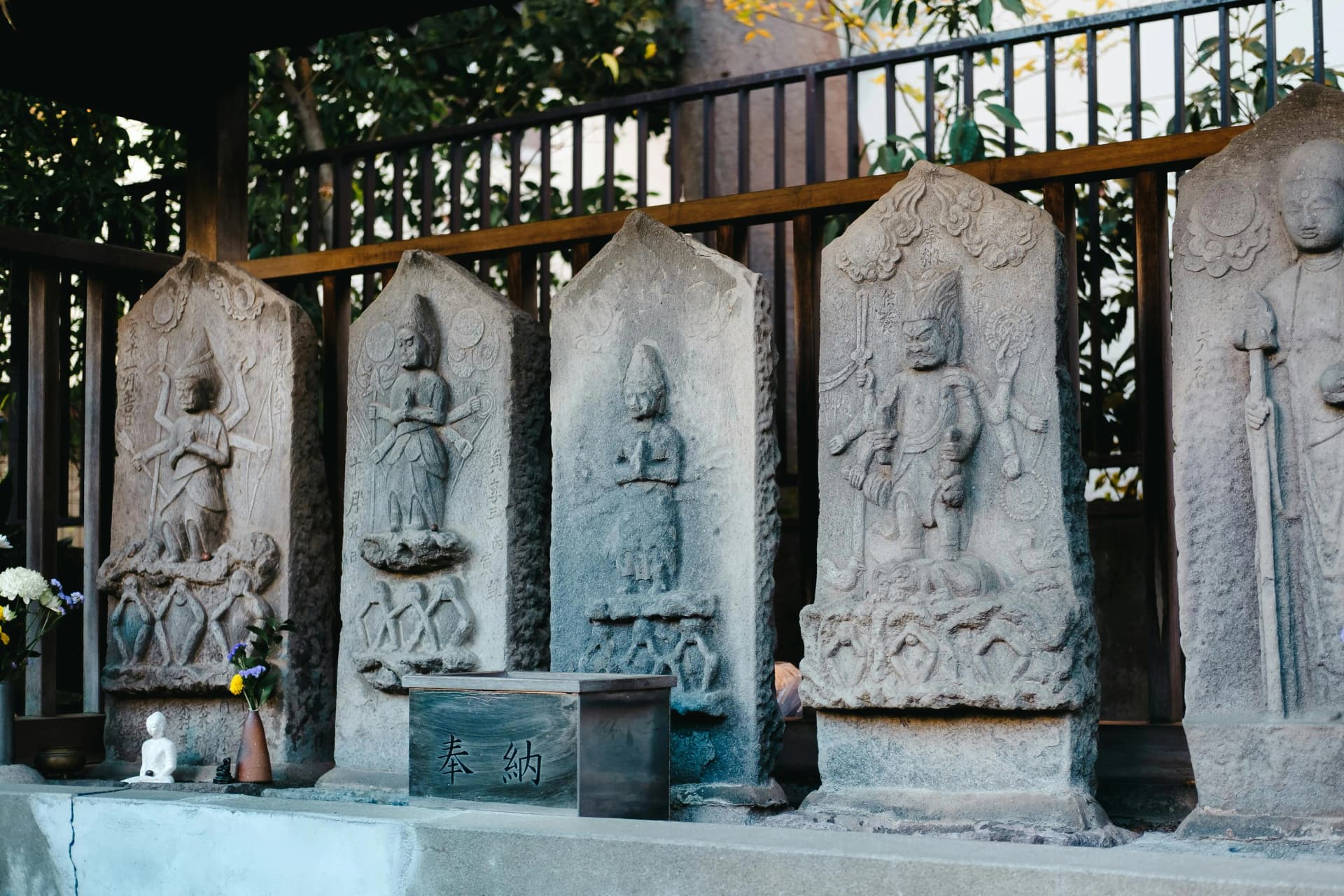
The 47 Ronin chose death to fulfil a debt of loyalty. Their graves have been visited by pilgrims for three centuries.
Sengakuji Temple is where the 47 Ronin are buried — the masterless samurai who avenged their lord's death and then surrendered to face execution in 1703. In 1701, their lord Asano Naganori was provoked into drawing his sword inside Edo Castle, a capital crime punishable by death the same day. His domain dissolved and his samurai became ronin. Forty-seven of them spent two years planning revenge, stormed the mansion of the official who had provoked Asano, killed him, and surrendered to their fate.
They were buried here at Sengakuji, where their lord was also interred. The graves have been visited by pilgrims every year since.
This is Chūshingura — Japan's defining story of loyalty, sacrifice, and the conflict between duty to one's lord and the laws of the state. It has been retold in kabuki, woodblock prints, films, and novels for three centuries. The graves at Sengakuji are where it actually happened.
The Ako Incident: The Full Story
To understand why the graves feel the way they do — incense always burning, visitors arriving with obvious intention — you need the full story. Most summaries reduce it to "samurai avenge their lord." The actual history is more complicated, and the complication is what made it last.
Who Kira was, and why they clashed. Kira Yoshinaka was a senior official of the Tokugawa shogunate, responsible for instructing provincial lords in the elaborate etiquette required at the shogun's court in Edo. Lords who wanted to learn this protocol depended entirely on Kira's goodwill. The system ran on gifts — effectively bribes — and Kira was known for extracting them aggressively. Asano Naganori, the young lord of the Ako domain in western Japan, apparently refused or underpaid. The exact nature of the provocation remains debated, but contemporary accounts agree that Kira treated Asano with deliberate condescension and humiliation over an extended period, apparently intending to make him look foolish in front of the shogun's court.
The attack, April 1701. On April 21, 1701, in the Matsu no Rōka corridor of Edo Castle, Asano finally broke. He drew a short blade and struck Kira — hitting him on the forehead and across the back, wounding but not killing him. Kira survived. Asano had committed two offenses simultaneously: drawing a weapon inside the shogun's palace (punishable by death), and failing to complete what he had started. The shogun Tsunayoshi ordered Asano to commit seppuku the same day. There was no investigation into Kira's conduct, no inquiry into provocation, no opportunity for Asano to explain himself. Kira received no punishment at all. The Ako domain was dissolved, its castle confiscated by the shogunate. Over three hundred samurai became ronin — masterless, unemployed, stripped of their status.
Oishi Kuranosuke and the long wait. Among Asano's retainers, one man emerged as the leader: Oishi Kuranosuke Yoshio, the senior administrator of the Ako domain. Oishi gathered forty-six loyal men around him and they swore a secret oath to avenge their lord by killing Kira. They knew this was forbidden by law — private revenge was prohibited in the Tokugawa peace — and they knew it would cost them their lives. They did it anyway.
The two-year wait before the raid was itself a strategic achievement. Kira had survived one attack already and had no intention of dying by another. He hired guards, reinforced his mansion, and deployed informants to watch the former Ako samurai. Oishi's response was to make the ronin appear harmless. He left his wife, dispersed his family, and threw himself into a life of visible debauchery — sake, pleasure houses, public spectacles of drunkenness. Passersby reportedly ridiculed him. Kira's informants reported back that the Ako ronin had abandoned any thought of revenge. The deception held for nearly two years.
The raid, December 14, 1702. On the night of December 14, 1702, in the middle of a snowstorm, forty-seven men in identical dark jackets — each bearing Asano's crest — assembled outside Kira's Edo mansion and split into two groups. One group attacked the front gate, one the rear. The orders Oishi had given were deliberate: find Kira without delay, avoid unnecessary combat, kill no one who did not resist. The fighting was brief. Kira's guards, outnumbered and caught off guard, were overpowered. The ronin then conducted a systematic search of the mansion.
They found Kira hiding — accounts say in a charcoal storage shed, wrapped in quilts. He refused to speak or identify himself. But when Oishi approached with a lantern and pulled back the robes, he found an old scar on the man's neck — the scar from Asano's blade seventeen months earlier. The identification was confirmed. Kira was killed. The raid had lasted roughly two hours.
The walk to Sengakuji. The ronin did not flee. They carried Kira's head across Edo to Sengakuji Temple, where Asano was buried. They washed the head at a well on the temple grounds — that well is still there — and presented it at their lord's grave. Then they sent word to the shogunate and surrendered.
Surrender and sentence. The shogunate was in an impossible position. The ronin had killed a shogunal official, which was murder under the law. But public opinion was overwhelmingly on their side. The forty-seven had done exactly what bushidō — the samurai code of loyalty — required of them. Executing them as common criminals would have been deeply unpopular. After weeks of deliberation and genuine philosophical debate among Confucian scholars, the shogunate reached its decision: the ronin would be allowed to die as samurai, by seppuku, rather than being executed as criminals. In February 1703, all forty-seven committed ritual suicide. They were buried together at Sengakuji, beside the grave of their lord.
The Philosophical Argument That Never Ended
The debate that paralyzed the shogunate for weeks in 1703 never fully resolved, and that unresolved tension is part of why the story persists. The ronin had broken the law. The Tokugawa peace depended on everyone obeying the state rather than their private loyalties. If samurai could conduct private vengeance whenever they believed their honor demanded it, the legal order would collapse.
But they had also fulfilled what the samurai code demanded of them in absolute terms. Their lord was dead, the man responsible lived unpunished, and they had spent two years — at the cost of their careers, their families, their lives — correcting that injustice. From a Confucian standpoint, which the shogunate also claimed to honor, this was loyal virtue in its purest form.
The shogunate's resolution — death by seppuku rather than execution — was a political compromise that didn't answer the question. It treated the ronin as both criminals and heroes simultaneously. Subsequent Japanese culture has never settled on a single interpretation, which is why the story has sustained three centuries of retelling. Each era finds its own meaning in the ambiguity.
What's Here
The graves. Forty-seven identical grave markers, plus the grave of their lord Asano, arranged in the temple cemetery. Each marker has a name. Incense is almost always burning — placed by visitors who treat the visit as a genuine pilgrimage rather than a tourist stop. This is not a museum exhibit. People come here with the intention of paying respect.
The graves are compact and simple, which makes the sustained intensity of visitors more striking. After three centuries, people are still coming.
Ōishi Kuranosuke's grave. The leader of the 47 ronin is buried separately from the others, slightly elevated. His is the most visited individual grave in the complex. Near the temple entrance, a bronze statue of Oishi stands — the first thing most visitors encounter before reaching the cemetery.
The museum. The small museum adjacent to the grounds holds the physical objects from the raid: helmets, weapons, the receipt given by the officials who received Kira's head after the ronin presented it here at the temple. The receipt is an extraordinary document — bureaucratic confirmation of a vengeance killing, processed with normal administrative procedure. The shogunate issued a receipt. That single object says more about the story's strangeness than most explanations.
The well. The well where the ronin washed Kira's head before presenting it at their lord's grave is still here, stone casing original. It is a small thing, but standing at it — knowing what happened here, on a cold December night in 1703 — is the kind of moment that justifies the detour.
Getting There
Sengakuji Station (Toei Asakusa Line) — 1 minute walk, direct exit to temple grounds
Shinagawa Station (JR, various lines) — 15 minute walk or 2 minutes by Toei Asakusa Line
Takanawa Gateway Station (JR Yamanote Line) — 5–10 minute walk via west exit
Admission and Hours
| Temple grounds | Free, open daily |
| Museum (義士記念館) | ¥500 adults |
| Hours | Temple: sunrise–sunset; Museum: 9:00–16:00 |
December 14th: The Gishi-sai Festival
The raid occurred on December 14, 1702. Every year on this date, Sengakuji holds the Akō Gishi-sai — a full day of commemoration that draws crowds to the temple and the surrounding streets. The day begins with a formal memorial service conducted by Zen Buddhist monks around 11:00, inside the main temple hall. In the afternoon, the festival's centrepiece begins: the Gishi Gyoretsu, a procession of forty-seven participants dressed in period samurai clothing who march from near Zojoji Temple (by Tokyo Tower) through the streets to Sengakuji, arriving around 15:00–15:30. The approach street fills with food stalls and visitors. The atmosphere is part pilgrimage, part neighbourhood festival, part historical commemoration — a combination that has repeated itself, without interruption, for over three hundred years.
If your trip falls in mid-December, the Gishi-sai is one of the more quietly extraordinary things Tokyo offers. It is attended by locals who take it seriously, not a performance staged for tourists.
Day Pairing
Shinagawa area: Sengakuji is two stops from Shinagawa on the Toei Asakusa Line. Shinagawa has a historic old road (Tokaido) connection and several traditional inns and restaurants. The combination of samurai history at the temple and the Tokaido post town atmosphere makes for a coherent historical half-day.
Ryogoku combination: Both Sengakuji and Ryogoku sit in the eastern/southern part of the city and connect through the Oedo Line. A samurai and sumo day — Sengakuji in the morning, Ryogoku (Sumo Museum, Hokusai Museum) in the afternoon — works with the geography.
For a guided visit that includes the full context of the 47 Ronin story, the Chūshingura narrative tradition, and how it reflects Japanese values around loyalty and obligation, Timeless Tokyo covers this depth. Infinite Tokyo for any custom day.
Frequently Asked Questions
How long does a visit to Sengakuji take? Plan one hour if you visit the temple grounds, cemetery, and museum. The graves themselves can be seen in under fifteen minutes if time is short, but the museum is worth the extra thirty to forty minutes — particularly the receipt document and the raid equipment.
Do I need to know the 47 Ronin story before visiting? No, but knowing even the outline transforms the visit. The graves are rows of stone markers to someone who doesn't know the story. To someone who does, each name carries specific weight. Reading this article is enough context before you go.
Is December 14th too crowded to enjoy? The Gishi-sai draws significant crowds, particularly during the procession around 15:00. The morning memorial service is quieter and more solemn. If you want atmosphere over spectacle, arrive in the morning. If you want to see the procession, arrive by 14:00 to find a good position on the approach street.
Is Sengakuji appropriate for children? Yes. The story is serious, not graphic — and Japanese children learn it in school. The graves, the well, the incense, and the museum create a setting that most older children find genuinely interesting. The moral questions the story raises — loyalty, law, the cost of honour — are the same questions taught in Japanese classrooms.
What is the closest station? Sengakuji Station on the Toei Asakusa Line, one minute from the temple. Exit A2 leads directly to the temple approach. It is one stop from Shinagawa on the same line.