Oedo is where serious collectors come. It's also where a ¥500 piece of Showa-era glassware can become the best souvenir from a Tokyo trip.
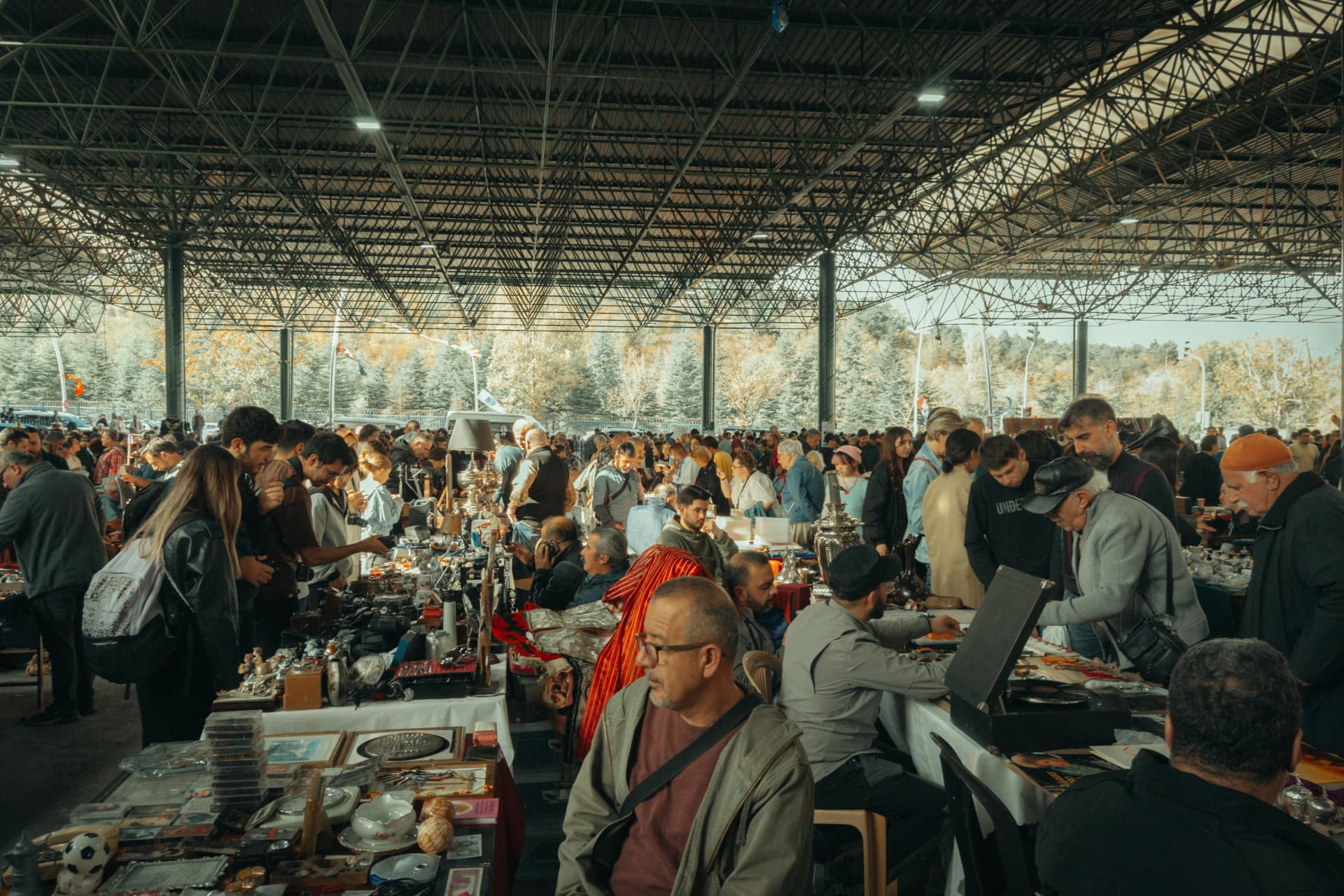
Oedo Antique Market is Japan's largest outdoor antique market — 250–300 dealers filling the plaza outside the Tokyo International Forum on the first and third Sunday of each month. Around 15,000 people come per event: a mix of serious collectors, dealers, and tourists who spend ¥800 on a Showa-era kokeshi doll and carry it home as the best souvenir of their trip. Both outcomes are valid.
The Market and Its History
Oedo began in September 2003, launched to commemorate the 400th anniversary of the founding of Edo — the city that became Tokyo. The organizers had a specific vision: not a flea market, not a craft fair, but a professional-grade outdoor antique event in the heart of the capital, run by licensed dealers who could explain what they were selling. It started with third-Sunday-only events. The first Sunday was added later as demand expanded. Today it draws around 250 registered dealers per event and roughly 15,000 visitors, making it the largest outdoor antique market in Japan by both measures.
The venue is deliberate. The Tokyo International Forum — designed by Rafael Viñoly, its elliptical glass hall soaring over the plaza below — gives Oedo a character that warehouse antique fairs lack. The market occupies a long outdoor corridor between the glass structure and a row of shops and cafés, shaded by mature trees. You're browsing lacquerware and Imari porcelain under open sky, a few hundred meters from Ginza and Tokyo Station.
When and Where
Schedule: 1st and 3rd Sunday of each month — but specific dates shift and do not always fall exactly on those Sundays. The actual calendar is published monthly on the official website.
Hours: 9:00 AM – 4:00 PM
Location: Tokyo International Forum, ground-level plaza (between Glass Hall A and the building's east side)
Station: JR Yurakucho Station — 20 meters from the nearest exit, roughly a 1-minute walk. Also accessible from Tokyo Station (10-minute walk via Marunouchi South Exit).
Cancellation: The market does not run in August due to heat. It is also weather-dependent and occasionally cancelled for Forum events. Always confirm the current month's schedule at antique-market.jp or t-i-forum.co.jp/en/antique/ before visiting — particularly in typhoon season (September–October) or on weekends that fall near public holidays when Forum events are common.
Admission: Free.
What You'll Find
The inventory at Oedo splits roughly 50/50 between Japanese antiques and international goods — a higher international ratio than most Japanese antique markets. That mix reflects the market's origins and its dealer base, which includes specialists who source from Europe, Southeast Asia, and the Americas alongside dealers whose stock is entirely domestic.
On the Japanese side, the depth is significant. Kimono and obi appear at nearly every market, often in better condition than comparable pieces you'd find at shrine sales, with pricing that starts around ¥1,000 for simpler pieces and climbs considerably for vintage Kyoto weaves or formal kuro-tomesode. Ceramics range from Edo-period Imari and Arita porcelain to Meiji-era export ware to 20th-century studio pottery — dealers typically know the kiln and period for what they're selling, which matters if you're buying seriously. Lacquerware, tansu furniture, noren door curtains, ukiyo-e woodblock prints, calligraphy scrolls, and antique maps round out the traditional category.
The Showa-era material — goods from roughly 1926 to 1989 — has grown as a category in recent years, driven by foreign collector interest in mid-century Japanese aesthetics. Old cameras (the Olympus, Minolta, and Asahi Pentax models that defined the 1960s and 70s), tin advertising signs, vintage glass, lacquered bento boxes, and enamelware appear regularly. These pieces often represent the best value for buyers without specialized knowledge: they're datable by feel, functional, genuinely old, and priced to move.
The international inventory is where the market gets genuinely surprising. Scandinavian furniture and ceramics, English silver, Southeast Asian batik and bronze, American diner glassware — dealers who specialize in international goods bring material that has no obvious reason to be in Tokyo, which is part of what makes it interesting.
On the more accessible end: sake cups from ¥500, small ceramic pieces from ¥1,500, vintage textiles from ¥3,000. On the serious end: Edo-period ironwork, signed woodblock prints, period tansu, and samurai sword fittings in the ¥40,000–¥150,000+ range. The market covers almost any budget and is organized around no particular entry point.
Understanding the Negotiation Culture
The negotiation question at Oedo is nuanced, and accounts vary — some sources claim fixed prices, others report 20-30% reductions through polite bargaining. The reality is that both are true, depending on the dealer.
Licensed professional dealers, particularly those selling higher-value antiques, often hold closer to their stated prices. They know the market for what they have. Lowball offers on a signed piece of Imari tend to produce a polite shake of the head.
On Showa-era items, foreign goods, and smaller decorative pieces, the picture is different. A polite counteroffer — delivered without aggression, in the context of genuine interest — frequently produces movement. The approach that works: handle the item properly, ask about it (even through a translation app), express that you like it, then offer 75-80% of the asking price. Buying two or three items from the same stall improves your position. Dealers who've connected with a buyer will find room that they wouldn't give a stranger who walked up and immediately named a lower number.
English ability varies significantly across the stalls. Many dealers have enough to state the price and explain the period or origin of an item. Some are fully conversational. A few require phone translation. The ones who speak the most English are often the ones who have been selling to international visitors longest — which also means they've calibrated their prices to international demand. That's worth knowing.
Getting the Best of the Market
Arrive at 9:00 AM. This is not advice to optimize your Instagram — it's practical. The pieces that serious collectors want are gone by 11:00 AM. Dealers who have outstanding individual items know it, and so do the buyers who show up in the first hour. If you arrive at noon, you are seeing a curated version of what was there in the morning. If you arrive at 9:00, you're seeing the full selection and competing with fewer people for the best items.
Bring cash. Cashless payment has expanded at Japanese markets, and some Oedo stalls accept cards or IC cards. But cash remains the default, particularly for negotiation — offering to pay in cash is sometimes itself a small negotiating point. ATMs are available inside the Tokyo International Forum building. Bring more than you plan to spend: the best finds at Oedo are rarely the ones you came looking for.
Move slowly and handle things. The best pieces at Oedo require picking things up, turning them over, looking at the base of a ceramic or the back of a print. Dealers expect this and generally appreciate it. Ask before touching anything obviously fragile or displayed behind glass. A rapid pass through produces a superficial result — what you find depends on how carefully you look.
Use the indoor Forum during rain. The market is weather-dependent and may cancel in heavy rain. In light rain or uncertain weather that hasn't yet triggered a cancellation, the glass hall of the Forum provides indoor space to wait it out — cafés and covered walkways give you options while you check the official website for updates.
Know the August rule. The market does not run in August. The heat at midday in the Forum plaza is the reason — it is genuinely uncomfortable, and the organizers have made a practical call. July markets still run; August does not.
Oedo vs. Other Tokyo Antique Markets
Oedo occupies the middle tier of Tokyo's antique market ecosystem. It sits above shrine sales — the monthly markets at Hanazono Shrine in Shinjuku or Nogi Shrine in Roppongi — in terms of dealer professionalism and selection quality. Shrine markets skew toward general flea market goods, with genuine antiques mixed in somewhat randomly. Oedo requires dealers to hold an antique dealer's license (古物商許可証), which filters the inventory toward verified antique goods. Prices run higher than shrine sales and lower than established antique galleries — which is exactly where they should be for a professional outdoor market.
The Heiwajima Antique Fair, held at the Tokyo Ryutsu Center three times a year (typically May, September, and January), is Oedo's closest competitor for serious collectors. Heiwajima skews toward higher-end inventory — signed ceramics, lacquerware, scroll paintings — and draws specialist buyers from across Japan. If Oedo is the regular visit, Heiwajima is the special occasion.
Day Pairing
Oedo + Ginza: Yurakucho Station is the southern border of Ginza. An antique morning followed by a Ginza afternoon is a natural combination — depachika food halls at Mitsukoshi and Matsuya, gallery-lined streets around Chuo-dori, and one of the city's highest concentrations of good coffee within walking distance of the Forum.
Oedo + Tsukiji: Both work on the same morning if timed correctly. The Tsukiji Outer Market operates from early morning and winds down by late morning — arriving at Tsukiji at 8:00 AM for breakfast and then walking or taking a short subway ride to Yurakucho for the antique market at 9:30 AM is a feasible sequence that produces two distinct experiences in a single half-day.
Oedo + Imperial Palace East Gardens: The East Gardens open at 9:00 AM on most days and are a 15-minute walk from the Forum — the market first, gardens as a quiet close to the morning, works well.
For a guided exploration that includes context on what you're looking at — how to distinguish Edo-period Imari from Meiji export ware, what the range of lacquer techniques tells you about a piece's age, how to read a ukiyo-e print — Infinite Tokyo allows any custom day built around specific interests.
Frequently Asked Questions
Does the market always run on the 1st and 3rd Sunday?
The general pattern is 1st and 3rd Sunday, but the actual dates shift month to month and do not always align exactly with those Sundays. In 2026, for example, the January market ran on the 18th and 25th — neither the 1st nor 3rd Sunday of the month. Always check the official schedule at antique-market.jp before planning your visit. The market does not run in August, and it may cancel for typhoons, heavy rain, or Forum events.
Can foreigners negotiate prices?
Yes, though with caveats. Negotiation is more natural on Showa-era items, foreign goods, and smaller decorative pieces than on serious antiques where the dealer has invested in knowing the provenance. The approach that works: handle the item thoughtfully, show genuine interest, ask about it, then offer 75-80% of the stated price. Buying multiple items from the same stall helps. Aggressive bargaining or immediate lowball offers tend to produce a polite no. A phone translation app is useful — it keeps the interaction warm rather than turning it into sign language.
What should I bring?
Cash is essential — more than you plan to spend, because the best finds are never the ones you anticipated. ATMs are available inside the Tokyo International Forum. Bring a reusable bag or a sturdy tote: most dealers will wrap fragile purchases simply but won't provide more than basic packaging. If you're planning to buy ceramics or anything breakable, bring bubble wrap or a soft cloth from your hotel.
What's the best time to arrive?
9:00 AM. The market opens at 9:00 AM and the first two hours are when the selection is fullest, the crowds lightest, and the dealers most engaged. If you want a casual browse and aren't hunting for specific pieces, arriving at 10:00–11:00 AM is fine. Arriving at noon or later means seeing what didn't sell in the morning.
What if it rains?
Light rain usually means the market runs in reduced form — some dealers don't set up, others cover their stalls and continue. Heavy rain typically cancels the event. Check the official website on the morning of your intended visit if there's any doubt. The covered arcades and interior spaces of the Tokyo International Forum provide shelter for waiting, and the Forum's café operates independently of the market. If the market is cancelled, the nearby Ginza galleries and Yurakucho's indoor shopping remain available.
At Hinomaru One, we design privately guided Tokyo days around experiences like this — not just the market itself, but the context that makes it legible. What period is that lacquerware from? How can you tell if an Imari piece is export ware or domestic? What distinguishes a Meiji woodblock from an Edo original? For a day that includes the Oedo Antique Market with interpretation built in, Infinite Tokyo is the tour we'd recommend.