Japanese textile professionals buy their fabric here. So does everyone else — no gatekeeping, no minimums.
Nippori Fabric Town — officially Nippori Sen-i Gai, Textile Street — is a kilometre of Arakawa Ward given over almost entirely to fabric: over 90 shops, professional pricing, and trade-level selection open to anyone who walks in. Running since the mid-twentieth century, and still operating on exactly those terms.
What the name doesn't convey is what you're actually walking into: a wholesale district that quietly opened its doors to everyone without making a fuss about it. The same shop selling suiting wool to a fashion student from Bunka Fashion College will sell you one metre of the same cloth at the same price, no trade licence, no minimum order, no second glance. That's the deal Nippori Fabric Town has always offered, and it hasn't changed.
A District With a History
The roots of Nippori Fabric Town stretch back to the Taisho era — roughly 1912 to 1926 — when remnant fabric dealers began operating out of Asakusa. These were はぎれ問屋, wholesalers dealing specifically in fabric off-cuts and end bolts, supplying vendors from provincial areas who couldn't afford to buy full rolls. When the Second World War reshaped Tokyo's urban geography, many of those dealers relocated to the area around Nippori Station, clustering along what would become the main Chuo Dori strip.
The post-war decades gave the district its organisational structure. In 1948, the Tokyo Fentsu Cooperative was established — fentsu being the Japanese rendering of "fents," the English textile trade term for remnant pieces. Eight years later, a separate association of wool and lining wholesalers formed in Arakawa. In 1969, both organisations merged to create the Tokyo Nippori Textile Wholesale Cooperative, which remains the backbone of the district today. That merger effectively formalised what had grown organically over two decades: a concentrated, self-organising trade district with its own identity.
For most of the Showa period — running until 1989 — Nippori was a professional's destination. The customer was understood to be a buyer for a shop, a small production house, or a provincial retailer. Retail customers weren't excluded, but they weren't the target. That model held until consumer interest in home sewing, cosplay construction, and independent fashion production made it commercially obvious to serve anyone who showed up. The shift happened gradually. By the time it was complete, nobody had really noticed, because the prices and the selection had stayed exactly the same.
Getting Here
Nippori Station sits on two useful lines: the JR Yamanote Line, which circles central Tokyo, and the Keisei Line, which connects directly to Narita Airport. Either deposits you at the station's West Exit, three minutes' walk from the beginning of the main fabric strip. The street is signed — look for the yellow signs marking the district boundary — and runs south from the station through Higashi-Nippori. The kilometre goes quickly on foot even when you stop to look at things, which you will.
What Closes When
Most shops run 10:00 to 18:00. Sunday is the significant variable. The wholesale heritage means the district has always operated on a trade week, and Sunday remains a rest day for the majority of shops — roughly 80 percent close. A Saturday visit is reliable; a Sunday visit requires confirming specific shops in advance. Some shops also close on Thursdays, following an older rotation that predates the district's current composition. The practical recommendation: Tuesday through Saturday gives you the fullest selection and the fewest closed shutters.
If you're combining Nippori with Yanaka — which you should — this matters. Yanaka Ginza, the old-town shopping street a short walk from the same station, closes many of its shops on Mondays. Visiting on a Wednesday or Thursday sidesteps both closure patterns simultaneously.
Tomato: The Anchor Store
Any visit to Nippori Fabric Town begins with Tomato, not because it's necessarily where you'll spend most of your money, but because it's the best way to orient yourself to what the district offers.
Tomato isn't a single shop. It's a cluster of purpose-built buildings spread across the main strip, each targeting a different part of the fabric and crafting supply chain. The Main Building runs five floors, with different fabric categories stacked by level — basics and general cottons in the lower floors, specialty and imported fabrics higher up. A 100 yen per metre section on one floor serves the budget end, though the honest advice is that the rest of the building runs only 20 to 30 percent above similar pricing at other Nippori shops, so the entire store qualifies as budget by Tokyo standards. The Tomato Interior Building handles upholstery, curtain fabric, and home decoration materials. The Notion Building covers everything else: zippers, buttons, thread, elastic, interfacing, sewing machine needles, and the accumulated small hardware of garment construction.
Tomato has been operating in Nippori for over 40 years. It runs an online shop, stocks fabric specifically categorised for cosplay and costume construction, and draws enough traffic on Saturdays during sales periods that checkout lines run past an hour. If you're visiting specifically for Tomato, weekday mornings before 11:00 give you room to actually look at things without competing for space at the remnant bins.
The Remnant Culture
The remnants — はぎれ in Japanese — deserve their own section because they're why many experienced visitors come specifically and why tourists often miss the point entirely on first visits.
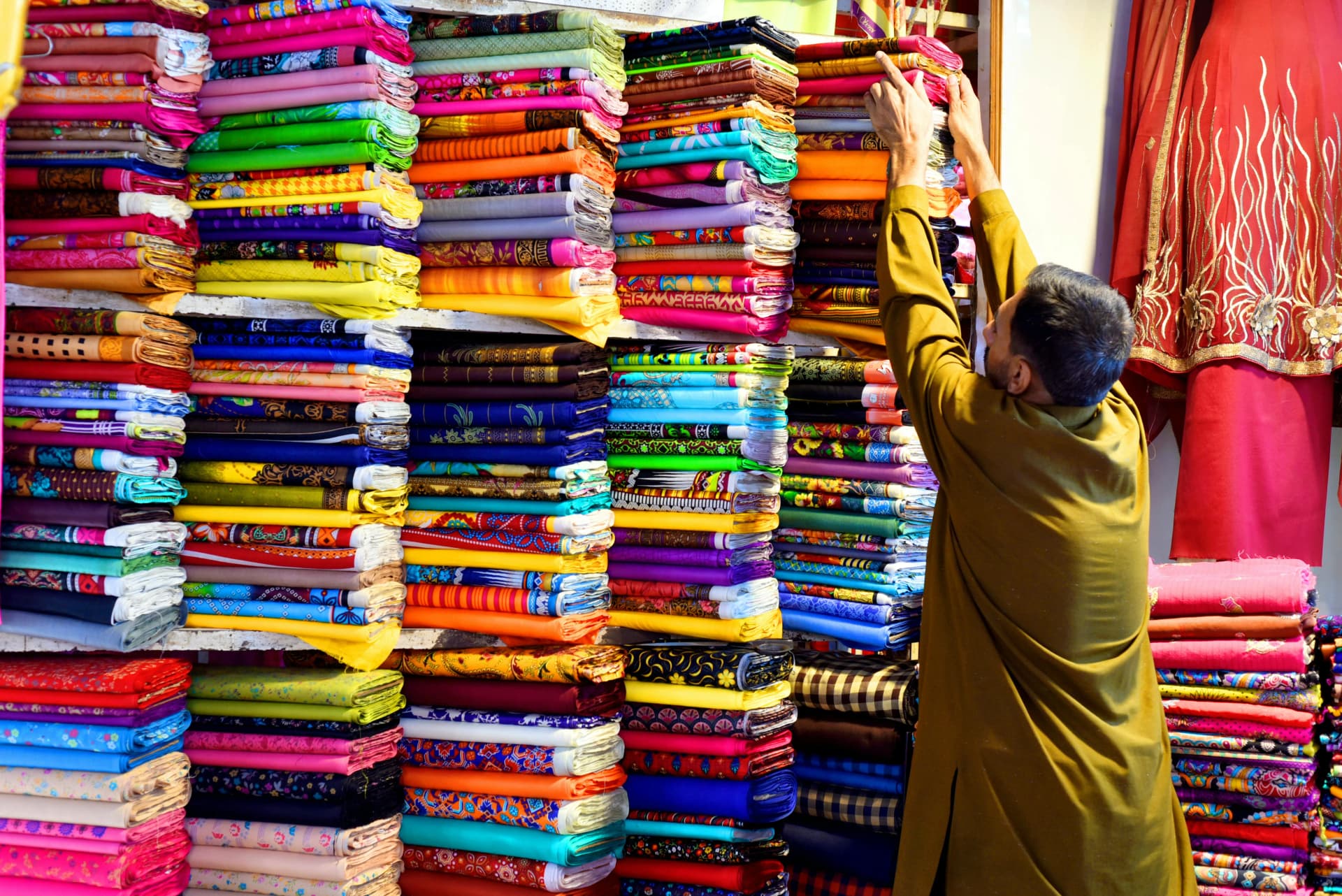
Every shop in the district generates end bolts: the final metre or two left on a roll after the main stock has sold. These remnants are moved to bins at significantly reduced prices, typically between ¥100 and ¥500 per piece, for materials that would otherwise cost several times more per metre from the main roll. The selection is completely random and changes every day. A remnant bin on a Tuesday might contain the tail end of a bolt of silk crepe, three pieces of Japanese cotton with a geometric print, and half a metre of theatrical stretch in deep burgundy. Come back Thursday and the bin is entirely different.
Experienced home sewers treat the remnant sections as the primary destination and the main shelves as backup. Small quantities of good fabric — enough for a blouse, a child's dress, a cushion cover, a costume accessory — are the practical reality for most home projects. At ¥200 for a remnant that gives you enough fabric for a blouse, the economics of Nippori become obvious. Arrive early, before other visitors have gone through the bins, and bring patience.
What Cosplayers Come For
The cosplay community has organised itself around Nippori Fabric Town for decades, and the district has organised itself around them in return. Tomato's cosplay section is explicitly stocked for costume construction: stretch fabrics, theatrical materials, faux leather, laminates, and the specific synthetic textiles that costume makers need for accurate reproductions of anime and game characters. Okuyama, one of the smaller specialist shops on the main strip, takes the specialisation further — the shop produces order-made cosplay costumes and stage uniforms alongside selling raw materials.
What cosplayers specifically need from Nippori that they can't easily get elsewhere in Tokyo is the combination of quantity and variety in stretch and theatrical fabrics. General fabric shops carry basics. Nippori carries the full range of specialty synthetics — holographic fabrics, glitter mesh, sculpted spandex, metallic lamé — at prices that make building multiple costumes financially feasible. A veteran cosplayer with twenty years of experience created a dedicated shopping map of the district that circulates in the community; it's a reliable indicator of how seriously the cosplay world takes Nippori as a sourcing destination.
What Home Sewers and Designers Come For
The home sewing audience and the fashion professional audience want different things from the same district, and Nippori delivers both.
Home sewers come primarily for Japanese cotton prints. The selection here is the largest in Tokyo: traditional patterns — sakura, cranes, geometric family crests, indigo-dyed motifs — alongside modern Japanese cotton in the kind of cheerful, design-forward prints that Japanese sewing culture favours. Prices run from around ¥380 to ¥800 per metre for cotton prints, with the lower end at Tomato and the specialist cotton shops. Quilting fabrics, batting, and the supplies for Japanese patchwork traditions are well represented. For anyone making children's clothes or pursuing the serious home sewing practice that has remained strong in Japan through multiple generations, the range is simply without comparison in Tokyo.
Fashion students and small production designers come for volume and professional pricing. Bunka Fashion College and other design schools send students to Nippori as a matter of routine — it's the standard sourcing location for small-batch production work and student projects that require real yardage at real prices. The wool selection at Nagato's dedicated wool building covers coat-weight and suiting fabrics for those working in that end of the range. Silk, linen, and European imports appear at several shops. For serious garment construction at professional but accessible prices, nothing in Tokyo competes.
Beyond Fabric: What Else Is Here
Several shops in the district deal exclusively or primarily in notions rather than fabric. For anyone making garments rather than simply buying material, these shops are at least as important as the fabric sellers. Yamayo — a two-room shop near the start of the strip — makes a good early stop for patterns, buttons, zippers, and basic supplies. The notion shops stock the full range of professional sewing hardware at professional prices: European zipper brands, Japanese thread in the complete spectrum of weights, interfacing by the metre, and the kind of buckles and D-rings that costume makers need.
At least one shop in the district offers custom fabric printing — the ability to have your own design transferred to fabric. The service targets small production runs but is available to individual customers.
The Yanaka Pairing
Nippori Station is the standard starting point for Yanaka, Tokyo's best-preserved pre-war neighbourhood, and the pairing is natural for a half-day in east Tokyo. The fabric district runs south from the station; Yanaka runs north and west. They ask for entirely different things — one is focused browsing with specific intent, the other is aimless wandering through old streets and past temple cemeteries — and the contrast is what makes the combination work. Allow three to four hours for Nippori if fabric is your purpose, then an hour or two in Yanaka's lanes. One stop south on the Yamanote Line puts you in Ueno for the museums if the day has more left in it.
For a full east Tokyo day built around these neighbourhoods, Infinite Tokyo allows a custom itinerary that sequences the fabric district, Yanaka's old streets, and whatever else fits your interests.
Practical Information
Nippori Station is served by the JR Yamanote Line and the Keisei Line. From the West Exit, the main fabric strip begins within three minutes on foot, clearly marked with yellow district signage. Most shops run 10:00 to 18:00. Sundays see the majority of the district closed; Saturdays are busy but open. The most comfortable visiting days are Tuesday through Friday, when the district is fully operational and weekday-quiet. Bring cash — most shops accept it; card acceptance varies and is not universal. Bring a bag — fabric is heavy when purchased by the metre, and the bags provided are functional but not generous.
Budget roughly two hours for a focused visit to Tomato and two or three other shops. Budget half a day if you intend to cover the full strip. The remnant bins reward time.
FAQ
Do I need to be a professional to shop at Nippori Fabric Town?
No. The district's wholesale history means it was once primarily trade-facing, but retail customers have been welcome for decades. There are no minimum purchase requirements, no trade credentials needed, and no distinction in pricing between professional and general customers. If you want one metre of fabric, you can buy one metre.
Is Nippori Fabric Town open on Sundays?
Most shops are not. Sunday is the traditional rest day for the majority of the district — roughly 80 percent of shops close. Saturday is the reliable alternative for weekend visitors; the district is fully open and operational, though busier. If Sunday is your only option, check the Nippori Fabric Town official site for a shop-by-shop holiday calendar before going.
What's the best time to arrive for remnant bins?
Early. The remnant sections — end bolts and off-cuts sold at ¥100 to ¥500 per piece — are picked through by other customers across the day. Arriving within 30 minutes of the 10:00 opening gives you the best selection before other visitors have gone through the bins. The remnant stock changes daily, so there's no predicting what you'll find, but early arrival maximises the options.
What do cosplayers specifically buy here that they can't get elsewhere in Tokyo?
Specialty theatrical stretch fabrics: holographic materials, laminates, metallic fabrics, sculpted spandex, and faux leather in the range of weights and finishes that accurate costume construction requires. General fabric shops in Tokyo carry basic stretch fabrics but not the full theatrical range. Tomato's cosplay section is explicitly stocked for costume makers, and Okuyama produces order-made cosplay costumes alongside its raw materials. The combination of selection and price is what draws the cosplay community here rather than to Harajuku or Shibuya fabric shops.
Can I combine Nippori Fabric Town with Yanaka in one visit?
Yes, and it's the natural combination. Nippori Station serves both: the fabric district runs south, Yanaka runs north and west. The best days for both are Tuesday through Saturday — Yanaka Ginza closes many shops on Mondays, while Nippori's district closes on Sundays. Allow three to four hours for the fabric district if fabric is your primary purpose, then an hour or two in Yanaka's lanes and cemetery paths before ending at Ueno if time allows.