Odaiba is most interesting as a record of what Tokyo thought it was becoming in the 1990s, and what it actually became when the plan failed.
Odaiba, Tokyo's man-made island, is named after something much older than the island: the gun emplacements (台場, daiba) the Tokugawa shogunate built in Tokyo Bay in 1853 to defend against Commodore Perry's Black Ships. Eight fortifications went up along the bay coast on the orders of Egawa Hidetatsu. The "o" (お) is an honorific that Tokyo residents added out of respect for the shogunate's defenses. What's left of the Third Battery is now Daiba Park, on the east side of the island. It's free and rarely crowded.
The modern island came out of land reclamation that began in the 1960s and sped up during the bubble of the 1980s. At the peak, the plan was a second central business district for Tokyo, joined to the mainland by the Rainbow Bridge, with residential towers, corporate headquarters, and the mixed-use city that 1980s planners were sure was the future. The Tokyo Metropolitan Government named the area the Rinkai Fukutoshin (臨海副都心, Waterfront Sub-Center) and spent heavily on infrastructure.
Then the bubble burst in 1991. The corporate tenants never showed up and the headquarters never moved. The residential towers, meant for workers at offices that didn't exist, got built anyway and filled slowly. Through the 1990s and 2000s Odaiba improvised, filling its business district with entertainment, shopping, and attractions nobody had drawn on the original plans.
teamLab, the Gundam statue, the malls, the beach, and the Pokémon theme park opening in 2026 all came out of Odaiba having to make do, and we think that improvising is the reason to go.
What's Open Now
TeamLab Planets is still the main reason most people come out this way, even though it's technically in Toyosu, one stop from Odaiba on the Yurikamome Line. You walk barefoot through rooms that switch between digital environments and knee-deep water, and it's open through the end of 2027. Book online ahead of time, because same-day tickets are scarce at busy times. The January 2025 expansion added the Athletics Forest and Catching and Collecting Extinct Forest, which pushes a typical visit from two hours to three.
The Unicorn Gundam statue, a 19.7-meter RX-0 Unicorn replica in front of DiverCity Tokyo Plaza, still runs regular transformation shows. Daytime shows are at 11:00, 13:00, 15:00, and 17:00. In the evening there's one every thirty minutes from 19:00 to 21:30, with music, video, and projection lighting. The Gundam Base Tokyo, a museum and shop for Gundam model kits on DiverCity's seventh floor, is still open.
Miraikan (日本科学未来館, the National Museum of Emerging Science and Innovation) is one of Tokyo's better museums for families and for anyone into technology, robotics, or ocean science. It's reliably less crowded than teamLab, and there's more to think about. The permanent exhibits on deep-sea research, space exploration, and robotics are good. The Geo-Cosmos, a suspended globe showing live earth data, is the thing everyone photographs.
Tokyo Joypolis is Japan's largest indoor amusement park, with over twenty attractions mixing arcade games, VR, and simulator rides. It's there for visitors who want something more active than museums and shopping.
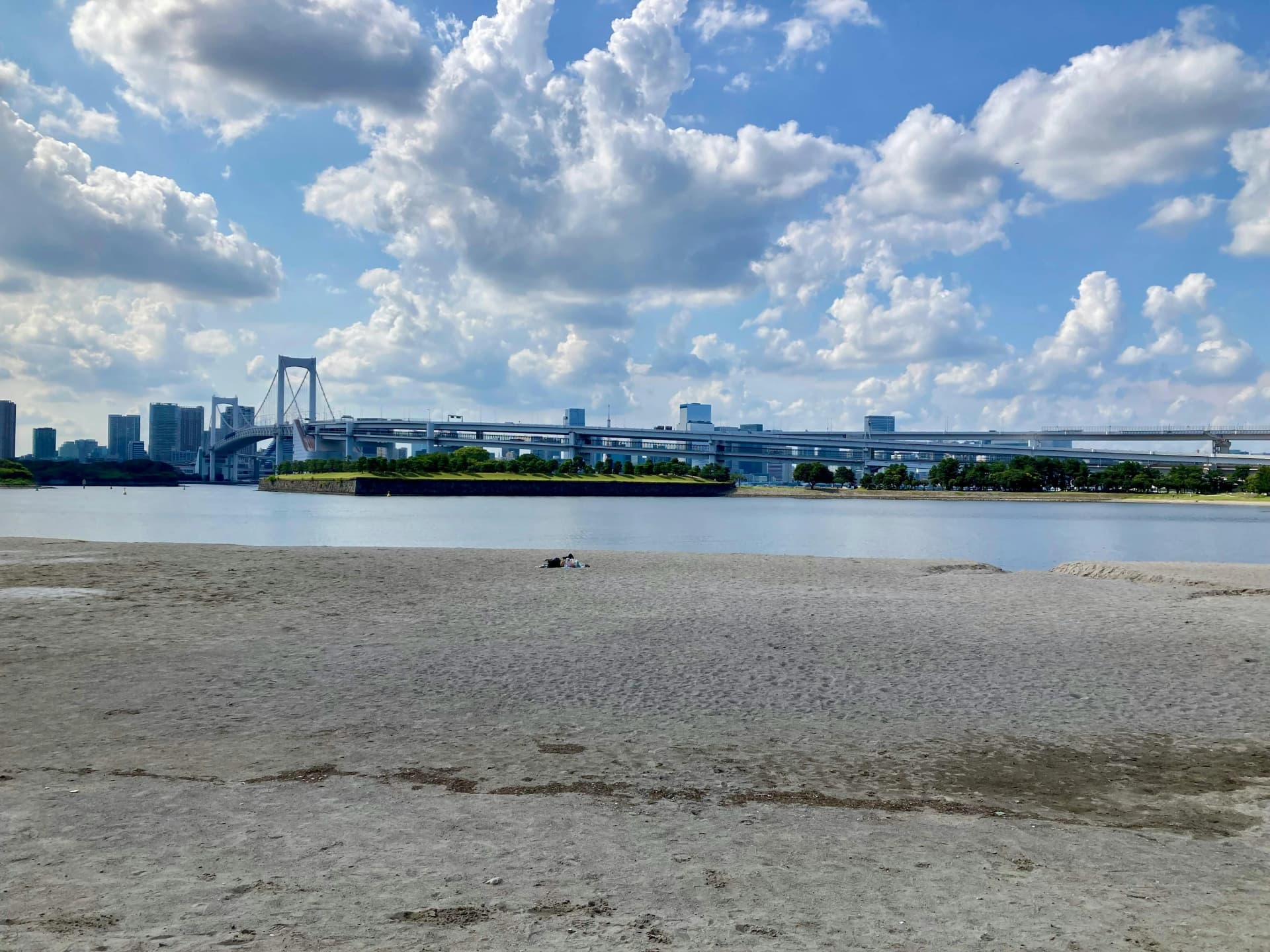
Odaiba Beach and Seaside Park stretches about 800 meters along the island's southern edge, on sand shipped in from Kozushima Island, 180 kilometers south. The Rainbow Bridge view from here is the one in most Odaiba promotional photos. English guides rarely mention that swimming is banned year-round, and for good reason. Tokyo's 23 wards share a combined sewer system, so heavy rain sends untreated sewage into the bay. Come to walk and look at the view, and stay out of the water. There are free foot showers. The park joins up with Shiokaze Park if you want to keep walking or cycling along the water.
Telecom Center Observatory, on the twenty-first floor of the Telecom Center building, has a clear 360-degree view of Rainbow Bridge, Tokyo Tower, Tokyo Skytree, and the bay from 99 meters up. It's a designated Japan Night View Heritage site. Entry is free, and so are the binoculars, and there are sofas. Hardly any tourists go because it doesn't have the branding of the commercial observation decks, so while people queue at the Gundam statue, this is often empty.
The Fuji Television Headquarters is the building with the spherical observation deck that shows up in every Odaiba skyline photo. The deck looks out over Rainbow Bridge, Tokyo Bay, and Tokyo Tower. Kenzo Tange designed the building, and its postmodern exterior is more interesting than the deck itself, though the view is real enough.
PokéPark: The 2026 Addition
A full-scale Pokémon theme park opens on the island in 2026 and will bring a lot of new visitors. Tickets are expected to cost between ¥3,500 and ¥5,000. Details were still coming out in early 2026, but a dedicated park from one of Japan's biggest entertainment franchises is a large bet on Odaiba as an entertainment destination.
The Rainbow Bridge
The Rainbow Bridge (レインボーブリッジ) links Odaiba to the Shibaura waterfront on the mainland. The pedestrian walkway on the lower deck is free and open in daylight, and it puts you above Tokyo Bay in a way the shore can't. It takes thirty to forty-five minutes one way. Come back on the Yurikamome Line, the automated train on the upper deck, for around ¥340.
The bridge was designed in the bubble years to be looked at from a distance as much as crossed, and the lighting was planned from the start. Seen lit up at night from Odaiba beach, or from a yakatabune houseboat on the bay, it's one of the better evening views in Tokyo.
The Yurikamome as Experience
The Yurikamome Line is an automated, driverless elevated train from Shimbashi to Toyosu via Odaiba, and it's one of the more interesting rides in Tokyo. With no driver, the front seats of the lead car look straight ahead through a floor-to-ceiling window. The track crosses Tokyo Bay on the Rainbow Bridge, and the ten-minute run into Odaiba, with the bridge overhead, the Gundam below, and Tokyo Tower behind you, looks like the designers framed it on purpose.
The ride from Shimbashi to Odaiba costs around ¥340 and isn't covered by the JR Pass. For the best view, get on at Toyosu, the eastern end of the line, instead of Shimbashi, since it's easier to line up for the front seats where the train starts its run. On weekdays you'll usually get them. On weekends, expect to let one or two trains go.
The Edo-Period Batteries
Most visitors walk right past the military history, though it's easy to find. The Third Battery (第三台場) survives in Daiba Park on the east side of the island, with stone walls and earthworks from the original 1853 fortifications. The Sixth Battery is still there as a small, isolated island you can see from Odaiba Marine Park but can't visit. The batteries are free, rarely crowded, and a strange contrast with the anime and entertainment next door.
The original plan called for eleven batteries in a defensive arc across Edo Bay from Shinagawa to Fukagawa. Six were finished, with up to five thousand laborers working day and night. The soil for the artificial islands was dug out of the Gotenyama hills, wrecking a famous cherry blossom spot, which was controversial even then. The forts never saw combat, and Perry's ships had already left by the time they were done. They did shape the bay's geography, though, and the name stuck: over generations 台場 became お台場, and the word for a gun emplacement became the name of a neighborhood that has nothing to do with guns.
If you remember the Daikanransha Ferris wheel, it was demolished in late 2022 when Palette Town closed, though plenty of English-language guides still mention it. The site is being redeveloped as TOKYO A-ARENA, a 10,000-capacity multi-purpose arena.
How to Get There
- Yurikamome Line: From Shimbashi, which we recommend for the view. Get off at Daiba Station for most attractions or Odaiba-Kaihinkoen for the beach and park. The line continues to Toyosu for TeamLab Planets.
- Rinkai Line: From Shinjuku (direct, 30 min) to Tokyo Teleport Station. Quicker from western Tokyo, but you miss the view over the bay.
- Water Bus: From Hinode Pier (near Hamamatsucho Station) to Odaiba Seaside Park. A nice option in good weather, though slower and more expensive than the train.
Frequently Asked Questions
Is Odaiba worth it if TeamLab is the main reason? Yes, as long as you do more than TeamLab. It takes two to three hours. Add the beach, the Rainbow Bridge walk, Miraikan, and the Gundam transformation shows and you have a full day. People who come only for TeamLab and leave miss the island.
Is DiverCity Tokyo Plaza open? Yes. As of 2026 DiverCity is open, with the Gundam statue, Gundam Base Tokyo, and ordinary mall shops. The statue's daytime transformation shows and evening performances are running on schedule.
Is Odaiba good for food? The malls have the usual chain restaurants. Near Odaiba Beach there are better places with bay views. Odaiba is somewhere you go for the attractions and eat while you're there. If eating well matters to you, eat before you come or plan around one specific restaurant.
Can I do Odaiba and TeamLab in half a day? Yes. TeamLab Planets at 11:00 AM, Miraikan at 2:00 PM, the Rainbow Bridge walk at 5:00 PM, the Gundam evening show at 7:00 PM, then dinner by the water. On weekends, leave extra time for the TeamLab entry queue.
Is the Yurikamome worth the cost just for the ride? At ¥340 one way, it's one of the cheapest scenic rides in Tokyo. The front-seat crossing of the bay is worth doing once, even with no other plans in Odaiba.
At Hinomaru One, our Infinite Tokyo itinerary includes Odaiba because it shows so clearly what happens when Tokyo's plans and reality part ways, and how the city adjusts. For families, Tokyo Together can build a day around teamLab, Miraikan, and the waterfront, which keeps teenagers and adults equally busy.