Ueno's world-class museums and discount markets aren't unrelated attractions — they're products of the same Meiji-era democratization project.
Ueno puts world-class museums and a discount market side by side, and this guide starts with why. Both came out of the same Meiji-era project to open culture up to ordinary people.
Five Minutes Between 120,000 Objects and 400 Discount Shops
Tokyo National Museum holds over 120,000 cultural properties, 89 of them National Treasures. That's roughly 10% of all the art and craft National Treasures in Japan. It's the country's oldest and largest art museum, spread over six buildings.
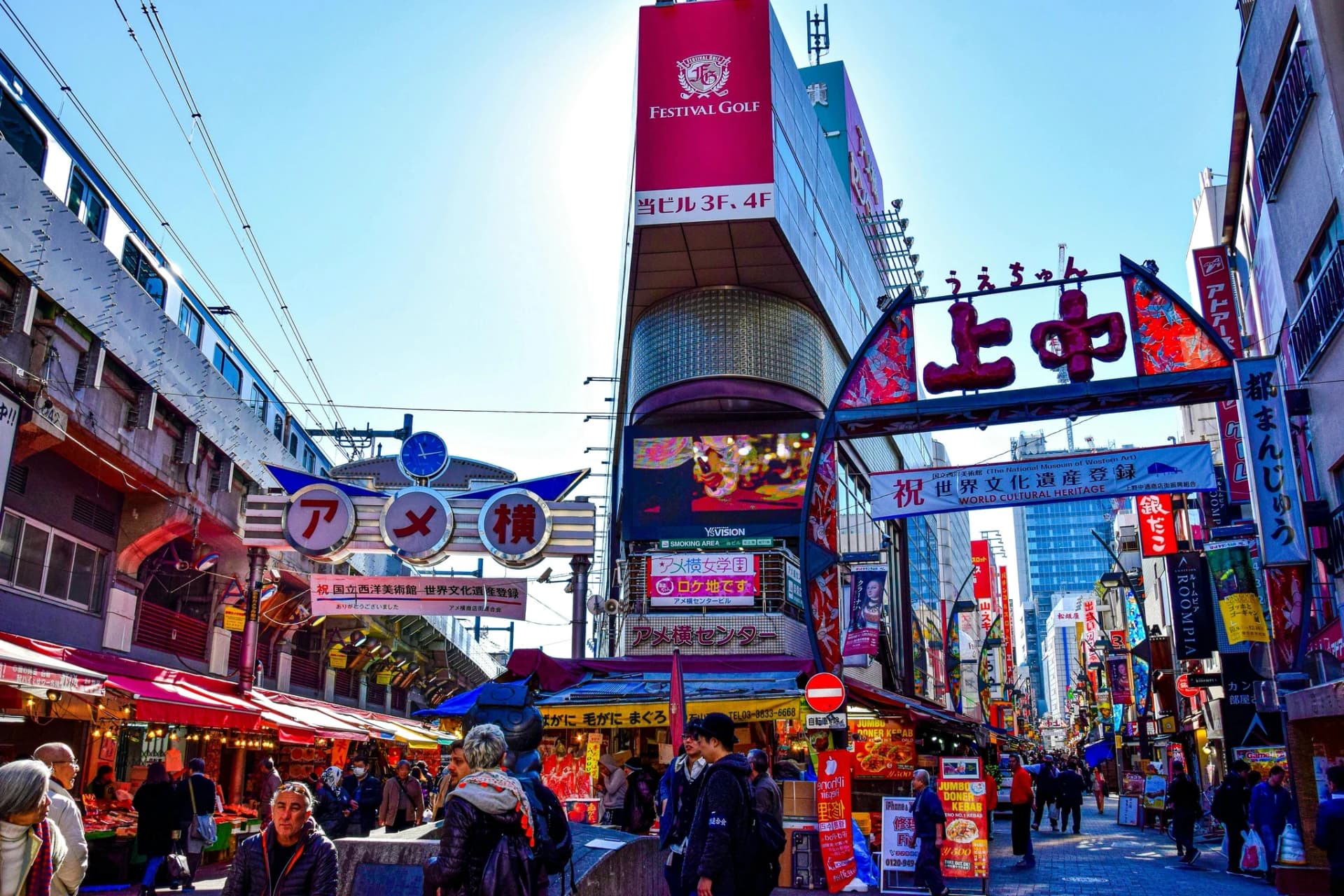
Five minutes' walk away, Ameyoko crams more than 400 shops into a 400-meter stretch under the JR tracks. It started as a black market after the war and still feels like one, with vendors shouting prices, crowds squeezing through narrow lanes, and boxes of chocolate sold auction-style.
The two share a neighborhood because they come from the same moment in history, when the Meiji government set out to bring culture to ordinary people. Japan's most important museums sit in a park next to a discount market because both were meant to serve the public, and knowing that makes it easier to decide what you want from Ueno.
The Deliberate Design: Why Museums and Markets Coexist Here
From Temple Grounds to People's Park
Ueno Park opened in 1873 on land that had belonged to Kan'ei-ji Temple. The temple was destroyed in the Battle of Ueno during the Boshin War of 1868, and a Dutch doctor named Bauduin persuaded the government to make the site a public park instead of a medical school.
The park was a political statement as much as a piece of planning. The Meiji government was bringing in Western ideas so new that Japanese had no words for them yet. The words for "museum" and "art" were coined in this period.
Culture for the Working Class
The park hosted four trade fairs meant to show off "civilization and enlightenment." Museums, a zoo, and a library followed quickly. What had been a religious site of the Tokugawa family became a people's park, where anyone could see culture that used to be kept for the elite.
In 1924 Emperor Taishō gave the park to the city. Its official name, Ueno Onshi Kōen ("Ueno Imperial Gift Park"), comes from that gift and that public purpose.
You can still see this history today. Admission to the Tokyo National Museum is ¥1,000, and under-18s get in free. The museums are clustered together because they were built for the same project. Ameyoko, a discount market for working-class shoppers, is the commercial side of the same idea.
The 120,000-Object Problem: Choosing What to See
"Visit Tokyo National Museum" is not much help on its own. The museum has 120,000 objects across six buildings, with about 3,000 on display at any one time. People who walk in without a plan get overwhelmed and remember almost nothing. We have a separate guide on which buildings to prioritize and how long to plan.
Tokyo National Museum: Not One Museum, But Six
The main Honkan building alone can eat a morning, with Japanese art and archaeology over two floors. The Toyokan covers Asian art, Heiseikan is Japanese archaeology, and Horyuji Homotsukan has Buddhist treasures from the 7th-century Horyuji Temple. Each building works as a museum in its own right.
For Japanese swords, samurai armor, or Buddhist sculpture, go to the Honkan and head straight for Room 2 on the second floor. That's the National Treasure Gallery, full of pieces Japanese kids see in their school textbooks. Start there, then work down to the first floor's collections, arranged by genre. If Asian art history is more your thing, go to the Toyokan instead. Try to sample everything and you'll enjoy none of it.
National Museum of Western Art: The Impressionist Exception
This is Tokyo's only permanent collection of Impressionist paintings. The Matsukata Collection has Monet's "Water Lilies," Renoir portraits, Van Gogh, and Cézanne, and Rodin's "The Thinker" and "The Gates of Hell" stand in the front garden. Le Corbusier designed the building. It's a UNESCO World Heritage Site and his only work in East Asia.
The permanent collection costs ¥500. Give it 90 minutes to two hours.
If You Care About Science
The National Museum of Nature and Science has two buildings and over 25,000 permanent exhibits. The dinosaur skeletons are the big draw (T-rex, Triceratops, and Futabasaurus, which was found in Japan). There's also Theater 360, a spherical 360-degree film, and the stuffed body of Hachiko, the famous loyal dog. The Japan Gallery building, finished in 1931, is shaped like an airplane from above and is an Important Cultural Property.
Admission is ¥640, and free for anyone up through high school. Plan on three to four hours if you want to see it properly.
If You Have 90 Minutes vs 4 Hours
With 90 minutes, pick one museum and one thing to focus on inside it. The Western Art Museum's permanent collection is the easiest fit. Four hours gets you one museum done properly or a quick look at two. A full day gets you two museums done well, and you still won't see everything.
Quick Reference: Which Museum for Which Interest
| Your Interest | Museum | Time Needed |
|---|---|---|
| Japanese art, swords, armor, Buddhist sculpture | Tokyo National Museum (Honkan) | 4-5 hours |
| Impressionist paintings, Rodin sculptures | National Museum of Western Art | 1.5-2 hours |
| Dinosaurs, science, hands-on exhibits | National Science Museum | 3-4 hours |
| Only 90 minutes available | Western Art (permanent collection) | Easiest to fit in |
Ameyoko's Internal Geography: Where to Find What
If all you're told is "walk through Ameyoko," you'll drift through the crowds without much point. Different parts of the market sell different things.
North End (Ueno Side): Seafood and Spectacle
The end nearest Ueno Station has the fresh seafood vendors and the well-known tatakiuri chocolate sales. At Shimura Shoten, staff do the traditional bang-selling routine, stuffing bags with chocolate while chanting "Irechae! Irechae!" ("Put it in! Put it in!"). A bag costs ¥1,000 for over ¥2,500 worth of chocolate. You don't see this much elsewhere in Tokyo anymore, but it carries on here.
This end also has Niku no Oyama, a butcher known for menchi-katsu (fried minced meat patties) you eat standing at the counter.
Ameyoko Center Building Basement: The Ethnic Kitchen
The basement is an Asian ingredients market, with Chinese, Thai, Korean, and Vietnamese products on the shelves. Locals come here for unusual spices, fermented pastes, and dried goods the regular Tokyo supermarkets don't carry.
Under the Tracks: Everything Else
Under the JR tracks you'll find discount cosmetics, military surplus at Nakata, sneakers, and dried fruit. Okuma Shokai is one of the best-stocked sukajan shops in Tokyo. Sukajan are the silk bomber jackets embroidered with dragons and cherry blossoms, first made when vendors sold to American soldiers after the war. Takeya, the big purple discount store, has cosmetics, clothes, and food over several floors.
Most shops open around 10:00 and close by 20:00, and many close on Wednesdays. If you're after something in particular, know which section to head for.
The Time Math That Defeats Most Visitors
Most Ueno plans go wrong because people underestimate how long each place takes and then try to fit everything into half a day.
The Cherry Blossom Trap
Every guide leads with Ueno's cherry blossoms. What they leave out is that over two million people come to the park during the two weeks of peak bloom. Visitors call the crowds "worse than Disneyland," and on weekends the paths are impassable. The park turns into one big hanami party, and the museums become an afterthought.
If you're coming for the museums, cherry blossom season is the worst time to do it. The other 96% of the year is better for that. When you start your day matters too. Go to the museums in the morning, when crowds are lighter and you have the energy for dense collections.
What 4 Hours Actually Buys You
-
Tokyo National Museum (Honkan only): 4-5 hours at least for a satisfying visit
-
National Museum of Western Art: 1.5-2 hours for the permanent collection
-
National Science Museum: 3-4 hours to see it properly
-
Ueno Zoo: 2-3 hours for a proper visit
-
Ameyoko: 1-2 hours if you know what you're after
Half a day is enough to do one of these well, and not enough to do three of them even passably. The same math applies all over Tokyo when you're thinking about how tour length affects what's possible.
The Honest Trade-Offs
You're really picking one version of Ueno. The first is four hours at Tokyo National Museum, focused on what you care about, with time to take it in. The second is the Western Art Museum plus an hour in Ameyoko, which fits in half a day but only skims both. The third is the family version: the zoo for the kids, a quick walk through Ameyoko, and no real museum time. Pick one before you get there and you'll leave happy instead of worn out.
What a Guide Actually Does in Ueno
In Ueno, most of a guide's work is triage, adjusting on the day, and explaining what's in the cases.
Triage Before You Arrive
The narrowing-down happens before you reach the park. In the conversations before the tour, the guide works out what you care about (Japanese swords or Impressionists, dinosaurs or Buddhist sculpture) and drops everything else. You arrive with a plan, instead of standing at the park entrance wondering where to begin.
Real-Time Adjustments
Plans change. The gallery you wanted is closed for renovation, you're flagging after an hour, or your teenager turns out to love the dinosaurs. A guide notices and adjusts, staying longer with what's working, cutting what isn't, and finding coffee when you need it. That's hard to do for yourself when you don't know what's around the next corner.
Reading What You're Looking At
Without context, a samurai sword in a case is just a sword. With it, you're looking at a particular blade from a particular period, made with techniques that changed over centuries, and you start to see why Japan still feels the way it does about these objects. A guide fills in that story for whatever you happen to be standing in front of.
Families at Ueno: Managing the Zoo-Museum Tension
Ueno gets sold as family-friendly, and it is, with some trade-offs.
The Honest Zoo Assessment
Ueno Zoo opened in 1882, which makes it Japan's oldest. It covers 14.4 hectares and has over 3,000 animals. It's also criticized for outdated enclosures, and some visitors find it depressing.
The twin pandas Xiao Xiao and Lei Lei were born at the zoo in 2021 and went back to China on January 27, 2026. For the first time since 1972, Japan has no pandas.
When the Zoo Makes Sense (and When It Doesn't)
For families with young children, the zoo gives the day some structure and something kids already like. Children don't need background to enjoy watching animals. At ¥600 it's cheaper than any of the museums, and there's room for kids to move around.
Older kids and teenagers can enjoy the museums if you pick around what they're into. A teenager who loves gaming might get more out of Akihabara than Ueno, while one who loves dinosaurs could be very happy in the National Science Museum's fossil halls.
Plan around their interests, not yours. For more on Tokyo days that teenagers actually enjoy, see our touring with teenagers guide.
The Family Ueno That Actually Works
Mixed-age groups have the hardest choice. The adults want museum time, the kids want the zoo, and doing both usually means nobody gets enough of either.
A guide can order the day so everyone gets something: the Science Museum and its hands-on exhibits in the morning, the zoo after lunch when the little ones need to run around, and Ameyoko at the end, where everyone can browse together. Nobody gets a full museum day, and nobody spends the whole day giving way to someone else either.
Tours That Include Ueno
For Depth-Seekers
Infinite Tokyo is our custom option for people who want serious museum time. A full day leaves four to five hours for Tokyo National Museum, with a guide who can pick through 120,000 objects based on what you're into, whether that's Japanese art history, Buddhist sculpture, swords and armor, or a well-chosen introduction if it's all new to you.
For Families
Tokyo Together is designed for multigenerational groups. The standard route includes lunch in Ueno and a walk through Ameyoko, and it can change depending on whether your family wants the zoo, the market, or a stop at the science museum.
Building Your Own Ueno Day
Ueno goes well with Asakusa (one subway stop away) or Yanaka (next door, and you can walk). Half a day in Ueno and an afternoon in Yanaka's old Tokyo streets gives you the big museums and a quiet neighborhood without museum overload. Tokyo Essentials suits visitors who want a guided morning and then time to explore on their own.
Should You Stay in Ueno?
Most guides skip this one, though judging by what people search for, plenty of you are asking.
The Airport Advantage That Matters
Of all the central Tokyo neighborhoods, Ueno has the best connection to Narita. The Keisei Skyliner runs straight from Narita Airport to Keisei Ueno Station in 41 minutes for ¥2,580, with no transfers and no hauling luggage between trains. Keisei Ueno is a short walk from JR Ueno. If you fly into Narita, staying in Ueno cuts out a whole leg of the trip compared with Shibuya or Shinjuku.
Haneda is different. There's no direct train. The fastest way is the Keikyu to Shinagawa (about 14 minutes), then the JR Keihin-Tohoku Line to Ueno (22 minutes), roughly 40-50 minutes once you count the transfer and the wait. That's fine, but no better than most central neighborhoods, so if you're coming from Haneda, Ueno has no particular edge.
For exact airport-to-hotel routes and real fares, use our airport transfer tool.
Where Ueno Sits in the City
Ueno is in the northeast of the city, which matters depending on what you plan to do.
Works well if your itinerary focuses on:
- Asakusa: 6 minutes by Metro Ginza Line
- Akihabara: 4 minutes by JR Keihin-Tohoku Line
- Yanaka: walkable from the park's north exit
- Museums and the park itself, since you're already there
- Narita arrival/departure (see above)
Less convenient if your itinerary includes:
- Day trips to Mt. Fuji or Nikko from Shinjuku
- Kyoto by Shinkansen from Tokyo Station, which is 12 minutes away by JR and manageable
- Shibuya, Harajuku, or Roppongi: 25-30 minutes at the very least
Hotels and What to Expect
Hotels are bunched near the park's Shinobazu Exit (the west side) and around Ueno Station. They lean mid-range to budget, with more business hotels than luxury ones, and prices are lower than in Shinjuku or Shibuya for similar quality. The hotel area by Ueno Park is quiet at night, busy as the neighborhood is during the day.
Two caveats. Parts of the area around the station have smartened up, but it's still gritty in places. And Ameyoko closes after 8 PM, so evenings are quieter than in Shinjuku and less lively than Asakusa's izakaya scene.
Who Should Stay in Ueno
Makes sense if: you're arriving from Narita, you'll spend most of your time in east Tokyo (Asakusa, Akihabara, Yanaka), you want plenty of time in the park's museums, or you're watching costs and want more hotel for your money.
Look elsewhere if: you're arriving from Haneda and want less time on trains, your trip is mostly west Tokyo, or you want nightlife within walking distance of your hotel.
Frequently Asked Questions
Is Ueno closer to Narita or Haneda?
Narita, clearly. The Keisei Skyliner goes straight from Narita Airport to Keisei Ueno Station in 41 minutes (¥2,580, no transfers). From Haneda you have to change, usually Keikyu to Shinagawa and then JR to Ueno, which takes 40-50 minutes and isn't especially fast. Simplicity is the bigger difference. The Skyliner is one train with no connections and big overhead racks for luggage, while the Haneda route means a platform change and two fares. For exact routes and costs from either airport, use our airport transfer tool.
Is it better to stay in Shinjuku, Ueno, or Asakusa for minimal train travel?
It depends on where you'll spend your days, so match your base to your plans.
Stay in Ueno if you'll spend most of your time in east Tokyo: Asakusa (6 min), Akihabara (4 min), and the park itself. It's also the best pick if you're flying into Narita.
Stay in Asakusa if Asakusa is the main thing you came for and you'd like to step out of the hotel straight into the neighborhood. JR connections from Asakusa are thinner than from Ueno or Shinjuku, so it suits people who aren't planning many day trips.
Stay in Shinjuku if you're focused on west Tokyo, day trips to Mt. Fuji or Hakone, or the Shinkansen to Kyoto (some routes leave from Shinjuku, or it's 20 minutes to Tokyo Station). Shinjuku also has by far the most nightlife of the three.
What is the market in Ueno called?
Ameyoko, short for Ameya Yokocho, which roughly means "candy vendor's alley." It's the 400-meter run of shops under the JR tracks between Ueno and Okachimachi stations. The name comes from the candy stalls that filled the market after the war. These days it sells seafood, cosmetics, clothes, military surplus, and dried goods, and the tatakiuri chocolate selling at the north end is the part everyone photographs.
Is it better to stay near Tokyo Station or Ueno Station for first-time visitors?
Either is a reasonable choice, and the difference comes down to where you're headed.
Tokyo Station has more Shinkansen routes (useful for day trips to Kyoto or elsewhere) and the Narita Express, and it sits more centrally between east and west Tokyo. Hotels around it tend to cost more.
Ueno has the Keisei Skyliner to Narita, which is faster and cheaper than the Narita Express. It puts the park museums and Ameyoko within walking distance, has better-value hotels, and is closer to Asakusa and Akihabara.
On a first visit spent mostly in east Tokyo, flying into Narita, Ueno is the better pick. If you're taking Shinkansen day trips or spreading out across the city, Tokyo Station is more central.