The most interesting public art in Tokyo is the art nobody told you to look down for.
Tokyo manhole covers stop people in their tracks. Somewhere between Ueno Park and Ryogoku, a first-time visitor crouches down and photographs the pavement. Not a temple. Not a neon sign. A manhole cover — cast iron, about 60 centimeters across, depicting a Pokémon in such precise detail it looks like it was designed for a museum floor rather than a sewer access point.
Japan has roughly 15 million manhole covers. Over 12,000 of them are unique. Every prefecture, most cities, and many individual wards have their own custom designs. Some are left unpainted — grey and functional. Others are cast in full color, painted by hand, one cover at a time, and installed as permanent street-level public art. Tokyo's are among the most concentrated and varied in the country.
Most tourists step over them.
Why Japan Decorates Manhole Covers
The first Japanese designer manhole cover appeared in 1977 in Naha City, Okinawa. The design showed fish swimming in clean water — an explicit message about what sewage systems actually do. It was a government PR exercise, and it worked well enough to spread.
In the mid-1980s, a construction ministry official named Yasutake Kameda formalized the idea. Japan's municipalities needed expensive sewage infrastructure upgrades. Local governments were resistant — the projects were disruptive and the costs were politically uncomfortable. Kameda's solution was to make the infrastructure itself something residents could take pride in. If the cover on the street told the story of your city — its landmarks, its flowers, its festivals, its mascots — the project underneath it became less abstract.
Colored covers appeared in 1981. They used fluorescent paints that remained visible at night, which gave them a practical secondary function: visible markers for firefighting and emergency access in low-light conditions. Anti-slip textures came standard. The design requirement and the safety requirement turned out to reinforce each other — the more elaborate the casting, the more surface grip.
What Kameda started as municipal persuasion became something else entirely. Over 90 percent of Japan's municipalities now have at least one custom design. The covers are cast using individual molds, then painted by hand — which means every single one is a small, durable original. There is no equivalent in any other country at this scale.
The Manhole Card Collector System
In 2016, a government-backed organization called the GKP — the Gesuido Koho Platform, or Sewer Public Information Platform — launched a national collector card program. The cards are free. Each one features a photograph of a specific manhole cover design on the front, with the GPS coordinates of its exact location. The back describes the design's origin and what it represents for that particular city or ward.
As of 2021, over 780 different card types had been issued. By mid-2022, more than one million individual cards had been distributed across Japan. The scale of the program is hard to overstate — this is a government agency running a nationwide collector campaign using storm drain infrastructure as the hook.
Cards are issued one per person, per location. You cannot order them online or pick them up at a general tourist office. You go to the designated distribution point — typically a ward office, a municipal water facility, or a specific public building — and collect it in person. The rule about visiting the place exists because the card is designed to bring you there, to the neighborhood, to the cover itself.
Getting Manhole Cards in Tokyo
Tokyo's distribution is managed by the Tokyo Bureau of Sewerage, with individual wards running their own parallel programs. The two most accessible central collection points are the Kuramae Water House in Taito Ward and the Tokyo Sewerage Museum in Koto Ward. Both distribute multiple Tokyo design cards and are worth visiting as destinations in their own right.
Ward-specific cards — like Kita Ward's seven designs, or Katsushika Ward's — are distributed from those wards' municipal offices or designated facilities. Opening hours and availability change, so the most reliable way to plan is the GKP's official search tool at gk-p.jp/mhcard, or the fan-run database at cardhunter.jp which tracks Tokyo distributions by ward and flags recent inventory changes.
Distribution points sometimes run out. Some operate on weekdays only. A few use a lottery system when demand is high. If you're serious about collecting, confirm the current status before making a trip to a specific office.
The Best Tokyo Manhole Covers — Ward by Ward
Tokyo's design manhole program formally covers all 62 wards, cities, and towns in the metropolitan area through the TOKYO Design Manhole Digital Rally, an app-based stamp rally connecting roughly 100 designated covers across the city. But you don't need an app to find the most interesting ones. Most are in neighborhoods you're likely visiting anyway.
The Cherry Blossom Cover — City-Wide
The most widely distributed Tokyo design is the oldest: a cherry blossom pattern representing the Tokyo Metropolitan Government. You'll see versions of it on streets throughout the city, often in white on dark grey cast iron. They're not rare enough to hunt — they're the baseline. What makes Tokyo interesting is everything layered on top.
Minato Ward — Sailor Moon
Minato Ward installed a series of Sailor Moon manhole covers drawing on the series' deep roots in the area. The mangaka Naoko Takeuchi set the story in Azabu-Juban, a neighborhood in Minato Ward, and the covers reflect that connection. The most photographed are near Shiba Park, close to a water supply station with a direct sightline to Tokyo Tower — which makes the juxtaposition particularly strong. Additional covers appear on the street opposite Onarimon Station, in front of the Minato Library. If your Tokyo day includes Roppongi or the Art Triangle circuit, Minato Ward's covers are a ten-minute walk from the main route.
Ueno — Pokémon
Japan's national "Poké Lids" project has placed Pokémon-themed covers in cities across the country. The only location within central Tokyo proper is Ueno Park, near the National Museum of Nature and Science — look for the whale skeleton statue at the museum entrance. The cover features Wynaut and Tyrunt, chosen for their connection to natural history and fossils, which aligns with the museum's collection. If you're building a day around Ueno, this is a two-minute detour from the standard park circuit.
Shinjuku — Godzilla
Kabukicho in Shinjuku has a Godzilla manhole cover, which fits. The neighborhood already has Godzilla leaning out of the Toho Cinemas building on its main entertainment strip. The cover was installed as part of Shinjuku Ward's push to make its entertainment district a destination rather than just a transit node. It's not subtle. It doesn't need to be.
Ryogoku — Sumo Wrestlers
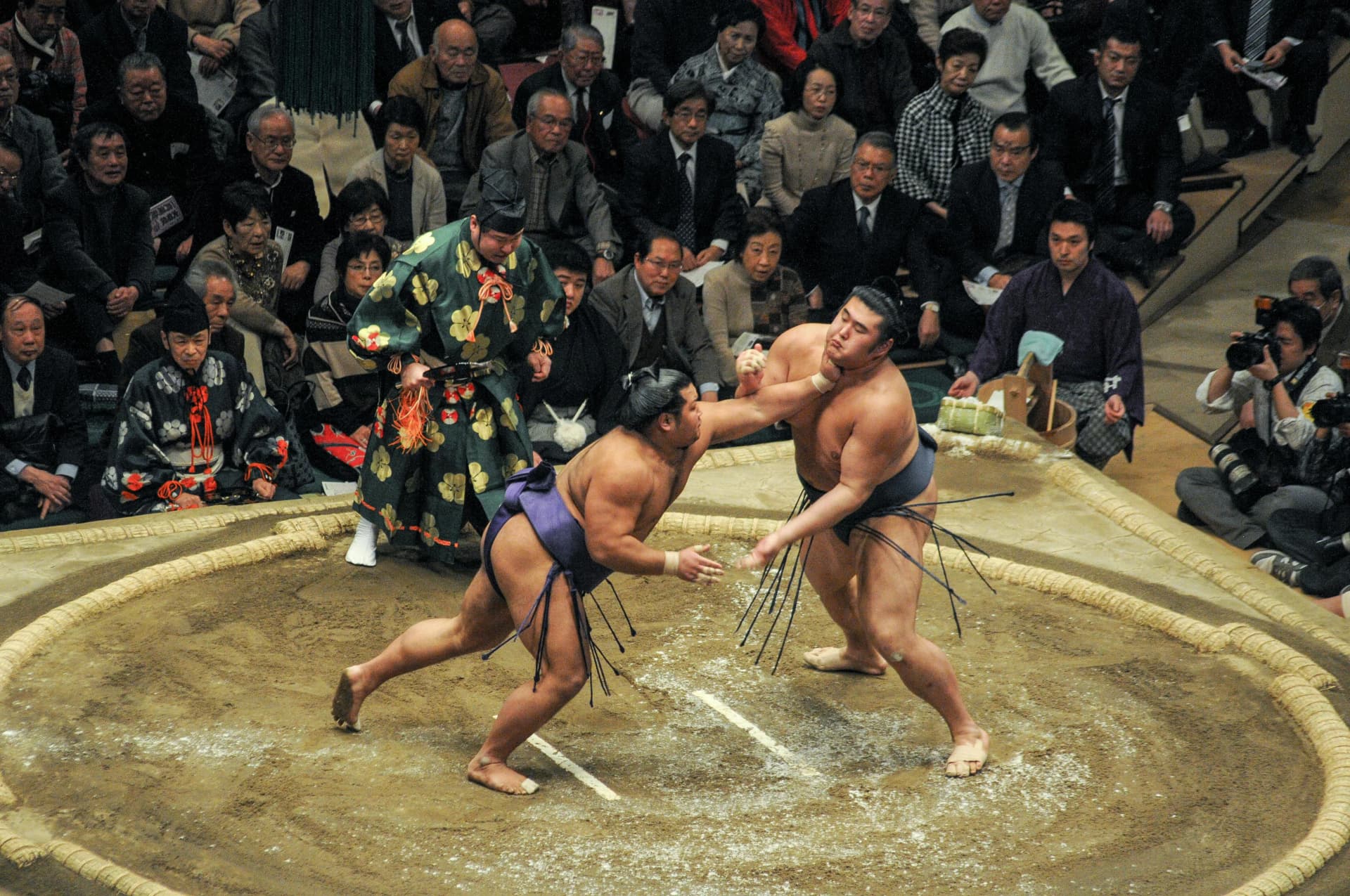
Ryogoku is Tokyo's sumo district, home to the Kokugikan arena, and its manhole covers reflect exactly that. Cast-iron sumo wrestlers mid-bout appear in the pavement around the arena area. Ryogoku is also one of the more satisfying neighborhoods for cover-hunting because the covers, the sumo stables, the chanko nabe restaurants, and the Edo-Tokyo Museum form a coherent day — everything in the ward tells a consistent story about a specific part of the city.
Chiyoda Ward — Astro Boy
Chiyoda Ward, which includes Akihabara and the corridors connecting it south toward Jinbocho, has Astro Boy covers. The connection is direct — Osamu Tezuka's studio was in this part of Tokyo, and Chiyoda Ward leans into its manga heritage. If you're spending time in Akihabara, the covers extend the neighborhood's visual language into the street itself.
Tama City — Hello Kitty
Tama City, in western Tokyo, is where Sanrio Puroland is located. Hello Kitty appears on the manhole covers throughout the area. Tama City is not central, but if you're taking the Keio Line west for any reason, or building a day around the theme park, the covers are part of a coherent character-themed neighborhood experience.
Shinbashi — Firefighters
The area around Shinbashi Station has covers depicting firefighters and fire hydrants — a reference to the neighborhood's historical role in Tokyo's development and its fire-station traditions. These are less photographed than the pop-culture designs, which makes them more interesting from a civic-art standpoint. They're doing what manhole covers were originally designed to do: tell the specific history of a specific place.
Building a Photo Walk Around Tokyo's Manhole Covers
The most common mistake is treating manhole hunting as a standalone activity. It isn't. The best approach is to add it as a layer to a neighborhood you're already walking — which is what makes Tokyo's covers work as a travel element.
For a morning in Ueno, the Pokémon cover near the museum fits naturally into a circuit from the park entrance through the museum district. The walk between the National Museum, the National Museum of Nature and Science, and the Metropolitan Museum of Art passes enough pavement to make looking down a habit.
For an afternoon in Shinjuku, the Godzilla cover in Kabukicho is on the same street as the Godzilla cinema building — the cover was placed deliberately within the broader spectacle of the entertainment district. Start at the east exit of Shinjuku Station, walk through Kabukicho, and the cover is near the main drag.
For Minato Ward, the Sailor Moon covers work well as a late morning loop — Shiba Park to Onarimon Station takes about twenty minutes on foot, and the route passes through residential Minato, which has a different texture than central Tokyo. Tokyo Tower is visible from multiple points along the walk.
Ryogoku is the most coherent single-ward manhole walk in the city. The sumo covers, the arena, the stables where you might see rikishi walking to morning practice, and the riverside scenery form a full two to three hour morning that requires nothing beyond your feet and an eye for the ground.
The TOKYO Design Manhole Digital Rally's map (tokyo-manhole.metro.tokyo.lg.jp) is the most comprehensive planning tool for anyone who wants to do this systematically. It plots all 100+ designated covers across the metropolitan area with transit directions. Offline, the photographs database at rojonomanhole.web.fc2.com covers Tokyo ward by ward with coordinates.
Practical Notes
The covers are set into public streets and sidewalks — there's no admission, no ticket, no hours. Rain makes painted covers slightly more vivid; overcast light reduces glare for photography. Morning is better than midday for shooting — foot traffic is lower and the light is softer.
For manhole cards, plan ahead. Tokyo Sewerage Museum (Koto Ward) and Kuramae Water House (Taito Ward) are the most consistent central distribution points. Ward-specific cards require visiting that ward's distribution office, often on weekday hours. Verify current availability via gk-p.jp/mhcard before traveling to a specific office.
The covers are cast iron and heavy. They are maintained by the municipality responsible for the infrastructure underneath. If you see a damaged or displaced cover, that's a call to the ward office, not a photo opportunity to step around.
FAQ
How many different manhole cover designs are there in Japan?
Over 12,000 unique designs across Japan's roughly 15 million total manhole covers. The number comes from the GKP, the government body that coordinates the national manhole card program. Not all designs are painted or colored — most of Japan's manhole covers are plain grey — but over 90 percent of municipalities have at least one custom design that represents their local area.
Are Tokyo manhole covers really painted by hand?
Yes. Japan's colored manhole covers are made using custom cast-iron molds specific to each region's design. The coloring is applied by hand, one cover at a time. This makes each painted cover a functional original — the design can be replicated via the mold, but the coloring is individual. Covers are made to anti-slip standards, which is why the relief designs are practical rather than just aesthetic.
What is the Manhole Card system and how do I get cards in Tokyo?
Manhole Cards are free collector cards issued by the GKP (Gesuido Koho Platform, Japan's Sewer Public Information Platform) in partnership with local governments. Each card shows a specific cover design with GPS coordinates and a description of the design's origins. You collect them in person from the designated distribution point in each ward or city — you can't order them online. In central Tokyo, the most accessible pickup locations are the Tokyo Sewerage Museum in Koto Ward and the Kuramae Water House in Taito Ward. Use gk-p.jp/mhcard to check current distribution points by ward before you go.
Do I need a specialist tour to find Tokyo's manhole covers?
No. The covers are in public streets and most named locations are easy to find independently. What a guide adds is context — knowing why Chiyoda Ward chose Astro Boy, why the Sailor Moon covers are specifically in Minato Ward, or how the Ryogoku sumo covers fit into the neighborhood's broader civic identity turns a photograph into something you can actually explain when you show it to someone. It's the difference between collecting images and understanding a city.
At Hinomaru One, we design private Tokyo days for people who want to understand the city rather than just cover it. Manhole covers are one lens. The guides who walk these neighborhoods know the stories behind what's underfoot — and what's at eye level too.