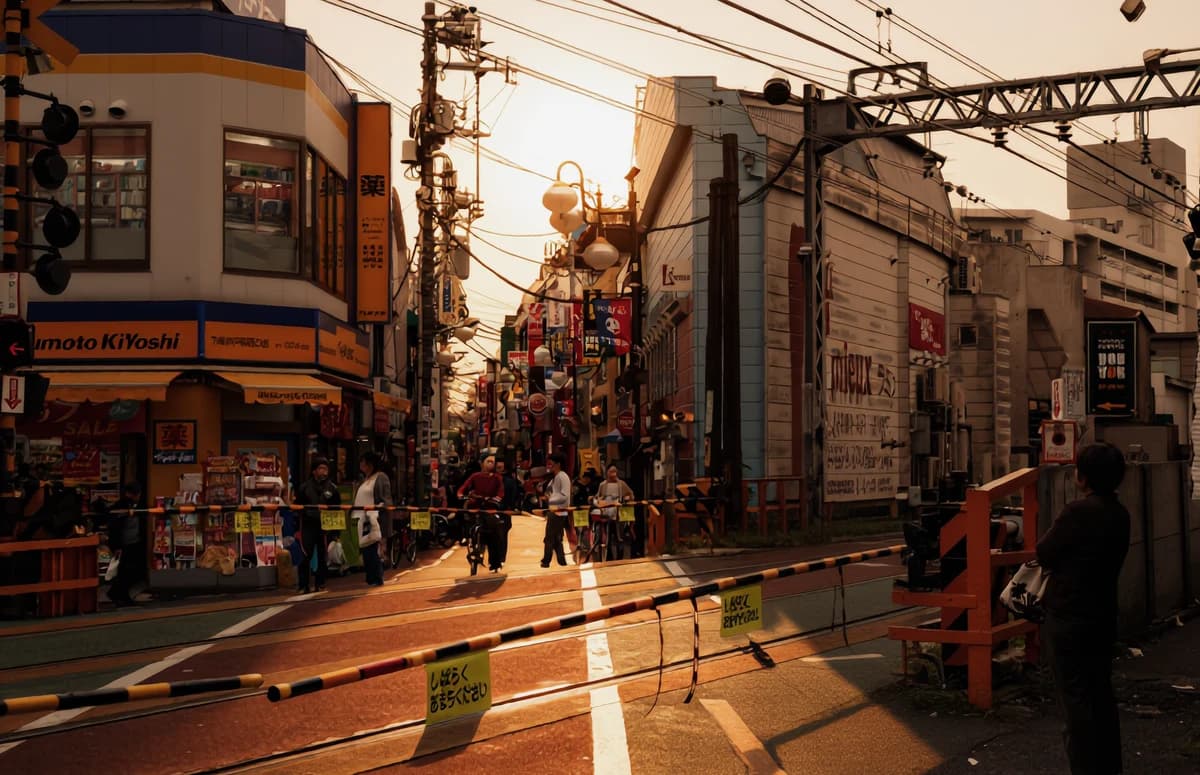
Shimotakaido still feels like a real neighborhood — because nobody decided to redevelop it.
Two stops west of Shimokitazawa on the Keio Line, Shimotakaido (下高井戸) is what a Tokyo shopping street looks like when nobody decides to redevelop it. There are 255 shops packed around the station, 43% of them selling food. The fishmonger knows his regulars. The tofu shop has been in the same spot for decades. The local cinema still sells tickets at the box office only because the owner thinks online reservations would be unfair to the elderly customers who walk over from the neighborhood.
One stop east, Meidaimae (明大前) runs on student energy from Meiji University's Izumi Campus. Cheaper ramen, more coffee shops, a different rhythm. The two stations are a ten-minute walk apart and feel like natural complements: one is your grandmother's neighborhood, the other is your first apartment after leaving home.
Neither station appears in any "must-see Tokyo" list. That's the point.
The Shotengai: A Shopping Street That Works
Shimotakaido's commercial roots go back to the Edo period. The area was part of Takaido-shuku, the first post town on the Koshu Kaido highway out of Nihonbashi. When the Setagaya Line opened from Sangenjaya to Shimotakaido in 1925, the trickle of shops became a proper commercial strip. By the early Showa era there were about 60 shops. Today the Shimotakaido Shotengai Shinko Kumiai counts 255 member shops spanning several connected streets: Nihon University-dori, Ekimae-dori, and Kitaguchi Renga-dori among them.
What makes this shotengai different from, say, Shimokitazawa's increasingly curated retail is that it still functions as a daily grocery run for the surrounding residential blocks. Greengrocers, fishmongers, butchers, rice shops. On Sundays and holidays, Koen-dori and Ekimae-dori close to traffic and become pedestrian-only, filled with families doing their weekly shopping. This isn't a heritage performance. People actually buy their dinner here.
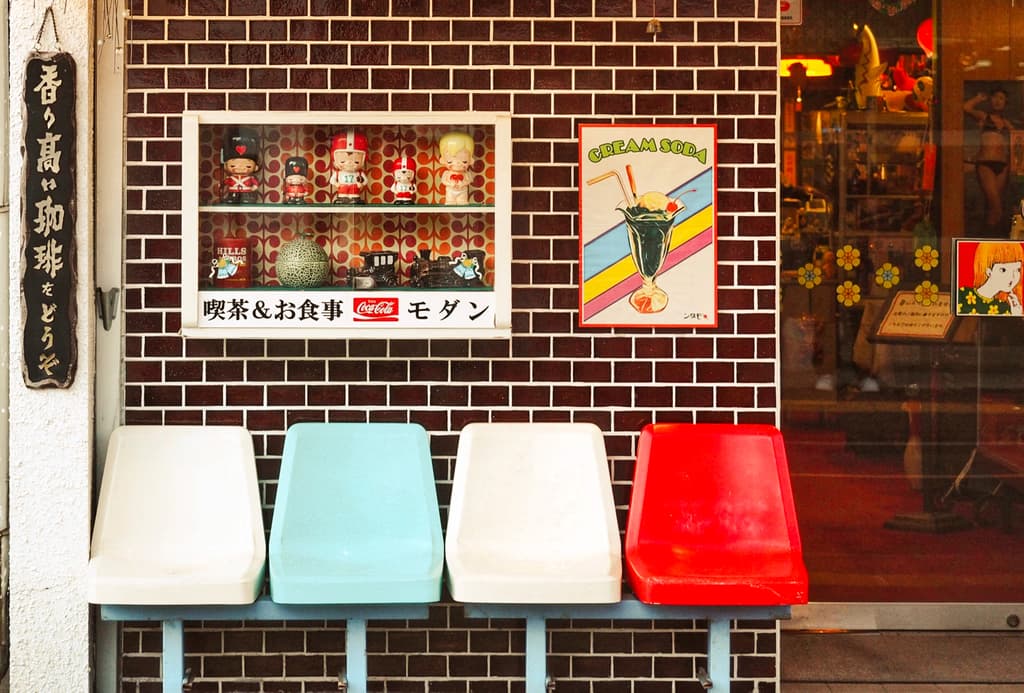
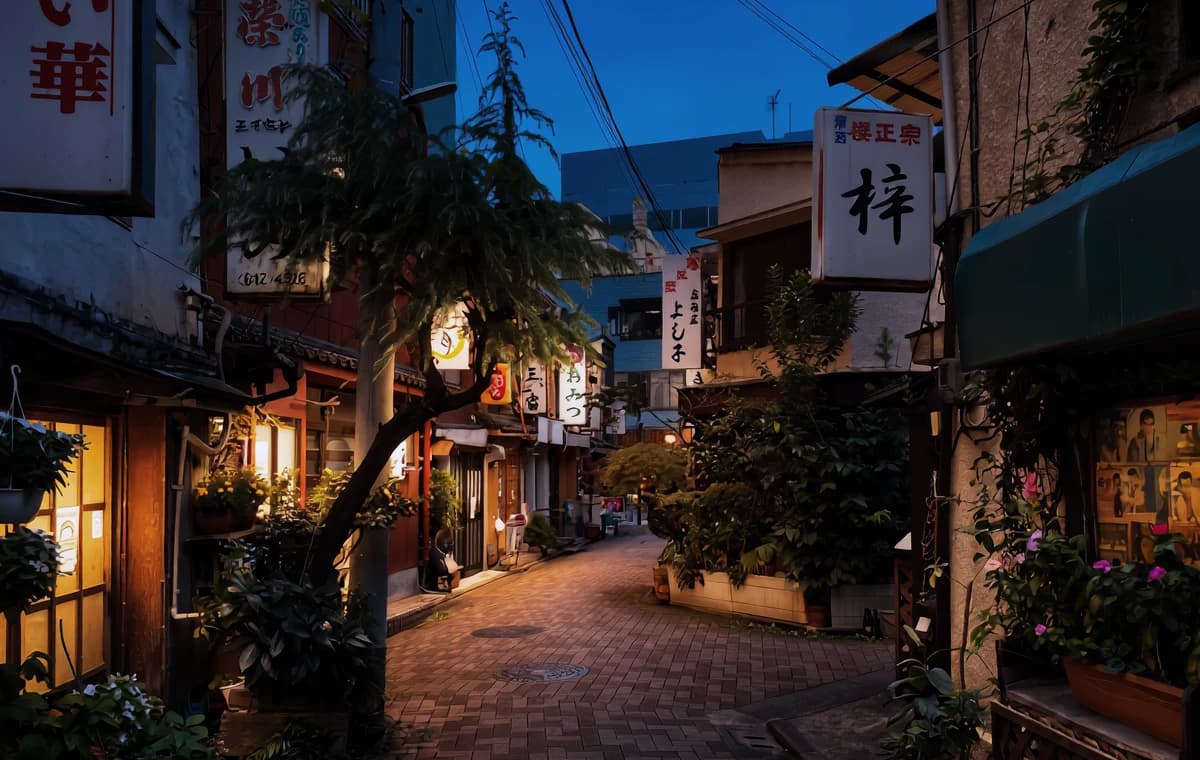
The streets are narrow and the signage is old. Some shops have hand-painted signs that haven't been redone since the 1970s. Chain stores exist but they don't dominate. The ratio of independent to chain skews heavily independent, which is increasingly rare in Tokyo shotengai where convenience stores and drugstore chains have been steadily replacing family-run shops for two decades. Walk through on a weekday evening and you'll hear shopkeepers calling out to passing neighbors by name. The senbei shop has a roasting grill going at the front. The greengrocer stacks seasonal fruit in crates on the sidewalk. It smells like rice crackers and grilled fish, not sanitizer and air conditioning.
Nihon University's College of Arts is also nearby (on the Nihon University-dori that cuts through the shotengai), which adds a younger undercurrent to what would otherwise be a purely residential shopping street. Students and grandmothers share the same sidewalk, which is part of the appeal.
The Ekimae Market
The most photogenic piece of the old shotengai was the Shimotakaido Ekimae Ichiba (下高井戸駅前市場), a covered market building constructed in 1956. It once held 16 shops under a single low roof, selling fish, tofu, pickles, and dried goods in a setup that felt frozen in postwar Tokyo.
The market closed in March 2024 after 68 years. The building had deteriorated beyond practical repair. By the final weeks, only a handful of shops were still operating. The Tokyo Shimbun covered the closing as a loss of local character, which it was.
The shotengai itself remains intact. The market was one building within a much larger commercial district. Its closure stung, but the shopping street around it is still very much alive.
Shimotakaido Cinema
This is the real draw for anyone interested in Tokyo's disappearing cultural infrastructure.
Shimotakaido Cinema (下高井戸シネマ) opened in the late 1950s as Keio Shimotakaido Toei, an Toei first-run movie house. In 1985 it moved to its current location on the second floor of a residential building. In 1988 it was renamed Shimotakaido Cinema.
The cinema nearly died in 1998. Its parent company, Herald, announced plans to exit the film business. The local shotengai and a community of film enthusiasts rallied to keep it open. Toshiaki Kinoshita and a co-manager took over operations, founding Cinema Avenue Co., Ltd. to run the theater independently.
Today it's a single-screen cinema with 126 seats. The programming mixes repertory classics, second-run features, mini-theater releases, and art films. It screens both Japanese and international work. It remains one of roughly ten theaters in Tokyo equipped for 35mm film projection, with three experienced projectionists on staff.
The business model is deliberately old-fashioned. There are no online reservations. You buy your ticket at the window. General admission is ¥1,700. The membership program costs ¥3,500 per year and drops the ticket price to ¥990 flat, plus you get two invitation tickets on signup and a free ticket after every five films. The cinema has around 5,000 members.
During COVID in March 2020, Shimotakaido Cinema was one of the first cinemas in Japan to launch a crowdfunding campaign. 1,673 people contributed. The cinema is still here.
If you visit one cultural spot in Shimotakaido, this is it. Check the screening schedule on their website before you go. The films change frequently and the programming leans toward quality over commercial safety.
Eating and Drinking in Shimotakaido
The food scene here isn't trendy. It's cheap, filling, and built for regulars. Shimotakaido is an izakaya neighborhood: the kind of place where you eat well for ¥2,000 and nobody is trying to get on Instagram.
Tatsumi (居酒屋たつみ)
The anchor izakaya, operating since 1980 with two locations in the shotengai. The main store is a four-minute walk from the station; the ekimae (station-front) branch is right by the tracks. Both serve homemade dishes, fresh sashimi, and a solid sake list. Course menus at the ekimae branch run ¥1,280 to ¥3,200. Tatsumi has a long relationship with Shimotakaido Cinema and displays the cinema's posters and screening schedules in the restaurant. Dinner at Tatsumi then a late show at the cinema is one of those quintessential local Tokyo evenings that you can't manufacture.
The Wider Drinking Scene
Shimotakaido's side streets are packed with small izakayas and standing bars (tachinomi). The density is high enough that you can bar-hop without a plan. Prices run lower than central Tokyo. This is a neighborhood where a beer and a few small plates still costs what it should.
For a specific recommendation beyond Tatsumi, look for the yakitori joints clustered around the south side of the station. The smoke and the red lanterns will find you before you find them.
The drinking here peaks on Friday evenings when the salarymen from the Keio Line commute pile off the train and fill the side streets. It's loud, unpretentious, and completely unselfconscious. Nobody is performing "authentic Tokyo" for visitors. They're having dinner. If you sit at a counter and order in even broken Japanese, you'll likely end up in conversation with whoever's sitting next to you. That's the kind of thing Shimotakaido is good for.
Meidaimae: The Student Side
One stop east on the Keio Line, Meidaimae (明大前) is a different animal. The station sits at the junction of the Keio Line and the Keio Inokashira Line, making it a transit hub for commuters heading to Shibuya or Kichijoji. But the neighborhood's character comes from Meiji University's Izumi Campus, about a five-minute walk from the station.
The campus opened in 1934 as the university's preparatory school. The station was renamed "Meidaimae" (literally "in front of Meiji University") the following year, in 1935. Today the Izumi Campus serves first and second-year students across six liberal arts faculties: Law, Commerce, Political Science and Economics, Arts and Letters, Business Administration, and Information and Communication.
Thirty thousand undergrads cycling through the neighborhood every year creates a specific commercial ecosystem. The restaurants are cheap. The ramen is plentiful. There are more coffee shops per block than the area's residential density would otherwise support. The vibe is younger and more transient than Shimotakaido, which has the settled quality of a neighborhood where people stay for decades.
Meidaimae doesn't have a shotengai in the traditional sense. It has a cluster of restaurants and shops serving the student population, concentrated along the road between the station and the campus. The station itself is a junction point where the Keio Line meets the Keio Inokashira Line, so it gets steady foot traffic from commuters transferring toward Shibuya, Kichijoji, and points west. That transit function keeps the commercial strip busier than you'd expect for a neighborhood this size.
The food around Meidaimae skews toward what students need: quick, filling, affordable. Ramen shops, gyudon chains, curry houses. The independent coffee shops are the standout. Several cater to students who need a place to study, so they tend to have good lighting, reasonable prices, and an implicit no-rush policy during off-peak hours.
If Shimotakaido is your grandmother's neighborhood, Meidaimae is the street where you ate cheap teishoku sets during your sophomore year and somehow never went back to after graduating.
The two stations are walkable in about ten minutes. Combining them in a single visit makes sense, especially if you're already on the Keio Line.
The Setagaya Line: Tokyo's Smallest Railway
Shimotakaido is the western terminus of the Tokyu Setagaya Line (東急世田谷線), and the tram is worth covering on its own because almost nothing in English does it justice.
The Setagaya Line is 5 kilometers long. It has 10 stations. It connects Shimotakaido to Sangenjaya, running through residential Setagaya Ward on a route that feels nothing like Tokyo. The trains are two-car trams, small and colorful, rolling through narrow corridors between houses at a pace that lets you look into people's gardens. There are no grade-separated tracks. The tram crosses regular streets at level crossings, pausing for traffic like a bus that happens to run on rails.
The line opened in 1925, the same year its Shimotakaido terminus was built. It's one of only two remaining tram lines in Tokyo (the other is the Toden Arakawa Line in the north). For visitors, it's genuinely one of the best ways to see how residential Tokyo actually looks: quiet streets, small temples, neighborhood parks, the ordinary texture of a city that 14 million people call home.
How to Ride It
Board at Shimotakaido (the westernmost station) or Sangenjaya (the easternmost, connecting to the Tokyu Den-en-toshi Line for Shibuya). A single ride costs ¥160 with IC card. The Setagaya Line Day Pass (世田谷線散策きっぷ) costs ¥380 and lets you hop on and off all day. Buy it from the driver when you board.
You pay when you board at most stations. At Sangenjaya and Shimotakaido, there are ticket gates. At intermediate stops, you board through the front door and tap your IC card on the reader.
Worth stopping at along the way:
- Setagaya Station / Kamimachi Station: The Setagaya Boro-ichi flea market happens here every December and January, a tradition dating back over 440 years
- Miyanosaka Station: Quiet residential area with Setagaya Hachimangu shrine nearby
- Matsuin Station: Close to Shorin-ji temple and residential streets that could be a film set for mid-Showa Tokyo
The whole line takes about 17 minutes end to end. The trams come every 6 to 8 minutes during the day, so there's no need to check a timetable. Just show up.
What makes the Setagaya Line worth riding isn't any single stop. It's the ride itself. The tram passes through the kind of residential Tokyo that visitors almost never see: laundry hanging on balconies, cats sleeping on walls, small gardens crammed into impossible spaces, the quiet hum of a city that works at human scale. It's the opposite of the Yamanote Line experience.
Riding it from Shimotakaido to Sangenjaya, poking around Sancha's izakaya alleys, then taking the Den-en-toshi Line back to Shibuya makes a strong half-day itinerary for anyone who wants to see Tokyo without the tourist infrastructure.
Getting There and Combining Neighborhoods
Shimotakaido is on the Keio Line, roughly 15 minutes from Shinjuku by express or semi-express train. Note that not all expresses stop at Shimotakaido; check the train type before boarding. Local and semi-express trains always stop. Meidaimae is one stop closer to Shinjuku on the same line and is served by more train types since it's a junction station with the Inokashira Line.
From Shibuya, take the Keio Inokashira Line to Meidaimae (about 10 minutes), then transfer to the Keio Line for one more stop to Shimotakaido. From central Tokyo, the most practical route is via Shinjuku.
Natural combinations:
- Shimotakaido → Setagaya Line → Sangenjaya: The tram ride connects two Showa-era drinking neighborhoods. Start with the shotengai in the afternoon, ride the Setagaya Line as sunset hits, arrive in Sancha for evening izakaya hopping.
- Shimokitazawa → Shimotakaido: Shimokitazawa is two stops east on the Keio Line. The contrast is stark and interesting. Shimokitazawa shows you what happens when a neighborhood gets discovered. Shimotakaido shows you what it looked like before that happened.
- Shimotakaido → Koenji: Not on the same line, but similar energy. Both are unreconstructed shotengai neighborhoods. Koenji tilts punk and vintage; Shimotakaido tilts Showa domestic. If you're interested in Tokyo's remaining old-school shopping streets, doing both in one day (connected via Shinjuku) paints a fuller picture.
Who Should Visit
Shimotakaido is not for everyone. There's no landmark attraction, no famous shrine, no Instagram spot. If you want efficient sightseeing, go somewhere else.
This is the neighborhood you visit when you want to understand how Tokyo actually works at street level. The shotengai is real commercial infrastructure, not a heritage project. The cinema is a genuine community institution, not a retro-themed bar. The izakayas are full of locals eating dinner, not tourists having an "authentic experience."
If that's what you're looking for, Shimotakaido will reward the visit. It's the kind of place that a local guide might take you to show you their actual neighborhood, because there's nothing here to perform. It just is what it is.