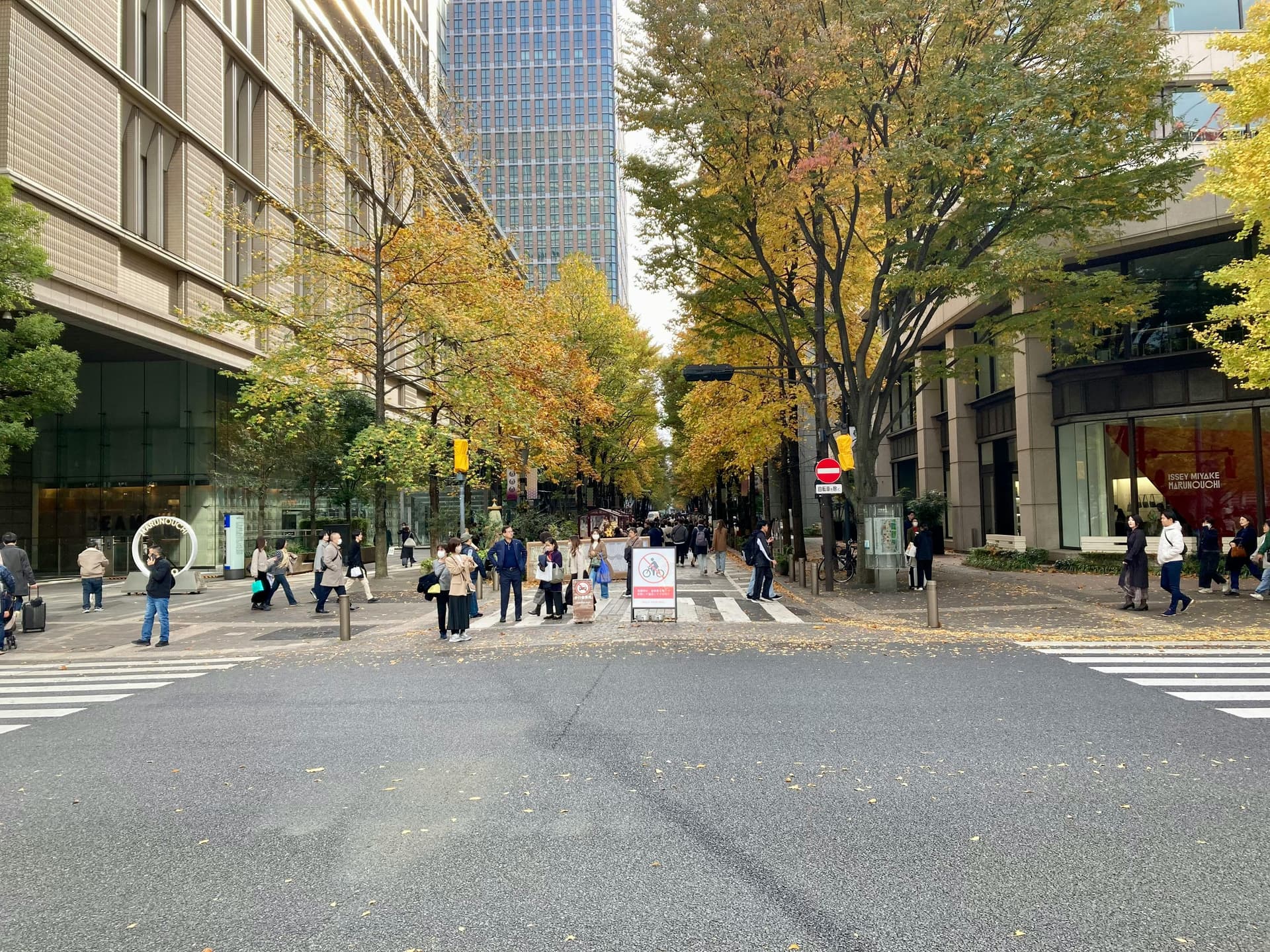
Marunouchi is not an organic neighborhood. It is a 135-year corporate real estate project by Mitsubishi, and that fact explains everything about the place.
Marunouchi didn't grow the way other Tokyo neighborhoods did, through centuries of small decisions piling up. One company bought it in a single deal, built it out, and still owns roughly a third of it, and nearly everything you notice along this 1.2-kilometer stretch between Tokyo Station and the Imperial Palace follows from that.
Before Mitsubishi: Samurai Estates to Wasteland
Marunouchi means "within the circle," because it sat inside the moats of Edo Castle. In the Edo period (1603-1868), the land right in front of the castle's main gate was called Daimyo Koji, or Feudal Lord Alley. The Tokugawa shoguns put the upper estates of powerful outer lords here, close enough to the castle to keep an eye on them. The Mizuno clan of Numazu, the Matsudaira of Matsumoto, and other domain lords kept their Tokyo residences on these blocks.
When the Meiji Restoration brought down the shogunate in 1868, the lords left and the government took their estates. The army moved in and used the land for barracks and drill grounds. By the late 1880s the military was moving to Azabu, and the government needed money to pay for the new facilities, so it put 135,000 tsubo of prime land up for sale.
Nobody wanted it. With the daimyo gone and the army on its way out, the area had turned into an overgrown field. People called it Mitsubishi-ga-hara, the Mitsubishi Plain, after the only buyer willing to take the risk.
The Purchase That Created Modern Marunouchi
In 1890, Iwasaki Yanosuke paid about 1.3 million yen for the whole plot. He was the younger brother of Mitsubishi's founder, Iwasaki Yataro, and the company's second president, and he said he wanted a business district that could stand alongside London and New York.
The government and the press thought he was a fool. The land was a long way from the existing commercial centers of Nihonbashi and Ginza. No trains ran there, and there was no proper water supply, no gas, and no sewers.
Mitsubishi brought in the British architect Josiah Conder, already famous for the Rokumeikan, as a long-term advisor. In 1890 the company set up the Marunouchi Architectural Office, which later became today's Mitsubishi Jisho Design. There were no accurate maps, so Conder's team surveyed the land from scratch and laid out a street grid with 36-meter-wide boulevards. Naka-dori is still that width today.
The first building, Mitsubishi Ichigo-kan (Building No.1), opened in June 1894. Conder designed it in red brick with steep roofs and classical window frames. Most English sources call the style Queen Anne, but Mitsubishi Jisho Design describes it as closer to Elizabethan Revival. A second building followed in July 1895 and a third in February 1896. The row of matching red-brick offices along Babasaki-dori gave the area a new nickname, Iccho London, or "One Block of London."
The name fit. The development block measured exactly one cho (about 100 meters), and the street really did look like a piece of commercial London dropped into Tokyo. It was the first street in Tokyo designed specifically for office work, with a British-style tenant setup where each ground-floor entrance led to its own vertical section of the building.
Tokyo Station: The Anchor That Changed Everything
Marunouchi went from an ambitious experiment to Tokyo's top business address in 1914, when Tokyo Station opened on its eastern edge.
The station's architect, Tatsuno Kingo, had studied under Conder. Tatsuno had his own signature look, red brick with horizontal bands of white stone, now called Tatsuno-shiki (Tatsuno style). The Marunouchi station building ran 335 meters along the western facade, with octagonal domes on both the north and south wings, and at the time it was one of the largest European-style buildings in Asia.
On May 25, 1945, American firebombing gutted it. Both domes collapsed and the whole third floor was destroyed. In the emergency rebuild of 1947, the station was patched up as a two-story building with a simpler roof, and it stayed that way for over sixty years.
The station you see today took five years to restore, from 2007 to 2012. Engineers rebuilt the third floor and both octagonal domes to Tatsuno's original 1914 design and put modern seismic isolation in the basement. The building had been named an Important Cultural Property in 2003, which gave the project legal and political weight, and it reopened in October 2012. When you stand in the station plaza and look up at the domes, keep in mind that those shapes didn't exist from 1945 to 2012.
Walking Naka-dori: The Street Mitsubishi Has Been Refining for 130 Years
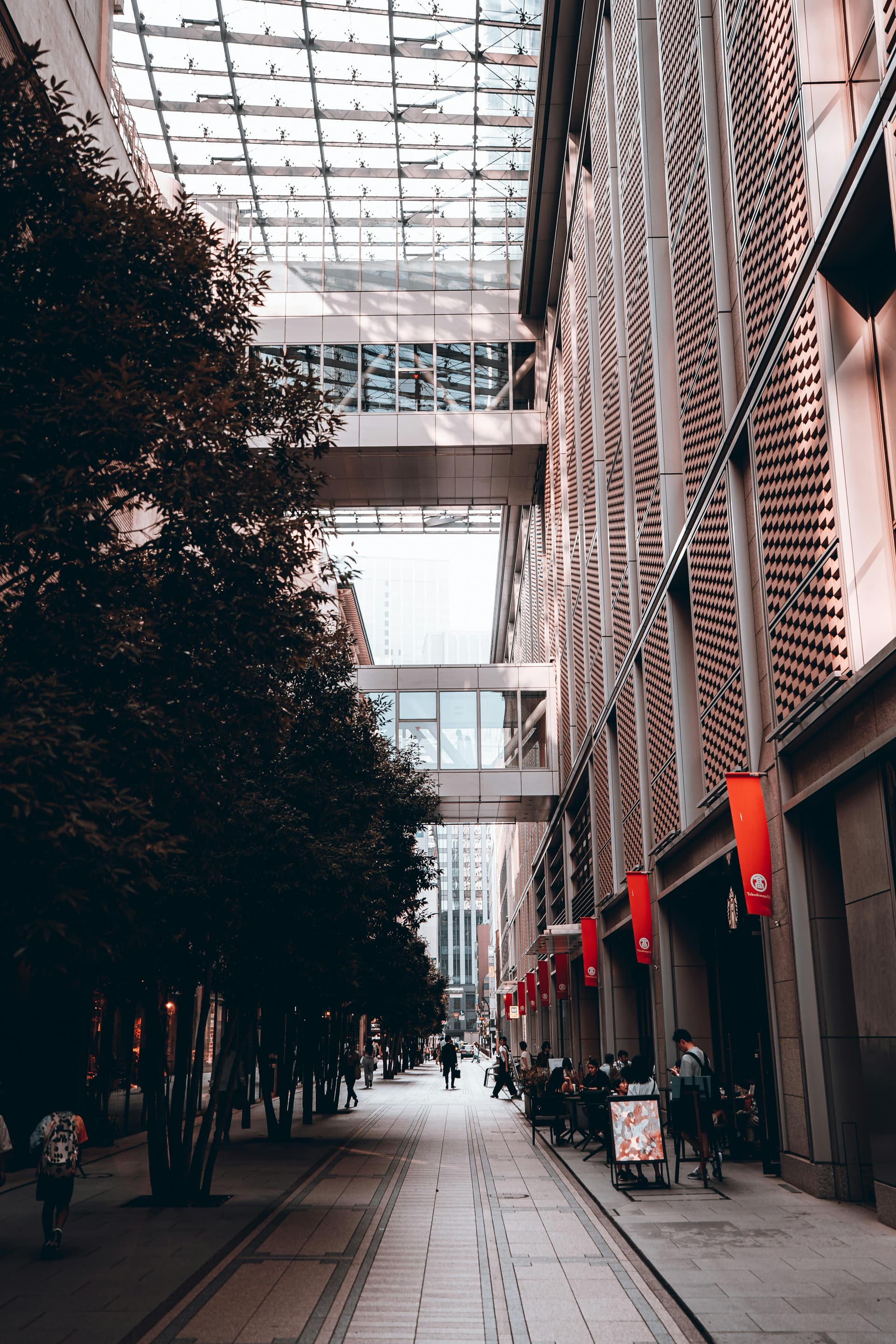
Marunouchi's main pedestrian boulevard runs 1.2 kilometers from near Tokyo Station toward Otemachi. The paving stones are Argentine porphyry. The zelkova trees make a canopy in summer, and in winter they hold 820,000 champagne-gold LEDs for the illumination (mid-November to mid-February, lit from 4pm every night).
On weekends and holidays from 11:00 to 17:00 the street is closed to cars, and the Urban Terrace program puts out tables, chairs, and food trucks. On weekdays, 230,000 office workers pour out at lunch.
Naka-dori differs from Tokyo's other upscale shopping streets because so much of it was planned. Mitsubishi Estate has controlled the tenant mix and the look of the street since the 1890s, and the 36-meter width was in the original plans 135 years ago. It feels orchestrated because it is.
The Buildings Worth Knowing
Maru Building and Shin-Maru Building
The original Marunouchi Building, finished in 1923 and designed by Sakurai Kotaro, was called "the largest building in the East" when it opened. It marked Marunouchi's shift from red-brick Iccho London to reinforced concrete towers. The current Maru Building, a 37-story high-rise, replaced it in September 2002 and started Marunouchi's modern wave of redevelopment.
The Shin-Maru Building (New Maru Building) opened in April 2007 across the station plaza, and the two buildings sit on either side of the view of Tokyo Station like a pair of bookends. The Maru Building's lower floors have about 150 shops and restaurants. The Shin-Maru Building has a 7th-floor terrace that looks straight at the station's restored facade. Both are shops on the lower floors and offices above.
The shops lean toward business-district taste, so don't come for the shopping. Come for the architecture and the station views, or because you need lunch between Tokyo Station and the palace.
KITTE
The name means "postage stamp" in Japanese, which gives away what the building used to be. The original Tokyo Central Post Office, designed by Yoshida Tetsuro in 1931, stood here for over eighty years. When the site was redeveloped, the post office's five-story facade was kept and built into JP Tower, a 38-story, 200-meter skyscraper finished in 2012. KITTE, the shopping and dining complex, takes up the first six floors and opened in March 2013.
Go for the 6th-floor rooftop garden. It looks down on Tokyo Station's red-brick facade, with trains coming and going below. It's free, there's no time limit, tripods aren't allowed, and the garden is lit until 9pm.
In the basement, the Intermediatheque, a free museum run by Japan Post and the University of Tokyo, shows natural history specimens and scientific instruments in glass cases. It feels more like a Victorian cabinet of curiosities than a modern exhibition, and people miss it because it's free and underground.
Mitsubishi Ichigokan Museum and Brick Square
The red-brick building at the south end of Naka-dori is a 2010 reconstruction of Marunouchi's first office building, the 1894 Conder-designed Mitsubishi Ichigo-kan. The original came down in 1968. The copy is close enough that some interior details, the staircase handrails for example, were reproduced from the original plans.
The museum inside runs three exhibitions a year, usually of 19th and early 20th century Western art, and has no permanent collection. It's open 10:00-18:00 Tuesday through Sunday, until 20:00 on Fridays and the second Wednesday of each month, and closed Mondays. Admission depends on the exhibition and is usually around 2,300 yen.
Brick Square is the courtyard around the museum, with a fountain, European-style planting, and a few restaurants with outdoor tables. Cafe 1894, inside the museum building, is in a room designed to echo the banking hall in the original. It does afternoon tea during the day and turns into a bar in the evening. The courtyard garden, including roses that nod to the original 1890s plantings, is free to walk into without a museum ticket.
Why One Company Still Matters
Mitsubishi Estate, the Mitsubishi group's real estate arm, owns about 30 of the roughly 100 buildings in Marunouchi. No other major business district in the world is concentrated in one owner's hands like this, so a single company decides the tenant mix, the architectural standards, the street furniture, and the pace of redevelopment.
You won't find competing signage or neon here, or a pachinko parlor squeezed between office towers. The wide boulevards and matching building setbacks come from one company's decisions over thirteen decades, and so do the trimmed trees.
It's also why Marunouchi can feel sterile. The district has more Fortune Global 500 headquarters than any comparable area, but that kind of corporate weight doesn't make a place interesting to visit.
The next building is already under construction. Torch Tower, a 62-story skyscraper connected directly to Tokyo Station, is due to open in 2028 as Japan's tallest building, and Mitsubishi Estate is building it.
Marunouchi vs Ginza vs Otemachi
These three districts sit right next to each other, and on a map they look interchangeable.
Marunouchi is corporate headquarters. The buildings are there to house companies and project the image those companies want. Visitors are welcome but come second, and the mood is formal and quiet.
Ginza is about selling. Flagship stores, department stores, and galleries that double as brand showrooms. If you want to shop, go to Ginza.
Otemachi is the northern extension of Marunouchi and even more corporate, with more bank headquarters and fewer restaurants. You rarely need to go unless you're staying at one of the luxury hotels in the newer towers (Aman Tokyo, The Tokyo Edition).
You can walk between all three in under 20 minutes. If you know what each one is for, you won't end up wandering between office towers wondering where the interesting part starts.
When to Come and Who Should Skip It
Weekday lunch, 11:30 to 13:30, is when Marunouchi is at its busiest. Office workers fill the restaurants and the sidewalks fill with people in suits who know where they're going. If you want to see what Marunouchi was built for, come then.
Weekend afternoons bring the car-free Naka-dori and a quieter mood. Some visitors find it peaceful and others find it dead, and they're both right.
Winter evenings in illumination season (mid-November to mid-February) are the exception. The lit boulevard against the station's red brick draws crowds even on weeknights. The rest of the year, Marunouchi is quiet after 7pm and empty after 11pm.
Skip Marunouchi if your time is short and you want Tokyo at full volume. Shinjuku, Shibuya, or Asakusa give you more per hour. Skip it if you're after nightlife, since outside winter the district is basically shut after dark.
Come if you care about architecture, if you want to see how corporate power shapes a city, or if you're passing through Tokyo Station anyway and have two hours to look around.
Where Hinomaru One Fits
Marunouchi makes a lot more sense when someone explains it. On your own you're walking past handsome buildings. With the background, you're walking through 135 years of one family's plan for Japanese capitalism, from Conder's red-brick "One Block of London" to Torch Tower's 2028 bid for the skyline.
Tokyo Essentials (6 hours, from $430 for 2 people) goes through Marunouchi as part of a wider introduction to Tokyo. The station's restoration, the Mitsubishi purchase, and the walk to the Imperial Palace come with the story behind them, which a plaque won't give you.
Infinite Tokyo (8 hours, from $550 for 2 people) is fully customizable. If you're interested in architecture and corporate history, a guide can build a day that runs from Marunouchi's 1890s beginnings through Tokyo Station's wartime destruction to the current redevelopment, with Nihonbashi and Ginza a short walk away.
At Hinomaru One, we design private Tokyo tours for first-time and returning travelers. They're unrushed and always built around you.
FAQ
Is Marunouchi worth visiting or just a transit corridor?
If architecture, urban history, or corporate culture interests you, two to three hours here is time well spent. If you want street food or sensory overload, go somewhere else.
What is the best time to visit Marunouchi?
Come at weekday lunch (11:30-13:30) to see the district at work, on weekend afternoons for the car-free Naka-dori, or on winter evenings (mid-November to mid-February) for the illumination. Weekday evenings outside winter aren't worth it.
How does Marunouchi connect to Tokyo Station?
Marunouchi is the area right outside Tokyo Station's western exit, so you're in it the moment you step out. The Maru Building and Shin-Maru Building are across the plaza, KITTE connects to the Marunouchi South Exit, and everything is within a 15-minute walk.
Why does Mitsubishi own so much of Marunouchi?
Iwasaki Yanosuke bought the whole area from the Meiji government in 1890 when nobody else wanted it. Mitsubishi developed it over 135 years and still owns about 30 of the roughly 100 buildings here.
Is the KITTE rooftop garden free?
Yes. It's free and open during KITTE hours, and it has one of the best raised views of Tokyo Station. You don't need a reservation and there's no time limit, but tripods aren't allowed. It's lit until 9pm.