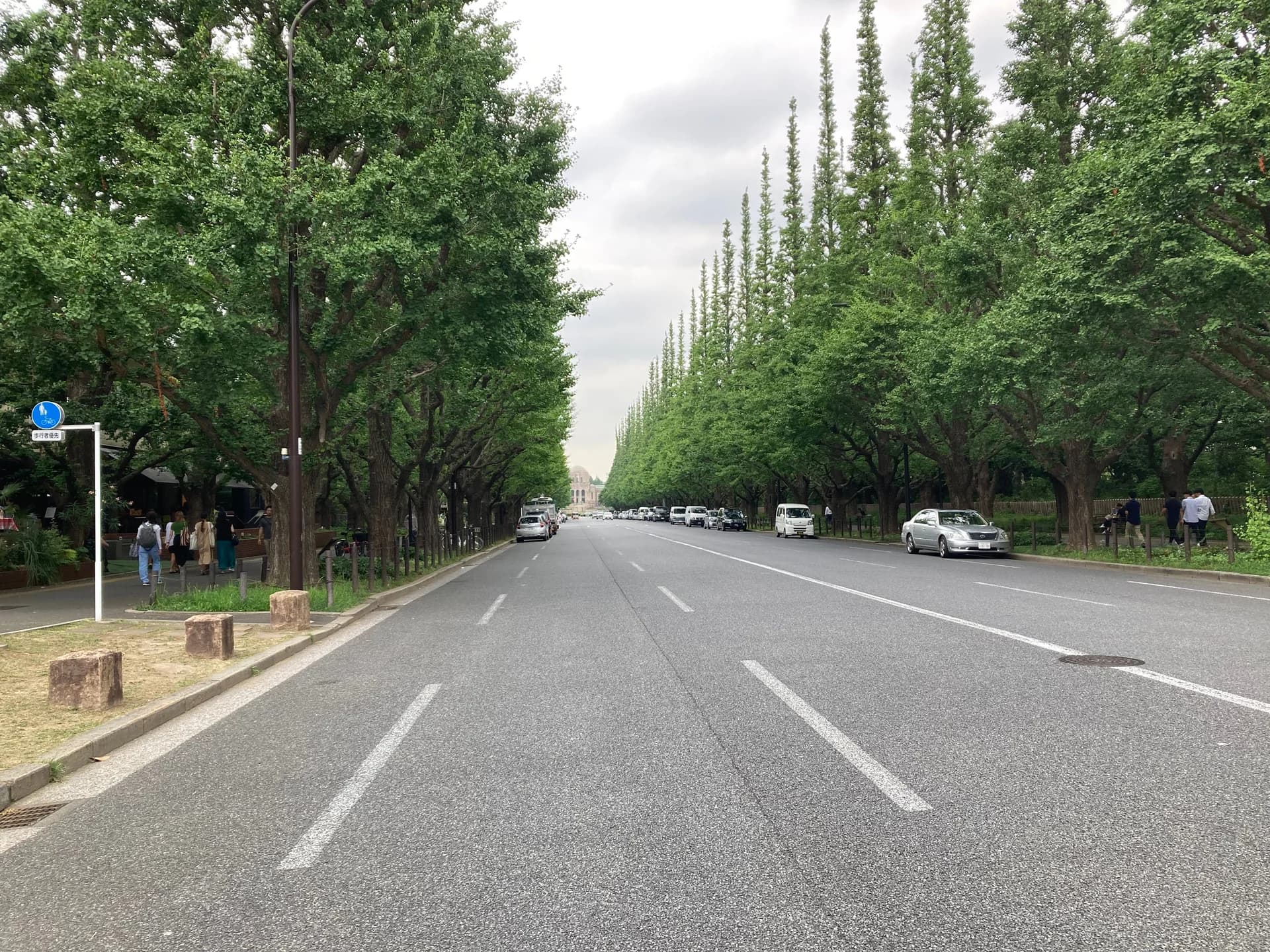
Omotesando is a boulevard lined with zelkova trees, luxury boutiques, and some of the most serious contemporary architecture in Japan. It runs for roughly a kilometre between Meiji-jingumae to the north and Aoyama-dori to the south, and most of the people who walk it come for the shopping. That's fine. The shopping is good. But the real story of this street played out between 2000 and 2010, when every major fashion house that opened a flagship here hired a significant architect to design the building. The Prada store is by Herzog & de Meuron. Tod's is Toyo Ito. Omotesando Hills is Tadao Ando. Louis Vuitton is Jun Aoki. Dior is SANAA. The result is an accidental open-air architecture gallery that costs nothing to walk and takes about thirty minutes if you know what you're looking at.
Most English-language guides mention the shopping and the zelkova trees and move on. This guide doesn't do that. The architecture story is the thing that makes Omotesando genuinely unusual, not just within Tokyo but globally, and almost nobody who visits realizes it. You can walk this street, look at six or seven buildings by Pritzker Prize winners and finalists, and understand something about how Japan approaches the relationship between commerce and design that you won't find explained anywhere else.
The street also connects to Harajuku at its northern end, Aoyama to the south, and Daikanyama further west. Each of these neighborhoods has a different character, and the boundaries between them blur in useful ways. But Omotesando itself has a specific identity: expensive, architecturally ambitious, and more rewarding than it first appears.
What Omotesando Actually Is
The avenue was built in 1920 as the main approach road to Meiji Shrine. The zelkova trees that line both sides were planted at the same time and are now protected by the city. For its first several decades, Omotesando was a residential and ceremonial street, quiet and tree-shaded, leading visitors from the commercial bustle of Aoyama toward the shrine grounds. That changed slowly after the war, then faster from the 1970s onward as fashion brands began opening stores along the boulevard.
By the late 1990s, Omotesando had become the preferred address for luxury fashion flagships in Tokyo. The reasons were practical: the street was wide, the foot traffic was affluent, and the lots were large enough to build something architecturally distinctive. Ginza had tradition. Shinjuku had volume. Omotesando had space and an audience that cared about design. When Prada decided to build a freestanding flagship in 2003, they didn't put it on a side street. They commissioned Herzog & de Meuron to design a building that would function as an advertisement for the brand's relationship with architecture. Every other luxury house on the street took notice, and the decade that followed produced the most concentrated cluster of architect-designed commercial buildings in Japan.
The neighborhood sits at the intersection of several distinct areas. Harajuku is immediately north, across the Meiji-jingumae intersection, with its youth culture, Takeshita Street, and chaotic energy. Aoyama is south and east, quieter, with galleries, design studios, and restaurants that cater to creative professionals in their 30s and 40s. Daikanyama is a 20-minute walk west, residential and bookish. Omotesando sits between all of these and borrows from none of them. Its identity is luxury fashion and architecture, and the two have become inseparable here.
The Omotesando Hills complex, opened in 2006, anchors the western stretch of the boulevard. It replaced the Dojunkai Apartments, a 1927 housing complex that had become a beloved neighborhood landmark. The replacement was controversial, which is part of why Tadao Ando was brought in: his design preserved the building height to match the zelkova canopy and incorporated a surviving section of the original apartments at the western end. That decision tells you something about how Omotesando operates. Even the commercial development here is expected to respect what came before.
The Architecture Walk
This section is the reason this guide exists. No other Omotesando article in English walks through the specific buildings and explains what you're looking at. If you do nothing else on this street, walk slowly and look up.
Omotesando Hills is the building you'll notice first if you approach from the station. Designed by Tadao Ando and opened in February 2006, it stretches along the boulevard for about 250 metres, never rising above the zelkova tree canopy. From outside, it reads as a long, low, restrained concrete wall. The drama is inside. Ando designed the interior around a continuous spiral ramp that descends six floors below street level, wrapping around a central atrium. The effect is of walking through a single unbroken path rather than navigating floors and escalators. The shops line the ramp on both sides, and natural light enters from above. Ando is known for his use of exposed concrete, and Omotesando Hills is one of his most ambitious commercial projects. The preserved section of the original Dojunkai Apartments at the building's western end, kept as a historical reference, is easy to miss but worth finding.
Prada Aoyama stands on a corner just south of the main boulevard, and it looks like nothing else on the street. Designed by the Swiss firm Herzog & de Meuron and completed in 2003, the building is a six-storey crystal of diamond-shaped glass panels. Each panel is either flat or convex, creating a surface that distorts reflections and light in different ways depending on where you stand and what time of day it is. The structural frame is visible through the glass, a grid of white steel tubes that gives the building its faceted geometry. At night, when the interior is lit, the whole structure glows. Herzog & de Meuron won the Pritzker Prize in 2001, and the Prada building is one of their most recognizable works. The interior is as considered as the exterior: display cases are integrated into the floor, and fitting rooms have glass walls that switch from transparent to opaque at the touch of a button.
Tod's Omotesando (now the Kering Building) is the work of Toyo Ito, completed in 2004. The facade is a concrete lattice that resembles the branching pattern of the zelkova trees across the street, and this wasn't decorative. Ito designed the branching concrete as the building's structural system, meaning the tree pattern on the outside is the load-bearing frame. There are no interior columns. The concrete branches split and reconnect as they rise, creating irregular window openings that let light through in unpredictable patterns. Ito won the Pritzker Prize in 2013, and this building is frequently cited in discussions of his work. It is one of the clearest examples in Tokyo of an architect designing a building that responds directly to its immediate environment rather than ignoring it.
Louis Vuitton Omotesando was designed by Jun Aoki and opened in 2002, making it one of the earlier entries in the architectural arms race that defined the decade. The facade is composed of stacked, offset rectangular volumes, each wrapped in a different material: mesh screens, glass panels, and perforated metal. The layered effect is meant to evoke stacked trunks, a reference to the brand's luggage heritage. The building is more restrained than Prada or Tod's, but the detailing rewards close inspection. Jun Aoki went on to design several other LV stores worldwide, but this one remains the flagship. The seventh floor houses Espace Louis Vuitton Tokyo, a free contemporary art gallery that rotates exhibitions and is worth the elevator ride even if you have no interest in handbags.
Dior Omotesando is the work of SANAA, the practice of Kazuyo Sejima and Ryue Nishizawa, and it opened in 2003. The building is wrapped in layers of translucent white acrylic panels that give it a soft, slightly blurred appearance from the street, as though you're seeing it through frosted glass. At night, the interior lighting turns the entire facade into a glowing lantern. SANAA won the Pritzker Prize in 2010, and their approach to transparency and lightness is visible here in condensed form. The building seems to float, which is precisely the effect they intended. The contrast with the heavier concrete and glass of its neighbours is striking and deliberate.
Nezu Museum sits at the far end of the boulevard, just past the Aoyama-dori intersection, and it operates in a completely different register. Designed by Kengo Kuma and reopened in 2009 after a full rebuild, the museum is entered through a long, narrow bamboo-lined approach corridor that compresses your field of vision before opening into the gallery spaces. The roof is a broad, sweeping plane of natural materials that extends over the entrance and grounds. The museum itself houses a significant collection of pre-modern Japanese and East Asian art, but the real draw for many visitors is the garden: roughly 17,000 square metres of landscaped woodland with tea houses, stone paths, and a pond. It feels impossible that this much green space exists minutes from the boulevard, and the transition from the commercial street to the garden is one of the best spatial sequences in Tokyo.
You can walk from Omotesando Hills to the Nezu Museum in about thirty minutes, passing all of these buildings on the way. If you know what you're looking at, this is one of the best architecture walks in the city. If you don't, it's still a pleasant stroll under zelkova trees. But knowing makes it better.
Cat Street and Ura-Harajuku
Running roughly parallel to Omotesando, one block north and then curving west toward Harajuku, Cat Street is the informal name for a narrow pedestrian path built over the culverted Shibuya River. The energy here is entirely different from the main boulevard. Where Omotesando is polished and international, Cat Street is younger, more casual, and more distinctly Japanese.
The shops along Cat Street lean toward Japanese streetwear, vintage clothing, sneakers, and independent boutiques run by designers who chose this location specifically because it isn't Omotesando. The crowd is younger, mostly 20s, and the aesthetic is street fashion rather than luxury. On weekend afternoons, the path fills with people who are dressed with the same care as the Omotesando shoppers but in a completely different direction: layered silhouettes, rare sneakers, vintage Americana reinterpreted through a Japanese lens.
The stretch closest to Harajuku has more foot traffic and more recognizable names. As you walk south toward Aoyama, the street gets quieter and the shops get smaller. Some of the most interesting finds are in this southern section, where a ceramics studio might sit next to a vintage furniture dealer and a coffee roaster. Cat Street functions as Omotesando's release valve, the place where the formality drops and the neighbourhood gets looser and more exploratory. If the main boulevard is for looking, Cat Street is for buying things you didn't know you wanted.
The street is also where Omotesando Koffee operated before expanding internationally. Founded by Eiichi Kunitomo, the original stand occupied a tiny traditional house on a side street nearby and became one of the most influential specialty coffee operations in Tokyo. The concept has since grown into multiple locations worldwide, but the area around Cat Street remains a centre of serious coffee culture.
Kotto-dori and Minami-Aoyama
South of the main boulevard, a few blocks toward Aoyama Cemetery, Kotto-dori (骨董通り, literally "Antique Street") runs parallel to Omotesando with a character that's quieter, more serious, and older in every sense. The street earned its name from the concentration of antique dealers that set up here decades ago, and enough of them remain to justify the name.
What you find on Kotto-dori depends on what you're looking for. The antique shops carry Meiji and Taisho-era furniture, ceramics, lacquerware, old maps, and woodblock prints. Some are proper galleries with high-end pieces priced accordingly. Others are cluttered shops where you might find something interesting for a few thousand yen if you're willing to browse. The clientele here is interior designers, serious collectors, and Japanese residents furnishing apartments. It's not a tourist attraction. It's a working antique district.
The broader Minami-Aoyama area around Kotto-dori has its own identity: galleries showing contemporary Japanese art, small design studios, restaurants that serve the surrounding offices. The Nezu Museum is within walking distance, and the streets connecting Kotto-dori to the museum are among the quietest and most pleasant in the area. This is where Omotesando's commercial intensity fades into something residential and reflective. If you've spent the morning on the main boulevard and Cat Street, the walk down to Kotto-dori and back provides a necessary change of pace.
Best Cafes in Omotesando
Koffee Mameya, on a backstreet between Omotesando and Cat Street, is a coffee bean specialist that functions more like a tasting room than a conventional cafe. There's no menu in the usual sense. You stand at the counter, describe what you like, and the barista selects beans from their rotating roster of partner roasteries around Japan and internationally. They brew a sample for you, talk you through the flavour profile, and sell the beans by weight. The approach is precise and educational without being pretentious. It is one of the most respected specialty coffee operations in Tokyo, and if you care about coffee at all, this is the stop that matters most in the area.
LATTEST Omotesando Espresso Bar occupies a bright, minimal space on the main boulevard and does the kind of straightforward specialty espresso drinks that work when you want good coffee without a lengthy consultation. The espresso is dialled in and the milk drinks are well-executed. It's the kind of place you stop at twice, once on the way up the boulevard and once on the way back.
Ralph's Coffee, inside the Ralph Lauren flagship on the boulevard, is not a specialty coffee destination but it's a good one. The space is designed with the same attention as the clothing store below, and the terrace seating on the upper floor offers a view down the tree-lined street that's one of the better vantage points in the area. Coffee is ¥700 to ¥900. Come for the seat, not the extraction.
Best Restaurants in Omotesando
The dining scene in Omotesando ranges from high-end tasting menus to lunch spots that serve the neighbourhood's office workers and shoppers. The quality floor is high because the local clientele expects it, and the prices reflect the address without being absurd by Tokyo standards.
For lunch, the restaurants inside Omotesando Hills offer a range of options at ¥1,500 to ¥3,500. The spiral ramp layout means each restaurant has a different view of the atrium, and the crowd is a mix of shoppers taking a break and local professionals. The quality is consistent rather than exceptional, but for a quick meal between galleries and boutiques, it works.
Anniversaire Omotesando, set back from the boulevard with a large terrace shaded by trees, is a French-influenced cafe and restaurant that's been an institution here for years. Lunch courses run ¥3,000 to ¥5,000 and skew toward brasserie-style cooking, salads, roasted meats, and seasonal plates. The terrace is the real draw, particularly in spring and autumn when the temperature is right for sitting outside. Weekend brunch fills up by noon. Book ahead or come on a weekday.
For a more serious meal, the side streets toward Minami-Aoyama hold a concentration of small, chef-driven restaurants that cater to the Aoyama gallery and fashion crowd. French and Italian dominate, with lunch courses from ¥5,000 and dinner from ¥10,000 upward. These restaurants change names and chefs more often than the architecture, so specific recommendations date quickly. The better strategy is to check Tabelog for the current top-rated options within a five-minute walk of the station and book a day or two ahead. The area rewards this approach more than most Tokyo neighbourhoods because the density of quality is unusually high.
How to Spend Time in Omotesando
Start at Omotesando Station, which sits at the intersection of the boulevard and Aoyama-dori. Take exit A2 and you'll emerge directly onto the tree-lined avenue. Walk northwest, toward Harajuku, and pay attention to the buildings on both sides. The architecture walk described above unfolds naturally in this direction: you'll pass Dior, Louis Vuitton, and Tod's on the way to Omotesando Hills. Stop inside Omotesando Hills to see Ando's spiral ramp, then continue to the end of the boulevard.
From the Harajuku end, you have a choice. Turn right onto Cat Street and walk south, browsing the streetwear shops and vintage stores. This will curve you back toward the Omotesando area in about twenty minutes. Or cross the intersection into Harajuku proper for Takeshita Street and Meiji Shrine, knowing that the energy shifts dramatically once you cross that line.
If you take Cat Street south, you'll eventually emerge near the backstreets of Aoyama. From here, walk to Kotto-dori for the antique shops, or continue to the Nezu Museum for the garden and the art collection. The museum alone justifies an hour, and the garden adds another thirty minutes easily.
A half day covers the architecture walk, Cat Street, and coffee. A full day adds the Nezu Museum, Kotto-dori, and a proper lunch. Omotesando connects naturally to Harajuku to the north (a 5-minute walk), Shibuya to the southwest (15 minutes on foot or one stop on the Ginza Line), and Daikanyama further west (about 20 minutes walking through quiet residential streets).
| Neighbourhood | Vibe | Best for | Crowd | Distance from Omotesando |
|---|---|---|---|---|
| Omotesando | Luxury fashion, architecture | Architecture walk, flagship shopping | Mixed, upscale | — |
| Harajuku | Youth culture, Takeshita | Street fashion, crepes | Teens, tourists | 5 min walk |
| Daikanyama | Design, books, quiet | T-Site, cafes | 30s-40s professionals | 20 min walk |
| Aoyama | Galleries, design studios | Art, quiet browsing | Creative 30s-40s | Adjacent |
Getting There and When to Visit
Omotesando Station is served by three Tokyo Metro lines: Ginza, Chiyoda, and Hanzomon. From most parts of central Tokyo, you can reach it in under twenty minutes with one transfer or fewer. Meiji-jingumae Station (Chiyoda and Fukutoshin Lines) serves the northern end of the boulevard, near the Harajuku intersection.
The best time to visit is a weekday morning. Most boutiques open at 11 AM, but the boulevard is worth walking before then, when the zelkova trees and the architecture have the street mostly to themselves. Weekend afternoons are busy, particularly along the main stretch and around Omotesando Hills. The side streets and Cat Street stay manageable even on Saturdays.
Cherry blossom season, late March through early April, transforms the street. The zelkova trees aren't cherries, but the broader Aoyama and Meiji Shrine area blooms heavily, and the combination of the architecture and the spring light makes this one of the best times to walk the boulevard. Autumn, when the zelkova leaves turn golden, is equally good and far less crowded.
Omotesando as Part of a Private Tour
Omotesando is where Tokyo's relationship between fashion, architecture, and street culture becomes visible in a single walk. Most visitors experience it as a shopping street. With the right context, it becomes an architecture tour, a design history lesson, and a window into how Japan treats the built environment as something worth investing in seriously.
For the architecture angle specifically, our Tokyo architecture tour covers constraint-driven design and the buildings that define the city's approach to structure — Omotesando's Pritzker Prize concentration fits naturally into that day. If shopping is the priority, our Tokyo shopping tour navigates the boutiques, vertical retail, and Japanese brands that don't surface without local knowledge. Or build your own route with Infinite Tokyo — a fully custom day designed around exactly what you want to see.