Sento is not a spa experience and it's not an onsen. It's a neighborhood institution that survived because the experience itself — the hot water, the quiet, the milk after — was worth continuing.
Sento, the public bathhouse, has been part of daily life in Tokyo since 1591. That year the first commercial one opened near Zenikamedashi Bridge in what is now Tokiwabashi, run by a man named Ise no Ichi who charged a single eiraku copper coin per visit. It was a steam room, not the hot-water soak you'll find today. Customers crouched through a low doorway called the zakuro-guchi (石榴口, pomegranate mouth) into the steam chamber, and the idea was new enough that people came just to see it. Within twenty years every neighborhood in Edo had a sento.
By 1968 Japan had nearly 18,000 of them. Then apartment plumbing got better, home bathtubs became standard, and most people stopped needing a neighborhood bathhouse. The count has dropped every year since. Tokyo has roughly 430 sento now, down from over 700 a decade ago, and it loses about five percent a year. At that rate the number halves again within a decade.
The ones still open survived because people kept coming for the bath itself. Lately the sauna boom, designer renovations, and inbound tourism have brought in visitors who would never have found these places before. In September 2025 the Tokyo Metropolitan Government launched the WELCOME! SENTO campaign and certified 63 sento across the city as tourist-friendly, with multilingual signage, cashless payment, and rental amenities. Getting in is easy now; the etiquette inside is what trips first-timers up.
What Sento Is
A sento is a public bathhouse. You pay ¥550 (the current adult admission in Tokyo, set by the metropolitan government, and no individual sento can legally charge more). You undress, wash yourself properly at a row of wash stations, soak in communal hot water, and go home. Thirty to sixty minutes covers it. Nobody swims, there's no dress code or restaurant, and nobody expects you to chat.
Sento water is heated, filtered tap water. Onsen water is natural hot spring water, which by law has to come out of the ground at 25°C or above or carry specific minerals at defined concentrations. Most sento run on municipal water, so the experience is plainer and more urban than the mountain ryokan picture people bring with them.
Then there's the super sento, a large leisure complex with several bath types, saunas, restaurants, and lounges. Those set their own prices (typically ¥800 to ¥2,500) and work on a different model. This article is about the traditional kind: the neighborhood bathhouse, ¥550, Mt. Fuji on the wall, milk in the fridge.
The Bathing Sequence
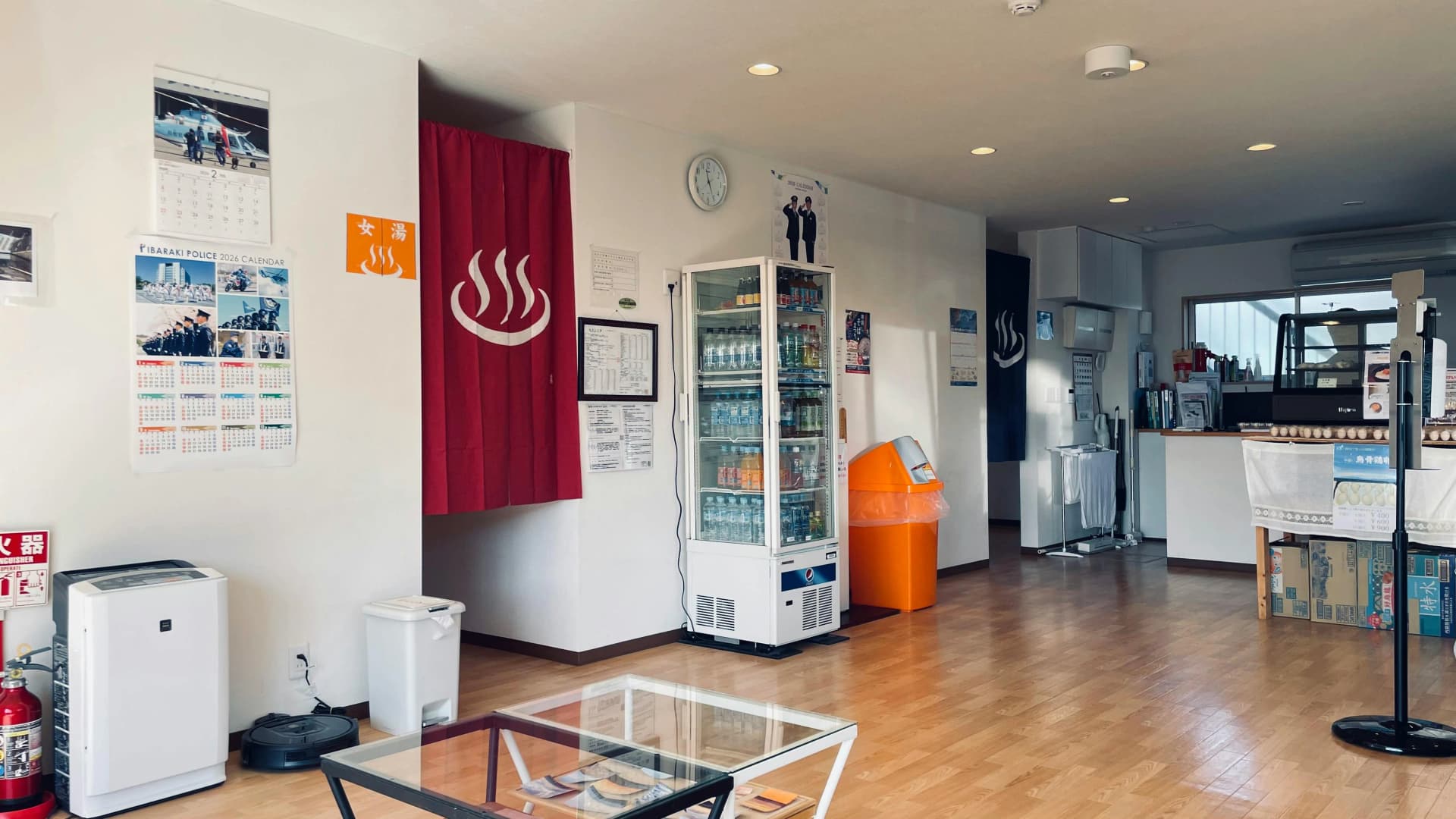
You'll meet one of two setups at the entrance. A traditional sento has a bandai (番台), a raised cashier booth sitting where the men's and women's changing rooms meet, so the attendant can see both sides at once. That worked because the attendant was someone the neighborhood knew and trusted. Most sento have since swapped the bandai for an ordinary front desk, and enthusiasts go out of their way for the few that still have one.
Take your shoes off at the entrance and put them in the wooden shoe lockers. Pay at the bandai, front desk, or ticket machine before you go into the changing room. Noren curtains mark which room is which: blue or indigo for men (男), red or pink for women (女).
In the changing room, take everything off. Nobody wears swimwear here, and people expect you to be naked. Put your clothes in a basket or locker and lock up your valuables. The locker key hangs on a rubber-band wristband that you keep on while you bathe. Carry your small towel and bathing supplies into the bathing room.
The kakeyu step. Before you go near the communal bath, scoop hot water from the wash stations with a wooden bucket and pour it over yourself. Japanese bathing sources all describe the same order: feet first, then legs, hips, abdomen, shoulders. Working from the extremities toward the heart lets your body adjust to the temperature and protects you from a blood pressure shock. English guides tend to just say "shower first," which skips the part Japanese bathers care about.
Soak briefly first. Many English guides get this step backwards. In the usual Japanese sequence you get into the hot bath for a short warm-up that opens your pores, then go back to the wash stations to clean properly. You haven't washed yet at this point, so keep it short.
Wash at the wash stations (洗い場). Each station has a stool, a mirror, a faucet, and a handheld showerhead. Sit on the stool, because standing up to wash splashes the people next to you and they'll notice. Wash your whole body with soap and shampoo. When you're done, rinse down your station and lean the basin against the wall instead of leaving it flat on the floor.
Return to the bath. Expect water around 40 to 44°C, which is a good deal hotter than most visitors are ready for. Five minutes is a normal first soak. Some people stay thirty minutes, moving between the hot bath and a cooler rest. Your towel never goes in the water. Leave it on the edge of the bath or fold it on your head.
Dry before leaving the bathing area. Wipe yourself down with the hand towel before you step back into the changing room. Regulars notice when someone drips across the wooden or tatami floor of the dressing area.
The Rules That Matter
Almost every rule comes from the fact that you're sharing the water.
Finish the kakeyu and the wash before you get in the bath. Keep your towel out of the water. No splashing, no swimming. Talk quietly if you talk at all, since plenty of regulars never say a word. If a wash station has someone's toiletries sitting on it, leave it alone: that's a regular's spot, and taking it causes quiet friction. Drink something afterward, because the hot water dries you out, which is exactly why the changing room has a fridge.
The Milk Ritual
Once you're dressed and cooling off in the changing room, you buy a glass bottle of cold milk from the fridge by the bandai. The choices are plain milk (牛乳), coffee milk (コーヒー牛乳), or fruit milk (フルーツ牛乳), and sento have sold all three since the 1930s. You drink it hands on hips, head tipped back, in one go. Plenty of Japanese people over forty think that's the proper way to end a sento visit, and nobody does it as a joke.
The changing room usually has a mechanical beam scale too, often from the 1960s or 1970s. Regulars weigh themselves before and after bathing, especially after the sauna, to keep an eye on their health.
The Mt. Fuji Murals
The big Mt. Fuji paintings on the back walls of Tokyo sento go back to 1912. The owner of Kikai-yu in Kanda asked a local painter, Kawagoe Kōshirō, to paint the bathhouse wall. Kawagoe was from Shizuoka Prefecture, Mt. Fuji's home prefecture, so he painted the mountain. Customers loved it, neighboring sento copied the idea, and within a generation Fuji was the standard picture in Kanto bathhouses.
Sento in Osaka, Kyoto, and the rest of western Japan usually have plain tiled walls. The Fuji mural is a Kanto habit, and you mostly see it around Tokyo.
Japan has only three professional sento mural painters left. Maruyama Kiyoto is in his early eighties, has been painting for over sixty-five years, and was named a Contemporary Master Craftsman (現代の名工) by the Japanese government. Nakajima Morio, seventy-one, holds the same title. Tanaka Mizuki, in her thirties, trained under both of them and is the only one who can carry the work on.
They paint on site, straight onto the wall, in one session of one to two days. There's no underdrawing; the whole picture goes up freehand at full size. They use four colors only, blue, red, yellow, and white, and mix everything else from those. Humidity wears the paint down, so a mural gets repainted every five to seven years or so, and the painter has to produce a new composition each time. The angle, season, and colors are never repeated exactly.
Painters in the trade have a saying: "Three years for sky, ten years for pine trees, a lifetime for Mt. Fuji."
Where to Go
Konparu-yu in Ginza has been open since 1863, which makes it one of the oldest sento left in Tokyo. It's five minutes from Shimbashi Station. Nakajima Morio painted the murals: a coastal Mt. Fuji on the men's side and a red Fuji on the women's. The tile work throughout is Kutani ceramic.
Kosugi-yu in Koenji, five minutes from the JR Chuo Line station, opened in 1933. Its curved karahafu entrance roof is a local landmark, and the Maruyama Kiyoto mural shows Mt. Fuji from Lake Saiko. People go for the milk bath. Hours: weekdays 15:30 to 1:45 AM, weekends from 8:00 AM. Closed Thursdays.
Kairyo-yu in Shibuya got a designer renovation in 2018: a black interior and a Mt. Fuji mural lit like a stage set. Tattoos are explicitly welcome. The sauna costs an extra ¥450. Hours: Monday to Friday 15:00 to 24:30, Sundays from 13:00 to 23:00. Closed Saturdays.
Kogane-yu in Sumida, near Kinshicho Station, was founded in 1932 and fully renovated in 2020. Manga artist Hoshiyori-ko painted the mural in an illustrated scroll style instead of the usual Mt. Fuji. You'll find tourists, young locals, and elderly regulars there in roughly equal measure.
Daikoku-yu near Oshiage Station in Sumida has been running since 1949, within sight of Tokyo Skytree. It feels like old downtown, with a traditional Mt. Fuji mural and water drawn from underground.
Tokyo's Black Water Baths
Tokyo does have natural mineral water, just not the volcanic kind you get at mountain onsen. It's kuro-yu (黒湯, black water), dark brown to black, pumped from underground reservoirs one hundred to twelve hundred meters down. The color comes from humic acid left by ancient plant matter breaking down, so you're more or less bathing in dissolved prehistoric forest. It carries sodium and organic minerals, and people say it softens the skin.
Most black water sento are in Ota Ward in southwest Tokyo, which has more sento packed into it than any other ward. You pay the same regulated ¥550 for natural mineral water that would cost ten times as much at a resort onsen. Kugahara-yu in Ota Ward has black water plus an outdoor bath and a carbonic spring. Yu-City Kamata draws its water from a hundred and twenty meters down.
Tourists don't really come to these. They're neighborhood bathhouses that happen to sit on very good water.
Tattoos
Sento tend to be more relaxed about tattoos than onsen resorts. Many small neighborhood sento have never posted a ban, and the working rule is that if there's no sign, you're probably fine. That goes double for foreign visitors with Western-style decorative tattoos, as opposed to full-body irezumi.
Policies still vary from place to place and change over time. Kairyo-yu in Shibuya explicitly welcomes tattoos. Sakura-kan in Ota Ward lets tattooed visitors in until 5:00 PM, and tattoos smaller than six by six centimeters are fine at any hour. Some places will let you cover a small tattoo with a waterproof sheet.
Your best bet is to check the sento's website or call ahead. If you have tattoos, start with the 63 WELCOME! SENTO certified locations, and still confirm before you go.
What to Bring
Bring a small towel for the bathing area and a bigger one for drying off, plus soap, shampoo, and conditioner. Many traditional sento don't provide toiletries, although renovated ones increasingly do. Most sell basic supplies at the front desk and rent towels for ¥50 to ¥100.
Carry exact change or small bills. Bandai attendants often can't break a ten-thousand-yen note, especially early in the day. Plenty of renovated sento now take IC cards (Suica and Pasmo) and credit cards, but the older ones are cash only.
Frequently Asked Questions
How much does sento cost in Tokyo? ¥550 for adults, ¥200 for children six to twelve, and ¥100 for children under six. The Tokyo Metropolitan Government sets these prices, so they're the same at every traditional sento in the city. Where there's a sauna, it costs an extra ¥400 to ¥600.
Is sento different from onsen? Yes. Sento uses heated tap water, and onsen uses natural hot spring water that meets specific temperature or mineral criteria. Some Tokyo sento, mostly in Ota Ward, pump real mineral water from deep underground and count as both. They still charge ¥550.
Can I go alone? Yes, and lots of people do. Many regulars come by themselves, soak in silence, and leave.
Is the water really that hot? Yes. The standard range is 40 to 44°C, and most first-timers last about five minutes before they need to cool off. Do the kakeyu first so your body can adjust, and lower yourself in slowly.
Are there English-friendly sento? The WELCOME! SENTO campaign certified 63 sento across Tokyo with multilingual signage, cashless payment, and illustrated etiquette guides. Daikoku-yu near Skytree has its own English website. Kairyo-yu in Shibuya and Kogane-yu in Kinshicho both see a lot of international visitors.
At Hinomaru One, Ordinary Tokyo covers the sento as part of how the city's daily infrastructure works. For decades hundreds of thousands of Tokyo residents got by without a bath at home, and the tour looks at how they managed and why the bathhouses kept going after the practical need was gone.