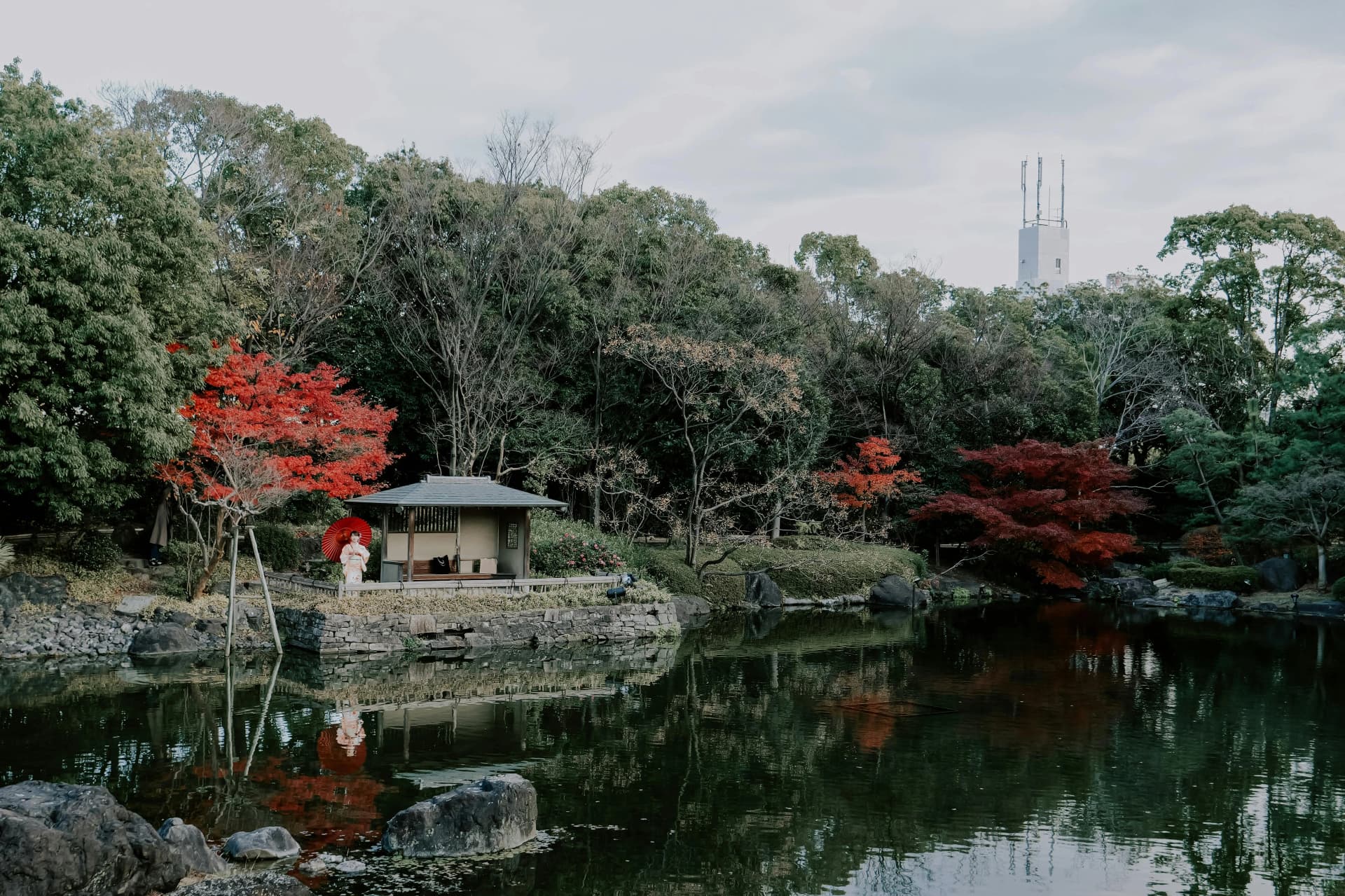
The tidal pond is unique in Japan: seawater from Tokyo Bay has been flowing in and out of it since the Edo period.
Hama Rikyu Gardens sit at the edge of Tokyo Bay, and standing by the Shioiri-no-Ike on a clear morning you see two Tokyos at once. In front of you, black pine branches arc over still seawater the color of green tea. Behind you, the Dentsu Tower and the Shiodome district rise above the garden wall as if dropped there from another century. That collision — feudal Japan and 21st-century corporate Tokyo sharing the same frame — is what makes Hama Rikyu worth the detour.
The garden holds Japan's highest dual heritage designation: Special Historic Site and Special Place of Scenic Beauty. At 250,000 square meters, it sits on land reclaimed from Tokyo Bay in the 17th century, surrounded on three sides by a seawater moat. Admission is ¥300. It's one of the more undervisited major gardens in the city, which is half its appeal.
The Shogunal History Behind the Garden
In 1654, Matsudaira Tsunashige — younger brother of the fourth Tokugawa Shogun, Ietsuna, and ruler of Kofu Domain — received permission to reclaim tidal shallows from Edo Bay. He built a villa on the reclaimed land called Kofu Hama-yashiki, the Kofu Beach Pavilion, at the mouth of the Sumida River where it emptied into the bay.
When Tsunashige's son became the sixth Tokugawa Shogun, Tokugawa Ienobu, the property passed into the shogunate's direct ownership and was renamed Hama Goten — the Beach Palace. Successive shoguns expanded it. The main palace burned in 1724 and was never rebuilt. By the time of the eleventh Shogun, Tokugawa Ienari — who ruled nearly five decades from 1787 to 1837, the longest reign of any Tokugawa shogun — the garden had reached roughly the form it holds today.
The garden served as a duck-hunting ground, with two dedicated kamoba (duck-hunting sites) around the tidal pond. Shoguns flew falcons here — the Taka-no-Ochaya, the Falcon Teahouse, still stands in the northeast corner. In 1729, a Vietnamese elephant given to the shogunate as a diplomatic gift lived on the grounds for twelve years. In 1867, the shogunate built a Western-style stone building here to receive foreign diplomats visiting Edo.
After the Meiji Restoration, Emperor Meiji proclaimed it the Hama Detached Palace and used it as a state guest house. Ulysses S. Grant stayed here for a month in 1879 during his world tour. The garden burned in the 1923 Great Kanto Earthquake and again in the March 1945 Tokyo air raids. In November 1945 the Imperial Household Agency transferred it to the Tokyo Metropolitan Government; it opened to the public in April 1946 and received its dual Special designation in 1952.
The Tidal Pond: How It Works
The Shioiri-no-Ike is the central reason to visit Hama Rikyu, and it deserves more than a glance. It is the only surviving Edo-period tidal pond in Tokyo — the only garden pond in the city that still receives direct seawater from Tokyo Bay.
The mechanism is straightforward but ancient: the pond connects to the bay through sluice gates, which open and close to regulate tidal flow. As the tide rises in Tokyo Bay, seawater pushes through the gates and raises the water level in the pond. As the tide ebbs, the gates drain it back. The cycle runs approximately every six hours, following the natural tidal rhythm of the bay. You can look up Tokyo Bay tide times (search: 東京湾 満潮) before your visit if you want to time your arrival for high tide, when the water level is highest and the reflections on the surface most vivid.
This system has been operating, in various states of repair, since the garden's founding in the 17th century. It meant the garden was never a static landscape — the water has always been alive, rising and falling with forces outside the garden walls. Saltwater fish and tidal birds move through the pond at different points in the cycle. In spring and summer, ducks, egrets, and herons work the shallows. The salinity keeps the pond clear in a way freshwater ponds in Tokyo's other parks are not.
The pond is large enough that different vantage points offer entirely different experiences. The eastern shore gives you the pine trees, the Nakajima Teahouse island, and the Shiodome towers behind. The western shore opens toward the seawater moat and the water horizon. Walking the full perimeter takes about 20 minutes at a slow pace.
The 300-Year-Old Pine
The black pine at the edge of the tidal pond is the most-photographed element in the garden. It's typically described as approximately 300 years old — a designation that rounds to somewhere in the late 17th to early 18th century, consistent with the garden's active development period under the early Tokugawa shoguns [UNVERIFIED: the exact age of the tree is an approximation based on historical planting records rather than dendrochronology]. What's not in dispute is its form: it has been trained and shaped by successive generations of gardeners over three centuries, resulting in a nearly horizontal profile with its longest branches extending out over the water.
Japanese black pine (kuromatsu) is the dominant species at Hama Rikyu, favored in coastal gardens for its salt tolerance. The pine's horizontal form is not accidental — it's the result of annual niwashi pruning stretching back to the Edo period. The trees have been shaped by hand every year for as long as the garden has existed.
The pine is at its best in autumn, when the pond reflects the surrounding maples and the green of the old pines holds against the orange and gold. In winter, after snowfall, the pine branches hold snow in a way that makes for the most striking photographs of the garden.
The Teahouses
The garden has four ochaya — tea pavilions used by the shoguns and imperial court. Nakajima-no-Ochaya is the one most visitors see. Originally built in 1704 on a small island in the center of the tidal pond and reconstructed most recently in 1983, it's reached via two short wooden bridges. Matcha tea with a Japanese sweet costs ¥800–1,000. You sit on the outer deck with water on three sides, pines overhead, and the Shiodome towers visible above the treeline — one of the better tea settings in central Tokyo.
Taka-no-Ochaya, the Falcon Teahouse, stands in the northeast section. It's the only thatched-roof structure in the garden, built of Japanese cedar, with a small enclosed room at the back where the shoguns' falcons were kept between hunts. The Tokyo Metropolitan Government spent ¥230 million restoring it in a project completed around 2019. The building can be viewed from outside; it's not a functioning teahouse. Matsu-no-Ochaya (rebuilt 2010) and Tsubame-no-Ochaya (rebuilt 2015) complete the set — successive shoguns used them for ikebana, waka poetry, and private meals.
Seasonal Flowers
The garden maintains plantings for every season. Plum blossoms arrive in late February; cherry blossoms peak in late March to early April — quieter than Ueno or Shinjuku Gyoen during peak blossom week, and the pond reflections make the cherry trees here worth seeing. Canola (nanohana) covers the open fields in yellow from late February through late March, vivid against the grey-green water and old pines.
Cosmos bloom in late September through October — large fields of pink and white across the garden's open areas. Autumn foliage peaks from late November through early December, when maple, ginkgo, and Japanese red maple turn against the old pines. The tidal pond in that light, with the Shiodome towers behind, is when the garden is most photogenic. Cluster amaryllis (higanbana) blooms deep red along the garden margins in late September — easy to miss, worth noting if you're visiting at the equinox.
Getting There
By foot: Shiodome Station (Toei Oedo Line, Yurikamome) is 7 minutes south. Shimbashi Station (JR Yamanote, Toei Asakusa, Tokyo Metro Ginza) is 10–12 minutes. Tsukijishijo Station (Toei Oedo) is 10 minutes to the eastern gate.
By water bus from Asakusa (recommended): Tokyo Cruise runs from Asakusa Pier (Azuma Bridge) directly to the pier inside the garden — 35 minutes along the Sumida River and into Tokyo Bay. The fare is ¥1,180 one way and includes garden admission. Departures from Asakusa to Hama Rikyu run at 11:40 and 14:20 as of 2026 [UNVERIFIED: check suijobus.co.jp before visiting; schedule changes seasonally]. Important: the water bus is drop-off only at Hama Rikyu — you cannot board at the garden pier for the return. Exit on foot toward Shiodome or combine the visit with a walk to Tsukiji, 10 minutes east.
The water bus entry is the better approach: you arrive from the bay side, the way the shogunate did, with the tidal pond opening on your left as you dock.
Admission and Hours
| Admission | ¥300 adults; ¥150 for ages 65 and over |
| Hours | 9:00 AM – 5:00 PM (last entry 4:30 PM) |
| Closed | December 29 – January 1 |
| Free admission days | May 4 (Greenery Day), October 1 (Metropolitan Citizens' Day) |
| Group discount | 20% off for parties of 20 or more |
| Water bus combo | ¥1,180 Asakusa → Hama Rikyu (includes admission) |
Primary school children and younger, and junior high school students who live or study in Tokyo, enter free.
Building a Full Day
The garden takes 60–90 minutes to cover thoroughly, including a matcha stop at the Nakajima teahouse. It works best as one anchor in a longer bay-area day.
The water bus day: Asakusa in the morning, then the 11:40 water bus from Asakusa pier. Arrive at the garden around noon, walk the grounds, take tea on the island. Exit toward Shiodome and continue into Ginza in the afternoon. The day connects two of Tokyo's most historically layered districts with one of the city's best transit experiences.
The bay and market day: Hama Rikyu at 9:00 open, then walk 10 minutes east to Tsukiji Outer Market for a late breakfast or early lunch. After Tsukiji, Ginza is 10–15 minutes further. The garden, the seafood market, and the luxury district all sit along the bay edge and flow naturally in sequence.
For a guided day built around this part of the city — the shogunal garden tradition, the bay history, the connections between districts — Tokyo Essentials covers it with the cultural depth the garden deserves. Infinite Tokyo allows any custom itinerary built around the water bus route or the bay area.
FAQ
What makes Hama Rikyu different from other Tokyo gardens? The tidal pond. It's the only surviving Edo-period garden in Tokyo where seawater from Tokyo Bay flows in and out via sluice gates, changing the water level with the tides twice a day. No other Tokyo garden operates this way, and the pond has been functioning on this mechanism since the 17th century.
Can I take the water bus from Hama Rikyu back to Asakusa? Not currently. Tokyo Cruise water buses stop at Hama Rikyu to drop off passengers, but you cannot board the boat there for the return trip to Asakusa. Plan to exit the garden toward Shiodome Station (7 minutes on foot) or Shimbashi Station (10–12 minutes) and take the train back.
When is the best time to visit Hama Rikyu? Autumn (late October through early December) for foliage and cosmos fields combined. Early spring (late February through March) for canola flowers and plum blossoms with fewer crowds than cherry blossom season. If you want to time the tidal pond at full water level, check Tokyo Bay high tide times online before visiting.
How long should I spend at the garden? Sixty to ninety minutes covers the garden thoroughly. Add 20–30 minutes if you stop for matcha at the Nakajima Teahouse. The island teahouse is worth including — the combination of the setting and the low admission price makes this one of the best-value tea experiences in central Tokyo.
Is the Nakajima Teahouse part of the garden admission? No. Garden admission is ¥300. Matcha tea and a Japanese sweet at the Nakajima Teahouse costs approximately ¥800–1,000 separately. The teahouse accepts walk-in visitors during garden hours; no reservation is required.