Live sumo is one of the most accessible and underrated things you can do in Tokyo — if you know when and how.
Watch sumo in Tokyo and it genuinely defies expectations. It's not the spectacle foreigners imagine — oversized wrestlers launching instantly at each other, one thrown out in two seconds, the next bout up before the crowd settles. It's also not the slow ceremonial ritual that skeptics warn you about. It's both, at the same time, delivered inside a 11,000-seat arena in Ryogoku where the smell of grilled chicken drifts through the concourse and sake cups are passed around tatami boxes.
The barrier isn't interest — most people who go say it's one of the best things they did in Tokyo. The barrier is logistics. Tickets sell out within minutes of release. The official site is in Japanese. Same-day options exist but come with uncertainty. And if you don't know what time to arrive, you'll sit through three hours of lower-division bouts you can't read before the fights that matter begin.
This guide covers everything you actually need to know.
When Tokyo Hosts Sumo
Japan holds six Grand Sumo Tournaments (basho) per year, spread across four cities. Tokyo gets three: January, May, and September. Each runs for 15 consecutive days at the Ryogoku Kokugikan in Sumida Ward — the same building that houses the Sumo Museum, one of Tokyo's most undervisited free attractions.
The 2026 tournament dates are:
| Tournament | Japanese Name | Dates | Notes |
|---|---|---|---|
| January | Hatsu Basho | Jan 11–25, 2026 | Emperor attending (confirmed) |
| May | Natsu Basho | May 10–24, 2026 | Ticket sales open Apr 4 |
| September | Aki Basho | Sep 13–27, 2026 | — |
Tickets go on general sale approximately one month before each tournament opens. Confirm exact dates on the Japan Sumo Association's official English site at sumo.or.jp.
A tournament ticket covers one full day. You arrive, watch as much as you want, and leave when you're done. There's a re-entry provision — you can exit and return once before 5pm — which makes it easy to step out for lunch in the Ryogoku neighborhood before coming back for the top-division bouts.
Getting Tickets: What Actually Works
Tickets sell out quickly, especially for weekends and final days when title implications are clearest. Here is how to buy them, in order of reliability.
The official site (sumo.pia.jp/en) is the lowest-cost option. It's operated by Ticket Pia on behalf of the Japan Sumo Association. Tickets are released roughly four to five weeks before the tournament starts. When they go on sale at 10am Japan time, demand is extreme — the site crashes regularly, and popular seat types are gone within minutes. If you're willing to sit at your computer at the exact release moment, this is worth attempting. You'll need a Japanese address for delivery or to collect from a Ticket Pia machine at the venue.
Tour packages through operators like Viator, Klook, and JTB Sunrise Tours cost considerably more but guarantee seats. Tokyo Cheapo paid ¥19,000 for a 2nd-floor B-class chair seat through JTB in January 2026 — roughly double face value — but the seat was secured, included a local English-speaking guide, and came with no uncertainty. If you're visiting once and need this to work, the price difference is reasonable.
Same-day tickets are available at the Kokugikan box office on the morning of each tournament day, but they're not reliable. Availability depends on no-shows and returns. On weekends and late-tournament days, there may be nothing. On weekdays mid-tournament, your chances improve.
A note on resellers: the Japan Sumo Association prohibits ticket resale, and venue staff have been documented scrutinising QR codes on electronic tickets from third-party brokers. Buysumotickets.com and similar services operate in a grey zone; use them as a last resort and check the booking terms carefully.
Seating Guide
| Seat Type | Location | Price Range | Notes |
|---|---|---|---|
| Tamari | Ringside cushions | ¥20,000/person | 16+ only. No food, drink, or phones during bouts. Closest to the ring. |
| Masu-seki | 1F tatami boxes | ¥8,500–¥15,000/person | Sold as a 4-person box. Must buy all 4 seats together. Traditional experience. |
| Arena Chair (SS–C) | 2F chair seats | ¥3,500–¥11,000 | Solo-friendly. Western seating. Less atmosphere but good sightlines. |
Masu-seki are the most photographed — the intimate floor boxes that look out across the clay ring. They're also the trickiest to get: you buy all four seats even if you're a couple, and you'll be sitting cross-legged for several hours. They're worth it if you can get them. For solo travelers and couples who want comfort, a second-floor chair seat in the A or B range is the practical call.
How the Day Works, Hour by Hour
Bouts run continuously from about 8am to just after 6pm, but the day is structured by division. Lower-ranked wrestlers fight first, working upward through the hierarchy until the top-division (Makuuchi) bouts begin at around 3:40pm and the final bout — often the most dramatic of the day — lands close to 6pm.
This means arriving at 8am will give you a full day in the arena with a sparse crowd and the unusual quiet of early-division wrestling. Arriving at 2pm is closer to what most tourists do: you catch the tail end of the Juryo division, settle in, get food, and are seated when Makuuchi starts. If your time is limited, arriving at 2pm and staying until the end gives you the complete emotional arc without the six-hour commitment.
The crowd builds through the afternoon. By the time the top-ranked wrestlers enter in the final hour, the arena is at full volume. The atmosphere isn't like Western sport — there are no stadium-orchestrated chants or DJ-managed crowd moments — but it has its own particular energy: concentrated, respectful, and suddenly explosive when an unexpected upset occurs.
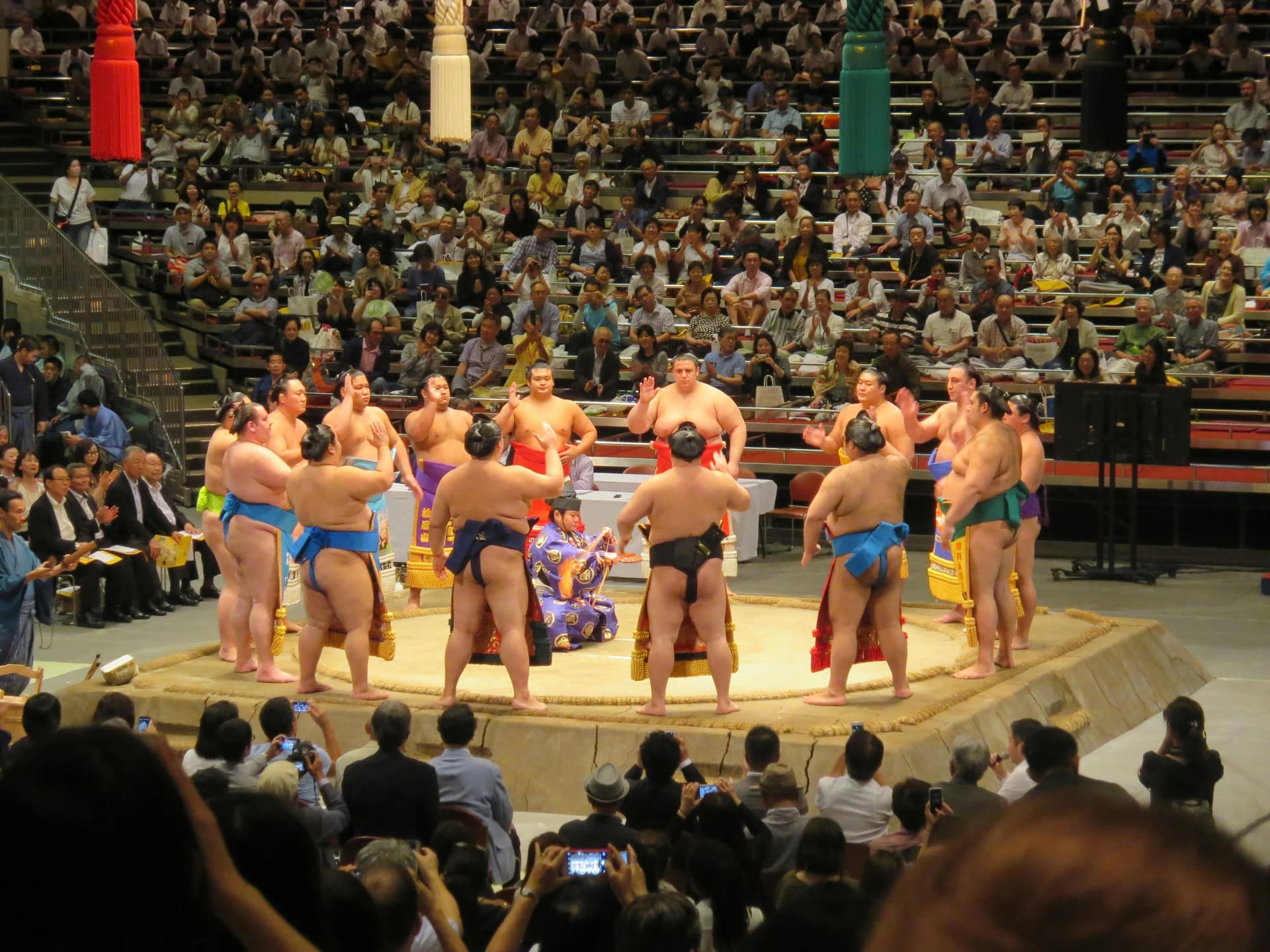
The yokozuna ring-entering ceremony (dohyo-iri), performed in the late afternoon before the top-ranked bouts begin, is worth your full attention. It's a slow, ritualized sequence of Shinto movements — the same ceremony performed essentially unchanged for over 200 years — and watching it live is categorically different from watching it on screen. If you're only going to see one thing at the arena, it's this.
A practical note: the day order is published on the sumo association's website each morning. You can look up which wrestlers are fighting whom and at roughly what time, which helps you calibrate your arrival.
What You're Watching
Each bout begins long before the wrestlers touch each other. They enter from opposite sides of the ring, perform their own ritual preparations — salt throwing, leg stomping, squatting — and make eye contact with their opponent across the raised clay dohyo. The pre-bout ritual can last several minutes for top-division wrestlers. The bout itself often lasts fewer than ten seconds.
The 82 official techniques (kimarite) that determine a bout's outcome range from the obvious — push out, throw down — to the technically specific. You don't need to know them to read what's happening. The basic logic is legible: whoever touches outside the straw ring boundary or touches the ground with anything other than the soles of their feet loses. What makes it interesting is the physical and tactical complexity packed into those few seconds.
Watching a few bouts before the top division helps calibrate your eye. Lower-division wrestlers are less polished, which paradoxically makes the technique more visible. By the time Makuuchi begins, you'll be reading the matches better.
The ranking system — from Yokozuna at the peak through Ozeki, Sekiwake, Komusubi, and the numbered Maegashira ranks — determines who fights whom. Higher-ranked wrestlers face tougher opponents later in the tournament. A wrestler's record across the 15 days determines whether they advance or fall in the next tournament's rankings, which gives every bout genuine stakes even in the middle of a tournament.
What to Eat and Drink
The food inside Kokugikan is specific and worth leaning into. The signature item is yakitori — grilled chicken skewers, sold from concession stands on multiple levels of the arena. The connection between sumo and chicken runs deep: chicken is considered lucky in sumo culture because it stands on two feet and never touches the ground with its hands, which means it never loses by sumo's logic. Fans have been eating yakitori at Tokyo tournaments since the 1950s. It's the right thing to order.
Beyond yakitori, the arena sells bento boxes (options typically include tempura, roast beef, and fish versions), chanko-nabe in small bowls — the protein-rich hot pot that wrestlers eat to build mass — and a range of packaged snacks. Beer and sake are both available and actively consumed. Masu-seki box holders, in particular, tend to arrive with significant food and drink provisions and eat throughout the day; it's a meal-and-sport combination that gives the floor seats a picnic energy that the upper tiers don't quite replicate.
If you want the full chanko-nabe experience rather than the arena's cup-sized version, Ryogoku's restaurant district delivers that after the tournament. The Sumo Museum article covers the neighborhood dining options in detail, including the best spots within walking distance of the arena.
Morning Practice: Watching Before the Crowds
Every sumo stable (heya) holds morning practice (asageiko) year-round, not just during tournament periods. Lower-ranked wrestlers begin around 6am; senior wrestlers enter the practice ring later, typically from 7am onward. Sessions end between 9am and 10am.
Watching asageiko gives you something a tournament doesn't: proximity, informality, and silence. You're sitting within a few meters of the ring while wrestlers train without ceremony or audience management. The contrast with the tournament setting is stark.
Access requires prior arrangement. Some stables accept visitors directly; others work exclusively through licensed guide services. The rules are strict regardless of how you arrive: you sit on the floor (either cross-legged or in formal seiza position), keep completely silent during practice, and follow any instructions given. Talking is prohibited. No exceptions, no leeway.
For foreign visitors, joining a guided tour is the most reliable path. Tours typically include hotel pickup, English-language cultural explanation during the session, and access to a stable that has an active agreement with the operator. The Naruto stable in Asakusa has been specifically confirmed for 2026 packages and is led by former Ozeki Kotooshu, now stable master Naruto Oyakata — one of the more internationally minded operations in Tokyo.
Booking through an established tour operator also protects you from the main risk of going independently: arriving unannounced, or with someone who doesn't know the rules, can result in being asked to leave — and burning goodwill for the visitors who come after you.
Getting There
Ryogoku Kokugikan is one station from Akihabara on the JR Sobu Line (Ryogoku Station, West Exit). The arena is visible from the station exit. During tournament periods, the surrounding streets are busy from mid-morning with wrestlers in yukata walking between stables and the venue — part of the neighborhood's particular tournament-day character that you don't experience anywhere else in Tokyo.
There's no benefit to taking a taxi or driving. Train access is straightforward, parking is limited, and the walk from the station is 90 seconds.
FAQ
Do I need to understand sumo to enjoy the tournament? No. The basic logic — last one touching the ring boundary or the ground loses — is immediately readable. Give yourself 30 minutes watching lower-division bouts to calibrate your eye, and the top-division matches become genuinely tense even without knowing the wrestlers' names.
How early should I buy tickets? For the official site, you need to be online at the exact moment general sale opens (usually 10am Japan time, roughly five weeks before the tournament). Popular days — weekends, final days — sell out within minutes. If you're booking a trip around sumo, lock in tour package tickets as soon as they're available. Don't assume you can handle this on arrival.
Can I watch sumo in Tokyo outside tournament periods? Not at the Kokugikan. The arena hosts three tournaments a year; there are no regular bouts outside those windows. Morning practice at stables runs year-round and is the alternative. It's a different experience — closer, quieter, no ceremony — but genuinely worth doing in its own right.
What should I wear? There's no dress code. Most Japanese attendees dress smartly-casually; some older regulars wear kimono. For masu-seki floor seats, wear something comfortable enough to sit cross-legged for several hours. Bring a small bag — the arena is large and you'll want hands free.
Is it worth attending more than one day? For most visitors, one day is sufficient and memorable. Serious sumo followers who track wrestler records find the last three to four days of a tournament most compelling, as title races and demotion fears peak. If your schedule allows flexibility, a final-week weekday often delivers the best combination of charged atmosphere and available same-day tickets.
At Hinomaru One, we build private Tokyo days around experiences like this — not just the ticket, but the full day in Ryogoku, the morning practice, the chanko dinner, the neighborhood context that makes it land. Infinite Tokyo is designed for exactly this kind of itinerary.