Free entry, one minute from Ryogoku Station, almost always uncrowded. The Sumo Museum is one of the best-value cultural experiences in Tokyo.
Sumo Museum is on the ground floor of Ryogoku Kokugikan — Tokyo's National Sumo Arena and the venue for three of the six annual tournaments. It is free to enter. It is almost always uncrowded. It holds ceremonial belts embroidered by hand for yokozuna (grand champions), Edo-period woodblock prints of legendary wrestlers, tournament ranking charts tracing the sport back to the 17th century, and archived footage of ring-entrance ceremonies performed by yokozuna who have since retired or died.
The Japan Sumo Association operates the museum, which means the collection is the institutional memory of the sport itself — not a tourism product, but a professional archive that happens to be open to the public. That distinction matters. What you see here is what the association considers worth preserving.
Getting There
Ryogoku Station (JR Sobu Line or Toei Oedo Line) — West exit, 1 minute walk. The arena is the large building immediately west of the JR station exit. The museum entrance is on the ground floor, clearly signed in English and Japanese.
Admission and Hours
| Admission | Free |
| Hours | 10:00 AM – 4:30 PM (last entry 4:00 PM) |
| Closed | Weekends and national holidays (outside tournaments) |
| Tournament days | Access requires a tournament ticket |
Important: The museum is closed on weekends during non-tournament periods. Visit on a weekday for guaranteed free access. During the three annual Tokyo tournaments — held in January, May, and September — the arena is in full use and museum entry requires a day ticket to the tournament.
1,500 Years of Recorded History in One Room
Sumo claims the longest documented history of any professional sport in Japan. The story begins not with a match but with a myth. In the Kojiki (712 CE) and the Nihon Shoki (720 CE) — Japan's oldest imperial chronicles — the gods Takemikazuchi and Takeminakata wrestle to determine which deity will control the Japanese islands. Takemikazuchi wins. This divine contest is the foundation myth of sumo, and it explains why the sport has always existed at the intersection of athletic competition and Shinto ritual: the dohyo (the clay ring) is considered sacred ground before a single wrestler steps onto it.
Documented historical practice begins in the Nara period (710–794 CE), when sumo was incorporated into imperial court ceremonies — not entertainment in the modern sense, but ritual acts aligned with prayers for harvest and national stability. By Japan's medieval period, sumo had spread far beyond the court into shrine festivals and village celebrations across the country.
The version of the sport recognizable today crystallised during the Edo period (1603–1867). In 1684, a former samurai named Ikazuchi Gondaiyu was granted permission to hold a formal benefit tournament — originally to raise money for shrines, temples, and bridges — and used the occasion to impose lasting structure on what had been a loosely organised practice. He defined the dohyo using straw and clay bales, simplified an overwhelming catalogue of techniques into manageable categories, and established rules against the kind of violence that had made earlier matches chaotic. The stable system (heya), the referee tradition (gyōji), and the ring-entering ceremony (dohyo-iri) all took formal shape in this era. So did the first identifiable sumo celebrities: Tanikaze Kajinosuke, Onogawa Kisaburō, and Raiden Tameemon became household names in Edo, their faces printed on woodblock portraits sold across the city.
The Sumo Museum — founded in 1954, relocated to Ryogoku when the new Kokugikan opened in 1985 — holds the physical residue of this history.
What's Here
The museum operates without a permanent collection on permanent display. Exhibitions rotate approximately three times per year, each built around a theme — a specific era, a legendary wrestler, a type of artefact, or the relationship between sumo and traditional art forms. Before visiting, it is worth checking the Japan Sumo Association's website to confirm the current exhibition focus. What follows describes the core categories of objects that cycle through the space.
Yokozuna ceremonial belts (化粧廻し). The kesho-mawashi is the visual centrepiece of every exhibition that features one. These aprons — worn exclusively by top-division wrestlers during the dohyo-iri ring-entrance ceremony — are made of silk, often embroidered with gold and metallic thread, and can reach 240 inches in length when fully extended. They are the most expensive garment in sumo: some have been designed using original artwork by celebrated painters, with one museum example created after a design by the nihonga painter Kataoka Tamako. The embroidery work alone represents hundreds of hours of skilled craft, and each belt is commissioned specifically for an individual yokozuna, tied to their rank, their stable, and their personal history in the sport. Seeing them at close range in the museum is a different experience from seeing a wrestler enter the ring wearing one — the detail that disappears at arena distance becomes fully visible in a glass case.
The dohyo-iri ceremony itself. Monitors in the exhibition room loop archived footage of historical ring-entrance ceremonies, which rewards some explanation. The dohyo-iri performed by a yokozuna is not the same ceremony performed by other wrestlers. The group ring-entrance by the top division precedes it. The yokozuna then enters alone, wearing the heavy ceremonial rope (tsuna) that gives the rank its name — yokozuna literally means "horizontal rope" — and performs a sequence of ritual movements rooted in Shinto practice: stamping the ground to drive out evil spirits, clapping to summon the gods' attention, stretching the arms wide to demonstrate that no weapons are concealed. The first yokozuna dohyo-iri on record was performed in 1789 by Tanikaze and Onogawa, the first two wrestlers officially granted the rank. There are two styles of the ceremony — Unryū and Shiranui — distinguished by subtle differences in arm position, and each sitting yokozuna learns whichever style his lineage follows. When you watch the archived footage in the museum, you are watching a ceremony performed in essentially the same way for over 200 years.
Banzuke ranking charts. The banzuke is the official ranking document published by the Japan Sumo Association before each tournament. It lists every professional wrestler's rank, determined by their performance in the previous tournament. What distinguishes the banzuke from a simple list is its form: it is written by certified calligraphers in a specific script style developed for this purpose, where the highest-ranked wrestlers' names appear in large, bold characters at the top, and the ranks narrow and compress toward the bottom until the lowest-division wrestlers appear in script barely readable without magnification. The hierarchy moves from Yokozuna at the peak — a rank from which a wrestler cannot be demoted, but which carries the expectation of retirement when performance declines — through Ozeki, Sekiwake, Komusubi, and the numbered Maegashira ranks that fill out the top division. Historical banzuke in the museum's collection trace these names across centuries of tournaments, making them simultaneously sporting records and documents of Japanese social history.
Edo-period woodblock prints (錦絵). Sumo wrestlers were Edo-period celebrities in the fullest sense — their portraits sold as consumer goods, their matches drawing massive crowds. The woodblock prints in the collection depict both match action and wrestler portraits, representing a distinct subcategory of ukiyo-e with its own conventions: wrestlers shown mid-technique, with stylised musculature and controlled intensity. Seeing these prints alongside the kesho-mawashi and the banzuke closes a historical loop — the same wrestlers whose ceremonial belts survive in the collection appear in these prints, frozen at the moment of competition.
Tournament Days vs Non-Tournament Days
On non-tournament weekdays, you walk in for free, share the space with fewer than a dozen other visitors, and have the exhibition largely to yourself. That is the default experience, and it is the right one for most travellers.
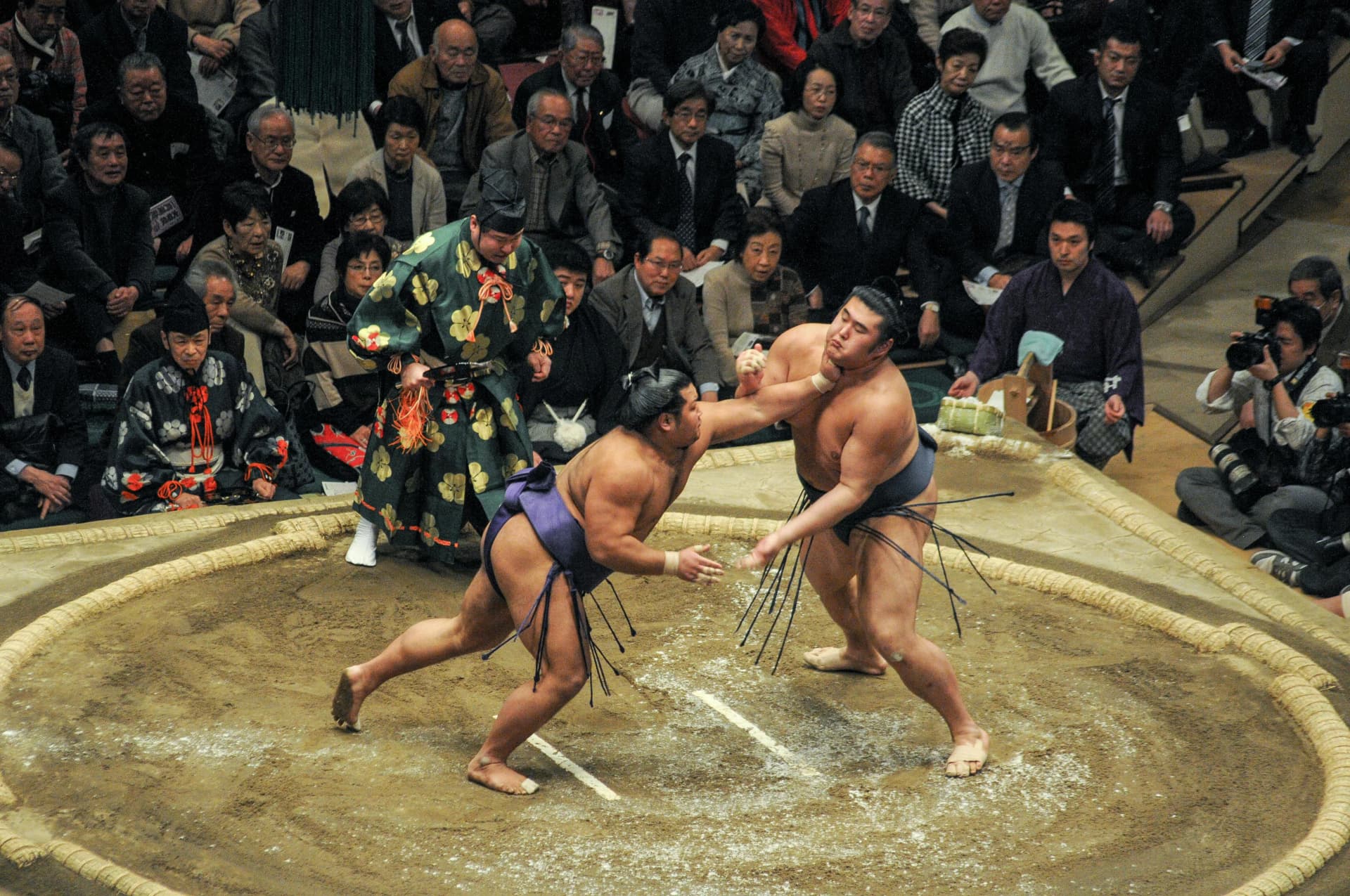
During the three Tokyo tournaments — January, May, and September, each running 15 days typically in the second and third week of the month — the dynamic changes entirely. The Kokugikan fills with 11,000 spectators each day. Museum access requires a tournament ticket, which also gets you into the sumo. If you can secure tickets, it is a remarkable combination: museum in the morning, hours of live bouts, the Yokozuna dohyo-iri performed live in the late afternoon. Tickets sell out quickly; the general sale window opens roughly five weeks before each tournament begins.
After the Museum: Chanko-nabe in Ryogoku
Chanko-nabe is the high-calorie hot pot that sumo wrestlers eat to build and maintain mass — a communal stew cooked at the table, typically a dashi or miso broth base filled with protein and vegetables. Ryogoku has more chanko-nabe restaurants per block than anywhere else in Tokyo, several opened by retired wrestlers carrying recipes from their training stables.
Tomoegata is the most well-known, a short walk from the Kokugikan, with a miso-based version refined over decades. Chanko Kirishima Ryogoku Honten runs a full-course format — sashimi and small dishes before the hot pot, sumo footage on the screens throughout. Course menus at both run ¥5,000–7,000 per person for dinner; lunch sets at several nearby spots land around ¥1,000–2,000. During tournament periods, reservations are essential — walk-ins become nearly impossible on evening match days.
Day Pairing: Ryogoku Full Day
Ryogoku is the most coherent single-neighbourhood full day in eastern Tokyo. The Sumo Museum, the chanko-nabe restaurants, the Sumida Hokusai Museum, and a walk along the Sumida River are all connected on foot within fifteen minutes of each other.
A reasonable sequence: museum in the mid-morning (45 minutes, free), chanko-nabe lunch at Tomoegata or Chanko Kirishima, the Sumida Hokusai Museum in the afternoon (1.5–2 hours), then Asakusa one stop away by train for dinner and an evening walk through Nakamise-dori. This covers two world-class museums, one culturally specific meal, and two of east Tokyo's most rewarding neighbourhoods, all without a taxi.
If you are in Tokyo during a sumo tournament and want to build a full day around the sport — museum, live bouts, chanko dinner — Infinite Tokyo can design that itinerary and handle the ticket logistics.
FAQ
Do I need to book in advance to visit the Sumo Museum? No booking is required on non-tournament weekdays. You walk in, it is free, and you are almost certainly not competing with a crowd. The only exception is during the three annual Tokyo tournaments in January, May, and September, when you need a tournament ticket to enter the Kokugikan building. Those tickets do require advance purchase.
What is currently on display at the museum? The museum does not run a fixed permanent collection. Exhibitions rotate approximately three times per year around different themes — historical banzuke, yokozuna ceremonial belts, Edo-period woodblock prints, specific wrestlers or eras. The Japan Sumo Association's website lists the current exhibition before each visit. It is worth checking before you go.
Can I watch live sumo if I visit Ryogoku? Live sumo at the Kokugikan happens only during the three annual Tokyo tournaments. Outside those windows, the arena does not hold regular bouts. Our complete guide to watching live sumo in Tokyo covers tournament dates, ticket buying strategies, seat types, and what to expect hour by hour. Some sumo stables also offer morning practice viewing (called asageiko) to visitors by appointment, though availability varies by stable and season.
Is the Sumo Museum suitable for children? Yes. The space is small and quiet, which suits younger children better than most museums. The woodblock prints are visually striking, and the archived match footage on the monitors tends to hold attention. There is no interactive element, but the kesho-mawashi in particular — the sheer scale and detail of the embroidered ceremonial belts — tends to land with children in a way that surprises parents.
What is the best time of year to visit Ryogoku? January, May, and September bring the tournaments, which means crowds and elevated energy across the whole neighbourhood — restaurants fill up, the arena is alive, and the sumo district feels like itself at full volume. The tradeoff is that free museum access disappears; you need a tournament ticket. For the quiet museum experience, any non-tournament weekday works, with the bonus that chanko-nabe restaurants are easier to get into without a reservation.