The world's only dedicated parasitology museum is free, takes 90 minutes, and is one of the hardest things in Tokyo to forget.
The Meguro Parasitological Museum was founded in 1953 by Dr. Satoru Kamegai, a parasitologist who believed the public needed to understand the organisms living inside them. It is the world's only dedicated parasitology research museum. It is free. It contains approximately 300 specimens selected from a collection of 60,000. The most famous of these is an 8.8-metre tapeworm.
This is not a morbid tourist trap. It's a genuine research institution — the museum continues to publish parasitological research — that happens to be open to the public. The tone is educational, the displays are well-labelled in both Japanese and English, and the experience of standing in front of a liquid-preserved tapeworm longer than a city bus is one that visitors consistently describe as impossible to forget.
In August 2022, Bill Gates visited, posed for a photo with the specimen, and posted it to Twitter noting it was "believed to be the world's longest tapeworm." The museum's website traffic surged the following day. The museum director, Toshiaki Kuramochi, admitted the team was "somewhat perplexed" by the response — they had been quietly operating for nearly 70 years and didn't expect the world's attention to arrive via a social media post about a worm. This remains genuinely off the standard tourist path.
The Man Who Built It
Understanding the museum requires understanding Dr. Kamegai. He funded it with his own money, which already tells you something. In the 1950s, parasitic infections were common across Japan — patients arrived at clinics carrying roundworms, flukes, and tapeworms as a matter of course. Dr. Kamegai treated them, but he also saw an opportunity. He wanted the specimens.
He developed a reputation for asking patients — politely, with deep bows — whether he might keep whatever emerged. He traveled around Japan collecting samples. He examined feces found on the street. He picked up dead animals on walks and looked inside them. It was said he found certain parasites genuinely cute (kawaii), and that he thought about them constantly. Staff noted his obsessive dedication: he once found new specimens while examining his own lunch.
By 1953, he had enough to open. The collection grew steadily. When Dr. Kamegai died in 2002, the museum had become an internationally recognized research institution, with a library of 60,000 specimens, 50,000 academic papers, and 5,000 books on parasitology. His successor, Professor Akihiko Uchida, added the gift shop — an acknowledgment that the museum needed to fund its own survival, since it operates on investment proceeds, donations, and merchandise sales. No government money. No entry fee, by the founder's original instruction.
Getting There
Meguro Station (JR Yamanote Line, Tokyo Metro Namboku Line, Tokyu Meguro Line) — West Exit
Walk: 10–12 minutes south along the main road
Bus: Tokyu Bus #2 from Meguro Station, 2 stops to Otori Jinja Mae (1 minute walk from stop)
The neighbourhood is quiet and residential. There is no signage announcing the museum from a distance. You find it when you're close to it, which feels appropriate.
Admission and Hours
| Admission | Free (donations welcome) |
| Hours | 10:00 AM – 5:00 PM |
| Open | Wednesday – Sunday |
| Closed | Monday, Tuesday, national holidays |
The building is small — two public floors totalling approximately 145 square metres — but the collection is dense. Plan at least 60–90 minutes if you read the panels carefully. The displays reward attention.
The First Floor: Diversity
The ground floor's purpose is to demonstrate the sheer breadth of parasitic life. Most visitors arrive with a mental model that extends to tapeworms, lice, and perhaps malaria. The first floor corrects that quickly.
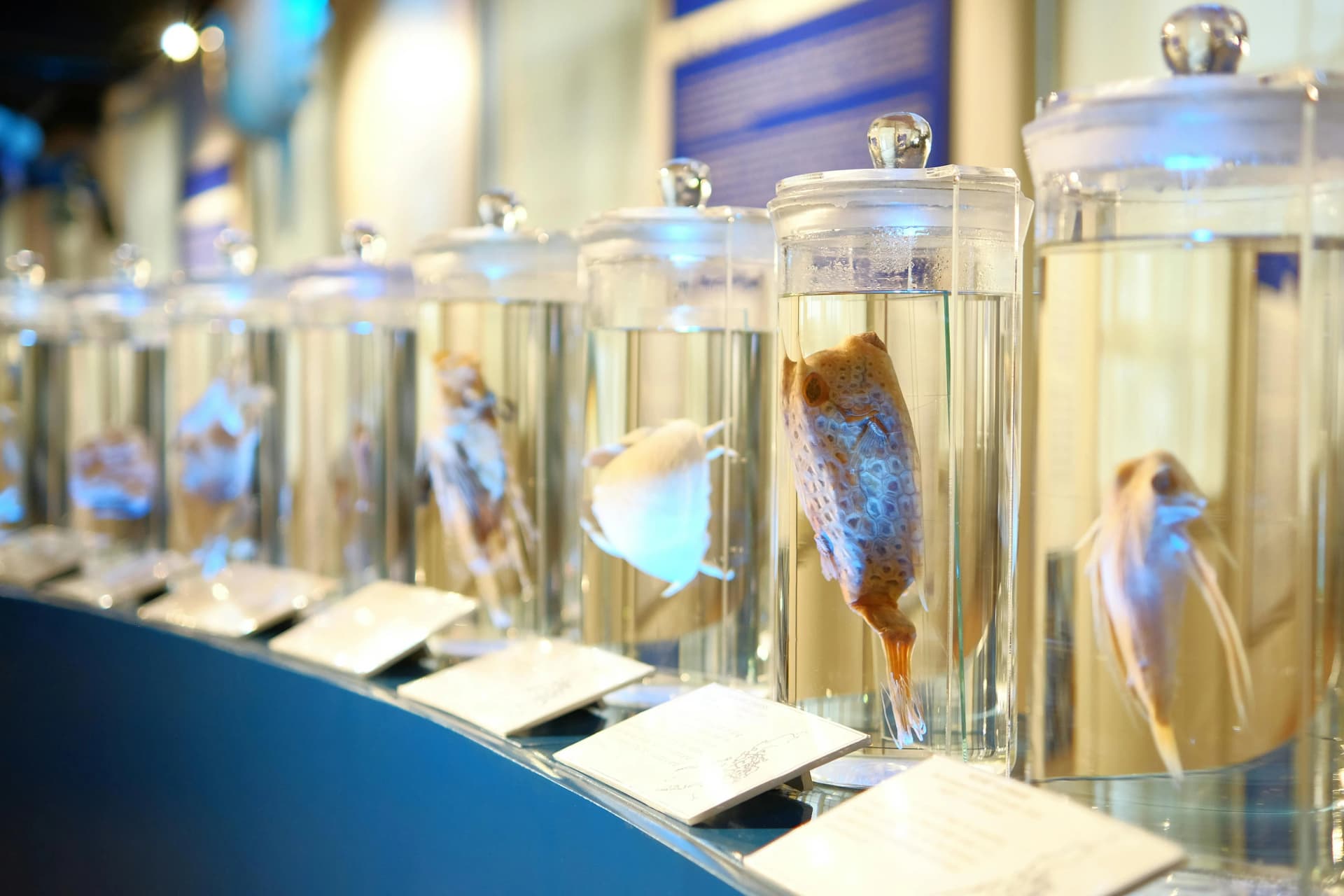
The cases contain flatworms, roundworms, tapeworms, parasitic insects, crustaceans, protozoa, and organisms from every branch of the animal kingdom that has ever evolved a strategy for living inside another creature. The specimens are preserved in formalin, housed in glass cases under consistent lighting, and accompanied by educational panels explaining each organism's lifecycle, host relationship, and infection route. Video displays run continuously, showing parasite behaviours in a way that static specimens cannot convey.
The organisms that stay with you longest are often not the most famous ones. Cases showing parasites that enter through the skin — through bare feet walking on contaminated soil, through water contact, through insect bites — make the abstract concept of infection routes suddenly concrete. The fish specimens are particularly arresting: worms erupting from a fish's eye socket, masses of white cysts pushing through stomach walls. The range of organisms that spend part or all of their lives inside other organisms is, it turns out, vast — and most of them have been at it for much longer than humans have existed.
The Second Floor and the Tapeworm
The second floor focuses on parasites that infect humans specifically: their lifecycles, infection mechanisms, the history of parasitology in Japan, and prevention. This is where the museum's most famous exhibit lives.
The story of the 8.8-metre specimen is worth knowing before you see it. In the 1980s, a man in his 40s noticed a white thread-like object passing through his body. He went to Dr. Kamegai, who administered an antiparasitic agent. What emerged, intact, measured 8.8 metres — roughly 29 feet. The suspected source was cherry-salmon sashimi consumed about three months earlier. A microscopic larval form had entered his digestive system and grown at a rate of approximately 10 centimetres per day, producing no symptoms the entire time. The man had no idea he was carrying it.
Dibothriocephalus nihonkaiensis — also referred to in older literature as Diphyllobothrium nihonkaiense, the Japanese broad tapeworm — is a cestode that commonly uses salmon as an intermediate host. Raw fish consumption remains the primary infection route; around 50 cases are reported annually in Japan. The organism is generally asymptomatic, which is part of what makes it clinically notable: patients discover it not through illness but through observation.
The museum's current director, Dr. Kuramochi, has noted that this specimen is now essentially irreplaceable. Modern antiparasitic drugs cause the worm to break apart inside the body before it can be expelled intact. The 8.8-metre tapeworm on display is a product of 1980s medicine — a complete specimen that today's treatment protocols could never produce again.
It is mounted on a backing board under LED lighting and displayed against a dark background. Its full length is visible. There is a moment, when you grasp the scale of it relative to the room, when the experience shifts from intellectual to visceral.
What Makes This Scientifically Significant
The museum operates as a genuine research institution. The upper floors above the public exhibition spaces house active laboratories and specimen archives. Five institutional functions run concurrently: research into parasite morphology, taxonomy, and distribution; educational programs including work-study placements and lectures; specimen collection and preservation; academic publication; and the museum shop.
The published output includes Research Bulletin of the Meguro Parasitological Museum and Progress of Parasitology in Japan. The research library contains not just the 60,000 preserved specimens but 50,000 academic papers and 5,000 books. This is an institution that happens to have public-facing exhibition floors, not a public museum that happens to do some science on the side.
The distinction matters because it changes what you're looking at. Every specimen on display was collected and preserved as part of a scientific program. The labels reflect active research. The lifecycle diagrams are derived from original work. When you read that Toxoplasma gondii can alter the behaviour of infected rats to make them attracted to cat urine — increasing the probability of the parasite completing its life cycle inside a feline host — you are reading the distilled conclusion of decades of parasitological research, much of which passed through institutions like this one.
The Gift Shop
The museum shop occupies a corner of the second floor and is one of the more distinctive retail experiences in Tokyo. Everything sold here funds the research.
The best-selling item — consistently, across years — is a ruler printed with illustrations of parasites. It costs ¥300, fits in a bag without effort, and produces a reliable reaction when produced at home. The illustration design was overhauled in 2007 to be scientifically accurate; the old version was deemed too cartoonish. Sales increased after the redesign.
The phone straps containing actual preserved specimens embedded in clear acrylic are the items most people have heard of. The organisms inside are either Nybelinia surmenicola (a cestode larva that parasitises squid) or Oncomelania nosophora (a freshwater snail that serves as an intermediate host for Schistosoma japonicum). They are small, real, and strange to hold. Bill Gates reportedly purchased museum merchandise during his 2022 visit — his exact selection is not confirmed in public sources, but the shop staff fielded many more requests after his Twitter post.
Other merchandise includes T-shirts with parasite illustrations, tote bags, postcards, the museum guidebook, and the institutional newsletter はらのむし通信 (Belly Bug Bulletin). Designs are created by museum staff; the shop is run as a direct support mechanism for operations, not contracted out.
When to Visit
The museum sees up to 800 visitors on busy days and approximately 50,000–57,000 annually. The building's compact size means that 40 people on the second floor simultaneously creates a noticeably crowded environment. Weekday mornings are the clearest recommendation for unhurried viewing. Weekend afternoons in tourist season will find the space more congested.
There are no timed entry slots and no advance booking. You simply arrive. The absence of commercial apparatus — no ticketing, no membership scheme, no audio guide rental — is part of the institutional character. It remains exactly what Dr. Kamegai intended: a research museum that is also open to whoever turns up.
Building a Meguro Day
The museum is in a quiet residential pocket of Meguro, about 12 minutes on foot from the station. The neighbourhood around it has cafes worth stopping at before or after the visit. The canal at Nakameguro is a 15-minute walk from the museum, making the combination natural.
Meguro afternoon:
- Coffee at a Meguro café (the neighbourhood has several good options along the walk south)
- Meguro Parasitological Museum (90 minutes)
- Walk to Nakameguro canal (15 minutes on foot)
- Nakameguro coffee, shops, or dinner along the canal
Full-day museum combination:
- Meguro Parasitological Museum in the morning (open at 10am)
- Lunch in Meguro
- Train to Ryogoku (20 minutes) → Sumida Hokusai Museum
- Evening walk along the Sumida
Both museums are free. The contrast — an institution dedicated to organisms living inside other organisms, and one dedicated to one of the most accomplished printmakers in history — makes for a day that resists easy description and tends to stay with people.
For a guided Meguro day that incorporates the parasitological museum within a broader Tokyo itinerary, Infinite Tokyo allows fully custom programming.
Frequently Asked Questions
Is the Meguro Parasitological Museum really free?
Yes. The museum has charged no admission since it opened in 1953, by the instruction of its founder Dr. Satoru Kamegai. Operations are funded through investment proceeds, donations, and gift shop sales. A donation box is available near the exit; contributions directly support the research programme.
How long does a visit take?
Sixty to ninety minutes is typical for visitors who read the display panels carefully. The two floors together cover approximately 145 square metres of exhibition space, which is compact. Rushing through takes 30 minutes; reading everything and watching the video displays takes closer to two hours.
Do I need to speak Japanese to understand the exhibits?
No. All major display panels are available in both Japanese and English. The lifecycle diagrams and specimen labels are bilingual. The English is clear and accurate — this is scientific English, not translated tourism copy.
What is the tapeworm, exactly, and how was it found?
The specimen is Dibothriocephalus nihonkaiensis, the Japanese broad tapeworm, and it measures 8.8 metres — making it one of the largest tapeworm specimens ever recovered intact from a human patient. It was extracted from a man in his 40s in the 1980s after he noticed an unusual object in his feces. Dr. Kamegai administered a medication to expel it. The suspected source was raw cherry-salmon sashimi eaten approximately three months earlier. The worm had grown roughly 10 centimetres per day inside the man's intestine with no symptoms. Modern antiparasitic drugs break tapeworms apart during treatment, meaning an intact specimen of this length could not be collected today — it is irreplaceable.
Is the museum appropriate for children?
The museum serves a broad age range, including school groups from across Japan. The content is presented scientifically rather than sensationally, and the display format — labelled specimens in glass cases — is similar to natural history museums elsewhere. Younger children may find certain specimens startling; the second-floor human parasitology exhibits are more graphic than the first floor. Staff are knowledgeable and accustomed to mixed groups. Barrier-free access is available, including a lift, wheelchair loan, and accessible toilets.