Nakameguro is a residential neighborhood where the cherry trees outgrew the factories. Understanding that sequence explains everything about the place.
Nakameguro is a residential neighborhood where the cherry trees outgrew the factories. Once you know that order of events, most of what you see there makes sense.
The river that wasn't scenic
The Meguro River runs roughly 8 kilometers from Setagaya ward through Meguro and into Shinagawa, where it meets Tokyo Bay. For most of its history, the river was a problem. It flooded regularly, being narrow, shallow, and winding. Bank protection works started in the Taisho era. A major flood-control project began in 1923 to build a boat dock between Dengaku Bridge and Saikachi Bridge, and finished in 1937. The dock was hardly used, because the river never carried enough water.
In the early Showa period it carried fertilizer, garbage, and bamboo for nori seaweed farming. Upstream, before the war, the water was clean enough for children to play in, and there were fireflies. Waterwheels powered milling and rice polishing. By the 1950s, factories lined both banks, the water was dirty, and textile dyers still did yuzen-nagashi, washing freshly dyed silk in the current. A man born in the area in the 1930s told a local magazine that in the mid-1950s, the Meguro River was not a place anyone went for leisure.
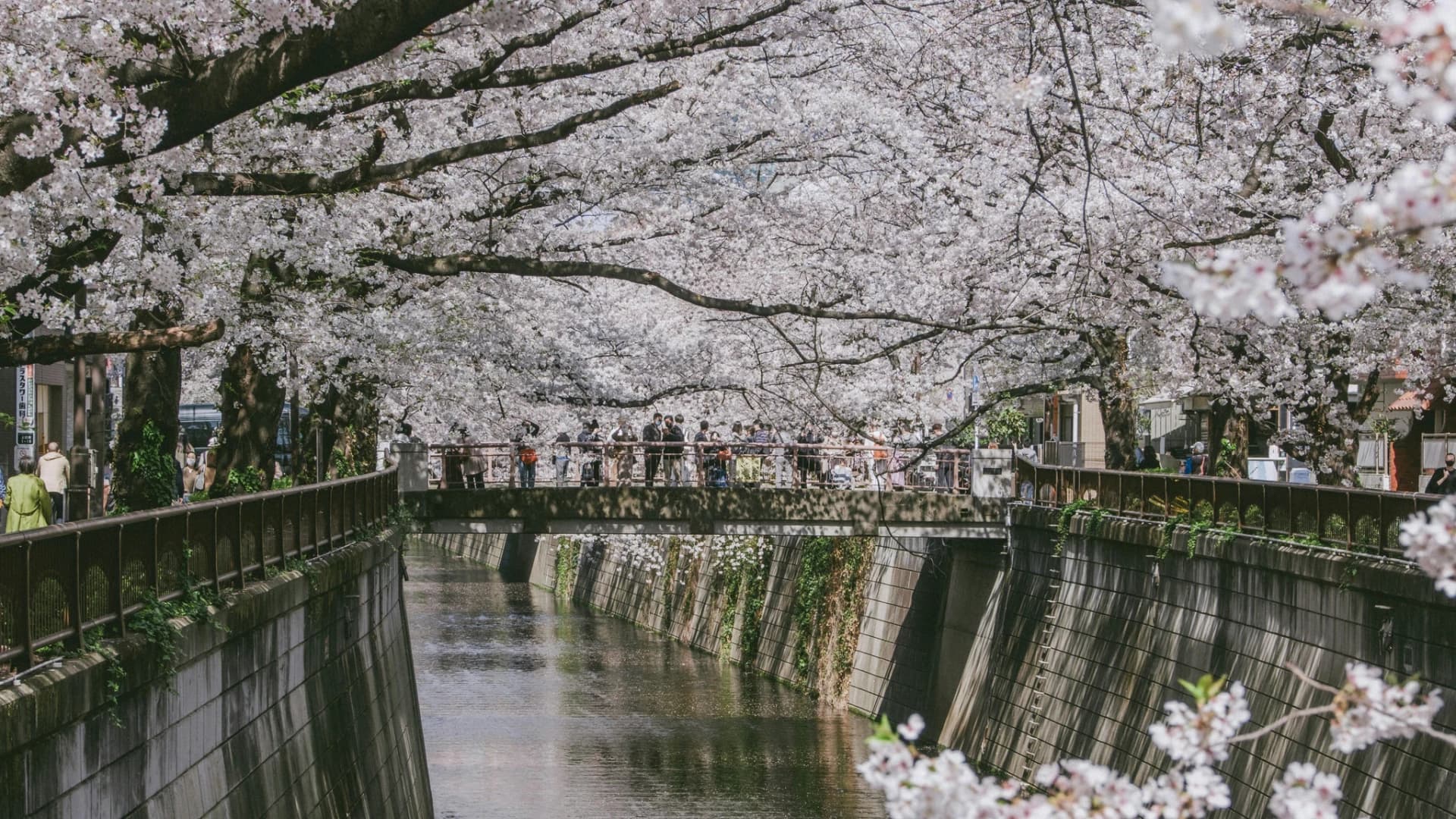
The first cherry trees went in during 1927, planted by local volunteers alongside a river improvement project. Whenever crews worked on the banks, residents planted more. The trees you see today are the third generation, replanted during subsequent revetment projects. There are roughly 800 Somei-Yoshino cherries along about 4 kilometers of the river, from the Ikejiri-Ohashi area downstream past Nakameguro Station.
For decades nobody came to see them, since they were surrounded by factories.
What changed in the 1990s and 2000s
The Tokyu Toyoko Line had connected Nakameguro to Shibuya since 1927, the same year the first cherry trees went in. The Tokyo Metro Hibiya Line came later and made the station a junction: four minutes to Shibuya, twelve to Roppongi, and walking distance to Daikanyama and Ebisu.
The factories and workshops closed. Meanwhile the third-generation cherry trees matured, and by the early 2000s the branches from both banks formed a canopy over the water near Nakameguro Station. Cafes and restaurants moved into the old factory spaces. Going from factory district to destination took roughly twenty years, between the mid-1990s and mid-2010s.
Rents went up with it. A solo apartment in Nakameguro now averages around 130,000 yen per month. A 1LDK regularly exceeds 200,000 yen. One pocket of the neighborhood, Higashiyama, is cheaper, at around 88,000 yen for a small 1R/1K. A 2020 analysis in the International Journal of Japanese Sociology cited Nakameguro as a textbook case of Tokyo gentrification, though the pattern differs from Western cities: rent inflation hit new construction and large apartments hard while older, smaller units stayed relatively flat. Higher prices have mostly priced out would-be newcomers rather than pushing out people already living there, and that demand has moved south toward Yutenji.
A 160-meter, 37-story residential tower is planned for the north side of the station. Marubeni Urban Development and Tokyu Corporation are leading the project, with construction targeted for 2030 and completion around 2033.
Cherry blossom season, honestly
The 800 trees along the river bloom from late March to early April, with branches arching over the water and petals landing on the surface. It looks like the photos. Peak bloom also brings what you've heard about: shoulder-to-shoulder crowds on both riverbanks, single-file foot traffic on the bridges, and view-blocking screens installed by the ward to manage overcrowding.
The Nakameguro Sakura Festival takes up one weekend at peak bloom, with yozakura (evening illumination) lighting the trees after dark and food stalls along the banks.
The section between Funairibashi Bridge and Komazawa Street blooms later than the rest of the river. If you arrive and the crowds near the station are at full density, walk upstream. You'll find the bloom a few days behind and far fewer people.
The rest of the year the same walk is quiet: a green canopy in summer, some color in autumn, bare branches over the water in winter. The river walk takes 30 to 45 minutes at a comfortable pace.
Meguro ward established the "Meguro no Sakura Fund" in 2014 to accept public donations for tree preservation. A regeneration action plan formalized in 2018 guides ongoing maintenance, including soil decompaction and structural pruning. In January 2024, crews treated 314 trees along 1.6 kilometers between Ohashi Bridge and Hinode Bridge, drilling into compacted soil and injecting compressed air and fertilizer. The trees are old and planted close together, and they need that kind of work to stay alive.
Under the tracks: Nakameguro Koukashita
In 2016, the dead space under the Tokyu Toyoko Line and Metro Hibiya Line elevated tracks became Nakameguro Koukashita, a 700-meter commercial strip. The design concept was called "Roof Sharing": individually designed shops sharing the concrete ceiling of the railway above.
The anchor tenant is Nakameguro Tsutaya Books, which opened in November 2016 as a combined bookstore and Starbucks. It goes well beyond a standard bookshop, with lifestyle goods, a lounge, and events. The rest of the 700 meters includes galleries (the development is also known as "Nakame Gallery Street"), the fashion label MHL, interior stores, and restaurants. Y2T Stand serves Portuguese-influenced food. Bars cluster toward the eastern end.
Before 2016 the space under the tracks was unused, just dark concrete pillars and chain-link fencing. The development turned it into a walkable shopping corridor without knocking anything down or pushing out existing shops, which is a big part of why it works.
The specific streets
Most guides tell you to "wander the side streets," which is true and not much help.
The backstreets north of the station hold the shops that define Nakameguro's reputation in design magazines. 1LDK is a boutique laid out like an apartment, with kitchen items where the kitchen would be and bedroom items where the bedroom would be. The shop manager is also the buyer and stocks it on personal taste. Traveler's Factory is in a converted 1950s paper factory and sells leather notebooks made to pick up a patina with use, plus stamps you can only get there and brass accessories. Cow Books sells only vintage books, enforces a no-photography policy, and expects silent browsing. The owner, Yoshiyuki Matsuura, is a known figure in Japanese publishing.
Along and near the river: Onibus Coffee is in a converted building beside the train tracks. Espresso runs around 450 yen. Sidewalk Stand defaults to a double shot and makes bagels with house-cured lox, and has two locations in the neighborhood. Both are small and owner-run, like most of the coffee here.
Seirinkan serves what it calls "Japanese pizza," made with domestic wheat. CNN has covered it. Wagyumafia sells wagyu sandwiches starting around 10,000 yen. City Bakery adapted its NYC pretzel croissant for the Japanese market, and the Nakameguro location has outlasted the original American chain.
Shokaku-ji Temple, established in 1619, is within walking distance. So is Sugekari Park, which is small and unspectacular and full of residents eating lunch.
The Starbucks Reserve Roastery
The Roastery opened in 2019 in a four-story, 32,000-square-foot building designed by Kengo Kuma. It's one of six Starbucks Reserve Roasteries in the world, with a roastery, bakery, tea room, cocktail bar, and merchandise shop inside. Coffee runs 1,000 to 1,500 yen. Cocktails start at 2,000 yen.
Peak wait times during weekends and holidays run 30 minutes to over four hours. The building uses a timed entry system during busy periods. In practice it runs like a tourist attraction that happens to sit in a residential neighborhood.
It's what most visitors come to Nakameguro for, and it tells you the least about the place. Three hours in the Starbucks queue is three hours you aren't spending in the neighborhood. If the building interests you (Kuma's architecture is worth a look), arrive when it opens at 8am on a weekday. Thirty minutes inside is enough.
How to spend a half-day here
Nakameguro is compact, so treat it as a morning or early afternoon stop. Three to four hours covers it.
Start with coffee at Onibus or Sidewalk Stand. Walk the backstreets north of the station: 1LDK, Traveler's Factory, Cow Books. Browse Nakameguro Koukashita from the station eastward. Walk along the river in whichever direction has fewer people. If you want lunch, Seirinkan for pizza or Kirara for something lighter.
The walk to Daikanyama takes about 15 minutes on foot. Daikanyama's T-Site Tsutaya is worth the detour. From there, Ebisu is another 10 minutes, and Ebisu Yokocho runs at a different speed entirely, a retro izakaya alley built for groups and noise. The three neighborhoods form a triangle you can walk in a single afternoon.
The neighborhood feels most like itself on weekday mornings, Tuesday through Thursday. Weekend afternoons bring crowds from across the city. Friday and Saturday evenings are social but packed.
When to skip it
If you have three to four days in Tokyo, Nakameguro is not where you should spend them. Asakusa, Shibuya, Harajuku, and Shinjuku give a first-time visitor more in less time. Nakameguro is for people interested in design, food, or residential Tokyo, and has little for anyone after landmarks or spectacle.
Oddly enough, cherry blossom season is the worst time to see what Nakameguro is really like, because the crowds bury the residential feel that makes it worth the trip. If you want cherry blossoms, other spots in Tokyo offer more space and fewer people.
For five or more days, or for a repeat visit, the neighborhood makes sense as part of the Daikanyama-Nakameguro-Ebisu triangle. Pair it with the areas nearby instead of making a trip just for it.
Where Hinomaru One Fits
A guide in Nakameguro explains what you are looking at. Without context, 1LDK looks like a clothing store, Traveler's Factory like a stationery shop, and Cow Books like a small used bookshop. With it, you see a particular approach to Japanese retail in each: the shop laid out as an apartment, the notebooks designed to age with use, and the house rules that are part of how Cow Books curates.
Ordinary Tokyo (8 hours, from $550 for 2 people) includes Nakameguro as part of a residential Tokyo day, alongside other neighborhoods that show how people in the city actually live.
Infinite Tokyo (8 hours, from $550 for 2 people) is fully customizable. You can build a half-day around the Daikanyama-Nakameguro-Ebisu triangle with a guide who knows which backstreet shops are worth your time and which river section blooms late.
At Hinomaru One, we plan private Tokyo tours for first-time and seasoned travelers, at an unhurried pace, with plenty of context, and built around what you want to see.
Frequently asked questions
Is Nakameguro worth visiting?
It depends on your interests and schedule. If you're into design, food, and residential Tokyo, yes, as a half-day with Daikanyama and Ebisu. On a first trip of three to four days, probably not, since other neighborhoods pack more in.
How do I get to Nakameguro?
Nakameguro Station is served by the Tokyu Toyoko Line and Tokyo Metro Hibiya Line. From Shibuya, it is one stop (four minutes) on the Toyoko Line. From Roppongi, take the Hibiya Line directly.
When is cherry blossom season at Meguro River?
From late March to early April, usually peaking in the last week of March or first days of April. Check the Japan Meteorological Corporation forecast closer to your trip. Expect heavy crowds during peak bloom, especially on weekends.
What should I do in Nakameguro besides cherry blossoms?
Walk the backstreets north of the station for design-focused retail (1LDK, Traveler's Factory, Cow Books). Browse Nakameguro Koukashita under the tracks. Have coffee at Onibus or Sidewalk Stand. Walk to Daikanyama (15 min) or Ebisu (25 min) to extend the day.
How long should I spend in Nakameguro?
Three to four hours covers the main streets, shops, river walk, and a meal. Allow less if you're passing through and more if you want to sit in cafes.