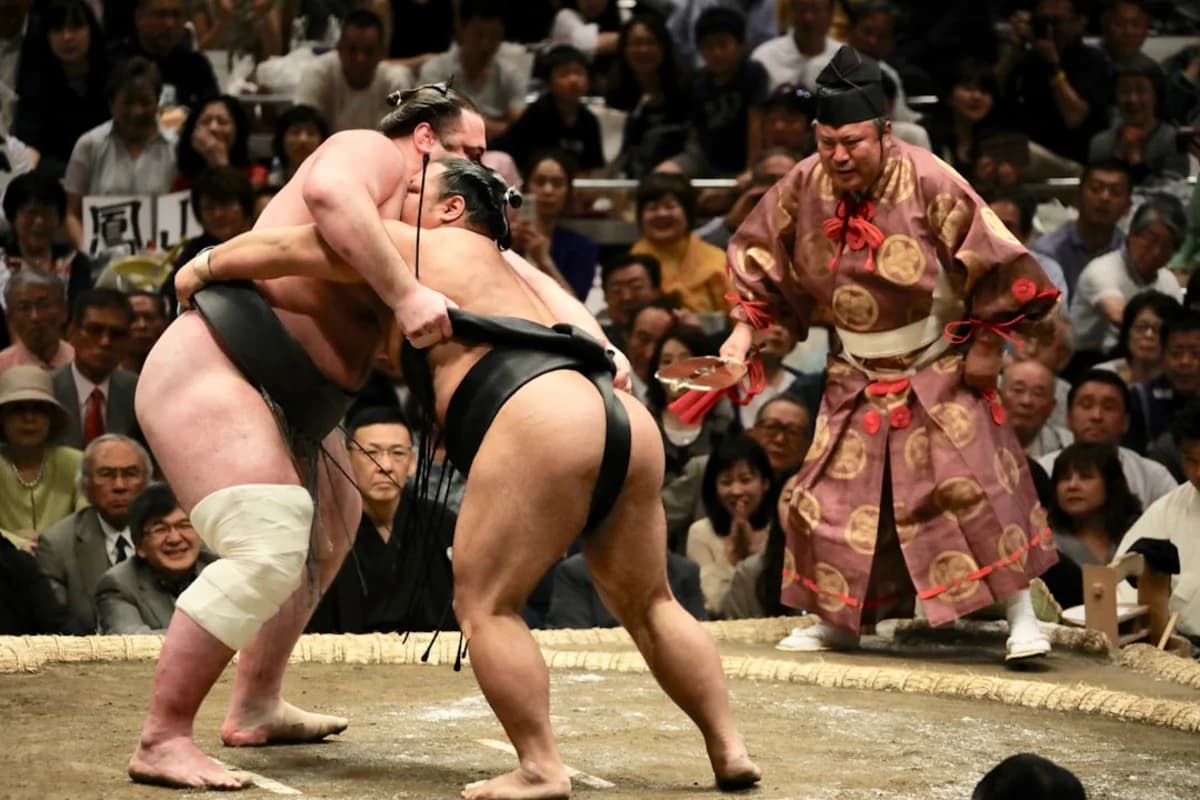
Most people come to Ryogoku for sumo. They want to see the Kokugikan, eat chanko nabe, maybe spot a wrestler on the street. That's a fine reason to visit. But Ryogoku is more than its headline attraction, and the neighborhood rewards people who stay past the obvious.
Ryogoku sits in Sumida Ward on the east bank of the Sumida River, directly across from central Tokyo. The name means "both countries" and dates back to when the Sumida River marked the boundary between Musashi Province and Shimosa Province. The Ryogoku Bridge, first built in 1659 after the devastating Meireki Fire killed over 100,000 people, connected the two sides and opened up the eastern bank for settlement. That bridge turned Ryogoku into one of Edo's major entertainment districts.
This is a shitamachi neighborhood in the truest sense. Low buildings, narrow streets, small shops run by the same families for decades. The pace is slower here than anywhere on the west side of Tokyo. There are no department stores, no fashion brands, no crowds pushing through scramble crossings. What there is: a 400-year relationship with sumo, temples that predate the modern city, and restaurants where retired wrestlers serve the same food they ate during training.
If you're visiting Monzen-Nakacho for its standing bars and izakayas, Ryogoku is five minutes north on the Oedo Line and a natural extension. If you're spending time in Asakusa, it's one stop on the JR Sobu Line. The neighborhood fits into an east Tokyo day without adding friction.
Sumo and Ryogoku: 400 Years of History
Sumo's connection to Ryogoku goes back to the early Edo period. The sport existed before that, but it was in this part of Edo that professional sumo found its permanent home.
The story starts at Eko-in (回向院), a Buddhist temple founded in 1657 to memorialize the victims of the Meireki Fire. By the late 1700s, the temple grounds had become the regular venue for kanjin-zumo, the officially sanctioned professional sumo tournaments. For roughly 150 years, from the late Edo period through to 1909, Eko-in was where sumo happened in Tokyo. The sport's rituals, rankings, and public culture all developed with Ryogoku as the backdrop.
The first permanent Kokugikan arena was built in Ryogoku in 1909, replacing the outdoor tournaments at Eko-in. It burned down, was rebuilt, and eventually the current Kokugikan opened in 1985 at its present location next to JR Ryogoku Station. The arena has been the home of Tokyo sumo ever since.
This history matters because it explains why Ryogoku isn't just "a place with a sumo arena." The entire neighborhood grew up around the sport. The stables are here because wrestlers have always trained here. The chanko restaurants exist because retired wrestlers opened them here. The culture is embedded in the streets, not confined to a building.
Professional sumo's connection to Monzen-Nakacho also runs deep. Tomioka Hachimangu in Monzen-Nakacho is where the Tokugawa shogunate first authorized professional sumo tournaments in 1684, making it the birthplace of organized sumo in Edo. Ryogoku inherited that tradition and built a permanent home for it.
The Three Tokyo Basho
The Kokugikan hosts three of sumo's six annual tournaments (called basho or honbasho). Tokyo's tournaments run in January (Hatsu Basho), May (Natsu Basho), and September (Aki Basho). Each tournament lasts 15 days, with bouts starting in the morning for lower-ranked wrestlers and building to the top-division matches in the late afternoon.
Getting tickets: Tickets go on sale roughly one month before each tournament through Ticket Ohzumo (チケット大相撲), operated by Pia at sumo.pia.jp. Popular seat categories sell out quickly, especially for weekend days and the final day (senshuraku). For a full breakdown of ticket types, pricing, timing, and what to expect hour by hour, see our guide to watching live sumo in Tokyo.
Seat types and prices:
- Tamari-seki (溜席): Ringside floor cushions closest to the action. The most expensive and hardest to get.
- Masu-seki (マス席): Traditional box seats on the first floor, each fitting 4 people in a small partitioned square. These are the traditional sumo-watching experience.
- Isu-seki (イス席): Individual chair seats on the second floor. More affordable and still a good view.
- Jiyuu-seki (自由席): Unreserved seats in the back rows of the second floor. Sold at the arena on the day of the tournament starting at 8:00 AM. Adults ¥2,200, children (4-15) ¥200. This is the budget option, but you need to arrive early and be prepared to watch the lower-division bouts.
The Japan Sumo Association Fan Club offers advance lottery access for members, which can help with popular dates. Some tea houses (sumo chaya) near the Kokugikan also sell package deals that include tickets, bento boxes, and souvenirs, though these come at a premium.
What to expect: A tournament day at the Kokugikan is an all-day event if you want it to be. Doors open around 8:00-8:45 AM depending on the day, and the top-division bouts start around 3:30-4:00 PM. Most casual visitors arrive in the early afternoon to catch the upper-ranked wrestlers. The atmosphere builds as the day progresses, reaching peak intensity for the final bouts around 5:30-6:00 PM.
Kokugikan: The Arena Itself
The current Kokugikan opened in January 1985 and seats about 11,000 spectators. Its green-roofed silhouette is visible from JR Ryogoku Station's west exit, about a one-minute walk. The building is functional rather than beautiful on the outside, but inside, the steep bowl design means every seat has a clear sightline to the dohyo (ring).
Outside tournament season: The Kokugikan doesn't go dormant between basho. The building hosts other events including boxing matches and concerts. The Sumo Museum (相撲博物館) inside the arena is open on weekdays during non-tournament periods (free admission, 10:00 AM-4:30 PM). The museum displays rotating exhibitions of sumo-related artifacts: woodblock prints, ceremonial aprons (kesho-mawashi), historical photographs, and handprints of past champions. It's small but well-curated.
During tournament periods, the Sumo Museum is accessible only to ticket holders. Its exhibitions change several times per year, so repeat visitors see different material.
The yakitori: The Kokugikan is quietly famous among locals for its yakitori. The arena has its own yakitori factory in the basement, and the chicken skewers sold during events are considered some of the best value yakitori in Tokyo. You can also buy them boxed at the arena shop outside tournament season. This is not a tourist gimmick. The yakitori operation has been running since the arena opened, and the quality holds up against dedicated yakitori restaurants.
Sumo Stables: What to Know Before You Go
Ryogoku and its surrounding streets have the highest concentration of sumo stables (heya) in Tokyo. There are roughly 40-plus active stables across the sport, and a significant number are clustered in Sumida Ward and neighboring areas.
A sumo stable is where wrestlers live, train, eat, and sleep. It's not a gym you can drop into. These are working training facilities and communal homes where hierarchy governs everything from who eats first to who cleans the toilets.
Morning practice (asa-geiko): The most accessible way to see sumo training up close. Practice typically runs from around 7:00-10:00 AM. Wrestlers train in the keiko-ba (practice ring) inside the stable, and a handful of stables allow outside visitors to observe.
How access actually works:
This is where most travel guides oversimplify things. The reality: most stables do not accept walk-in visitors. Access requires advance contact, usually in Japanese, and most stables limit observation to specific days or by introduction.
A few stables are known for being more accessible:
-
Arashio-beya (荒汐部屋): Located in Nihonbashi-Hamacho (not in Ryogoku proper, but nearby). This stable has glass windows along the street, allowing passersby to watch morning practice from outside without entering the stable. It's the easiest way to see training without any arrangement. The stable's website (arashio.net) has viewing guidelines.
-
Tokitsukaze-beya (時津風部屋): Has accepted walk-in observers on a limited capacity basis. Check current status before going.
For other stables, the standard approach is to contact the stable directly (in Japanese) or go through a tour operator who has an existing relationship. Some hotels in the area offer package stays that include arranged stable visits. The Hotel New Otani, for example, has offered sumo morning practice packages.
Rules if you do get access:
- Arrive on time and sit quietly in the designated area
- No talking, no phones ringing, no flash photography
- Don't eat or drink in the practice area
- Bow when entering and leaving
- Follow any instructions from stable staff immediately
- Leave when practice ends; don't linger
When practice doesn't happen: Stables do not hold practice during tournament periods (wrestlers compete instead). Practice is also lighter or suspended during breaks between tournaments. The best time to observe is in the weeks leading up to a tournament, when training intensity peaks.
For visitors who want the sumo training experience but can't arrange stable access, some tour operators offer organized morning practice viewing tours that handle the logistics and Japanese-language communication. Our Timeless Tokyo experience can incorporate sumo culture elements into a full-day traditional Tokyo itinerary.
Edo-Tokyo Museum
The Edo-Tokyo Museum (江戸東京博物館) has been closed for major renovation since April 2022. The museum is scheduled to reopen on March 31, 2026, after roughly four years of work.
Before closing, the museum was one of Ryogoku's biggest draws. The building itself is striking: a massive elevated structure designed by architect Kiyonori Kikutake, raised on pillars to echo the form of an old Edo-period warehouse. Inside, the museum covers the history of Tokyo from its founding as Edo in 1590 through the modern era, using a mix of full-scale replicas, models, and original artifacts.
The permanent exhibition included a life-size replica of the Nihonbashi bridge, scale models of Edo-period townhouses, recreations of Meiji-era buildings, and exhibits on the 1923 Great Kanto Earthquake and the 1945 firebombing. The museum was particularly strong at showing how ordinary people lived across different periods, not just the grand political narrative.
What the renovation means: The museum closed in April 2022 for large-scale facility renewal. A countdown site (madakana-edohaku.jp) tracked the renovation progress, and in late 2025 the Tokyo Metropolitan Government held events marking the 100-day countdown to reopening. The reopening is set for March 31, 2026.
If you're visiting Ryogoku after late March 2026, the museum should be open again and worth several hours. If you're visiting before that date, it's closed and there's nothing to see from the outside that justifies a detour. The museum's outreach program ran temporary exhibitions at other venues during the closure, so check the official site (edo-tokyo-museum.or.jp) for any satellite exhibitions.
Nearby alternative: The Sumida Hokusai Museum, a few minutes' walk from the Kokugikan, is dedicated to the ukiyo-e artist Katsushika Hokusai, who was born in the Ryogoku area. It's small but focused, and the building by architect Kazuyo Sejima is worth seeing on its own. Open year-round (closed Mondays).
Chanko Nabe: The Wrestler's Hot Pot
Chanko nabe is Ryogoku's signature food, and the connection to sumo is direct. Chanko is what sumo wrestlers eat during training: a large communal hot pot packed with protein, vegetables, and broth, designed to build weight efficiently. The junior-ranked wrestlers cook it for the senior wrestlers, and the recipes pass down through each stable's tradition.
When wrestlers retire, many open chanko restaurants. Ryogoku has the highest concentration of these restaurants in Japan. Each one serves a slightly different version based on which stable the owner came from, so you're not just eating a generic hot pot. You're eating a specific stable's training food.
What's in it: The base is typically chicken broth (chicken is considered lucky in sumo because chickens stand on two legs, like a wrestler who hasn't been thrown down). Ingredients vary but usually include chicken, tofu, vegetables (Chinese cabbage, mushrooms, carrots, green onions), and sometimes fish or meatballs. It's hearty, warming, and designed to be eaten in large quantities.
Where to eat it:
-
Chanko Kirishima (ちゃんこ霧島): Run by former wrestler Kirishima (later stablemaster of Michinoku-beya). One of the most well-known chanko restaurants in Ryogoku. Multiple sources confirm it as a top recommendation. Expect to pay around ¥3,000-5,000 per person for a full chanko course.
-
Kawasaki (ちゃんこ川﨑): One of the oldest chanko restaurants in the area, with decades of history. Known for a traditional, less-touristy atmosphere. Multiple Japanese food guides list it among the essential Ryogoku chanko shops.
-
Chanko Tomoegata (ちゃんこ巴潟): Another long-established restaurant with strong ties to the sumo world. Frequently appears on recommended lists across Japanese dining sites.
Most chanko restaurants serve lunch sets at lower prices than dinner courses. Lunch is also less crowded. During tournament season (January, May, September), expect longer waits at the popular spots, especially in the evening after bouts end.
A note for solo travelers: Chanko nabe is traditionally communal, served in a large pot for sharing. Some restaurants offer individual-sized portions or lunch sets for solo diners, but it's worth asking when booking or arriving.
The Neighborhood Beyond Sumo
Ryogoku's sumo identity is earned, but the neighborhood has layers that predate the sport and exist independent of it.
Eko-in Temple
Eko-in (回向院) deserves more than a footnote in the sumo section. Founded in 1657 to memorialize the 100,000-plus victims of the Meireki Fire, it became one of Edo's most important temples. The temple operated on a principle of universal memorial: it accepted prayers for all beings, not just humans. This was unusual for the time.
Beyond its sumo history (hosting professional tournaments for 150 years), Eko-in became a gathering place for Edo's entertainment culture. The temple grounds hosted misemono (sideshow exhibitions), performances, and seasonal festivals. The famous grave of Nezumi Kozo, a Robin Hood-like thief from the Edo period, is here. Visitors still chip pieces from the gravestone as good-luck charms, and the stone has been replaced multiple times over the centuries.
Eko-in is a five-minute walk south of JR Ryogoku Station. It's free to enter and usually quiet.
The Sumida River
Ryogoku's western edge runs along the Sumida River, and the riverside walkway offers one of the better urban walks in east Tokyo. The Ryogoku Bridge provides views upstream toward the Tokyo Skytree and downstream toward the river's bend.
The Sumida River has deep historical significance for this area. In the Edo period, Ryogoku Bridge was one of the main gathering points for the annual Kawabiraki (river opening) festival, which included fireworks displays. This tradition evolved into what is now the Sumida River Fireworks Festival (隅田川花火大会), held in late July and one of Tokyo's largest summer events.
The Ryogoku Fireworks Museum (両国花火資料館), a small free museum near the river, documents the history of fireworks in the area. It's tiny and only takes about 20 minutes, but it connects Ryogoku's river culture to a tradition that stretches back centuries.
Kyu-Yasuda Garden
Kyu-Yasuda Garden (旧安田庭園) sits directly behind the Kokugikan and is one of Tokyo's less-visited traditional gardens. Originally built in the Edo period as a daimyo garden, it features a tidal pond that once rose and fell with the Sumida River's tides (it now uses a pump system). The garden is small enough to walk through in 15-20 minutes but well-maintained and genuinely peaceful.
Free admission, open daily. It's a good palate cleanser between the Kokugikan and whatever else you're doing in the area.
Shitamachi Streets
The streets between the main attractions hold the real shitamachi character. Small ramen shops, family-run senbei (rice cracker) stores, and local izakayas line the back streets. Yokoami-cho and the areas south of the station toward Eko-in have the most atmosphere.
The Yokozuna Dori (横綱通り) shopping street near the station has a mix of tourist-facing chanko restaurants and genuinely local businesses. Look for the wrestler handprint displays embedded in the sidewalk along the main streets. They're easy to miss but everywhere once you start noticing.
Getting There and Combining Areas
Train access:
- JR Sobu Line: Ryogoku Station. One stop from Akihabara (3 minutes), two stops from Asakusa-bashi. This is the most convenient line for most visitors.
- Toei Oedo Line: Ryogoku Station (E-12). Direct connections to Monzen-Nakacho (5 minutes), Tsukishima, Roppongi, and Shinjuku.
The JR station's west exit puts you directly next to the Kokugikan. The Oedo Line station exit is a few minutes' walk east.
Combining with other neighborhoods:
Ryogoku + Monzen-Nakacho: The strongest combination. Five minutes on the Oedo Line. Spend the morning on sumo culture in Ryogoku, then head south for afternoon drinks and dinner in Monnaka's standing bars and izakayas. The shitamachi thread connects both neighborhoods naturally.
Ryogoku + Asakusa: The JR Sobu Line connects Ryogoku to Asakusa-bashi, from which Asakusa is a short walk or one subway stop. Alternatively, walking along the Sumida River from Ryogoku to Asakusa takes about 25-30 minutes and is genuinely pleasant. This combination works for a full east-Tokyo day focused on history and traditional culture.
Ryogoku + Akihabara: Three minutes on the JR Sobu Line. This is more of a transit convenience than a thematic pairing, but it means you can combine the two areas without wasted time if your interests span sumo and electronics.
How much time to spend: During a tournament, a full day. You can arrive for the late-morning bouts, eat chanko for lunch, watch the top-division matches, and still have time for Eko-in and a river walk. Outside tournament season, half a day is enough to cover the Sumo Museum, Eko-in, the Edo-Tokyo Museum (when open), chanko lunch, and a neighborhood walk. Add the other half to Monzen-Nakacho or Asakusa.
Tournament season planning: If visiting during January, May, or September, buy Kokugikan tickets as soon as they go on sale (about one month before the tournament starts). Check sumo.pia.jp for exact sale dates. Day-of jiyuu-seki tickets are available but require very early arrival. Plan your chanko dinner for a weeknight if possible to avoid the post-bout rush at popular restaurants.
For visitors interested in experiencing Ryogoku's sumo culture and east Tokyo's traditional side with context and access that's hard to arrange independently, our Timeless Tokyo guided experience covers the cultural foundations that make neighborhoods like Ryogoku meaningful.
Ryogoku rewards the curious. Come for the sumo, stay for the shitamachi streets, the temple history, and the hot pot. It's one of the few Tokyo neighborhoods that hasn't been smoothed over by development, and that's exactly what makes it worth visiting.