Shin-Okubo is not a performance of Koreatown. It's a real neighborhood where people live and work and eat Korean food. The interesting question is what happened to it.
The story of Shin-Okubo's Koreatown is a 20-year arc that most English-language guides compress into a single enthusiastic sentence: lively, K-pop, Korean food. The fuller version goes through a World Cup, a TV drama, a political crisis, and a slow contraction. That fuller version is more useful, because it explains what you're actually walking into.
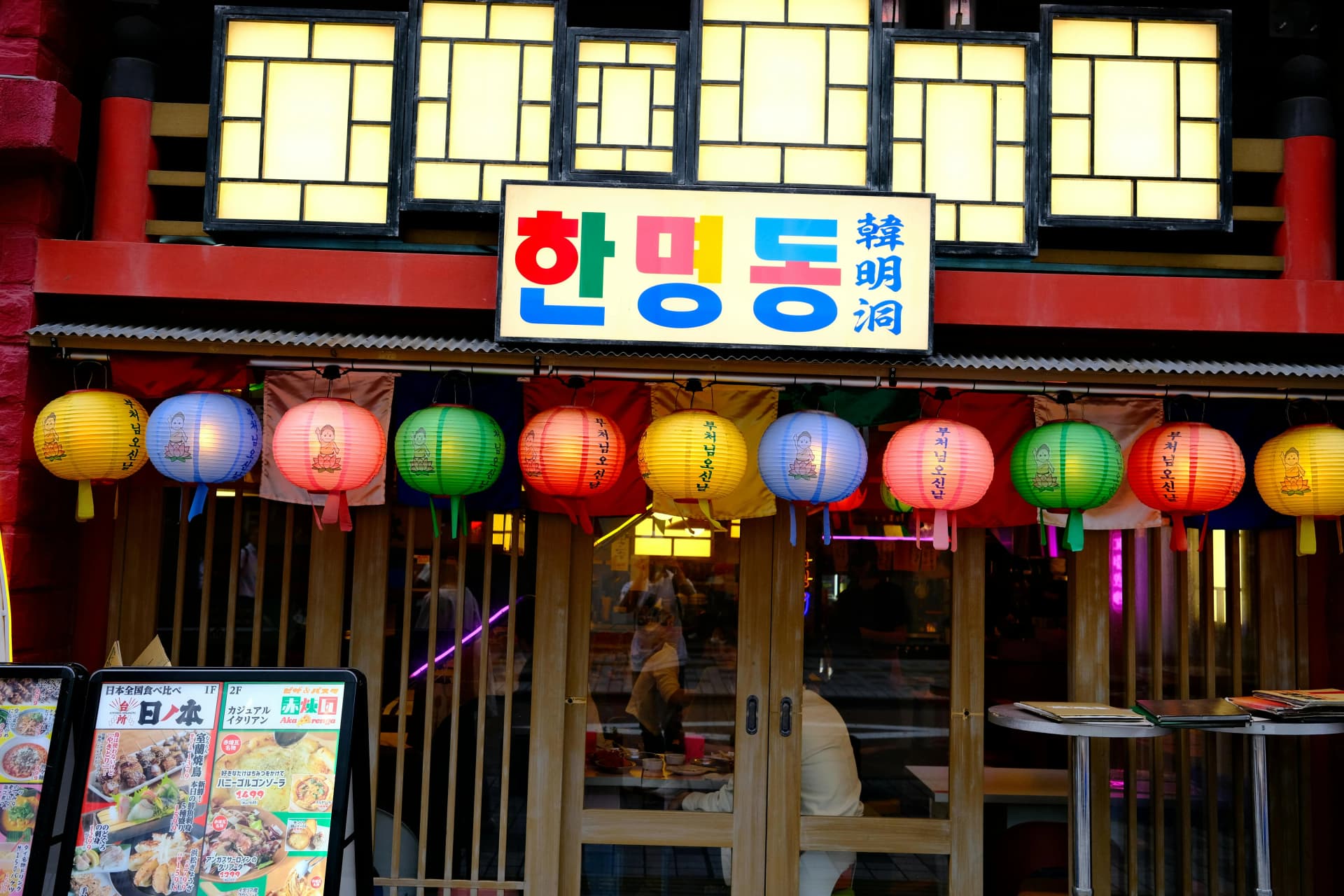
Shin-Okubo sits between JR Shin-Okubo Station and JR Okubo Station on the Yamanote/Sobu lines, adjacent to Shinjuku. The area between the two stations — specifically the block defined by Shokuan-dori (職安通り) and the street running toward the station that locals call Ikemen-dori (イケメン通り) — is the Koreatown core. This geography is not obvious when you're walking it; the station signage doesn't prepare you, and the transition from regular Shinjuku into the Korean commercial zone is gradual enough that you may have been in it for three minutes before you register the shift. You notice the Korean script on restaurant signs first, then the cosmetics shops with their displays of sheet masks and serums stacked floor to ceiling, then the smell of grilling meat pulling through an open door.
Before the K-Wave
The Korean community in the Okubo area did not begin with K-pop. It predates the entertainment boom by decades. The roots are in the Zainichi Korean population — ethnic Koreans who came to Japan during the colonial period (1910–1945), many as forced laborers, and their descendants who remained after the war. By the postwar period, Okubo had become one of several areas in Tokyo with a concentrated Korean residential presence, alongside parts of Arakawa and southern Shinjuku.
This community was not a commercial district in any tourist-facing sense. It was a residential and small-business community: Korean-language churches, small grocery shops selling kimchi and doenjang, a handful of restaurants that served Korean food to Korean customers. The area around what is now Shin-Okubo Station had Korean barbecue restaurants operating through the 1970s and 1980s — businesses that predated the concept of "Koreatown" as a destination by a generation. The Korean restaurant Embassy (大使館), which sat beneath the JR tracks, was one of the anchors of this older community.
The Zainichi population in the broader Okubo area was never exclusively Korean. The neighborhood's proximity to Shinjuku — with its concentration of jobs in entertainment, construction, and service industries — made it a landing zone for successive waves of immigration from across Asia. But the Korean community was the earliest and most established, and the infrastructure it built — the churches, the grocers, the restaurants — became the scaffold that the later commercial Koreatown would build on.
How It Grew
The Koreatown as a recognizable commercial entity has existed for approximately 20 years, with its most intense period of growth running from roughly 2002 to 2012. The 2002 Japan-Korea co-hosted FIFA World Cup was the first catalyst — the Korean community in Tokyo gathered in Shin-Okubo to watch the Korean national team's matches, and the energy of those match-viewing crowds drew attention to the area as a Korean commercial zone. Japanese media covered the gatherings. Non-Korean Tokyoites came to see what the excitement was about, discovered the restaurants, and came back.
The second and larger catalyst was the Korean drama Winter Sonata (冬のソナタ), which aired in Japan in 2004 and triggered what became known as the 韓流ブーム — the Korean Wave boom. The drama's popularity in Japan was disproportionate to what it received in Western markets — a specific Japanese demographic, primarily women in their 30s and 40s, became intensely engaged with Korean pop culture during this period, and Shin-Okubo's Korean restaurants, cosmetics shops, and entertainment venues expanded to serve them. By the mid-2000s, the area had developed a self-reinforcing identity as Tokyo's Koreatown. New shops opened monthly. Korean-language signage that had been discreet became prominent. The 韓流 label — previously a niche term — entered mainstream Japanese vocabulary.
At peak, around 2012, Shin-Okubo had approximately 500 Korean-related shops operating in the area between the two stations. This was the high-water mark.
What Happened in 2012
In the summer of 2012, when the Korean president Lee Myung-bak visited the disputed islands (known as Dokdo in Korea, Takeshima in Japan), the political response in Japan included a significant increase in anti-Korean demonstrations. These demonstrations took place in Shin-Okubo itself — organized by groups whose names and positions on Korean residents are a matter of documented public record. Marches came through the commercial streets. Amplified speeches targeted Korean business owners by name. The demonstrations caused measurable harm to the Korean business community: according to the Shinjuku Korean Business Association, sales at many Korean shops fell by half during this period, and multiple restaurants and retail shops closed.
The political temperature has since lowered. One significant development was the passage of Japan's Hate Speech Act (ヘイトスピーチ解消法) in 2016, which — while lacking criminal penalties — formally recognized hate speech against ethnic minorities as unacceptable and gave local governments a framework to deny permits for discriminatory demonstrations. Kawasaki, another city with a significant Zainichi population, went further with its own ordinance including penalties. The organized street demonstrations that characterized the 2012–2015 period have largely stopped in Shin-Okubo, though the community's memory of them has not.
The peak has not returned.
What It Is Now
Walking into Shin-Okubo from the station in 2026, you step into a street that announces itself through competing sensory inputs. Hangul script on every storefront, sometimes larger than the Japanese below it. K-pop playing from open shop doors — not one song but several, overlapping from adjacent businesses. Glass display cases of Korean cosmetics brands with packaging in pastel pinks and mint greens. Claw machines stocked with K-pop idol photo cards. The smell of sesame oil and grilling pork from the restaurant basements. On weekend afternoons, the sidewalks are tight with foot traffic — groups of teenagers in K-pop merchandise, older Korean women carrying grocery bags, tourists consulting their phones.
The Koreatown that remains is more coherent and more working-class than the K-wave peak, but smaller. The Korean restaurants that survive include the long-established samgyeopsal specialists that built the area's reputation — Tonchang (とんちゃん) is among the oldest, credited with helping establish the pork belly restaurant format in Tokyo's Koreatown.
Samgyeopsal — thick-cut pork belly grilled at the table — is the format the area is best known for. The experience has a specific rhythm: you order the meat by weight, the server brings it raw on a plate along with a portable gas grill or charcoal brazier. You grill the slices yourself, cutting them with scissors as the fat renders. Meanwhile the banchan arrive — small dishes of kimchi, pickled radish, raw garlic cloves, sliced green chili peppers, ssamjang (a thick fermented paste). When the meat is done, you take a lettuce leaf, lay in a slice of pork, add a smear of ssamjang, a sliver of garlic, a piece of kimchi, and fold it into a bundle you eat in one bite. The Korean version differs from Japanese yakiniku in that the accompaniments are more varied, the flavors more aggressive, and the result messier and more communal. The banchan at the better Shin-Okubo places are replenished without asking — a Korean service norm that Japanese yakiniku shops do not follow.
Korean fried chicken has a specific technique that produces a genuinely superior product: brined, double-fried at different temperatures, then sauced while the exterior is still hot enough to absorb flavor without going soggy. The skin ends up shatteringly crispy without being dry inside. The yangnyeom (sweet-spicy) and ganjang (soy garlic) variations are both worth trying. The best places in Shin-Okubo make this for a Korean clientele that knows what good Korean fried chicken should be, which means the standard is honest. Expect to wait on weekends — the popular spots turn out birds at capacity.
Tteokbokki — chewy rice cakes in a sweet-spicy gochujang sauce — is the other street-level staple. Several shops along the main street sell it from open-front counters, sometimes alongside odeng (fish cake skewers in a light broth). These are standing-and-eating operations: you pay, you get a paper cup or a shallow tray, you eat it in the street or at a narrow counter. The quality varies, but the format is the authentic Korean street food experience, not a performance of it.
Chikinam (치킨남) — Korean BBQ hot pot — has appeared in the area over the past decade. The version involving cooking marinated chicken in a sweet-spicy sauce at the table, then eating it with rice and kimchi, is filling and distinctive. It sits somewhere between the barbecue format and a stew, and it works particularly well in winter.
The street food element that survives best is hotteok (호떡) — the sweet Korean pancake filled with brown sugar, cinnamon, and nuts — sold from stands in the evening along the main approach to Shin-Okubo Station. This is a genuine street food made for people taking it home or eating it walking, not for people who want to photograph it. You will smell it before you see the stand.
The International Layer
The cosmetics and K-pop merchandise shops that expanded during the K-wave have contracted from their peak. What has filled some of that space — and this is an important development for understanding the area in 2026 — is a broader international food scene that reflects the actual demographics of the Okubo neighborhood.
Walk two blocks off the main Korean strip and you find Nepali restaurants serving dal bhat on steel thali plates. Vietnamese pho shops with menus in Vietnamese and Japanese, no English. Thai restaurants that are not the sanitized-for-Japanese-palates version but the version where you specify your spice level and they believe you. A halal grocery store serving the area's growing Muslim population. Chinese restaurants — not the old-guard Yokohama Chinatown style but newer mainland Chinese operations serving Sichuan and Hunan food with a heat level that would clear a Japanese izakaya.
This is not gentrification or dilution. It is the natural evolution of an international corridor in a city that is slowly, unevenly becoming more cosmopolitan. The Korean businesses remain the dominant commercial presence. But the side streets tell you that Shin-Okubo in 2026 is less "Tokyo's Koreatown" and more "Tokyo's most concentrated international neighborhood." The Korean identity is the anchor, but the neighborhood has absorbed its neighbors' cuisines and communities in a way that makes it more interesting, not less.
The K-Pop Element
The K-pop element has not disappeared. The karaoke parlors (KTV) that serve the Korean community are still operating, and on weekend evenings the area around the station has a younger, more explicitly K-pop-oriented crowd. Shops selling official and unofficial idol merchandise — photo cards, lightsticks, albums — cluster near the station entrance. You will see groups of teenagers sorting through photo card binders with the intensity of stock traders.
But the mass-market K-wave tourism that some English-language guides still describe — queues outside Korean cosmetics shops, bus tours pulling up to Ikemen-dori — is from a period that has passed. The K-pop shops serve a committed fandom, not a casual tourist market. The distinction matters because it changes what you should expect: this is not Harajuku-style spectacle. It is people buying specific things they came to buy.
How to Get There
Shin-Okubo Station is on the JR Yamanote Line — the same loop line that connects Tokyo, Shibuya, Shinjuku, Ikebukuro, and Ueno. From Shinjuku, it is one stop northbound, about two minutes. From Tokyo Station, it is roughly 20 minutes on the Yamanote Line without transferring. The Sobu Line also stops at Okubo Station, which is a five-minute walk from the Koreatown core and often less crowded.
The practical consideration is that Shin-Okubo is immediately adjacent to Shinjuku, and combining the two is natural. An evening in Shin-Okubo for dinner — samgyeopsal, Korean fried chicken, or one of the newer Southeast Asian options — fits easily before or after whatever you're doing in Shinjuku. The walk from Shinjuku Station's east exit takes you through regular Shinjuku office and commercial streets before you reach the area where Korean signage becomes visible. The transition takes about eight minutes on foot and is unremarkable — there is no arch, no gate, no announcement. The neighborhood simply starts.
If you are using a Suica or Pasmo IC card, you can tap in and out at Shin-Okubo with no planning required. If you hold a JR Pass, the Yamanote Line is covered. There is no subway station in Shin-Okubo itself — it is JR only.
Frequently Asked Questions
Is Shin-Okubo safe to visit? Yes — it is a residential and commercial neighborhood in Shinjuku Ward. The political demonstrations that affected the area in 2012–2015 are not a current feature. The 2016 Hate Speech Act and subsequent local ordinances have reduced organized anti-Korean activity. The area is active in the evenings and on weekends, with a mixed Korean, Japanese, and international local clientele.
Is it worth visiting if I'm not into K-pop? Yes — the Korean food in Shin-Okubo is some of the most authentic Korean food in Tokyo, and the best of it predates the K-wave entirely. The samgyeopsal places and the Korean fried chicken places are genuinely good and worth knowing about on their own terms, independent of pop culture. The newer international food options — Nepali, Vietnamese, Thai — add further reason to visit for food alone.
What's the best time to go? Evenings from 6pm give you the clearest picture of the area as a functioning neighborhood eating and drinking district. The weekend daytime has a younger K-pop-oriented crowd and tighter sidewalks. Weekday afternoons are quieter and better for the food without the tourism overlay. If you want hotteok from the street stands, go in the evening — the stands operate from late afternoon.
Can I combine Shin-Okubo with Shinjuku? Easily, and most people should. Shin-Okubo is an eight-minute walk from Shinjuku Station's east exit, or one stop on the Yamanote Line. A natural pattern is dinner in Shin-Okubo followed by drinks or exploration in Shinjuku, or vice versa. The Golden Gai bar district and Kabukicho are both within walking distance.
What should I buy in Shin-Okubo? Korean cosmetics — sheet masks, serums, sunscreen — are the area's strongest retail category and are priced lower than at department stores. Korean grocery items (gochujang, dried seaweed, instant tteokbokki kits) make good edible souvenirs if you have luggage space. The K-pop merchandise shops are worthwhile if you know what you're looking for, but browsing without a specific target is less rewarding than the food.
How does Shin-Okubo compare to other ethnic neighborhoods in Tokyo? It is the largest and most established ethnic commercial district in Tokyo. The nearest comparable is the newer Chinatown in Ikebukuro's north exit. The contrast is that Shin-Okubo is a community that grew organically over decades from a residential base, while Ikebukuro's Chinatown is more recent and more explicitly commercial. Both are worth knowing about for different reasons.
At Hinomaru One, we build private Tokyo days around the city's actual ethnic and cultural geography — including the neighborhoods that aren't on the tourist maps. Ordinary Tokyo covers Shin-Okubo and the surrounding Shinjuku area as part of understanding how Tokyo's international communities actually live.