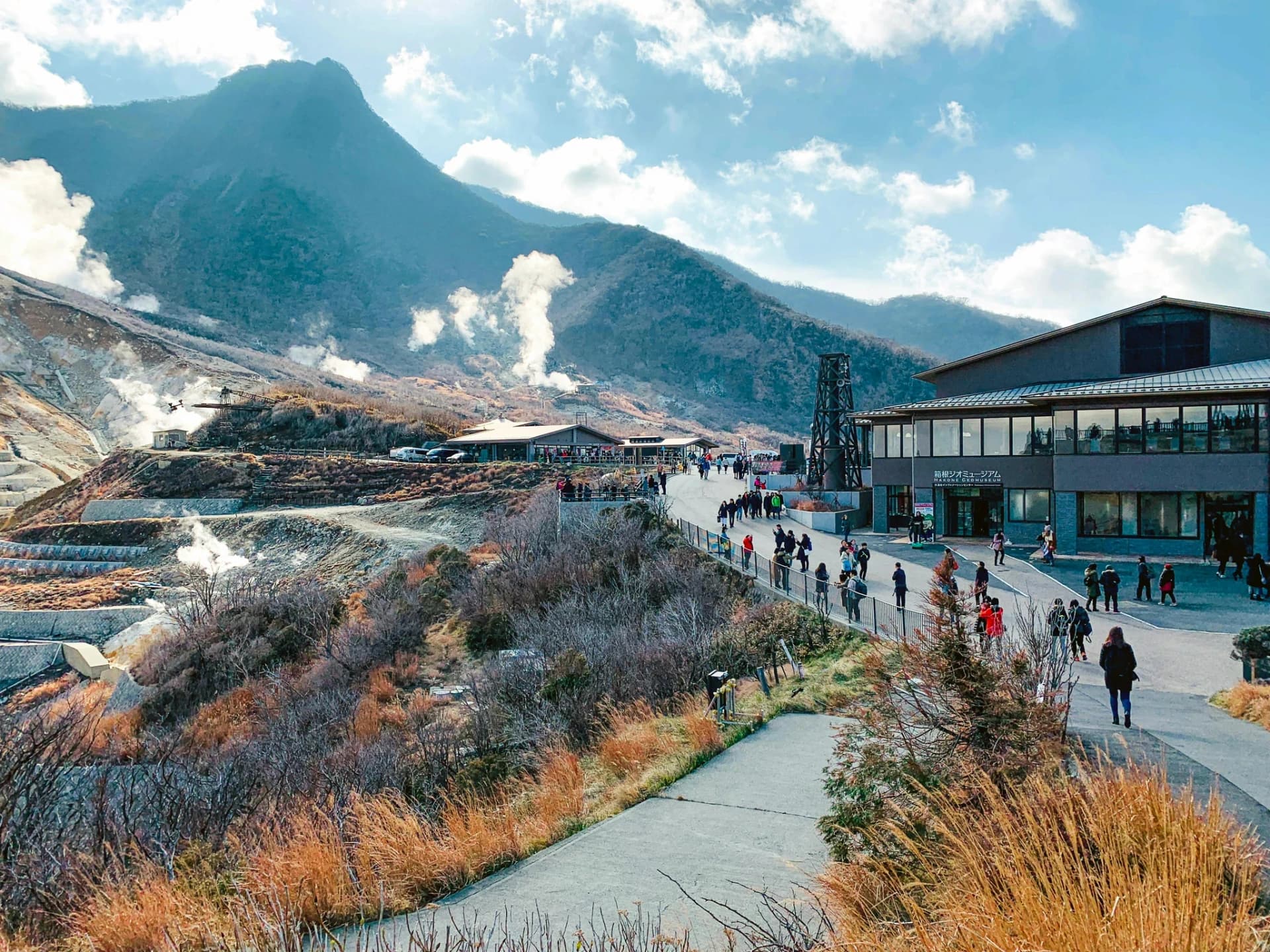
The Hakone Loop is the appetizer. The onsen experience is the meal.
A Hakone day trip gets you the Loop and the sights, but the onsen is the main course, and most itineraries leave it until there's no time left for it.
Hakone is 90 minutes from Tokyo and shows up on every day trip list. Most guides tell you to "do the Loop" and tick off the sights. Done that way, the day leaves most travelers feeling rushed. We'd plan it differently.
The Appetizer Problem
Everyone arrives in Hakone with a checklist: the Hakone Loop, the pirate ship, the black eggs at Owakudani, and maybe Mt. Fuji if the weather cooperates.
Hakone is a hot spring town, though, and for centuries people have come here to soak and slow down. The volcanic scenery, the ropeway over the sulfur vents, and the boat across the crater lake are fun, but they come before the part the town is built around: a long bath and an unhurried evening.
Most day trip guides tuck a line at the end: "Consider staying overnight for a more relaxed experience." They rarely say what that means or why it matters.
What Hakone actually is
Hakone is a cluster of small towns spread across a volcanic caldera and linked by trains, cable cars, ropeways, and boats. The famous "Hakone Loop" is that transport network, sold as an attraction in its own right.
The Loop is a way of getting around. Completing it takes 4-5 hours of transit alone: the Tozan Railway from Yumoto to Gora (35 minutes), the cable car to Sounzan (10 minutes), the ropeway to Togendai (25-30 minutes with a change at Owakudani), the pirate ship across Lake Ashi (40 minutes), and the bus back to Yumoto (25-30 minutes). At busy times you can wait 30+ minutes at each stage, and by then most of your day has gone on moving between them.
The math nobody tells you
A Hakone day trip from Tokyo takes 10-12 hours door to door. The Romancecar from Shinjuku is 80-85 minutes each way, which leaves 7-9 hours on the ground.
Give 4-5 hours to the Loop and you have 2-4 hours left for eating, soaking, wandering, or just sitting. Attractions close at 5 PM, and restaurants close by 6 PM unless you're eating at a hotel.
So people come home with plenty of photos and a vague memory of running from one thing to the next. A good day trip is possible. It just can't include everything.
A Day Trip Done Right
Decide what matters most to you and let the rest go.
You're really choosing between two days. One is scenic, built around the Loop and the mountain views. The other is built around the onsen, with soaking ahead of sightseeing. Trying to fit both in is what produces the rushed, disappointing day people complain about.
Leave early, return early
Take the first Romancecar from Shinjuku. Departures start at 7:00 AM, with 1-3 trains an hour through the day. The GSE trains with observation deck seats leave at 7:37 AM on weekdays and 8:00 AM on weekends, and if you want the panoramic front row, book early.
If you haven't picked where to stay in Tokyo yet, hotel choice affects day trip logistics more than people expect. Staying near Shinjuku cuts out the cross-town transfer that adds 30-60 minutes to your morning.
How to book observation deck seats: Reserve online at e-Romancecar (web-odakyu.com/e-romancecar). You don't need an account. Tickets go on sale at 10:00 AM JST exactly one month before departure, and the 32 observation seats (16 front, 16 rear) go fast. Have your credit card ready, know your backup seats, and be online right at 10:00. They cost the same as regular seats.
Plan to start back by 4:00-4:30 PM. That gets you through the sights before they close and means you aren't sprinting for the last Romancecar. If you do miss it, the Shinkansen from Odawara runs past 10:00 PM, and the regular JR Tokaido line runs later than that.
Pick your priority
If you want the scenic Loop experience: Do the Loop clockwise from Hakone-Yumoto. Stop at Owakudani for the black eggs and the volcanic views, then take the pirate ship across Lake Ashi. Skip a proper onsen soak, because you won't have time to relax in it. A quick foot bath is realistic. A full soak isn't.
If you want the onsen experience: Skip most of the Loop. Go straight to a day-use onsen near Hakone-Yumoto and spend 2-3 hours there. You can still ride the Tozan Railway up to Gora and back, but don't try to finish the full circuit.
The Yumoto option
For an onsen day, Hakone-Yumoto has good day-use baths within shuttle distance of the station. Tenzan has traditional outdoor baths in the forest and is tattoo-friendly. Hakone Yuryo is more modern and has private baths. Kappa Tengoku, right behind the station, is the budget pick. (Prices are in the quick reference table at the end.)
You give up the big scenic sights and get what Hakone is actually known for: sitting in hot mineral water while the tension drains out, and moving slowly. Pack accordingly. You'll want a small towel and clothes that are easy to get in and out of.
What Overnight Actually Unlocks
Everyone says staying overnight is better. Here is what the evening and morning look like.
What to expect at a ryokan
| Time | What happens |
|---|---|
| 3:00 PM | Check-in opens |
| 5:30 PM | Latest arrival if you want kaiseki (ingredients prepared fresh—late arrivals may not be served) |
| 6:00 PM | Dinner begins, takes 2-3 hours |
| After dinner | Evening soak, relaxed and unhurried |
| Early morning | Morning soak, when the baths are quiet and you might have them to yourself |
| 8:00 or 9:30 AM | Breakfast |
That schedule is the Hakone most day trippers never see. The kaiseki dinner alone surprises most people: 8-12 courses served one after another, eaten in yukata, and planned to cover all five tastes (bitter, salty, sour, sweet, umami). One traveler put it this way: "I learned to eat with my eyes and to listen with my taste buds." If you'd like something in the same spirit in Tokyo, our culture guide covers traditional cultural experiences.
On a day trip, by the time you reach a ryokan area it's time to head back.
Where to stay
| Tier | Price (per person w/ meals) | Examples | Notable |
|---|---|---|---|
| Budget | ¥10,000-20,000 | Kinokuniya Ryokan (since 1715, 12 generations), Fukuzumiro (125-year-old wooden inn on Hayakawa River) | Shared bathrooms, traditional atmosphere |
| Mid-range | ¥20,000-40,000 | Hakone Suishoen (open-air baths in all 23 rooms), Mount View Hakone (rare milky-white nigori-yu water), Tensui Saryo (welcome foot bath + plum wine) | Private baths, more amenities |
| Luxury | ¥50,000+ | Gora Kadan (former imperial retreat, Relais & Châteaux), Hakone Ginyu (private open-air baths overlooking valley) | Full-service, exceptional facilities |
Book early. The best-rated ryokans sell out weeks ahead, especially at weekends. For an ordinary visit, 2-3 weeks ahead is usually fine. For weekends, book 4-6 weeks out. For the peak seasons (cherry blossom in late March and early April, Golden Week, and the autumn leaves in November), book 2-3 months ahead. Booking.com works well for foreigners. Rakuten Travel and Jalan.net often have better rates, but they're mostly in Japanese.
Why pace is the point
People who stay overnight often call it one of the best "only-in-Japan" experiences of their trip, and when they explain why, they talk about the pace more than any one sight.
Hakone does charge a "Tokyo doorstep premium." The same money gets you a better ryokan in a less famous onsen area like the Izu Peninsula. Hakone is 90 minutes from Shinjuku, sits on the Tokyo-Kyoto route, and is easy for foreigners, which is why it's the default for first-timers, and we think that's a fair trade.
Mt. Fuji: Hope for It, Don't Plan Around It
Hakone is sold as a place to see Mt. Fuji. In practice you need two lots of luck.
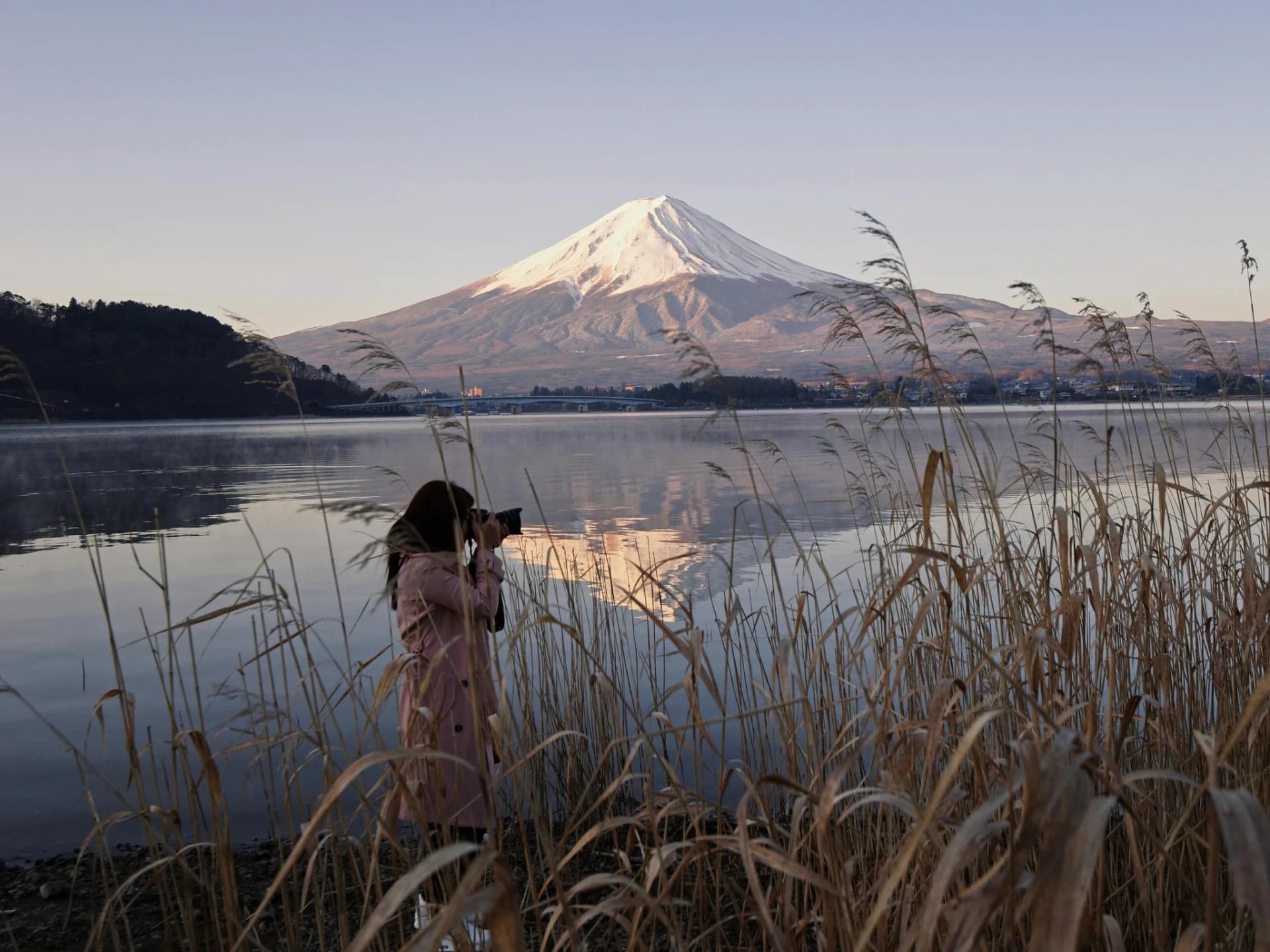
Fuji is 50 kilometers away. For a clear view from Hakone, the sky has to be clear in Hakone and at the mountain, and those are two separate weather systems. Winter gives you 50-68% odds (December is best at ~68%). In summer it drops to 10-20%, because humidity, haze, and cloud make Fuji hard or impossible to see.
Your best chance is early morning, before the clouds build, from Owakudani or the Lake Ashi shore. Even travelers who check the webcams and time their visit carefully sometimes see nothing.
Hakone is still worth it on a cloudy day. Owakudani, the volcanic valley, works in any weather. One traveler called it "stepping onto another planet," and between the yellow sulfur deposits, the hissing steam vents, and the mineral smell, there's nothing like it anywhere else around Tokyo. Riding the ropeway over the valley with steam rising from the vents below is dramatic whatever is happening 50 kilometers away. Locals called the place "Jigokudani" (Valley of Hell) before it was renamed for tourists.
Lake Ashi is lovely without Fuji on the horizon, and the onsen doesn't need a view at all.
So don't build your day around a view that may not show up. Give yourself the best odds (morning, high ground) and then stop worrying about it. If Fuji appears, treat it as a bonus.
A practical note: Owakudani sometimes closes. Volcanic activity raised the alert level in 2015 and 2019 and shut the ropeway completely. High winds (30m/s+) and typhoons suspend service, and winter maintenance closes some sections. Check Hakone Navi before you go. Replacement buses run when the ropeway is down.
If you're visiting in June: The rainy season brings fog that can hide the mountains. It also brings 10,000 hydrangeas flowering along the Tozan Railway tracks, and the trains become the "Ajisai Train," with flowers brushing the windows as you climb. From June 14-30, the Night Hydrangea Train runs lit-up evening rides with reserved seats (¥500). We like Hakone in June more than the forecasts would suggest.
What Most Tourists Miss
The Loop gets all the attention, and these places get very little.
The 400-Year-Old Teahouse
Amazake Chaya is the last thatched-roof teahouse left on the Old Tokaido Highway, the road that once linked Tokyo and Kyoto. The Yamamoto family has run it for 13 generations with the same menu: amazake (a sweet, non-alcoholic fermented rice drink, ¥400) and chikara-mochi (rice cakes grilled over charcoal, with black sesame, soy sauce, or sweet soybean powder).
The earthen floors, the open hearth, and the smoke-blackened ceiling haven't changed since the Edo period. One of the 47 Ronin used to come here. Travelers describe it as "atmospherically dark and smokey," and it does feel like time stopped inside. Your clothes will smell of smoke afterward.
The teahouse is between Lake Ashi and Hakone-Yumoto. Take the K bus from either direction and get off at "Amazake-chaya." Allow 30-45 minutes for the stop, since the bus only comes every 30 minutes.
The Cedar Avenue
Near Lake Ashi, a 500-meter stretch of the Old Tokaido Highway is lined with 400-year-old cedars, planted in the 1650s to shelter travelers from rain and sun. After a morning of trains and cable cars, the huge trunks and the smell of the forest are a welcome change.
You can stroll it in 15-20 minutes. Start from Hakone-machi or Moto-Hakone and walk toward Hakone Checkpoint.
Hakone Marquetry (Yosegi Zaiku)
Hakone's traditional craft uses 50+ kinds of wood to make geometric patterns with no paint or stain. Every color comes from the wood itself. The best-known pieces are himitsu-bako, puzzle boxes that only open if you slide the panels in the right order, and some take 10+ moves.
To watch the craft being made, go to Hamamatsuya, a 200-year-old shop where Ishikawa Ichiro, the 7th-generation owner and a government-designated traditional craftsman, works on the second floor. He's a direct descendant of Ishikawa Nihei, who invented yosegi zaiku in the 1830s. Watching is free.
For a souvenir, skip the black egg chocolates and get chopstick rests (~¥500) or keychains, which at least have something to do with the place.
Do You Need a Guide?
Hakone is scenic and well signposted. Most of what you come for is visual: volcanic vents, mountain views, the lake. There's less to interpret than in Tokyo, and independent travelers get around fine.
A guide does help in some cases: families with young children juggling logistics, travelers with mobility concerns who need to know the routes, or anyone who finds foreign transit stressful.
We don't operate in Hakone. Our tours are Tokyo-only. If you're deciding where to spend your guide budget, Tokyo is where cultural interpretation matters more than help getting around. If you'd like a referral to a Hakone partner we trust, get in touch and tell us what you're looking for.
Logistics That Actually Matter
What guided Hakone tours typically include
Private Hakone day tours from Tokyo include:
-
Hotel pickup in Tokyo (usually 8:00-8:30 AM)
-
Private vehicle and driver for the day
-
English-speaking guide
-
Flexible itinerary based on your interests
-
Return to Tokyo by early evening
Typical pricing:
-
Private car + guide: ¥100,000-150,000/day ($650-1,000) for groups up to 4-6 people
-
Private car only (no guide): ~¥90,000/day for a van/Alphard
-
Small group tours: ¥15,000-25,000/person ($100-165)
Most charters are 10 hours, and overtime is ¥5,000/hour.
You're paying for the planning you'd otherwise do yourself: transport, timing, getting between areas, and (with a guide) someone who can change the day around the weather, the crowds, or how tired you are. To see how tour costs compare with other Tokyo expenses, see our cost guide.
If you're deciding between guided and self-guided
| Guided | Self-guided | |
|---|---|---|
| Transit planning | Handled for you | Hakone Free Pass (¥7,100 for 2-day from Shinjuku) + Romancecar (¥1,200 each way) |
| Pickup/dropoff | Door-to-door from Tokyo hotel | You navigate to/from stations |
| Flexibility | Guide adjusts for crowds, weather, energy | You follow your own plan |
| Context | Someone explains Owakudani geology, checkpoint history, craft workshops | Self-directed; signage is good |
| Accessibility | Support built in | You navigate independently |
| Best for | Families, mobility concerns, transit anxiety | Independent travelers comfortable with Japanese transit |
The same thinking applies here as in how to choose a Tokyo private tour, if you want a fuller way to make the call.
Day onsen quick reference
| Onsen | Price | Style | Notes |
|---|---|---|---|
| Tenzan | ¥1,300-1,450 | Traditional outdoor | Tattoo-friendly, shuttle from station |
| Hakone Yuryo | ¥1,600-1,900 | Modern | Free shuttle, private baths available |
| Yunessun | ¥1,500-3,500 | Water park + traditional | Swimsuits required in pool area, good for kids |
| Kappa Tengoku | From ¥800 | Basic | Budget option, behind station |
Accessibility notes
The Hakone Loop is more accessible than most people expect:
-
Ropeway: Fully barrier-free at all stations. Wheelchairs roll straight on, and each gondola takes two wheelchairs.
-
Cable car: The platforms at Gora and Sounzan sit on a steep incline. Staff will help, but the slope can feel unnerving. There's a wheelchair area inside the carriages.
-
Pirate ship: Ramps at every port and elevators to the top deck. Wheelchairs can be borrowed free at each port.
-
Buses: Most Hakone buses take wheelchairs, and staff strap them down for the winding mountain roads.
-
Toilets: Every station on the Loop has a wheelchair-accessible toilet.
The real limitation: The Loop itself is manageable. Getting to things off the Loop is the hard part.
| Location | Issue | Workaround |
|---|---|---|
| Owakudani | Black eggs and best Fuji viewpoint require stairs | View from ropeway; skip eggs or have companion fetch |
| Hakone Shrine | Many stairs from walking approach | Car/taxi to parking area #1, then elevator through Hall of Treasures |
| Open-Air Museum | Chokoku-no-Mori Station isn't accessible | Go to Gora Station, take hilly road down |
For travelers with mobility concerns: A private car tour often makes more sense than the Loop. A car reaches places the transit can't and skips the steep station transfers.
If staying overnight: Traditional ryokan rooms are hard for wheelchair users. Wheelchairs can't go on tatami, and many rooms have a raised floor at the entrance. Look specifically for "barrier-free" rooms, or for modern hotels with Western-style accessible rooms.
If you're also planning Tokyo and have mobility concerns, navigating Tokyo with accessibility needs is a different problem, and one where a guide can help a lot more.
Where Hinomaru One Fits
We don't operate in Hakone, but if Tokyo is on your itinerary too, that's where we can help. Tokyo has far more that benefits from someone explaining it than Hakone's scenic, well-signposted sights, so your guide budget goes further there.
At Hinomaru One, we plan unhurried, fully customized private Tokyo tours for first-time and returning travelers, with a guide who explains what you're seeing.