Zojoji is where the Tokugawa shoguns are buried, and most of what made it famous burned in 1945. What survives (one gate, one bronze door, a row of graves) is worth knowing before you go.
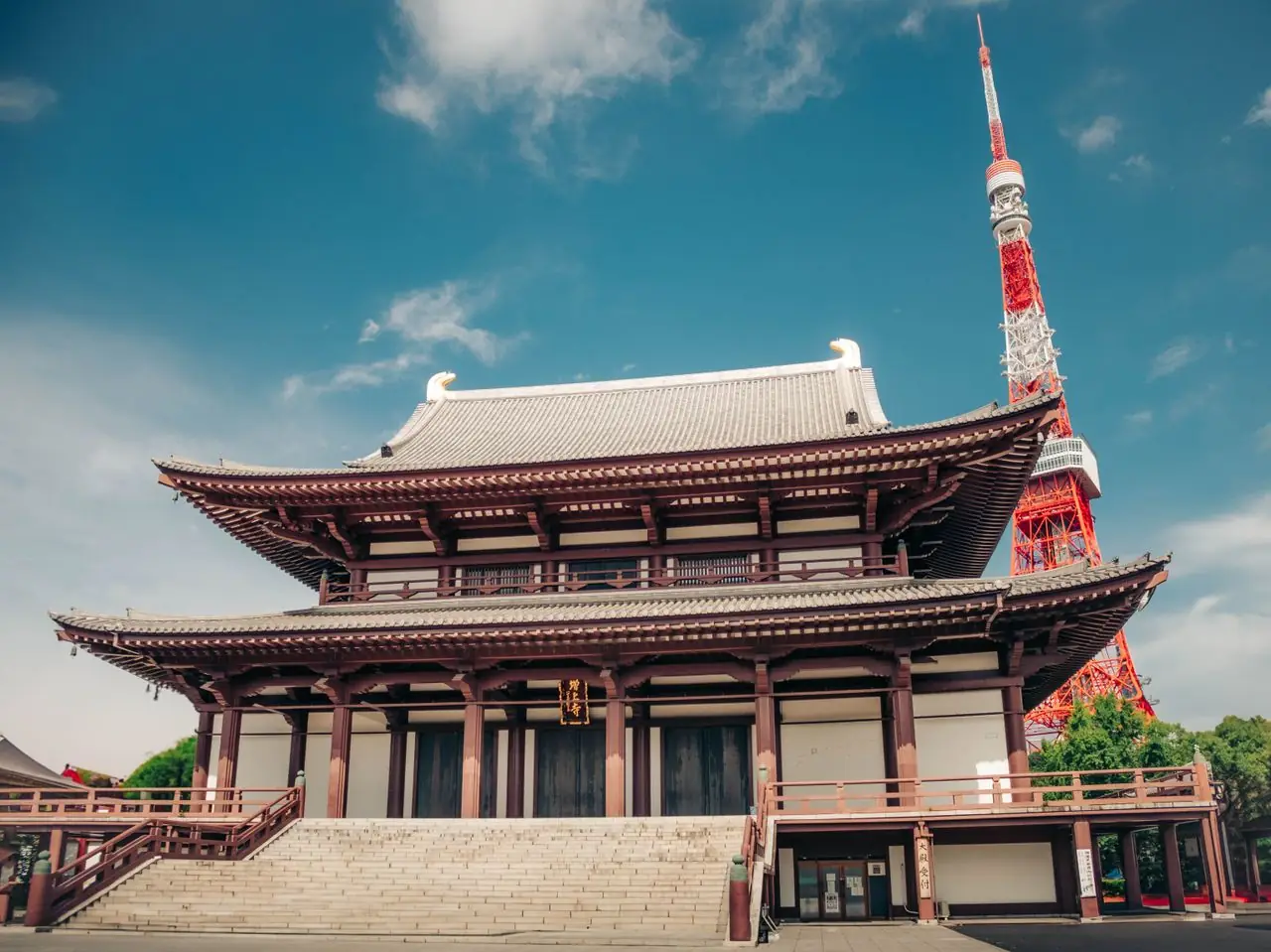
Zojoji Temple is the family temple of the Tokugawa shoguns, and six of the fifteen are buried behind its main hall. Most people come for the photo: a big Buddhist hall with Tokyo Tower rising straight up behind the roof. The photo is worth taking. But the temple was once one of the grandest religious sites in Japan, and most of that burned in a single spring in 1945. What you see now is what came through the fire, and it makes more sense once you know which parts those are.
The temple was founded in 1393, and it moved to its current site in Shiba in 1598. Tokugawa Ieyasu had chosen it as his family temple soon after he took over the Kanto region in 1590. Through the Edo period it grew into the head temple of the Jodo (Pure Land) school in eastern Japan, and its grounds took in most of what is now Shiba Park, the Prince hotels and the hill under Tokyo Tower.
The Gate You Probably Won't See
The Sangedatsumon, the huge two-storey main gate on Hibiya-dori, is the reason Zojoji appears in every list of old Tokyo buildings. It was built in 1622, and it's the only major structure on the grounds that came through the air raids of 1945. It's an Important Cultural Property and one of the oldest wooden buildings in Tokyo. The name means "gate of release from the three afflictions": greed, anger and ignorance. Walking through it is supposed to leave all three behind.
Here's what English guides haven't caught up with. The gate is under a major restoration, its first in about fifty years, and it is completely enclosed. The temple put up a steel shed over the whole gate, finished in August 2025, and printed a photograph of the gate on a giant mesh sheet across the side facing Hibiya-dori. So the vermilion gate you see from the street is, for now, a picture of itself. A narrow passage under the shed is open again, so you can still walk through the gate into the temple. The Buddha statues that sat on the upper floor have been taken down for repair, and the central Shaka triad went to a workshop in Kyoto. The temple expects to finish the work around autumn 2032.
If you want to see the real thing, the temple's own site has photos of the 1622 woodwork. Otherwise, look back down the street toward Daimon Station at the Daimon, the old outer gate that gives the area its name. The current one is a concrete rebuild from 1937, but it stands where the Edo-period gate stood. Every pilgrim to Zojoji passed under it.
The Main Hall and the Tokyo Tower Shot
Past the gate, a wide stone courtyard leads up to the Daiden, the main hall, rebuilt in 1974 to a traditional design. It's open from 6:00 to 17:30, and you can go in to see the Amida Buddha that is the temple's main image. Inside it's a working temple, with services and chanting. Visitors are welcome, so keep your voice down.
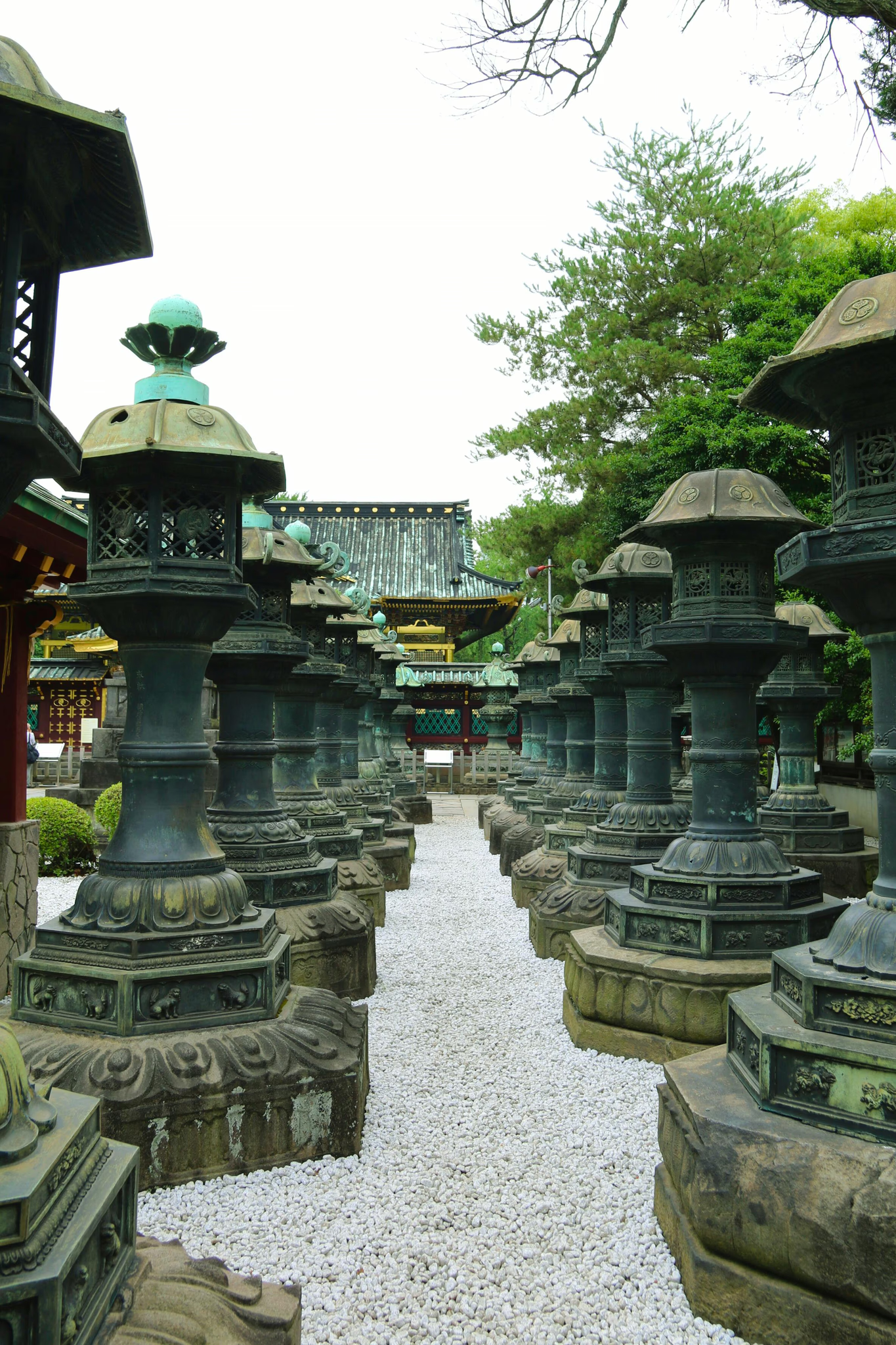
The Tokyo Tower photo is taken from the courtyard, looking up the steps toward the hall. From there the tower seems to rise straight out of the roofline. The hall faces east toward Hibiya-dori, so morning light falls on its front. After dark the tower is lit and the hall becomes a dark shape in front of it. People also shoot along the rows of stone lanterns, where the tower shows above the trees.
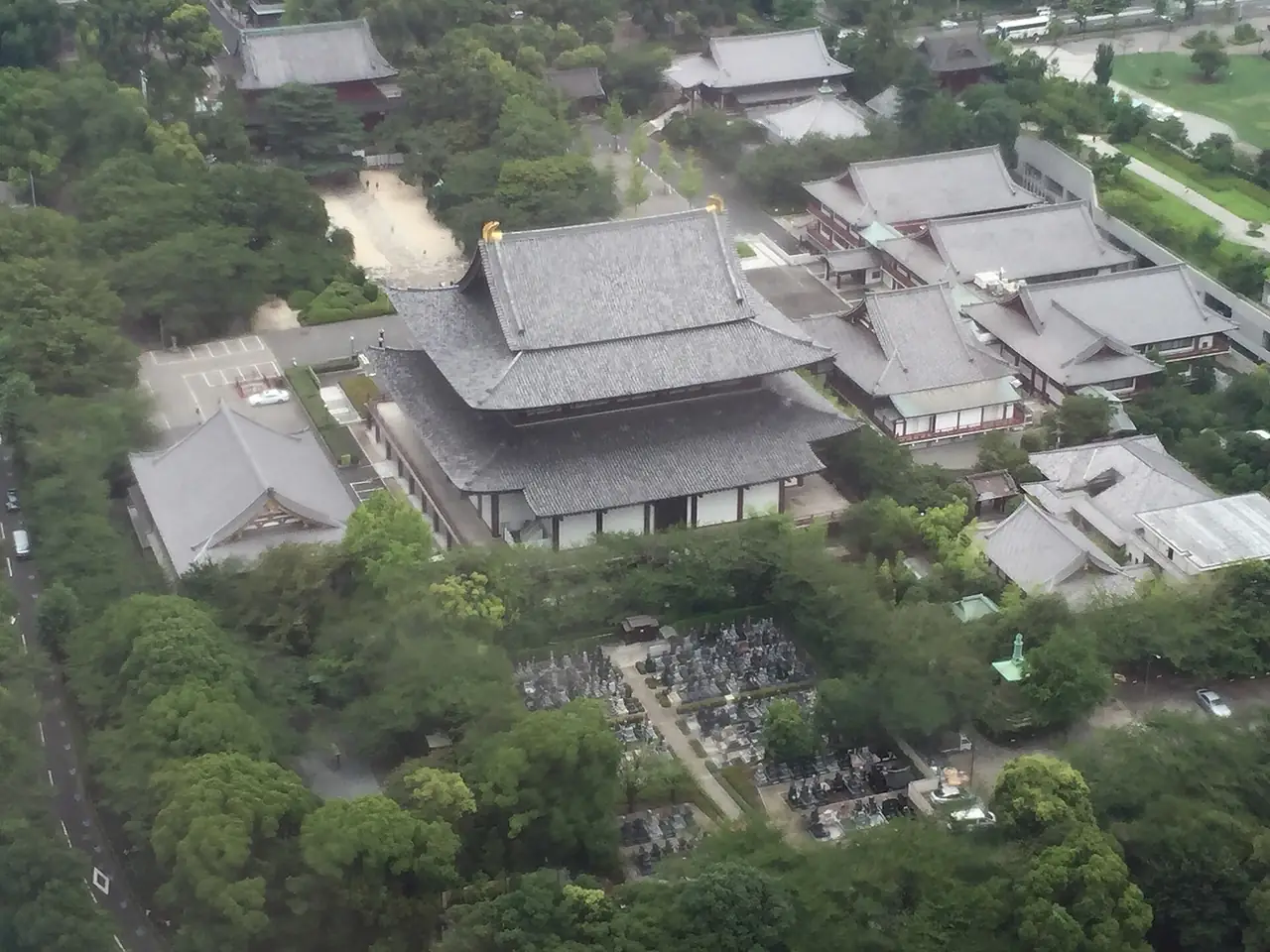
The tower and the temple are close for a reason: the tower stands on former temple land. When the broadcasting company looked for a site in the 1950s, the old Zojoji grounds had already been carved into park plots. It bought a plot on the temple's former hillside called Momijiyama. You can read more about the tower itself on our Tokyo Tower page. Seen from the tower's observation deck, the hall and the graveyard below it are easy to pick out.
To the right of the main hall is the Ankokuden, which holds the Black Honzon, an Amida image Tokugawa Ieyasu is said to have carried into battle to pray for victory. It's a hidden image, shown only on the 15th of January, May and September. The Ankokuden also has a statue of Princess Kazunomiya, who comes up again below.
The Jizō Garden
Walk along the north side of the grounds toward the graveyard and you reach the rows of small stone jizō. There are about 1,300 of them, and the temple says they have been added gradually since around 1975. Families dedicate them for a child's healthy growth, or in memory of a child lost before birth (mizuko).
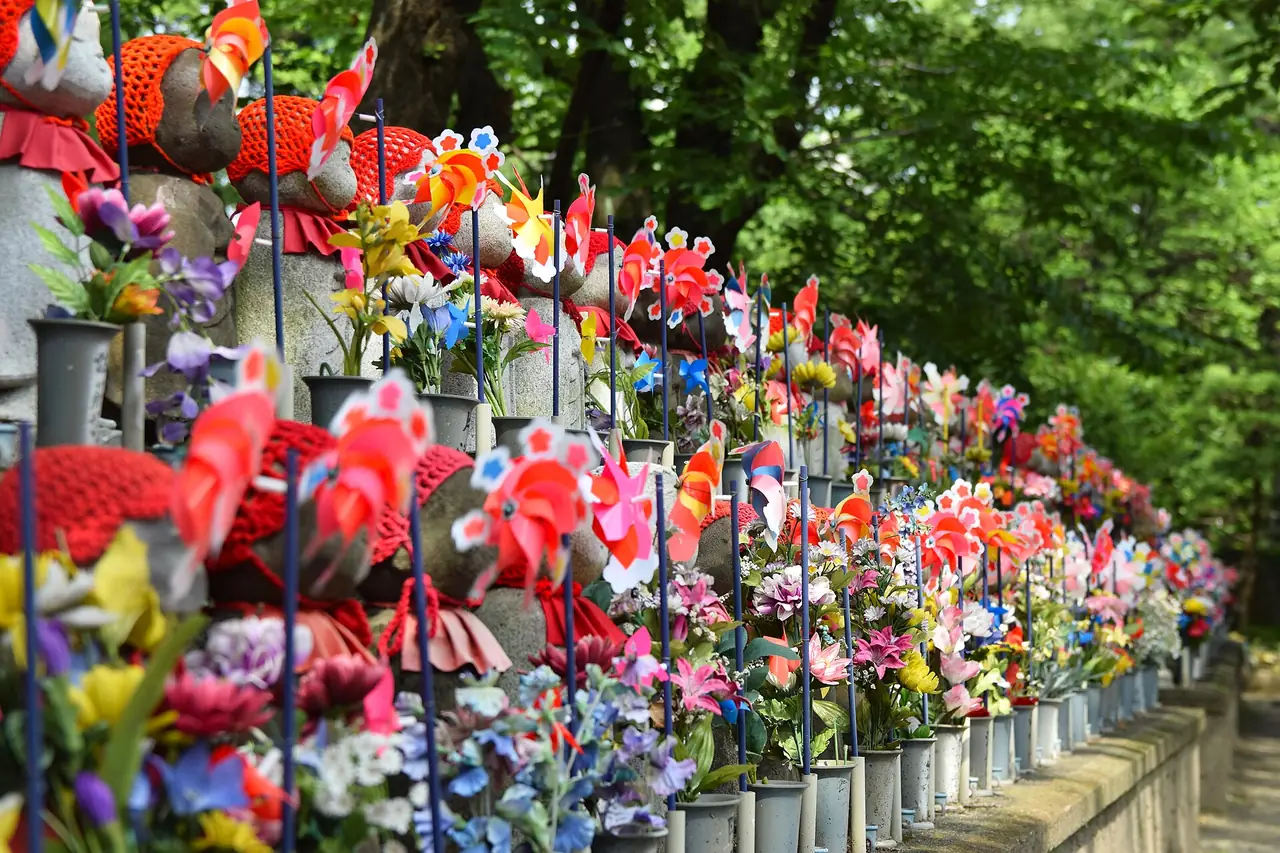
Each statue wears a red knitted cap and a bib, and most hold a pinwheel. On a windy day hundreds of them spin at once. The colours look cheerful in photos, but this is a memorial for children, many of them lost to miscarriage or stillbirth. Photograph from the path, and don't touch the statues or the offerings. If a family is praying at one of them, wait or walk on.
The Tokugawa Mausoleum
Before 1945, the Tokugawa mausoleums at Zojoji were compared to Nikko. Two complexes of lacquered, carved and gilded halls stood on the north and south sides of the main hall, and several were National Treasures. The air raids of March and May 1945 burned almost all of it. In 1958, as the land was being redeveloped, the graves were excavated and studied, and the remains were cremated and reburied together in a single walled graveyard behind the Ankokuden. The old mausoleum sites are now under the Tokyo Prince Hotel and The Prince Park Tower Tokyo.
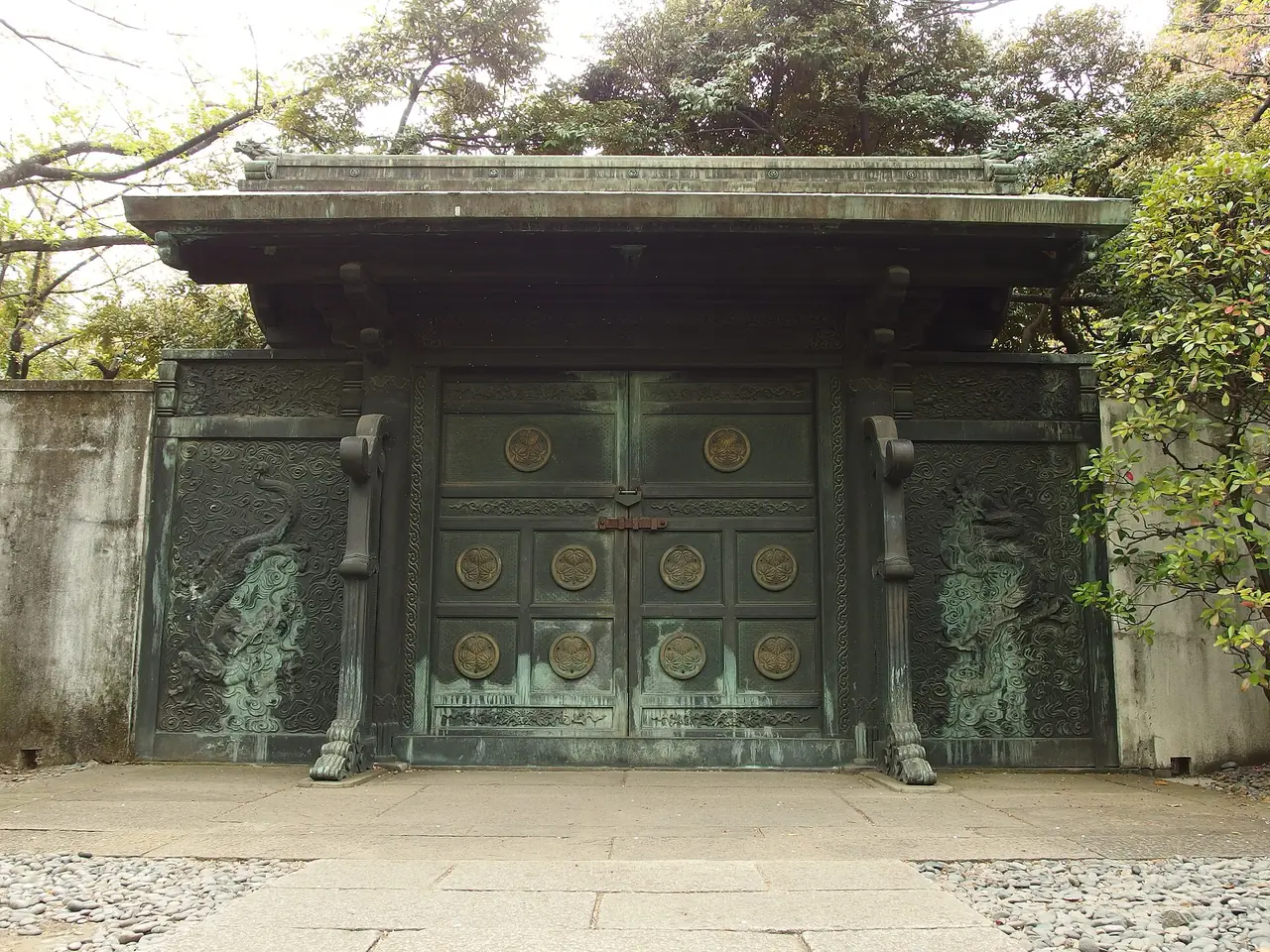
You enter the graveyard through a cast bronze gate with dragons on its side panels. It's one of the few pieces of the old mausoleums that survived. It was the inner gate of the sixth shogun Ienobu's mausoleum, moved here to guard the new graveyard. Inside, hōtō, stupa-shaped tombs, stand in a quiet row: Hidetada (2nd), Ienobu (6th), Ietsugu (7th), Ieshige (9th), Ieyoshi (12th) and Iemochi (14th), along with wives, concubines and children. The temple counts 38 people buried here.
The graveyard is closed until December 1, 2026. The temple is rebuilding the ticket booth and has suspended visits from October 27 to December 1, 2026. It's also closed every Tuesday unless that Tuesday is a public holiday. Outside those dates, entry is ¥500 (free for high school students and younger), from 11:00 to 15:00 on weekdays and 10:00 to 16:00 on weekends and holidays.
The Photograph in Kazunomiya's Coffin
Kazunomiya's tomb stands beside her husband's, and the story behind it is the best reason to go into the graveyard.
Kazunomiya was the younger sister of Emperor Kōmei. In 1862 she was married to the young shogun Tokugawa Iemochi to ease tension between the court in Kyoto and the shogunate in Edo. It was a political marriage, arranged after her earlier engagement to Prince Arisugawa Taruhito was broken off. Iemochi died at Osaka Castle in 1866, aged 20. Kazunomiya outlived him by eleven years and asked to be buried beside him, and when she died in 1877 she was buried at Zojoji next to his grave.
In 1958 the excavation team opened her coffin. Suzuki Hisashi, the anthropologist who led the study of the remains, later wrote in Hone wa Kataru (The Bones Speak) that there were no other grave goods. There was only one dirty glass plate, lying between her arms. At first no one thought much of it. A researcher took it back to the lab to clean, held it up to an electric light, and saw that it was a wet-plate photograph: a young man in a formal long-trousered hitatare robe and a tall eboshi court hat.
The next day, Suzuki wrote, the image was gone. The emulsion had disappeared from the plate, and it was plain glass. Other retellings say it faded over a few days. Why it happened is still unclear. Accounts blame the handling after excavation, light, or air reaching a plate that had been sealed in a coffin for eighty years.
So who was he? Most people assume Iemochi, and Japanese accounts quote one witness describing a full-cheeked, boyish face. But there is no surviving record that Iemochi was ever photographed, which is why some writers suggest it was her former fiancé, Prince Arisugawa. Japanese sources lean toward Iemochi, partly because she chose to be buried beside him, but no one can prove it. The only copy disappeared within a day of being found.
The Treasures Gallery
Under the main hall, the Treasures Gallery shows what the lost mausoleums looked like. The centrepiece is a 1:10 model of Hidetada's mausoleum, the Taitokuin, built for the 1910 Japan-British Exhibition in London. It then spent most of a century in storage in the British Royal Collection before coming back to Zojoji, and it has been on show since 2015. The roof of the main hall is displayed separately so you can look down into the lacquered, painted interior. Admission is ¥700, or ¥1,000 with the graveyard. The gallery stays open while the graveyard is closed. It's closed on Tuesdays and keeps the same hours as the graveyard.
Shiba Park and Getting There
Shiba Park, which wraps around the temple, opened in 1873 as one of Tokyo's first public parks, laid out on the temple's former grounds. It's spread out and broken up by roads, but it has plenty of benches and paths up toward the tower.
The nearest stations are Onarimon and Shibakoen on the Toei Mita Line, each about three minutes' walk, and Daimon (Toei Asakusa and Oedo lines), about five. From JR Hamamatsucho it's about ten minutes on foot through the Daimon gate. Zojoji fits well into a day around the bay: Hama-rikyu Gardens is within walking distance to the east, past Hamamatsucho, and Shimbashi is one stop up the JR line from Hamamatsucho, good for an after-work yakitori dinner. Going the other way, Tokyo Tower is next door and Roppongi is a short taxi ride or a longer walk uphill to the west.
Zojoji isn't on any of our fixed itineraries, but it fits easily into a custom day. Infinite Tokyo can build one around the Tokugawa story, from the shoguns' graves here to the bay gardens they used for falconry.
FAQ
Is Zojoji free to visit? The grounds and the main hall are free. The main hall is open from 6:00 to 17:30. The Tokugawa graveyard costs ¥500 and the Treasures Gallery ¥700, or ¥1,000 for both, as of 2026.
Can I visit the Tokugawa graves in November 2026? No. The graveyard is closed from October 27 to December 1, 2026, while the ticket booth is rebuilt. You can still see the bronze gate from outside, and the Treasures Gallery under the main hall stays open. The graveyard is also closed every Tuesday that isn't a public holiday.
Is the Sangedatsumon gate open? You can walk through it, but you can't really see it. It's inside a steel restoration shed with a printed image of the gate on the front, and work is expected to finish around autumn 2032.
Where is the best spot for the Zojoji and Tokyo Tower photo? From the stone courtyard below the main hall steps, looking straight at the hall. The tower rises directly behind the roof. Evening works well too, when the tower is lit.
Which shoguns are buried at Zojoji? Six: Hidetada, Ienobu, Ietsugu, Ieshige, Ieyoshi and Iemochi, along with Princess Kazunomiya and other wives and children of the shoguns. Ieyasu himself is enshrined at Nikko.
Photo credits
- Zōjō-ji's main hall and temple buildings seen from the Tokyo Tower observation deck: Ph0kin / Wikimedia Commons, CC BY-SA 4.0, resized
- Rows of jizō statues at Zōjō-ji in red knitted caps with pinwheels and flowers: Raita Futo / Wikimedia Commons, CC BY 2.0, resized
- Cast bronze gate with dragon reliefs at the entrance to the Tokugawa shogun graves at Zōjō-ji: Guilhem Vellut / Wikimedia Commons, CC BY 2.0, resized